Spatter by Paty Jager

paty shadow (1)When I started my first mystery novel, Double Duplicity: A Shandra Higheagle Mystery, I had a “novel” way for the victim to be stabbed. While writing the story I had to write the scene when my main character the amateur sleuth, who in the first book hadn’t had any mystery/murder events in her life to that point.

The first thing I did was connect online with a forensic coroner who explained different types of stabbing with me. I asked if my murder weapon (not a knife but I won’t say what it is in case you haven’t read the book ;)) would cause spatter. Would the person who used the weapon have blood on them?

This is what the specialist said:

1) The “spatter” will depend on what the blade hits and the overlay of clothing.

2) Each rib has an artery that runs on the bottom side, in a groove (the intercostal artery). Hitting one of these, or tearing it by breaking the rib, will cause more bleeding—most of which will be internal—into the chest cavity.

3) There’s not likely to be any spatter until the weapon is pulled out; most of the external bleeding comes from removing the weapon.

4) If the weapon hits the heart, a lot more bleeding will happen—again, mostly internal, but some external. The right side of the heart is closest to the chest wall; this is the lower pressure side of the heart.

5) After the weapon is removed, blood leakage will be a pulsatile ooze, but not shoot across the room.

6) If the lung is hit, the biggest risk is air leakage in the chest (pneumothorax) and
bleeding in the chest cavity (hemothorax) or both (hemopneumothorax). The blood leakage from the chest is a frothy red/pink, as it’s full of air.

7) Clothing is going to make spatter much less likely, except for removing the weapon.

Here’s an article the specialist suggested:
http://medicalscenewriter.blogspot.com/2012/09/stab-wound-to-chest.html

Double Duplicity (652x1024)Here is the scene where Shandra finds the gallery owner. 

“Paula?” A light shone around the edges of the partially open office door. Shandra pushed the door open. “Why aren’t you answer—”

Paula’s arms hung splayed away from her body that was cradled in her leather office chair. A large red patch spread across her body and lifeless eyes stared up at the ceiling.

Shandra backed out of the room. She couldn’t swallow for the lump of fear and vileness she’d just witnessed.

“Think… Call the police.” She punched in 9 as sirens shrieked and grew louder. “Maybe they’re coming here.” They had to be coming here. This town is too small for there to be two incidents where the cops are needed at the same time.

And this is what the seasoned detective thought when he walked into the same room.

He slipped his pack off his shoulder and extracted booties and latex gloves from the outside pockets before swinging it back onto his shoulder. He pulled the booties over his cowboy boots and wrestled his hands into the latex gloves.

The metallic tang of blood assaulted his nostrils as he stepped into the room. The scent stopped his feet and sent his mind spinning back in time to the gang fight he’d walked into in Chicago. There were many who left the alley in body bags. The scent of blood had permeated the whole alley where the two gangs had used every weapon they could get their hands on to annihilate the other.

His month long hospital stay, six months of grueling rehab, and then facing the leaders of the gangs as he testified at their trials was one horrendous bad dream. As soon as his part in the trials was over, his resignation hit the commander’s desk and he came home.

Ryan shook his head clearing it of the past and stared at the woman sprawled in the chair, staring at the ceiling. His gaze immediately landed on the large dark spot covering her chest. From lack of blood on the floor, if it was a bullet, it didn’t exit the back. Making it a small caliber and less likely anyone heard the shot. He peered closer. The large amount of blood and ripped clothing around the wound dismissed his thoughts of it being a bullet that caused the wound.

He slipped a hand into the outside pocket of the backpack and pulled out his digital camera. The click of photos one by one capturing the scene from all angles, triggered his detective mode. He forgot all else, moving in a circle, closing in on the body. Standing over the body, he looked straight down at her chest. The torn clothing at the entry sight and the gaping hole with pink foam…this wasn’t caused by a clean stab of a knife, it was viciously twisted to cause maximum damage.

Depending on the person and their knowledge it makes a difference in how the research is used.

Shandra Higheagle Mystery Series Books

Double Duplicity

Tarnished Remains

Deadly Aim

Murderous Secrets – coming the end of September

Paty Jager

Writing into the Sunset

Guest Author – Robin Weaver

Make Your Corpse Behave

I once critiqued a novel where the villain forced the heroine to participate in a tea party with a week-old corpse. Can you say “ewww?”

Or if you know your corpses, you’re saying “uh-uh, no way.” And you’d be correct. Unless the body had been on ice and the tea party occurred in an Antarctica, gases from the decomposing body (and the resulting OMG-what-is-that-smell) would have made that little social gathering impossible.

After I created a stink—nothing nearly as putrid as the tea party corpse—my friend corrected her error, but too many mystery authors treat the dead body without adequately considering the decaying process. We don’t accurately depict the condition of our corpse based on time since demise and environmental conditions.

I didn’t start out to be an expert in rigor mortises (and I use the term expert very loosely). I wrote a novel about a woman with hyperosmia—a hypersensitive sense of smell. My heroine kept scrubbing the floor trying to get rid of an offensive odor. The smell, naturally, was a dead body in the basement (after all, I am a mystery writer). Only I needed to understand exactly how and when the odor would emanate. How long must a poor unfortunate soul be deceased before antiperspirants ceases to work? So I did some research and consulted some “real” experts.

Decomposition begins at the moment of death. When the heart stops, blood no longer flows through the body. Most of the corpse will turn a deadly white (pun intended), but gravity causes the blood to pool in the body parts closest to the ground. The resulting bluish-purple discoloration is called livor mortis. As authors, this makes for some vivid descriptions. Also, the pooling of blood will enable your heroine to know when a body has been moved. If your corpse is lying face-down and your arm-chair detective notices visible pooled blood on the victim’s back—the body “ain’t” where it fell.

So back to our corpse… In three to six hours, the muscles become rigid (a.k.a. rigor mortis). Rigor affects the jaw first, then face and neck, the trunk and arms, and finally the legs and feet. If your detective isn’t squeamish, touching the corpse (“ewww” again) to determine what parts are rigid can help determine the time of death—even before the coroner arrives. Rigor peaks at twelve hours, and dissipates after 48 hours. Hint: your stiff is no longer stiff after two days.

Within 24-72 hours things get gory. The internal organs begin to decompose as the body’s remaining oxygen is gobbled up by aerobic microbes, already present in the gizzards before death. Enzymes in the pancreas cause the body’s organs to digest themselves. The cells in the body literally burst open. If you’re like me, you’re thinking, YUCK. But it gets worse. Microbes tag-team these enzymes, turning the body green from the belly onwards.

Only it gets worse. Within three to five days, gases (methane, hydrogen sulfide, mercaptans) produced by the decaying process accumulate and cause the abdomen to distend. The cadaver will have an overall bloated appearance and smell bloody awful. The skin blisters, the tongue protrudes, and pressure forces gases and frothy liquids out the nose, mouth and, eh…other orifices. This same buildup of pressure may also cause the body to rupture. And I won’t even mention the flies and maggots the corpse attracts. Let’s just say the folks producing those zombie shows got a lot of things right.

Within a month, nails and teeth fall out. NOTE: Contrary to popular belief, skin and hair do NOT continue to grow after death. The skin shrinks, making nails and hair “appear” longer. The body starts to dry out. If the cadaver is unprotected, those insects I’m not mentioning will have chowed down on any remaining flesh; moths and bacteria consume the hair. If the body is not protected from the elements, within a year only bones remain. However, those same bones can last a hundred years if the soil is not highly acidic or too warm.
Keep in mind, many conditions affect the rate of deterioration. Corpses last longer in cold, dry environments and zombify really fast in tropical climates. Believe it or not, a body lasts longer in the water than in open air and even longer in the ground. The embalming process can slow the decay, but even the best undertaker is no match for Mother Nature’s recycling machine. Deterioration continues, even in the coffin. Within a year, bones and teeth are usually all that remain

Some corpses, however take an interesting turn. If the body comes into contact with cold earth or water, adipocere can develop. This waxy material is formed when bacteria breaks down tissue and naturally preserves the inner organs. For the writer, adipocere can create an interesting plot twist since the victim will have died much earlier than it seems.

Because so many factors affect rigor mortis, forensic pathologists rely on other methods to determine time of death (TOD), one being body temperature. When the heart stops beating, the body temperature falls about 1.5 degrees Fahrenheit each hour until it reaches room temperature. Of course this method is only viable if the corpse is discovered within seventeen hours of death.

Another way to determine TOD is via the corpse’s belly contents. The degree of digestion since the last meal enables examiners to gauge how long the person lived after eating at Taco Bell (which may also be the cause of death). Yet another method to assess TOD is via insect activity, but I’ve already said I won’t talk about that.

I have treated a very serious subject with a large degree of irreverence, but that’s my defense mechanism in high gear. While the idea of the real corpse is disgusting, it’s as important as the real killer. Treat your corpse accurately. As writers, we have an obligation to “get it right.”

In my newest release, Framing Noverta, I took the simple way out. I had my corpse discovered a mere two hours after death—no gory parts, no repulsive odor. I did get the exit wound right though.

Framing NovertaHow can you uphold the law when following the rules will destroy everything worth protecting?

Weary of D.C. murder and mayhem, Cal Henderson trades in his city badge for a sheriff’s star. Regrettably, his Tennessee hometown proves anything but peaceful—a woman is shot dead in her bed and the only viable suspects are his best friend, Noverta, and the love of Cal’s life—the current Mrs. Grace Gardner.

Noverta escapes from jail, making Cal question his efforts to prove the man’s innocence. As more evidence points toward Grace’s involvement in the murder, Cal’s core principles crumble. Can he do the right if his action destroys everything worth protecting?

Guest Author – Kathleen Kaska

Inspirations from Long Ago

Typewriter, newspaper, glasses and a cup of coffee on desk, high angle view, close up

As soon as I graduated from college, I packed two bags and my dog and left Austin to
experience life in the Big Apple. I’d grown up in a small town, worked my butt off to get
through college, and after receiving my diploma, headed straight to New York City. No job
awaited me there; I had no place to live and very little money; and I knew hardly anyone.

But adventure called. Miraculously, everything worked out and I stayed for eighteen months. That was thirty-five years ago. At the time I had no aspirations of becoming a writer. I just wanted to experience life in one of the most thrilling cities on the planet. Little did I realize that my time in NYC would become valuable to my future writing.

I’m now working on a new mystery series; this one is set in 1945 in Manhattan. Mickey
Spillane, Rex Stout, Dashiell Hammett, and Raymond Chandler were inspirational in my
decision to try my hand at hardboiled crime fiction. Once I began writing, memories of my time in New York came flooding back; the jazz club on Seventh Avenue where I bartended; the homeless woman who went by the name of Rooster; an elderly woman who lived in Hell’s Kitchen who believed the entire state of Texas was responsible for assassinating JKF (and since I was a Texan, I was part of that conspiracy); my apartment on 30th and Madison; the Dubrovnik Hotel down the street; a dark, eerie bar I happened to walk into one day; and the deli near my apartment where I learned to order cream cheese with my bagel by asking for a schmear. All these find their way into my new book.

I am glad I took time to visit some of Manhattan’s other institutions while living there, and not just the popular venues on every tourist’s list like the Empire State Building, United
Nations, Statue of Liberty, and Central Park; but places frequented by locals: Carnegie’s Deli in Midtown (famous for corned-beef and pastrami sandwiches); Sardi’s Restaurant in the theatre district (known for the caricatures of show-business celebrities displayed on the walls); and what became my favorite Italian restaurant in Little Italy, Luna’s on Mulberry Street. All these establishments have become my down-and-out detective protagonist’s regular hangouts. He also moves into the Dubrovnik Hotel after his apartment is ransacked and most of his positions destroyed. Rooster and the elderly woman are regulars on the street corners of Hell’s Kitchen where he lives in an apartment over Frank’s Place (based on that eerie bar).

But what really helped me develop a sense of place were the sounds and smells I vividly recall: I loved hearing the staccato chatter of short-order cooks behind the deli counter on the first floor in my apartment building; those early morning, marshy smells wafting in from the East River as I strolled down Water Street, damp with dew, in Lower Manhattan; the noise of food purveyor trucks rattling down the street on their way to make restaurant deliveries—all come alive in my story. I’m only halfway through the first draft, and am eager for more tidbits to pop up from the treasure trove of memories I’d stored up more than three decades ago.

300_Murder at the Driskill_mockup01About Kathleen

Kathleen Kaska is a writer of mysteries, nonfiction, travel articles, and stage plays. When she is not writing, she spends much of her time with her husband traveling the back roads and byways around the country, looking for new venues for her mysteries and bird watching along the Texas coast and beyond. Her latest mystery is Murder at the Driskill (LL-Publications). It was her passion for birds that led to the publication The Man Who Saved the Whooping Crane: The Robert Porter Allen Story (University Press of Florida).

Buy Link: goo.gl/lnf2WU

http://www.kathleenkaska.com

http://www.kathleenkaskawrites.blogspot.com/

http://www.facebook.com/kathleenkaska

https://twitter.com/KKaskaAuthor

Guest Blogger – Lea Wait

Old houses have always fascinated me.

I’ve lived in old houses – in fact, I’ve never lived in a home or apartment built after 1920. I’ve even bought old homes that needed a lot of love (and money) to give them amenities like plumbing and heat.

The house I live in now was built in 1774 on an island in a Maine river. In 1832 it was moved across the frozen river and pulled up a steep hill to where it is today. My family has only owned this home since the mid-1950s, but I often think of the people who lived here in the eighteenth and nineteenth centuries, and I’ve actually included them in some of my historical novels.

The history of the house itself was the basis for Shadows on the Coast of Maine, the second in my Shadows Antique Print Mystery series. (And – no – the mystery is fictional. We didn’t find THAT when we uncovered the original fireplace.)

I’ve loved the homes I’ve lived in. But I’ve always had a special fascination for old deserted, dilapidated, houses.

Victorian farmhouses crumbling next to their barns on land that’s now fallow. Elegant mansions that became too expensive to heat, or too easy to tax, that were abandoned, perhaps eventually to become office buildings, or apartments, or turned into nursing homes or bed and breakfasts. Or, sadly and too often, bulldozed to make way for more modern, more cost-effective, buildings.

I love books centered around mysterious houses, too. I can’t resist books by authors like Mary Stewart and Daphne du Maurier and Kate Morton. I love mysteries by Linda Fairstein because, although they’re not exactly about large houses, they do incorporate the hidden history of famous New York City landmarks.

I even dream of immense houses full of rooms. I dream of walking through corridors and planning how I’m going to fix up the rooms for people in my family, or for people who are homeless. The houses in my dreams are always in poor condition, but I know they can be brought back to life. The empty rooms can become a home.

I’ve been having dreams like that since I was a child. (Any psychoanalysts out there?)

So it probably isn’t a surprise that my latest book is about – guess what? A large nineteenth century estate on the coast of Maine that, in 1970, was the place a teenaged girl died.

No one has lived in the house for years.

No question. It’s my kind of house.

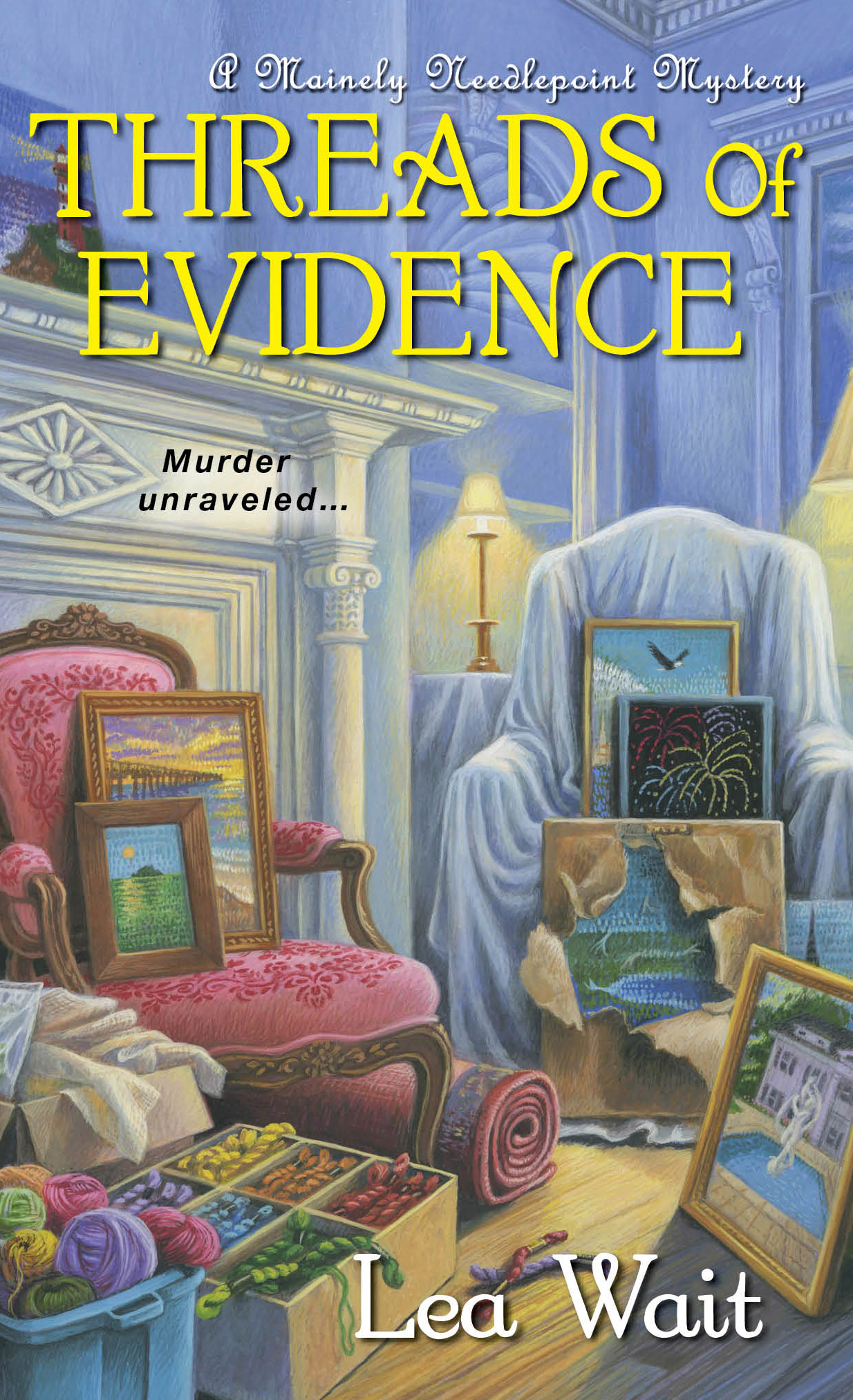
THREADSOFEVIDENCELea’s latest book is THREADS OF EVIDENCE. The old Gardner estate in Haven Harbor, Maine been deserted for years. Folks in town thought it should be torn down. But now a famous Hollywood actress has bought it. Does she have a special reason to come to Haven Harbor? The small village is full of old secrets. When needlepointer Angie Curtis is asked to restore a series of old needlepoint pictures found in the Gardener house, she finds clues that may lead to discovering what really happened in 1970, when seventeen-year-old Jasmine Gardener died there.

Amazon link:

http://www. amazon.com/Threads-Evidence-&pebp=1433544126655&perid=OTJPND2814N6ZJ8AS7F1

DSC01566Lea Wait writes the Shadows Antique Print mystery series, the Mainely Needlepoint series, and historical novels for young people. As a single parent she adopted her four daughters from different Asian countries. She’s now the grandmother of eight, and lives on the coast of Maine with her husband, artist Bob Thomas, and their black cat, Shadow. To learn more about Lea and her books, see http://www.leawait.com and friend her on Facebook and Goodreads.

That Could Kill Someone by Paty Jager

paty shadow (1)As a murder mystery writer there are times when I have to acknowledge the fact my brain and actions could lead one to think I’m a psychopath or serial killer. 😉

I’m constantly on the lookout for ways to kill someone that is easy or unusual. Not because there is anyone in particular I’m thinking of offing, but because I need to find unusual and hard to discover mysteries/ ways of murder for my amateur sleuth and detective to come up against.

A recent trip on the Steens Mountains in eastern Oregon had my mind flashing in overdrive with scenarios that could happen on an innocent trek to the wilderness. Around one small lake where people camp and fish the undergrowth was so thick a person could be killed and their body hidden for quite some time before either the smell aroused a curious dog or coyote or kids playing would find it. The body could be hidden for weeks, months, or years, depending on when the killing happened and if there were people around to smell the decaying body. The high precipice where a person can look down over a mile to the Alvord desert is also an innocent, yet deadly spot. The vistas are breathtaking. Someone struck in awe of the sight could easily have a miss-step or push that sends them plummeting to their death.

Another interesting tourist spot is Diamond Craters. These large craters caused by lava tubes and bubbles are deep. The upper edge is lined with uneven, craggy rocks that could easily trip a person to fall head first into the crater and land on large boulders, up-heaved lava waves or a rattlesnake. Once the victim has fallen into the crater and is injured, if no one came along during a hot summer day, and if the injuries from the fall or a snake didn’t get them first, the hot sun and no water would give a person heat stroke.

Even the local historical museum had a storage room of sorts in the back that held antique items that had yet to be put in the museum. There were several long, heavy metal branding irons that could easily be swung with enough force to crack a skull and the body could be shoved behind a large wooden sign leaning against the wall. Or the rusted metal plow hanging from the ceiling could “accidentally” fall on an unsuspecting victim.

Even my own property has several places if not careful someone with a grudge could send a boulder hurtling down the side of the hill to wipe out an unsuspecting victim.

Double Duplicity (652x1024)I’ve always had an imagination that would put my family and friends into danger now I do it with my characters in the Shandra Higheagle Mystery Series.

www.patyjager.net

Writing into the Sunset

Facebook