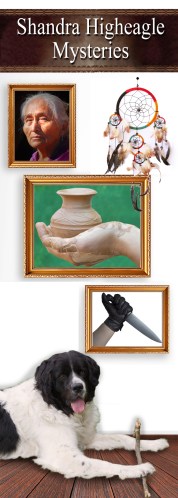
Dreaming up an Amateur Sleuth by Paty Jager

Dream your dreams with your eyes closed…paty shadow (1)

But live your Dreams with your eyes open—

                                                                     ~Cherokee~

The amateur sleuth in my Shandra Higheagle Mystery Series is half Nez Perce. She was raised to hide her Native American heritage when her Nez Perce father died and her mother remarried. However, her paternal grandmother kept in touch, and Shandra spent a summer during her teen-age years with her grandmother on the reservation. Her grandmother said Shandra had powers. When Shandra announced that at home her mother and step-father quickly made her see it was an old woman’s way to making an awkward teenaged girl feel special–nothing more.

As an adult, Shandra visits her grandmother more and is interested in discovering more about her roots. But her grandmother dies, leaving Shandra a note requesting she attend the Seven Drum Ceremony after the funeral.

While in the midst of murders and mystery, Shandra’s grandmother comes to her in dreams showing her clues to the true murderer. While Shandra investigates the dreams and discovers helpful information, she has a hard time believing the dreams and her grandmother’s presence.

This is the information I came up with when I was brainstorming who my amateur sleuth would be in the mystery series I wanted to write. I started with the niggling that I wanted a Native American character. But not being Native American myself, I didn’t know the first thing about being from that heritage. That’s when I came up with the idea of her being kept from those roots. It allowed me to discover Shandra’s heritage as she is discovering it, a piece at a time.

To add a bit more of the “mysticism” or “dreamer” qualities to the Native American element I have her deceased grandmother come to her in dreams. Visions and dreams are instrumental in Native American culture. This was my way of drawing on elements that could be intrinsic to Shandra.

And all amateur sleuths need a person in law enforcement to keep them safe. I gave Shandra handsome Weippe County Detective Ryan Greer. He believes in Shandra’s dreams more than her in the beginning thanks to his Irish mother who taught him to believe in things you can’t see.

I’m enjoying getting to know Shandra and Ryan better with each book I write and having them meet the locals of Huckleberry, Idaho and the unique murders that draw Shandra into the investigations. And I can use the backdrop of the ski resort and the art communities because Shandra is a potter whose works are considered art.

What draws you to the main character in a mystery series? What elements in a character haven’t you seen that you would like to see?

Publication1

www.patyjager.net

Writing into the Sunset

Guest Blogger S.L. Smith – Murder on a Stick

Before explainingMurder on a Stick(3) why I wrote Murder on a Stick, I’ll tell you a bit about myself and my writing.
One of the first decisions I made, as an author, was where to stage my novels. It boiled down to creating a fictional setting or writing about the familiar. I chose the latter. The Pete Culnane mysteries are set in St. Paul, Minnesota––my home for the past three decades. One benefit is a built-in audience of locals who enjoy books set in locations they know. A drawback is my compulsion to get it right, portraying the sights, sounds, and smells in a way that rings true for locals and becomes real for those who have never been here.

Despite my knowledge of St. Paul, each novel requires lots of on-site and Internet research, and a variety of interviews. While looking for a location for book three, I thought about the Great Minnesota Get Together, otherwise known as the State Fair. Most Midwesterners have at least a passing knowledge of this fair. That gave me a shot at attracting them as readers. However, the overriding reason for selecting this venue was my love for this event. I’m not alone there. The 2015 attendance (12 days) was 1,779,738.

While writing Murder on a Stick, I spent four days at the fair, researching. My efforts included speaking with police and deputies from across the state. These are people who use vacation hours to ply their trade at the fair. A paramedic and an EMT from the St. Paul Fire Department explained the role they play and the tools at their disposal. A volunteer from one of the information booths provided pages of facts and trivia about the fair. I love learning when I read, and I used some of this information to provide that opportunity to my readership. The thing that surprised me the most was a fair-related tidbit about Teddy Roosevelt.

You can get almost anything on a stick at the Minnesota State Fair. Murder on a Stick takes that a step further. Due to my commitment to realism, I felt compelled to obtain a sample of the sticks on which 100+ foods are served. These delicacies include hot dish, s’mores, key lime pie, and walleye pike. Obtaining these sticks took a couple of days. Thankfully, the vendors gave me their sticks without the food. Hence, I saved a fortune and avoided gaining 50 pounds. I drew upon the expertise of a retired lead investigator from the Ramsey County Medical Examiner’s Office to determine if any of these sticks was a feasible weapon. The title of this novel provides the answer.  🙂  By the way, any idea what using one of those sticks as a weapon says about the crime?

The State Fair is located in Falcon Heights, a suburb of St. Paul. My protagonists do not have jurisdiction there. You have to read the book to discover why that didn’t handcuff me.

By now, I hope it’s clear that I enjoy the research part of writing, and that there are few places where it’s more fun than at the Minnesota State Fair.

Book Blurb:

You can get almost anything on a stick at the Minnesota State
Fair. This year, murder is added to the list. Family and friends
construct radically different portraits of the victim, and the
list of suspects keeps growing. No suspect has a corroborated alibi. Three admit being at the
fair that day.

The investigation crisscrosses the Twin Cities,
and travels from the fairgrounds to Rochester. St. Paul
investigators Pete Culnane and Martin Tierney must separate
fact from fiction, truth from lies.

Bio:

Sharon Newer Pipe PhotoS.L. Smith’s long career working alongside law enforcement and fire officials while with the Minnesota Department of Public Safety inspire and inform her mystery novels. Yearly trips to the iconic Minnesota State Fair addicted her to the unique atmosphere and the foods often found only at the fair.

Buy links:

http://www.amazon.com/S.L.-Smith/e/B005GVK1DO/ref=sr_ntt_srch_lnk_1?qid=1445136445&sr=1-1

social media links:

Facebook:

https://www.facebook.com/SLSmithauthor2012?ref=ts&fref=ts

LinkedIn:

https://www.linkedin.com/profile/view?id=AAkAAAMQ48sB4Tnfh8fQc3wE0z7MfGkdaF3ajf0&authType=NAME_SEARCH&authToken=Oyje&locale=en_US&trk=tyah&trkInfo=clickedVertical%3Amynetwork%2CclickedEntityId%3A51438539%2CauthType%3ANAME_SEARCH%2Cidx%3A1-1-1%2CtarId%3A1445136900972%2Ctas%3ASharon%20l.%20%20Smith&_mSplash=1

Series- Keeping it Interesting by Paty Jager

paty shadow (1)I don’t know how you feel about reading mystery series but I love reading and writing them. Following a character on their journey through life, murders, and mayhem is fun. They have personal triumphs and failures, that the reader who has become a part of that character’s world can cheer and cry over.

Some of my favorite characters and series to read over the years have been Mrs. Polifax by Dorothy Gilman, Tony Hillerman’s Navajo Mysteries with Joe Leaphorn,  Leighann Dobbs, Blackmore Sisters, Marilyn Meredith’s Tempe Crabtree and J.L. Simpsons’s Daisy Dunlop. I enjoy meeting back up with them in each book and seeing what mayhem they get into.

I like writing series because I can continue relationships, make new relationship, and have a cast of characters I know and can take on adventures. Whether they are the main characters, Shandra Higheagle and Ryan Greer of if they are the quirky, endearing, and annoying secondary characters, like Crazy Lil, Sheba the dog, Ryan’s nosy family,  or the cast of characters who live in Huckleberry.

The murdered person and the murder suspects are usually new characters, which means I have to discover all I can about them before I start writing the books. But that is one of the best parts about a mystery, discovering how to make characters connect and have motives for the murder that happened.

I’ve never thought of myself as analytical or a puzzle solver but I love piecing the story together to have my sleuths think it’s one person only to discover it could be someone else. Keeping my sleuths guessing, I hope also keeps  the readers guessing.

I just released the fourth book on my Shandra Higheagle mystery series- Murderous Secrets. This book has Shandra delving into her father’s death. She’d always been told it was a rodeo accident, but as her grandmother continues to come to her in dreams, she begins to feel it wasn’t an accident and searches for the truth.

A bonus about this book, the timing couldn’t have been better, because it happens in December and ends on Christmas Eve.

Murderous SecretsMurderous Secrets

Jealousy…Deception…Murder

The accident that took her father’s life has always haunted Shandra Higheagle. When her dreams become too real, she knows it’s time to discover the truth. It doesn’t take long to suspect her father had been murdered and that someone is unhappy with her probing.

Detective Ryan Greer knows Shandra well enough to insist he be kept informed of her investigation into the decades old death of her father. When signs implicate her mother, he can’t withhold the information, even though he realizes it could complicate their relationship.

Buy Links:

AmazonNook –  KoboWindtree Press

Award-winning author Paty Jager and her husband raise alfalfa hay in rural eastern Oregon. On her road to publication she wrote freelance articles for two local newspapers and enjoyed her job with the County Extension service as a 4-H Program Assistant. Raising hay and cattle, riding horses, and battling rattlesnakes, she not only writes the western lifestyle, she lives it.

All her work has Western or Native American elements in them along with hints of humor and engaging characters. Her penchant for research takes her on side trips that eventually turn into yet another story.

You can learn more about Paty at

her blog; Writing into the Sunset

her website; http://www.patyjager.net

Facebook; https://www.facebook.com/pages/Paty-Jager/132536633482029

Newsletter: Paty’s Prattle: http://eepurl.com/1CFgX

Paty’s Posse: https://www.facebook.com/groups/402519373168442/?ref=bookmarks

Goodreads http://www.goodreads.com/author/show/1005334.Paty_Jager

twitter @patyjag.

Spatter by Paty Jager

paty shadow (1)When I started my first mystery novel, Double Duplicity: A Shandra Higheagle Mystery, I had a “novel” way for the victim to be stabbed. While writing the story I had to write the scene when my main character the amateur sleuth, who in the first book hadn’t had any mystery/murder events in her life to that point.

The first thing I did was connect online with a forensic coroner who explained different types of stabbing with me. I asked if my murder weapon (not a knife but I won’t say what it is in case you haven’t read the book ;)) would cause spatter. Would the person who used the weapon have blood on them?

This is what the specialist said:

1) The “spatter” will depend on what the blade hits and the overlay of clothing.

2) Each rib has an artery that runs on the bottom side, in a groove (the intercostal artery). Hitting one of these, or tearing it by breaking the rib, will cause more bleeding—most of which will be internal—into the chest cavity.

3) There’s not likely to be any spatter until the weapon is pulled out; most of the external bleeding comes from removing the weapon.

4) If the weapon hits the heart, a lot more bleeding will happen—again, mostly internal, but some external. The right side of the heart is closest to the chest wall; this is the lower pressure side of the heart.

5) After the weapon is removed, blood leakage will be a pulsatile ooze, but not shoot across the room.

6) If the lung is hit, the biggest risk is air leakage in the chest (pneumothorax) and
bleeding in the chest cavity (hemothorax) or both (hemopneumothorax). The blood leakage from the chest is a frothy red/pink, as it’s full of air.

7) Clothing is going to make spatter much less likely, except for removing the weapon.

Here’s an article the specialist suggested:
http://medicalscenewriter.blogspot.com/2012/09/stab-wound-to-chest.html

Double Duplicity (652x1024)Here is the scene where Shandra finds the gallery owner. 

“Paula?” A light shone around the edges of the partially open office door. Shandra pushed the door open. “Why aren’t you answer—”

Paula’s arms hung splayed away from her body that was cradled in her leather office chair. A large red patch spread across her body and lifeless eyes stared up at the ceiling.

Shandra backed out of the room. She couldn’t swallow for the lump of fear and vileness she’d just witnessed.

“Think… Call the police.” She punched in 9 as sirens shrieked and grew louder. “Maybe they’re coming here.” They had to be coming here. This town is too small for there to be two incidents where the cops are needed at the same time.

And this is what the seasoned detective thought when he walked into the same room.

He slipped his pack off his shoulder and extracted booties and latex gloves from the outside pockets before swinging it back onto his shoulder. He pulled the booties over his cowboy boots and wrestled his hands into the latex gloves.

The metallic tang of blood assaulted his nostrils as he stepped into the room. The scent stopped his feet and sent his mind spinning back in time to the gang fight he’d walked into in Chicago. There were many who left the alley in body bags. The scent of blood had permeated the whole alley where the two gangs had used every weapon they could get their hands on to annihilate the other.

His month long hospital stay, six months of grueling rehab, and then facing the leaders of the gangs as he testified at their trials was one horrendous bad dream. As soon as his part in the trials was over, his resignation hit the commander’s desk and he came home.

Ryan shook his head clearing it of the past and stared at the woman sprawled in the chair, staring at the ceiling. His gaze immediately landed on the large dark spot covering her chest. From lack of blood on the floor, if it was a bullet, it didn’t exit the back. Making it a small caliber and less likely anyone heard the shot. He peered closer. The large amount of blood and ripped clothing around the wound dismissed his thoughts of it being a bullet that caused the wound.

He slipped a hand into the outside pocket of the backpack and pulled out his digital camera. The click of photos one by one capturing the scene from all angles, triggered his detective mode. He forgot all else, moving in a circle, closing in on the body. Standing over the body, he looked straight down at her chest. The torn clothing at the entry sight and the gaping hole with pink foam…this wasn’t caused by a clean stab of a knife, it was viciously twisted to cause maximum damage.

Depending on the person and their knowledge it makes a difference in how the research is used.

Shandra Higheagle Mystery Series Books

Double Duplicity

Tarnished Remains

Deadly Aim

Murderous Secrets – coming the end of September

Paty Jager

Writing into the Sunset

Guest Author – Robin Weaver

Make Your Corpse Behave

I once critiqued a novel where the villain forced the heroine to participate in a tea party with a week-old corpse. Can you say “ewww?”

Or if you know your corpses, you’re saying “uh-uh, no way.” And you’d be correct. Unless the body had been on ice and the tea party occurred in an Antarctica, gases from the decomposing body (and the resulting OMG-what-is-that-smell) would have made that little social gathering impossible.

After I created a stink—nothing nearly as putrid as the tea party corpse—my friend corrected her error, but too many mystery authors treat the dead body without adequately considering the decaying process. We don’t accurately depict the condition of our corpse based on time since demise and environmental conditions.

I didn’t start out to be an expert in rigor mortises (and I use the term expert very loosely). I wrote a novel about a woman with hyperosmia—a hypersensitive sense of smell. My heroine kept scrubbing the floor trying to get rid of an offensive odor. The smell, naturally, was a dead body in the basement (after all, I am a mystery writer). Only I needed to understand exactly how and when the odor would emanate. How long must a poor unfortunate soul be deceased before antiperspirants ceases to work? So I did some research and consulted some “real” experts.

Decomposition begins at the moment of death. When the heart stops, blood no longer flows through the body. Most of the corpse will turn a deadly white (pun intended), but gravity causes the blood to pool in the body parts closest to the ground. The resulting bluish-purple discoloration is called livor mortis. As authors, this makes for some vivid descriptions. Also, the pooling of blood will enable your heroine to know when a body has been moved. If your corpse is lying face-down and your arm-chair detective notices visible pooled blood on the victim’s back—the body “ain’t” where it fell.

So back to our corpse… In three to six hours, the muscles become rigid (a.k.a. rigor mortis). Rigor affects the jaw first, then face and neck, the trunk and arms, and finally the legs and feet. If your detective isn’t squeamish, touching the corpse (“ewww” again) to determine what parts are rigid can help determine the time of death—even before the coroner arrives. Rigor peaks at twelve hours, and dissipates after 48 hours. Hint: your stiff is no longer stiff after two days.

Within 24-72 hours things get gory. The internal organs begin to decompose as the body’s remaining oxygen is gobbled up by aerobic microbes, already present in the gizzards before death. Enzymes in the pancreas cause the body’s organs to digest themselves. The cells in the body literally burst open. If you’re like me, you’re thinking, YUCK. But it gets worse. Microbes tag-team these enzymes, turning the body green from the belly onwards.

Only it gets worse. Within three to five days, gases (methane, hydrogen sulfide, mercaptans) produced by the decaying process accumulate and cause the abdomen to distend. The cadaver will have an overall bloated appearance and smell bloody awful. The skin blisters, the tongue protrudes, and pressure forces gases and frothy liquids out the nose, mouth and, eh…other orifices. This same buildup of pressure may also cause the body to rupture. And I won’t even mention the flies and maggots the corpse attracts. Let’s just say the folks producing those zombie shows got a lot of things right.

Within a month, nails and teeth fall out. NOTE: Contrary to popular belief, skin and hair do NOT continue to grow after death. The skin shrinks, making nails and hair “appear” longer. The body starts to dry out. If the cadaver is unprotected, those insects I’m not mentioning will have chowed down on any remaining flesh; moths and bacteria consume the hair. If the body is not protected from the elements, within a year only bones remain. However, those same bones can last a hundred years if the soil is not highly acidic or too warm.
Keep in mind, many conditions affect the rate of deterioration. Corpses last longer in cold, dry environments and zombify really fast in tropical climates. Believe it or not, a body lasts longer in the water than in open air and even longer in the ground. The embalming process can slow the decay, but even the best undertaker is no match for Mother Nature’s recycling machine. Deterioration continues, even in the coffin. Within a year, bones and teeth are usually all that remain

Some corpses, however take an interesting turn. If the body comes into contact with cold earth or water, adipocere can develop. This waxy material is formed when bacteria breaks down tissue and naturally preserves the inner organs. For the writer, adipocere can create an interesting plot twist since the victim will have died much earlier than it seems.

Because so many factors affect rigor mortis, forensic pathologists rely on other methods to determine time of death (TOD), one being body temperature. When the heart stops beating, the body temperature falls about 1.5 degrees Fahrenheit each hour until it reaches room temperature. Of course this method is only viable if the corpse is discovered within seventeen hours of death.

Another way to determine TOD is via the corpse’s belly contents. The degree of digestion since the last meal enables examiners to gauge how long the person lived after eating at Taco Bell (which may also be the cause of death). Yet another method to assess TOD is via insect activity, but I’ve already said I won’t talk about that.

I have treated a very serious subject with a large degree of irreverence, but that’s my defense mechanism in high gear. While the idea of the real corpse is disgusting, it’s as important as the real killer. Treat your corpse accurately. As writers, we have an obligation to “get it right.”

In my newest release, Framing Noverta, I took the simple way out. I had my corpse discovered a mere two hours after death—no gory parts, no repulsive odor. I did get the exit wound right though.

Framing NovertaHow can you uphold the law when following the rules will destroy everything worth protecting?

Weary of D.C. murder and mayhem, Cal Henderson trades in his city badge for a sheriff’s star. Regrettably, his Tennessee hometown proves anything but peaceful—a woman is shot dead in her bed and the only viable suspects are his best friend, Noverta, and the love of Cal’s life—the current Mrs. Grace Gardner.

Noverta escapes from jail, making Cal question his efforts to prove the man’s innocence. As more evidence points toward Grace’s involvement in the murder, Cal’s core principles crumble. Can he do the right if his action destroys everything worth protecting?