
The question of place has been in the air and on blogs lately, including here in a useful post by Donalee Moulton. I’ve been thinking about another perspective that came up in my reading lately—location as muse.
Few writers or artists stay in one locale but if they do so it’s because of a special affinity for that one place. Wendell Berry is well known for his series of novels and short stories about the fictional Port William, set in his beloved Kentucky, as well as for his nonfiction on the issues besieging farmers and farm communities. By focusing on one location, Berry creates an entire community of interrelated families, histories of growth and change, and effects of changes in the larger, surrounding world. His narrow focus on one place, one he knows well, has led to a prolific career in both fiction and nonfiction, including poetry. Reading even one book introduces the reader to an entire family, way of life (farming), and community (Port William).
Sally Mann, the photographer, has made the same choice by focusing on Lexington, Virginia, her home state. She’s known for her photographs of children and families as well as the area in Virginia.
I think of these two artists because their work stands out for its depth and breadth while not straying far from home. Each piece is linked to another, and each location is explored in several ways. I think of these two writers also because I understand their sense of rootedness and its importance. It’s a truism to say that our place shapes us, but it is less often observed that we are still most often limited in our understanding of what that location means, of how it shapes us, of what the consequences are.
When I began writing crime fiction I created a fictional town, Mellingham, which is really the town I grew up in. Several readers have asked if that town is really X or Y, usually referring to a small town in Essex County they’re familiar with. The only people who recognize the place are those who live there, and have for some time. (The key, which few seem to consider, is the layout of certain streets.)
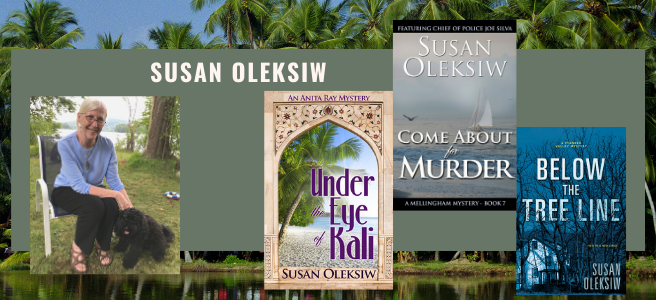
There are seven books in the Mellingham series, and I have long considered these enough because these seven stories complete the trajectory of Chief Joe Silva’s adult life, his progression from a chronically reluctant bachelor to a devoted stepfather in a committed relationship. But there are more stories in Mellingham, and more corners of the town that have yet to be explored. I’ve been struggling with this question for some time—do I continue the Mellingham series, or let it go (as I have) and continue with the two other series that haven’t reached their finale. Anita Ray, in the Anita Ray series, isn’t getting any closer to finding a partner or changing her carefree life of sleuthing with and without a camera. Felicity O’Brien, in the Pioneer Valley series, is more likely to reach her fitting ending, which includes changes to her beloved farm. But I’m not sure I want to write that one either.
The commitment to a single place means we see more of it. We see what we don’t need as well as what we think we need for a particular story. For me, knowing the town’s history also means a cacophony of voices from the past calling to me to resolve the mystery of the unusual tools found in the shed of what was once a furniture workshop in the 1930s. Or the story of a small freestanding ballroom converted to a condo in the middle of a pasture where no flock of four-legged animals ever roamed. The loss of craftsmanship in modern industry circles around the first history and the changing world of New England social life is hidden in the second.
For me, writing a crime novel isn’t a question of merely coming up with an idea and planting it in a preferred location. I struggle with setting as much as with character. The ideas I spelled out above are organic to the place, and understanding how that can be so defines the story. To tell the story of one particular small-scale furniture workshop I have to resuscitate the Mellingham series. Some stories are so insistent. They can be worse than some characters (alive and fictional).
I’ve had the Mellingham series on my mind because Worldwide Mystery is reprinting the last two books in the Mellingham series for its book club as well as general sales. Chief Joe Silva retired, but the town is still there, and its history unhidden. What to do, what to do.

 Ladies of Mystery
I, too set my books in one location identified correctly as Santa Cruz, California. When I decided to finish the Regan McHenry Real Estate Mysteries series, I created a completely different character but kept the location. I need to be able to see where things take place so I will always be in Santa Cruz and the surrounding areas.
LikeLike
What a worthwhile dilemma, Susan! Whichever direction you go in, I know a good book will result. Regarding native turf, my family never stayed in one place long enough to really know it and then, it was more of a larger town or even city. The two drawbacks about a city are space restrictions and you can lose touch with nature (getting to know your neighbors is a roll of the dice wherever you live, I’ve discovered). So, I guess it only stands to reason the Alvarez Mysteries take place in Palo Alto, California, and the Persephone Cole Vintage Mysteries take place in New York City. Norm (hubby) and I have lived in the foothills of San Jose, Ca, for nineteen years, the longest amount of time either one of us have stayed in one place. But I love to read about small towns and the people who live there. And if you throw in a murder, I’m with you to the max.
LikeLike