
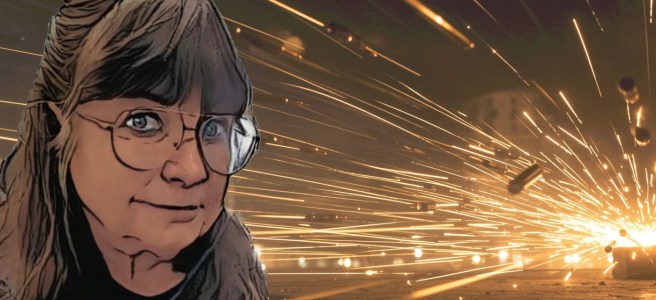
I was watching an Amazon movie the other night, and doing what I so often do, especially when I’m bored. I try to write the scene. It is a sort of mental exercise, meant, I hope, to sharpen my writing skills. Especially for action sequences.
I practice while watching boring scenes of mayhem. That night, the first description that came to mind was: “He landed on his feet in a hail of bullets and leveled everything and everyone standing.” But who is that guy on the right? “A man emerged from the shadows cast by the lowering sun. His assault rifle leading the way.” Why did the pillar just explode? “Another figure stepped into a sheen of light, a silver box clutched in his left hand, his index finger tapping a red button.” Why did he hesitate in his tapping? “A slim figure emerged, a revolver pointed at the back of his dark curls.” Then, he, I, the hero, leveled everything and everyone standing. “The structure roared with the sound of weapons. Ragged breaths and soft moans punctuated the silence that followed.”
I see the scene in my head as I write. My fingers pound it out on the keyboard. I mutter the next sentence, the words coming in a rush. I’ve been stopped by difficulty breathing from the effort of creating mayhem.
Then I read what I’ve written aloud. Is it even possible (cue the research)? Does any element fight the immediacy? Is it the scene I dreamed, saw, thought I wrote? Does it promote the emotions I want? What does it say about my characters? Good and bad, does it show what each character is willing to do to survive, win, be triumphant? Will the reader be caught up in the moment?
Here’s an action passage from “Saving Calypso”, which I’m glad no one observed me writing:
“Grieg elbowed downhill to the flipped travois, where it angled over Boomer’s broken body and considered the tools at his disposal. Rex. Frisco.* The broken branch from the travois. He searched Boomer’s pockets for anything he could use as a weapon. Nothing, except the arrow lodged in the dead man’s throat and Callie’s pocketknife.
Grieg steeled himself before yanking the arrow from Boomer’s neck. It was as awful as he anticipated; Boomer’s blood splattered the front of his shirt and his forearms. He wiped the arrow with leaves, not questioning why it mattered given how he planned to use it, then fingered the two-inch blade out of the pocketknife. Armed, he cozied up to Boomer’s cooling body for cover. A sharp whine descended. An arrow bored into the uphill side of the travois. Grieg counted the fletched shafts he’d seen in Bolt’s quiver. Six, maybe seven. He’d lofted three at Grieg the day before. One in Boomer. Two now. One left. Then, the knife or a bullet.
The next arrow pierced the blanket, lodging in Boomer’s right shoulder. Grieg grunted for effect. The third arrow grazed Grieg’s right calf. Okay, eight.”
And, in reverse, I cast the parts and imagine the scene on screen. In this case, Ryan Gosling, as my lost soul geologist with “a certain set of skills” and wry self-awareness, and Tom Hardy as the newly revealed arrow-launching predator. I have Gosling dye his hair, and Hardy grow his, then I play the scene in my head.
Does it work? Is it too gross for the genre? Yes, I can get pretty gritty. That pops when you cast the parts and play the reel out in your head. If it works, it works; if it doesn’t, it’s back to retooling, jiggering, and writing.
In other words, writing a great action sequence is as easy as landing on your feet in a hail of bullets.
- Note: Rex and Frisco are horses. In Grieg’s words: “As for my buddy Frisco, make sure he gets a good scrubbing, groom him until he purrs and feed him as much as he can eat. Believe me, I’d stand him to a beer if I could.”
Visit my website: https://dzchurch.com to read more about me, my books, or to sign-up for my newsletter.


I get caught up in the action when I’m writing those scenes, and then when I go back through and edit, I see where it might be over the top or needs some info to make it clearer. Fun Post!!
LikeLike
Good post. I love the sentence “He landed on his feet in a hail of bullets.” Arrows seem more barbaric to me, but they are certainly just as lethal. Does Saving Calypso take place on an island? I don’t know why I ASK THAT!
LikeLike
“Saving Calypso” takes place in the high Sierra, outside Yosemite National Park. But I do have a book that takes place on an island “Booth Island.”
LikeLike
That’s what I must be thinking of. Thanks for clearing it up.
LikeLike
Yikes! I’ll stick to cozies–less exhausting. You’ve convinced me they make up these movies as they go along–no need for a script or even a generic plot. Wild for sure.
LikeLike