

Okay, I was trying to be provocative. There isn’t a perfect anything, not even a perfect mystery. Although Agatha Christie’s Murder on the Orient Express comes awfully close. Daphne du Maurier’s Rebecca does, too. And there are more modern reads like Gone Girl by Gillian Flynn. But I digress. Back to me writing a perfect whodunit. It’s a worthy goal.
I am heartened by the fact that writing a good mystery is a practiced art. If I play tennis five hours every day, which I don’t but let’s just say I do, I’m going to get pretty good at it. Same with writing a mystery. I keep in mind that a mystery is a well-written novel that happens to center around a dead body done in by person or persons unknown.
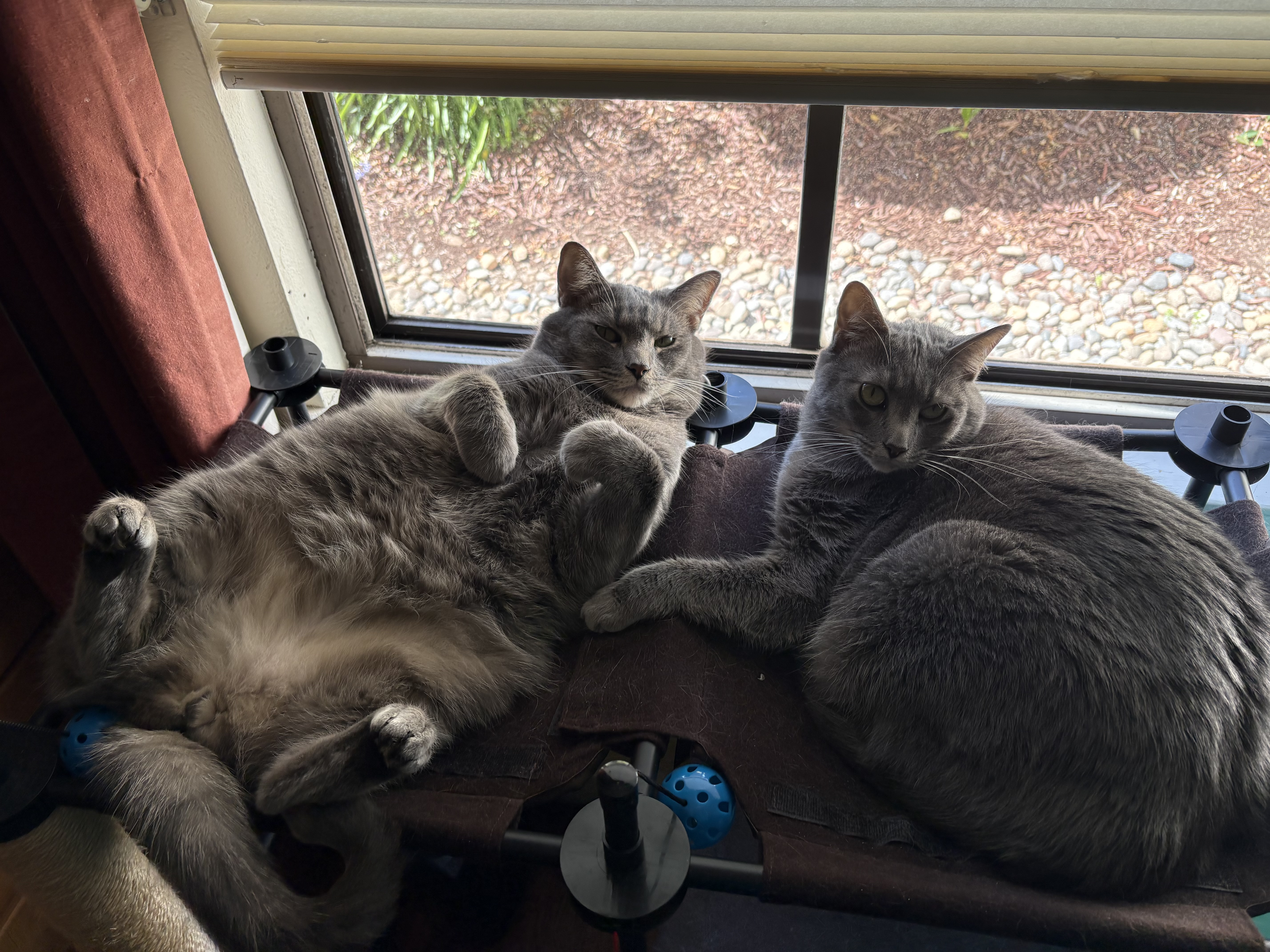
There are some who believe there is a definite separation between the genres of mystery, suspense, and thriller, although many of us combine the three elements when writing our novels. I certainly do. Regardless, I like to keep the definitions straight in my head in case one of our two cats ask what’s the dif. Daphne and Niles are an inquisitive pair (Niles is the one with his belly hanging out).
Mystery – A puzzle of person, place or thing, a ‘whodunit.’ The reader is given clues but has no idea, along with the protagonist, what the outcome will be. If the protagonist is in danger, it’s only when s/he is getting closer to the truth. Mysteries are more of the mind than anything else. Will the protagonist solve the mystery?
Suspense – A ticking time bomb that must be resolved. It has danger but not necessarily action. The reader is often aware of the clues sooner than the protagonist, who must work against time. Suspense plays more on the readers’ emotions. Will the protagonist stop the culprit in time?
Thriller – From the onset, the protagonist is in jeopardy and knows it. The protagonist and reader share the same information at the same time. The thriller has lots of action and keeps the reader on the edge of the seat. No time for thinking or feeling. Will the protagonist survive?
The Cozy Mystery is usually solved by an amateur, often someone who just ‘happens’ to be around at the moment or ‘happens’ to become involved no matter how many books there are in the series. This person does something else for a living but is always bright and committed. The plus side for this type of mystery is the writer ‘merely’ needs to come up with a good story and run with it. No special knowledge is necessary. The protagonist often doesn’t know much more than the reader from the onset of the story. The protagonist learns as s/he goes along, often helped out by a loved one or friend, who tends to have ‘insider info’ that’s missing from our hero. Well, someone has to help advance the plot!
The Detective Mystery revolves around a professional private investigator or law officer, someone who does this for a living. The plus side of this kind of mystery is the writer can dig deeper, go into more detail, reveal maximum facts to the reader, often getting into scenes and places otherwise not available to the average Joe Schmoe. This protagonist is usually more committed to the cause than anyone else, for whatever reason. When I find that reason I’ve got the heart of my story.
Speaking of protagonists, it is essential to have an interesting protagonist, not necessarily likeable, but one with redeeming characteristics. This protagonist should be intelligent and different, someone who knows the rules, but breaks them. S/he has something personal to overcome such as yearning to be a better person or feeling guilty because s/he can’t be. They should also want something, even if it’s a glass of water. Nothing propels a character forward more than wanting something.
When I read mysteries containing successful protagonists, from Miss Marple to Nero Wolf, Sam Spade to Hamish Macbeth, Sherlock Holmes to V.I. Warshawski, I find they all have one thing in common: they are unique. It is essential the protagonist is someone I would want to spend time with at a dinner party, even if once I get home I say, “Wow! What an oddball. I’m glad I don’t have to live with her/him.” Being normal and ordinary just isn’t part of the package. I tend to save that for my youthful love interests.
After I’ve created my protagonist, I occasionally do an essay or interview with her/him in order to flesh the character out. I ask questions, such as: How do they react under pressure? What do they cherish? What do they abhor? Do they believe in justice above all else? Where is their point of mercy? Would they, themselves, take a life? If so, how do they live with that? Then of course, I have to ask what is their favorite color? Not only does that make them feel more ‘real’ to me, but sometimes the mundane can be very revealing.
Now I’ve got the protagonist who’s going to solve the crime(s). Good for me. But where’s my plot? It’s murderous, of course, but I’ve got 175 plus pages to fill out. When I have no idea what kind of plot to wrap around my victim(s), I pick up a magazine, newspaper, listen to a newscast, or search the internet. Sometimes people in my own life have weird stories they love to talk about. So, I listen, absorb, and delve.
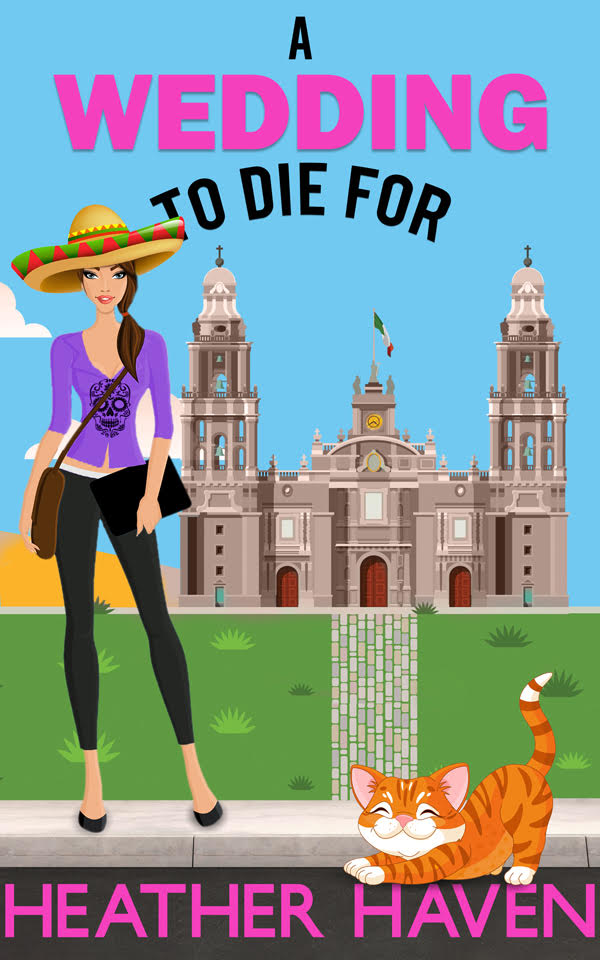
The 2nd novel of the Alvarez Family Murder Mystery Series, A Wedding to Die For, started with an article from National Geographic. It was about an extended family of Egyptian grave robbers, who discovered an ancient royal burial chamber containing precious artifacts. They kept the knowledge to themselves and pilfered from the tomb taking one piece at a time. They did this for generations. They took just enough to feed, clothe, and educate themselves. After decades of careful use of the money, this family came into positions of power within their community and Egypt. Unfortunately, one of them got greedy. Their chicanery was revealed, but it took 60 years to do so. I was entranced. I knew I wanted to take this situation, transfer it to Mexico, and create a powerful family to become the nemesis of the Alvarez clan.
The sub-plot of A Wedding to Die For was a mythical search engine start-up company, Bingo-Bango, and its inhabitants. I felt the sub-plot added a lot of fun and depth to the story, even though it had little to do with the main plot. I did manage, however, to have a situation arise from the sub-plot that gave the protagonist, Lee, an answer to a big problem in the main plot. That was yummy. The finale was the wedding, of course. When I tied everything together, I had the skeleton of my book.
Finally, I go on to the dastardly deed of the murder itself. When my imagination is doing the victim in, the sky’s the limit. What I need to keep in mind, though, is the type of mystery I’m writing. Soft and sweet? Hard-boiled and gritty? Having a disabled little old lady, raped, mutilated and dismembered on page 5 of a story sets up a dark flavor, no matter how many doilies and kittens I throw in.
I have discovered with the cozy it’s best to have the murder victim go in a way that’s more palatable to the reader and off-scene, if possible. But that doesn’t stop me from trying to make it inventive. Drowned in a vat of cabernet sauvignon comes to mind. Someday I may try that. I live in wine country, so forgive me.
If I’m writing a hard-boiled detective story where the protagonist eats rusty nails, drinks rotgut, spits on people’s shoes, and hasn’t talked to his mother since he was eight, dismemberment might not be a bad way to go. Hmmm. Decisions, decisions.
After choosing the protagonist and victim, I try to provide a myriad of suspects with access to the victim(s) at the time of demise. Or just the opposite – no one at all. Right away tension is created. Who, who, who? How, how, how? I ratchet it up whenever I can because I have a pretty fertile imagination. Some say demented. Whatever. You say potato, I say potahto.
Whatever method I choose, I try to do something unusual with it. The method of death, the way the body is discovered, the person discovering it, etc., might have an unusual bend. If I go for the disabled little old lady, for instance, I might have my protagonist find out she was a scam artist on the side, bilking widows and orphans. If I have my victim drown in a vat of 1997 Mouton-Rothschild Bordeaux Blend, maybe I’ll have him be a tea-totaler.
Now that I have some sort of murder going, I start popping in characters that might work with the story. Sometimes I have a chat with these characters as I drive to the supermarket. Maybe when I stop for a light or while standing in the checkout line I’ll go through a scene in my head, acting out certain things. Thank God for cell phones. Nowadays, those nearby assume I’m having an animated conversation on my phone and not demented. Ah! There’s that word again.
When the plot and characters come together, and I’ve eliminated things that don’t work but glom on like crazy to things that do, I sit down and start writing. This is usually the time when the first draft almost writes itself. I just try to keep up.
Hanging over my head all the while is the fervent prayer that this novel will get as near as possible to the proverbial perfect mystery. Wish me luck.


Love RIP, tho. Might use it myself! Thanks, H
LikeLike
What a fun post! You always write entertaining pieces, but this is one of your best.
LikeLike
Thank you, Nancy Lynn! Appreciate the kind words.
LikeLike
Great post, Heather. You give good, succinct analyses of both the crime fiction genre and the writing process. Well done!
LikeLike
That means a lot to me, Peggy, coming from you. Thank you.
LikeLike
Fun post, Heather! It is always good to have things we know reintroduced to make us think about where we are in the work in progress. I want my Cuddle Farm books to be more cozy, but my mind just likes to wade into the deep, dark water. So I am continually dragging myself back to the shore with this book, to keep it cozy.
LikeLike
Paty, I have to remind myself often about this. It’s so easy for me to deviate from the original plan and write darker. Thanks for your words.
LikeLike
I would guess that all of us writers read and nod all the way through this post, admiring how succinctly you outline the subgenres and possible modes of death, but it then occurred to me that any non writer reading this would think we’re ready to fall down in fit and foam at the mouth, with so much going on in our heads while we’re standing in the checkout line waiting our turn to pay for bananas and bread. Seriously, after reading this, I think the stumbling block I’m having with my current RIP is it’s more thriller than detective, so thanks for clarifying that for me. This is a very thorough overview for any writer wondering where she is in the genre (a question I have to ask myself when I’m flailing, which happens more often than I like to admit). Thanks for posting this.
LikeLike
Susan, sometimes I feel like I’m going to foam at the mouth just trying to get through the day. Thanks for letting me know that breaking down what we do was of any help to you. A thriller! So exciting for the reader. What does RIP stand for? Or is RIP a pun for WIP? Or, as usual, have I missed something?
LikeLike
Oops! Yes, it’s a typo. Though sometimes I do feel this one will do me in.
LikeLike