A Drawback of Being a Writer by Heather Haven

Being a writer has a lot of perks. One of them is everyone around thinks of you as rather a wizard. There’s something magical about writing to those who don’t. And here you are, making up all this stuff that goes on for chapters and chapters. Then wham! You have a novel, complete sentences and all. Impressive stuff.

There is a drawback, however. Whatever we write, we try to do it to the best of our ability. That works fine for a novel, short story, eulogy, or speech about water rights. When it comes to how many quarts of milk we need or should we have spaghetti or fish for dinner, it’s another matter. Just how eloquent should you be on a grocery list? But we try. How we try. We can’t let our readers down, even if they are only the cats, who in my case, think I’m overrated, anyway.

Speaking of quarts of milk, that reminds me of the writer, Scott Turow. I remember him giving an interview years ago and telling a wonderful story. His wife asked him to write a note to the milkman about cancelling a future delivery. Remember when we had those? People who delivered one thing to your home at no extra monthly cost to you? Now, of course, there is Safeway, Nob Hill, and Walmart delivering the whole kit and kaboodle for a fee. From bathing suits to prescriptions to food.  One Stop Shopping without having to stop and shop. Sometimes the milk is warm, the eggs are cracked, and they’ve thrown in baby wipes which I didn’t order, but nobody’s perfect.

But I digress. Back to Scott Turow, his wife, and the milkman. After an hour, his wife appeared at Turow’s desk and seized the scratched-out paper he labored upon. She sat down and scribbled, hold the milk on Thursday. Thanks. Then she got up and taped it to the front door.

As Mr. Turow was speaking to a room full of writers, his story not only got a big guffaw, but a round of applause. Nobody knows better than we do how the search for the perfect word becomes all encompassing. And how long it takes to find that word matters not. We are writers and that’s our job.

I tell people repeatedly when I give a lecture or speak to a book club, that what we do isn’t smoke and mirrors. It’s like tennis. The more you practice, the better you get. Yes, you have to have a certain amount of talent, but what it really takes is hard work, tenacity, and joy.

Joy is a definite perk. No matter what’s going on in the world out there or in my world at home, when I sit down to write, I am taken to a place I want to be.

Hmmm. In a way, that is magical.
 I can’t read while I write

Which is a shame because my to-be-read pile is growing every day, filled with intriguing titles, but I’m working on book seven in my PIP Inc. Mysteries series which means no reading until it’s finished. You might wonder why I can’t read when I write. I’m a very undisciplined writer so it’s not like I sit at my computer tapping away all day long. Why, then, can’t I read when I take a break from writing?

I consider my particular writing and reading impairment as the result of being a good realtor for almost twenty-five years. Realtors are taught to mimic clients talking speed, body language especially use of hands, emotions, and language as much as possible. Classes are taught in how to do those things. I dropped out after the first class because I’m a natural mime, always have been. That helped me as a real estate agent and probably has helped in other situations, too, but as a writer it’s a problem for me.

Many cozy mysteries are written in first person. I don’t do that. I write in third person. But if I’m reading a good cozy written in first person, I start to slip into that style of writing which makes a mess of the POV and my manuscript in progress.

There are other distractions, too. Dialogue is a potential problem. After fifty pages of another writer’s dialogue, my characters begin to mimic their phraseology and start to take on their use of language. Mime time again.

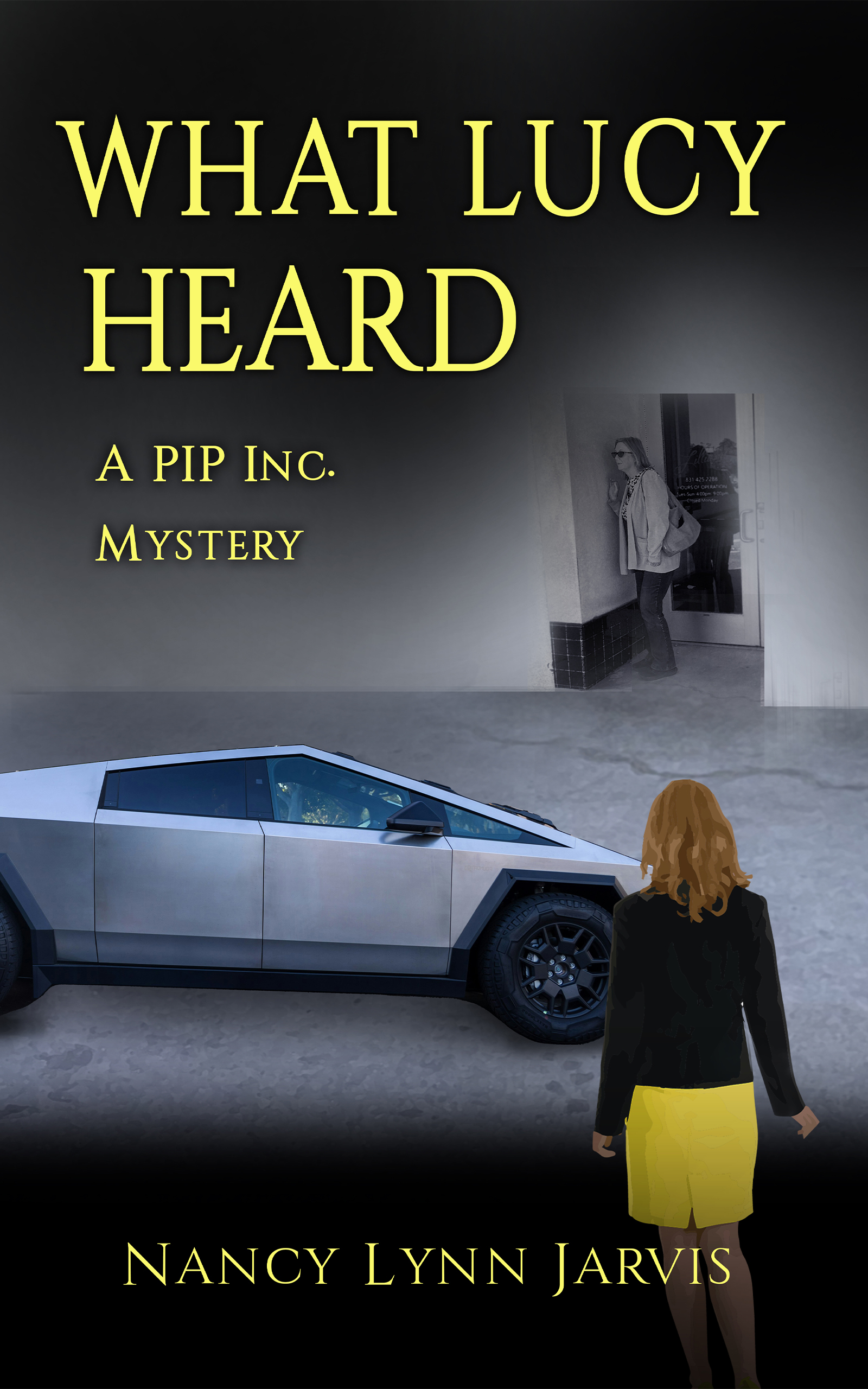
My storyline suffers when I read while writing. I do a short psychological profile and background history for most of my characters before they head for their places on my pages. I do use a timeline because I need to know who knew what when or I get lost having, for example, a clue about when a character who had taken her hearing aids out in a noisy restaurant, put them back in (critically important in What Lucy Heard, for example) and why her dinner companion didn’t know she had.

My outlines are a lot more flexible, though. Before starting a book, I know who the killer is, how and why the murder victim was killed, how the story will begin and how it will end, and have characters I want to introduce to move the story forward, but there’s a great deal of flexibility in how all those pieces come together. If I read while writing, the mimic in me invariably spots a clever plot twist in the work I’m reading and wants to incorporate it in what I’m writing, which as you can imagine, makes a mess of my plot. I do wonder if it’s just me or if other writers have the same problems?

Until my book is finished and off to the editor, I’m sorry Nicole, Vinnie, Mary, Robin, Valerie, Claire, Genevive, Richard, and Verlin. Your books will have to wait a bit longer to be read, but I do know how important reviews are so I promise to leave one as soon as I finish reading your book.  It’s the least I can do for keeping you waiting while I write.

My Plot Walks In

I recently returned from a trip to Italy. I started in Naples on my own, then headed to Rome to join a Road Scholar tour that took me through Rome, Florence and Venice. I enjoyed art, architecture, the countryside, the history, the people, the street life—also the pasta and gelato.

As a writer, I am constantly on the lookout for story ideas. I was sure that my sojourn in Bella Italia would provide. Indeed, it did.

The tour included lectures by various experts who discussed everything from the Forum and the Colosseum in Rome, to the Duomo in Florence, and the Bridge of Sighs that spans a canal in Venice.

In the middle of one such lecture, my plot walked in, giving me that wonderful feeling. The feeling that says: That’s it! Here’s where I can hang my novel!

I’m not going to tell you what it is. I don’t discuss my ideas before I have a chance to develop them further. Suffice to say, it’s a good idea. An excellent excuse to take another trip to Italy.

Hmm, does one really need an excuse to go to Italy?

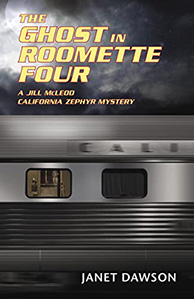
I write a historical mystery series featuring Jill McLeod, who is a Zephyrette, or train hostess, traveling on the old California Zephyr, a streamliner train that ran between the Bay Area from 1949 to 1970. For this series, my character walked in first. Once I learned about Zephyrettes, I had to write a mystery with one as a protagonist.

The plot of the third book walked in when I took an excursion on a private Pullman sleeper car similar to those found on the California Zephyr. In this case the car was attached to the rear of an Amtrak train and we were making a trip from Los Angeles to San Diego.

When we were parked in the station at San Diego, the rail car’s owner told the passengers a tale about another excursion. The passengers on that trip had commented that there was something odd happening in one of the sleeper. They were hearing voices and hearing bells rings. Maybe he had a ghost, we said.

That idea walked into my fertile mystery writer’s brain. Soon my fictional Zephyrette Jill was returning to her onboard compartment late at night when she encountered something she couldn’t explain. And that’s how I came to write The Ghost in Roomette Four.

I was planning a trip to Paris at the same time I was working on the Jeri Howard novel Witness to Evil. Well, if I was going to Paris, so was Jeri.

Why would an Oakland private investigator take a trip to Paris and wind up investigating a case? I could think of two reasons for Jeri’s trip to La Belle France:  because she is paid to do so, to retrieve something—or someone. Turns out the someone is the catalyst. Seventeen-year-old Darcy, a problem child if ever there was one, swiped Mom’s credit card and flew to Paris. Darcy’s parents hire Jeri to find her and bring her back.

Jeri thinks that these two people have more money than sense, but hey, a job’s a job. She flies to the City of Lights and searches for Darcy, interested in the teenager’s why as well as her whereabouts. I figured once I got to Paris, I would figure out what I needed for my plot.

I kept bumping up against the Holocaust.

On the Île de la Cité, tucked behind Notre Dame, is the Mémorial des Martyrs de la Déportation. It’s a sobering place to visit, honoring the 200,000 French citizens deported to Nazi concentration camps during World War II.

Later during that visit, I wandered through the Marais, the historic district of Paris that includes portions of the Third and Fourth Arrondissements. In the late nineteenth and early twentieth centuries, this district had a thriving Jewish community. I was looking for a museum. I didn’t find that particular museum. But I found something else—an exhibit about the deportation of the French Jews.

What stays with me all these years later are the posters that family members put up after the liberation, searching for news of family members who disappeared during the war.

How does that figure into the plot of Witness to Evil? Read the book and find out.