
by donalee Moulton
Great writers don’t need an editor. They demand one. What first-rate writers understand is that another pair of eyes or a fresh pair of eyes are essential to successful communication. This second looks brings a new perspective, the distance that only time (even a little time) can offer, and renewed energy to improve content.
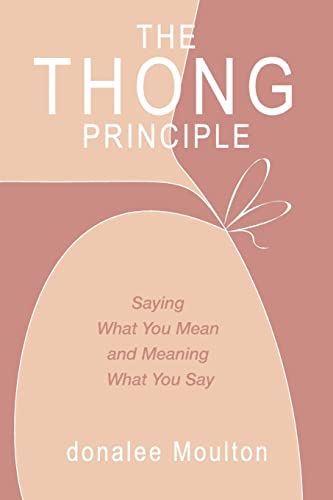
In my book The Thong Principle: Saying What You Mean and Meaning What you Say, I suggest readers try this exercise. You’ll need a piece of paper, 8.5” x 11” if possible.
Now transform that flat piece of paper into the world’s most wonderful flying machine. The goal is to soar, specifically to fly as far as possible. Take a few minutes to play with different designs, then stand up and launch your creation. How far did it go?
Now let’s rethink, or edit, the exercise. What did your flying machine look like? Something similar to a paper airplane?
Let’s review the instructions, the language. Nowhere did it say to build a paper airplane. It said a flying machine. The goal was distance. What would be an easier way to build a flying machine? What would get us great distance?
Crumpling the paper into a ball would.
That’s what editing does. As we write, whether for a reader or a listener, we dive in. Ideas flow. We create content. We think about our audience. We identify important points to make. We’re in the midst of our content, our characters, and our creativity.
When we edit, we take a step back. We come up for air. We have a different perspective – and a draft on which to overlay a fresh set of eyes. Even short pieces of writing should be edited. We need to think before we walk away. We need to give ourselves time to review and revise. To take one last read through (or think through). You’ll be surprised at what you missed or decide to revise.
Editing is essential to clear, concise, compelling writing. But editing isn’t just one thing. Just as pizza isn’t just one thing. There is deep dish pizza with red carnival spinach. Thin crust pepperoni and Bloomsdale spinach. New York-style pizza with Tyee spinach. Notice though that although the type of pizza is different there are common elements.
That’s also true when it comes to editing. There are three broad types: substantive editing, stylistic editing, and copyediting.
I thought we could spend a little time exploring these different types of editing in future blogs. Until then, I’d love to hear from you about your editing process, what drives you nuts, what makes your heart sing.

 Ladies of Mystery
Hmmm. I love to edit. Looking for the perfect word to take the place of a so-so one fills me with joy. I actually gloat. I don’t even mind removing chunks of dialog or narrative that don’t work. If it’s actually a good piece of work but not right where it is, sometimes I save it for a later book. But then, of course, I forget about it later on. Well. Here’s living proof. I’m weird.
But I do have two editors, one for content, one for grammar. Because, as you write, fresh eyes. Great post!
LikeLike
For me, the joy in editing comes from what you’re talking about. Finding the right word, the right image, the right flow. You know you just made the writing better.
LikeLike
I haven’t liked editing from the beginning, because back then I was using a typewriter. If I found an error, I had to retype the whole page! And sometimes fixing that error would leave space or move words to the next page, and you’d have to retype that one and all the pages after until a new chapter.
Now I prefer to re-read what I wrote the day before, tweaking and editing as I read. Then I have less editing to do when the book is finished and it doesn’t feel so tiresome as working on the whole book at one time.
Good post! Looking forward to your upcoming posts.
LikeLike
I know what you mean about editing feeling like work. Rewarding, but work nonetheless. Writing doesn’t usually feel that way.
LikeLike