Thankful, grateful

Since this is Thanksgiving season, I decided to ask myself what is it about my writing career that I’m most thankful for. There are so many things to be thankful for, and I feel I need to remind myself once in a while just what they are.

I was listening to a podcast the other day and the narrator asked the author what part of the writing process she would outsource if she could.

This writer is a quite successful independent author. She said that when she started out, she did everything. But she’d become quite successful and was able to hire a personal assistant to help her. One of the things her PA does is format her books.

Since that is one of the hardest parts of the job for me, I laughed and told a friend, “When I get rich and famous, I’m going to outsource formatting my books!”

I’ve already hired two editors and a cover designer. But I felt like I wasn’t making enough money to source anything else out. Then I noticed on the email I got from the woman who designed the cover for my Christmas Romance she had added, please talk to me about formatting.

I took a chance and asked her. Her prices were so reasonable I didn’t have to wait until I became rich and famous. I told her what a nightmare it was for me. She said she’d be happy to do it because she’d done so many it wasn’t a nightmare for her. I was thrilled by how fast she got it done. And when I tried to upload my files to Amazon and Ingram they went through without a glitch. I am so thankful to Paty Jager who told me about Covers by Karen. Paty has always patiently answered my questions.

On the podcast they suggested doing the parts of the writing business that you love and hiring the rest out. I like marketing my books. I know I’m not that successful at it, but it’s a part of the business that I enjoy. So, for now, I’ll continue to try and market them. If I could afford to have a marketing person, you can be sure I would.

My books are so much better since I hired my editors. They go through my books and give me feedback, and correct grammar and spelling. They are incredible.

I’m so thankful for my cover designers. I used 99 Designs for the first four books and Covers by Karen for the last one. They all did such a great job. I know writers who design their own covers, and they are beautiful. I think that’s great, but I’m not a designer. I have no idea how to even begin to do that, so I’m thankful for artists who are good at what they do and design the covers for me.

I love having the freedom to pick the titles and the cover design. And I love to write, of course, or I wouldn’t be doing this.

I love my readers and I’m so thankful for them. Even though my tribe isn’t that big yet, they are wonderful. They share my social media posts and tell their friends to read my books. A couple of my readers have asked their libraries to carry my books. They are amazing!

 It makes my day when one writes to say they enjoyed my book and couldn’t put it down. Or they stayed up all night reading. One reader told me this about the Christmas Romance I just published: “I loved every page!”

I’ve been so lucky along my journey to meet so many wonderful people. From the writing instructors to other writers who have gone out of their way to offer help when I’ve needed it. I’ve also reached out to industry professionals who’ve been more than kind and answered questions about law enforcement.

I’m thankful for my family who have encouraged me and helped in any way they can, from designing and maintaining my website, to taking my author picture to reading early drafts and giving input and editing.

I love this job. As I read back over this blogpost, I realize how lucky I am to have so many people who have helped me along the way. I hope to write for many more years, and I hope that I’ll look back often and think about all that I’m grateful for.  It’s easy to get caught up in the grumbling, and I do from time to time. But when I stop to think about it, there is a lot more to be grateful for than to grumble about.

Happy Thanksgiving! I hope you are counting your blessings too.

And the answer is…

Scroll down for the answers. Next month I’ll share the questions about theft.

#1: When were the first portable timekeeping devices — in other words, the world’s first watches — first invented?

A. 16th century (the Early Modern Age)
B. 18th century (the Age of Enlightenment)
C. 20th century (the Age when Bind’s characters were born)

#2: Who were wristwatches originally designed for?

A. Men, because men get everything first
B. Women, because they are the smarter sex
C. Police officers, because they carry guns

#3: When did wristwatches gain popularity among men?

A. During the Roaring Twenties
B. During the Industrial Revolution
C. During World War 1

#4: Which old Hollywood movie star’s watch shattered records when it sold at auction in 2017?

A. Clark Gable, The King of Hollywood
B. Archibald Alexander Leach (you probably know him as Cary Grant)
C. Paul Newman aka Cool Hand Luke

#5: From 2021 to 2022, luxury watch thefts rose by 65% in London. What happened as a result?

A. A petition to ban the sale of machetes
B. An ordinance prohibiting anyone wearing a luxury watch in public
C. A law forbidding anyone to take a photo of the Crown’s wristwatch

#6: If not for a Rolex watch, Albert Johnson Walker might not have served 26 years in prison. Where was he incarcerated?

A. England
B. Canada
C. St. Pierre

Question #1: The answer is A. German clockmaker Peter Henlein is credited with inventing the first watch around 1510. Because of its size (about 3 inches), it was best suited to be worn on a pendant or attached to a belt.  

Question #2: The answer is B. Wristwatches were originally created for women. They were seen as both elegant pieces of jewelry and functional timepieces. According to the Guinness World Records, Swiss watchmaker Patek Philippe made the first wristwatch in 1868 for a Hungarian Countess. Men preferred pocket watches at that time.

Question #3: The answer is C. During World War I, wristwatches became a necessity because soldiers needed to tell time quickly and easily. This translated to civilian life after the war. By the 1930s, wristwatch sales had surpassed pocket watch sales.

Question #4: The answer is C. Movie star and race car driver Paul Newman’s Rolex Daytona sold at auction for $17.8 million in 2017. The watch had been a gift from his wife actress Joanne Woodward—engraved with the words “Drive Carefully, Me.”

Question #5: The answer is A. A London councillor launched a petition to ban the sale of machetes after having his watch stolen by a machete-wielding thief in 2022. The petition got almost 140,000 signatures.

Question #6: The answer is both A & B. In 1996, British police used a Rolex watch to identify a body found in the English Channel. When they visited the home of Ronald Platt, they discovered his business partner, Canadian-born Albert Johnson Walker, pretending to be him.  In 1998, Walker was convicted of first-degree murder and incarcerated in England. In 2005, he was allowed to transfer to a Canadian prison where he was further convicted of embezzling millions from his Canadian clients. In 2024, he was still in prison in B.C.

cover of donalee Moulton's book Bind

Guest Blogger ~ Helen Hynson Vettori

Have you ever heard of the term Black Swan? Not the bird found in Australia – the expression. It means a catastrophic event that could not have been foreseen or imagined because of its unprecedented impact. As a decorated EMT/Paramedic and award-winning US Homeland Security emergency manager, I planned and prepared for, responded to, and recovered from devastating crises. Experience from those professions forged my credibility to imagine plots driven by horrific circumstances, but, until I retired, I never imagined I would pen a Black Swan trilogy thriller novel series. The Ladies of Mystery invited me to introduce you to the first book, Black Swan Impact, on November 2, 2024, and one year later they repeated the kindness by welcoming me to spotlight the second book, Black Swan Shock.

As you might have guessed from the title, the catastrophe that could not be foreseen or imagined in Black Swan Shock is a massive earthquake. Like the first book, it is an award-winning, internationally acclaimed work, but unlike the first, it won the 2025 Mystery / Thriller category from The International Impact Book Awards even before its publication. The honor may be attributed to the stunning calamity and the strong, likeable, and multifaceted characters.

The primary protagonist, Marla Case, is a major reason for its recognition because she is so compelling. Beyond the professional and technical influences that helped me to shape her, the personal one that inspired me most was our neighbor, Millie Wiggins. Millie and her family live a few doors up and walk past our home often. She always smiles and spreads her joy whenever I see her. She was born with Down syndrome and personalizes it beautifully. I used Millie’s wonderful traits to develop Marla who also has the condition.

Then, an earthquake resonates with readers because seismic events are a recognized part of our dynamic world. However, while tremors are common, mammoth upheavals are not, captivating the audience. Through that catastrophic event I build tension with vivid and stunning scenarios. Of course, imagination was a key element, but I also called upon my experiences as a former paramedic and emergency manager, firsthand accounts from fire and rescue personnel, and research related to the 1811-1812 New Madrid Earthquake to deliver plausible and anxious situations.

As an avid thriller enthusiast myself, I strive to offer readers exciting and intriguing fiction because that is the great appeal of the genre. From its opening, Black Swan Shock surprises readers as Marla runs the race of her life. Then, the plot crescendos when a historic earthquake strikes. The elite athlete and her family are caught in mayhem, hooking the audience by intimately sharing their trials and successes. Juxtaposed hair-raising scenes alongside altruism and wonderful relationships, readers will experience tension one moment and then joy the next.

BLACK SWAN SHOCK

Marla Case, an elite Olympic-bound athlete, finds her devotion to competition fading and chooses to step away. She considers becoming a medical responder and learns about the profession from a paramedic friend. Before committing to the rescue service, Marla accompanies her mother on an academic tour that ends abruptly when a massive earthquake strikes. The athlete reacts to save victims with her physical skills and newly acquired understanding of some emergency medical actions. She becomes a beacon of hope for the citizens of St. Louis, Missouri. However, personal tragedy affects Marla, as well, and she struggles to find catharsis herself.

Black Swan Shock is available worldwide from your favorite bookstore or online bookseller like Barnes and Noble and Amazon in hardcover, paperback, and electronic versions. E-books are obtainable immediately, but audio-book lovers will need to wait to listen to it. That format should be released in the first quarter of 2026. If you prefer, you may find links to purchase a paperback, hardcover, or e-book at my Website https://www.helenhynsonvettori.com/.

ISBN 9798895436257 (Paperback)

ISBN 9798895436264 (Hardcover)

ISBN9798895436288 (ePub e-book)

ISBN 9798895436271 (Audiobook) 

Helen Hynson Vettori (pronounced: HELL-lun HIN-suhn Ve-TOR-ee ) was born in Washington, DC, and has always lived and worked in the National Capital Region. Her knowledge and experiences gained as a commended EMT/paramedic in the Bethesda-Chevy Chase Rescue Squad and Employee of the Year emergency manager in the Department of Homeland Security enable her to write books with credible and thrilling Black Swan plots. She lives in Leesburg, VA, with her husband and enjoys hobbies like fine art painting and traveling, but, most importantly, she likes spending time with family. You may find out more about the author at her Website https://www.helenhynsonvettori.com/, follow her on Instagram @helenhvettori, or subscribe to her monthly topics on Substack https://helenhvettori.substack.com/.  

Of Dinosaurs and Digits

by Janis Patterson


Be warned. There is a rant coming!


I am old. I must admit it. Some people might even call me a dinosaur… an appellation I am proud to claim. I mean, how nifty to have someone talking about you and being interested in you a couple of million years after you died!


I even wrote my first real book on an ancient manual typewriter. (My very first book was done with pencil and paper, but I was only four I hadn’t learned to type yet. I was ten before I could convince my dad to teach me.) Then, a couple of books later I graduated to a portable electric – an SCM in cloud blue – and boy, did I feel like I was in tall cotton. It was like heaven, and the bulging muscles the manual had built up in my fingers gradually faded away. My problem was paper. Paper was (proportionally) more expensive then than now and each draft required paper. Lots of it.


I became adept at adapting and scavenging. I’d use old drafts, slash a Mark-A-Lot through the typed side (which bled through to the other side, creating some interesting problems on occasion) and type the new story on the back. Then one day I got lucky. A business in the building where I worked went out of business and put half a dozen reams of their stationery out for garbage. Needless to say the garbage didn’t get them. For at least three books I felt so elegant typing my rough drafts on 35lb (I think – it was definitely heavy) deckle-edged grey paper. Sad thing was, there had to be a clean final copy typed for submissions. In those antique days there were no Xeroxes, just a very messy and expensive wet process copy machine, so you had to watch your one precious clean copy like a hawk, or go spend the time typing a second one.


Finally computers came in. My first memory typewriter/computer was an Olivetti, at the time the world standard instead of IBM, which wasn’t selling in the US so they were practically giving them away. It had about a two page memory and showed one line of copy at a time. And we writers were delighted. I used that for about two books then IBM PC clones became affordable even to poor writers like me and I adapted. I gave the Olivetti to my mother, but she could never master it. She’d call in tears so often trying to make it behave – it did work as just a regular typewriter just as well and was grade-school simple but she and it never did mesh, so I finally took it away from her and gave it to some charity.


With a small succession of ever-more-useful PCs I upped my output and was very happy. Some of the later ones even had internal memory, but the luxury of saving to a floppy disk was wonderful. The best thing, however, was the cut-and-paste function. Until that cut and paste was actually that, with scissors and cellophane tape and a lot of retyping.
I went through computers fairly quickly, as the older PCs seemingly weren’t made to last. Nowadays though, the computers are made to last, but the MicroSoft programs are ‘upgraded’ with depressing regularity and even more depressingly higher prices. This is what made me so angry with MS that my darling husband gifted me with a Mac Book Pro eight years ago, and it has ticked along happily ever since then except for a couple of swelling battery replacements.Yes, there was a learning curve, but I overcame that through pure fury at MS, and now have acquired two more Macs, one solely for long distance travel and another waiting in the wings to supplement my ageing Pro.


And still MS tries to keep their bottom line by dictating ever newer program ‘upgrades.’


This is the basic point of this rather angry little screed. Why must we continue buying and rebuying to get new features that we do not use, do not need and do not want in order to keep support for the programs we do use, need and want? Why doesn’t MS put out a ‘writers version’ – slimmed down, practical and simple to use – that doesn’t have something unwanted and complicated added on with deadly and costly regularity? Same reason they are becoming reluctant to sell a program in a one-time buy, preferring instead to make customers rent it so they can bloat and complicate it even further with ‘improvements.’


The answer is obvious, and I could describe it perfectly with one or two possibly rude words that no lady should ever use.


And that is why I’m exploring and switching to other ‘office-style’ suites. Someday I am going to find the perfect one, and when I do I’ll share my choice with you in case you should want it.


Of course, I could – and do – just keep using the version I like, but I live in terror of my data simply evaporating some day. (I do keep various versions in various formats – paranoia can save your life…) If necessary, I could go back to the manual typewriter or (though my aged fingers tremble at the thought) plain white typing paper and a pencil.


The thing is, writers should be concentrating on their writing instead of having to constantly juggle with the tools of writing. Is that such an outrageous concept?

More Character Development – Gabriel Hawke

I had a reader ask me how I come up with my characters. Last month I wrote about how I came up with Shandra Higheagle, my main character in the Shandra Higheagle Mysteries.

This month I’ll tell you how I came up with Gabriel Hawke, the main character in the Gabriel Hawke Novels. How I came up with names and secondary characters.

To start with, I wanted to set a series in the county where I grew up. I love the mountains, the valleys, the rivers, and the lakes. Wallowa County is beautiful year-round. Growing up in a small community, you learn the dynamics quickly. There are people whose families homesteaded; they feel the county is theirs. Anyone who moves in is an outsider until they have lived there for several generations It’s just the way it is. That makes for conflicts and misunderstandings. And small communities have secrets. Some are a hundred years old and some aren’t that old, but they are there and you know in a rural area, gossip moves faster than an F-16. Those were part of the reasons I picked this county for my setting. That and I wanted a Game Warden and have deaths in the mountains.

I asked my son-in-law if I could ride along with an Oregon State Police Fish and Wildlife Trooper. He set it up, and I spent a day riding around the county, learning what the job entailed, and I knew this was my character’s occupation. The trooper I rode with told me about how he could go from one corner of the county to the opposite one in one day, checking hunting tags or doing a callout. The county is 3,152 square miles. So it could take several hours to go from one corner to the other because most of the roads are gravel or logging roads that he navigates.

While riding with him, he told me stories about some incidents that he helped with and told how he not only does his job as a Fish and Wildlife officer, he also has to do the job of a State Trooper because the county is so large yet only has a population of 7,500, so there are few county and state law enforcement officers. In fact, there are four main towns in the county and only one has city police. It is the county seat.

My friend author Carmen Peone took this photo for me.

Now for Hawke. Because Wallowa County was the summer and winter home of the Wallowa band of Nimiipuu, or Nez Perce, I wanted my character to be of that tribe and to protect the land and animals of his ancestors. I gave him a backstory of growing up on the Umatilla Reservation outside of Pendleton- 3 hours from Wallowa County. His mother is Cayuse and his father was from the Nimiipuu Lapwai Reservation in Idaho. He excelled in sports in high school and went on to join the Marines. He was there four years and came back to Oregon and entered the Oregon State Police Academy. His first job was patrolling I-84 between La Grande and Hermiston — that meant he could live on the reservation and work.

He met a woman, married her and then ended up arresting her brother for drugs. She left him and when there was an opening in the Wallowas, he applied and got it. He isn’t a young trooper. He’s actually been a trooper long enough he could retire. He’s in his late fifties, getting closer to sixty, but he loves his job.

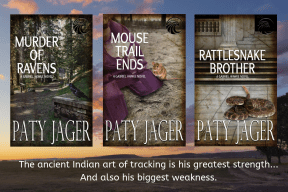
This was all the information I knew when I started writing the first book, Murder of Ravens.

I started that book with him being a mature single man living in a studio apartment over an indoor horse arena. He has a horse, a mule, and a dog. Since he isn’t one to get caught up in names, his horse is Jack, the name he had when Hawke purchased him. The mule came without a name, and after Hawke dealt with its cantankerous disposition, he named the mule Horse, hoping it would act more like a horse than a stubborn mule. And Dog is his constant companion when he’s out in the mountains or at home. When the animal came to him when he said, “Come Dog,” Hawke decided the name was good enough.

The horse stable where Hawke lives is part of a farm run by Herb and Darlene Trembley. Over the years, the landlords have become friends and an excellent resource for Hawke when he’s looking into families with history in the county. They grew up here, and their families have been in the county for generations.

While patrolling in the Wallowa Mountains and Eagle Cap Wilderness, Hawke enjoys the freedom of wearing his civilian clothes so poachers won’t take pot shots at him. He takes Dog with him, rides Jack, and packs Horse. They are a smooth-working team when Horse is having a good day. Hawke loves being in the mountains and takes all the patrols that he can.

While in the mountains investigating a death at Charlie’s Hunting Lodge, he butts heads with the new owner, Charlie’s niece, Dani Singer. Initially, they don’t get along and don’t understand one another. Hawke is trying to reconnect with his heritage, and she has run from it her whole life, pretending she wasn’t Indigenous, to not be tossed aside when she applied for the Air Force Academy. She made it in and became a skilled pilot. Since retiring from the Air Force, she uses that skill to fly clients into the Hunting Lodge with her plane and helicopter. As the series progresses, so does their admiration for one another.

The other secondary characters who show up in most of the books are Kitree, the girl who outfoxes Hawke in Book 2, Mouse Trail Ends. She ends up an orphan when her parents are killed while camping in the mountains. She is adopted by Tuck and Sage Kimball, Dani’s wrangler and cook at the hunting lodge.

His mother, Mimi Shumack, still lives at the Umatilla Reservation. He visits her often. She is a big part of who he is as an adult. She remarried when Hawke’s father left and had a daughter who is ten years younger than Hawke. The stepfather was a mean drunk. This shaped who Hawke is today.

Then I had to discover how many city police, county officers, and state police are in the county. I gave them all names, and they come and go in each book depending on what is happening.

Hawke’s personality is quiet, reflective. He rarely loses his temper unless he sees an animal or person being mistreated. He believes in taking care of the land and animals to keep nature at peace. He upholds the laws but will bend the law if it will catch a killer. He has tracking skills he uses not only to follow tracks but also to follow the trail of clues he uncovers while investigating. His need to find the truth or evidence can sometimes get him into trouble, but he manages with the help of Dog and friends to get out of it.

If you haven’t had the chance to read one of Hawke’s books, you can find Murder of Ravens at my website in ebook, audiobook, and print.

Murder of Ravens

The ancient art of tracking is his greatest strength…

And his biggest weakness.

Fish and Wildlife State Trooper Gabriel Hawke believes he’s chasing poachers.

However, he encounters a wildlife biologist standing over a body wearing a wolf tracking collar.

He uses master tracker skills taught to him by his Nez Perce grandfather to follow clues on the mountain. Paper trails and the whisper of rumors in the rural community where he works, draws Hawke to a conclusion that he finds bitter.

Arresting his brother-in-law ended his marriage, could solving this murder ruin a friendship?

Universal book link: https://www.books2read.com/u/bxZwMP

There’s a bundle of holiday gifts coming your way! 

I’m joining eleven other fabulous, award-winning, and best-selling mystery authors for a 12 DAYS OF CHRISTMAS STORY GIVEAWAY.

Here’s how it will work: 

For eleven days starting December 1st, you’ll receive a link for a completely free holiday story–no newsletter signups necessary. Then, on the 12th day, you’ll get a bundle of extra goodies to celebrate the season

Sound like fun?

If you want to make sure not to miss any of the stories and bonuses, you can sign up for my newsletter using this link: https://successful-speaker-2057.kit.com/dddfb95104