

Last month we talked about giving your story a title. Unlike article titles, book titles are usually the domain of the writer.
This may be because the writer has a closer connection to the topic, the editor wants the writer to do the work, or the writer and editor see it as the author’s prerogative. But just because the book writer usually develops the title doesn’t mean the editor will accept it. They will tell you if they don’t like it, and why. They will tell you if it won’t work, and why.Let’s look at what constitutes – usually – a good book title, and then I will use my first book as an example.
Because book titles are one of the first things a potential reader sees, they need to hook that reader. It’s recommended the title give away a little something about the plot and the nature of your book. Is it going to be action-packed, romantic, whimsical?
Here are the three main ingredients in a strong title:
Ingredient#1
LENGTH.
Shorter is better. Shorter tends to be more memorable, more powerful. Some experts advocate for the one-word title, but one-word titles are more limiting for search engines. Fewer examples are found. The recommendation: three or four words.
Ingredient #2
IMPACT.
The title should draw the reader in because it is evocative; it speaks to what lies within the pages of the book. It sets the stage for what they can expect.
Ingredient #3
UNIQUENESS.
Titles that we can remember, titles that stand out from the crowd are winners. This may be a play on words, a pun, a jab, a literary reference, a phrase that speaks to mind, heart and spirit.
In short, titles are essential to the sale of a book. And they are not easy. Let’s look at one title I’m very familiar with.
My first book is Hung Out to Die. It’s a murder mystery. The main character is CEO of a cannabis-production company in Elmsdale, Nova Scotia. As I was writing this book, a funny aside started to take place involving a word the main character had never heard before: Chunderfuck. In my mind, that became the title of the book with asterisks replacing two of the letters in the last syllable. I then built on this concept. Future books would have similar fun but profane titles: Numb Nuts, Dick Wad…. You get the idea.
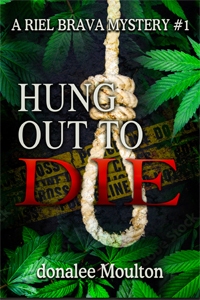
It was not meant to be. As I was starting to shop around my book, I realized the title might lead agents and publishers to conclude the book would be darker, edgier, grittier than it is. Indeed, it’s actually funny. I also didn’t want to turn off publishers before they even read the book. I went with a working title instead: So, A psychopath walked into a bar. In my mind, the book would still be called Chunderf**k, an issue I would raise with my publisher as soon as I had one. Which I (with gratitude) did. My publisher, BWL Publishing, was more than open to changing the title. But not to Chunderf**k – and not for the reason you might think. Search engines don’t pick up asterisks.
Dammit.
So the book became Hung Out to Die. It’s a play on words, drying plants is linked to cannabis, and the victim dies by hanging. It’s short, it’s got some oomph, but let’s face it. It’s no Chunderf**k.
I’d love to hear your thoughts on titles. And asterisks.


I try to keep my titles short, though you wouldn’t know it with the new book coming out in my new series. Some have said it’s too long but it is supposed to be reminiscent of a Christmas carol.
My Hawke books have wild animals in the titles because he is a fish and game warden. My Spotted Pony Casino titles all come from gambling terms.
I think it is good to keep the titles short and have them relate to the story. Good post!
LikeLike
I love titles in a series that connect to one another in some way. Very memorable.
LikeLiked by 1 person
Donalee, I’m with you. A title really sells the goods. Now that I’m no longer with a traditional publisher, I have fun ‘finding’ a title for one of my books. I think a favorite of mine is The CEO Came DOA, whick of course, was suggested by the charming 40s comedy with Bette David and James Cagney, “The Bride Came C.O.D.” Great post.
LikeLike
Great title. LOL
LikeLike