

The “What-if” Thriller Game
Most thriller writers are suckers for a good story. I’m one of them. And if the story is true, many of us start playing the “what-if” game. What if I took a character and imagined it happened to her? What if I set the story in Chicago? What if I created a backstory that explained the current situation?
“What-if’ing” is often the first step I take to suss out a new story or novel. In fact, I’m pretty sure I started writing historical thrillers because I “what-if”ed an ordinary person living through a period of extraordinary turmoil. What if a group of hippies lived together during the 1968 Chicago Democratic Convention? That became Set The Night on Fire. What if a young American woman got caught in the 1979 Iranian Revolution? A Bitter Veil. What if two Vietnamese sisters had to cope with the Vietnam War? A Bend in the River.
However, I didn’t have to “what-if” the circumstances of my recent thriller, Max’s War, published in April, 2024. My late father-in-law, Fred Hellmann, was an immigrant from Germany. He was “off the boat” in 1939. He’d grown up in affluence in Regensburg, a city that, as far back as the Middle Ages, was a center for trade and commerce. Growing up, Fred had his own horse and carriage. His father bred racehorses and owned a bicycle and wheel shop. They lived in the best part of town with plenty of household help.
All of that changed when Hitler came to power—the Hellmanns were Jewish. From 1933 on, the Nazi government tightened the noose on all German Jews by issuing laws that slowly, inexorably restricted their education, their ability to make a living, their social lives, and their freedom. Goebbels piled on with misinformation that depicted Jews as odious creatures who couldn’t be trusted. In the early 1930s Jews were encouraged to leave Germany. Or else.
Fred’s family heeded the warning and moved to Holland, which at the time, was a neutral country. The Netherlands had a history of tolerance. Jews assimilated and inter-married. For a couple of years things after they moved, life was peaceful. The Hellmanns even imagined returning to Germany after Hitler was thrown out of power.
Except they never did.
With the looming invasion of Holland a certainty, a relative in Philadelphia offered to sponsor Fred if he emigrated to the US. She couldn’t sponsor his parents, though. Only him. Fred’s family made a heartbreaking decision. Fred would go to America. His parents would remain in Holland. Leaving was problematic, however. It was no longer permitted. So, in 1939 Fred hid in a truck filled with coffins. He made it to the ship that brought him from Rotterdam to New York. From there he took a train to Philadelphia.
For two years he took odd jobs as a delivery boy and studied English. He learned he was the sole survivor of his family. Sometime after Pearl Harbor he was drafted into the US Army.
Because he was German and an immigrant, he was sent to Ontario, Canada, after Basic Training, where he was trained by the OSS to interrogate German POWs and to ferret out intel about German troop movements: where they were, where they were planning to go, and how well equipped they were.
Fred was sent back behind enemy lines at the end of 1943. He spent almost two years as an interrogator and a spy. In 1945 he was asked to remain with the OSS for another year. But he’d become engaged to a lady in Philadelphia who said enough was enough. She couldn’t wait another year. So Fred came back to the States. He married Lucy, and their first son Mark was born in 1946. I married Mark in 1979.
While not as dramatic as the first part of his life, Fred’s post-war life was marked by what we now know as PTSD. As far as we knew, he never talked about the war… not to his two sons or his friends. Once in a while, an anecdote leaked out. The coffin story… how he came to have a German knife and Lugar… how he impersonated a Wehrmacht officer to elicit information from German POWs. How his best OSS buddy substituted for him during a mission and was killed. I’ve included a fictionalization of those events in Max’s War. And added to them.
Still, those are just scattered remembrances. We tried to get his Army records so we’d know exactly where he was trained and deployed, but they were destroyed in a fire at the St. Louis Army record center shortly after it opened.
As a thriller writer who’s fascinated with spy-craft, I’ve wanted to write about his exploits for years. When I heard about the Ritchie Boys and how they did exactly what Fred did during the war, I wondered whether he trained with them. Long story short: We have no proof one way or the other. But I have since learned that the OSS and Ritchie Boys were kissing cousins during the war. They often shared training and missions. More than a few soldiers floated between the two organizations. In fact, an OSS camp lay just a few miles from Camp Ritchie in rural Maryland. So it’s entirely possible.
The great thing about fiction is that we can create stories that raise issues of extraordinary conflict, morality, and good vs. evil. While Fred’s story will always have a few loose ends, Max’s doesn’t. The plot of Max’s War emerged organically from Fred’s story. Where I didn’t know the facts, the “what-if” exercise helped me fashion what I hope are plausible events. In that respect, it is both the easiest and most difficult novel I’ve ever written. I hope you will agree.
A sweeping World War 2 saga in which a young German Jew flees Europe, emigrates to America, and joins the Army to fight Nazis
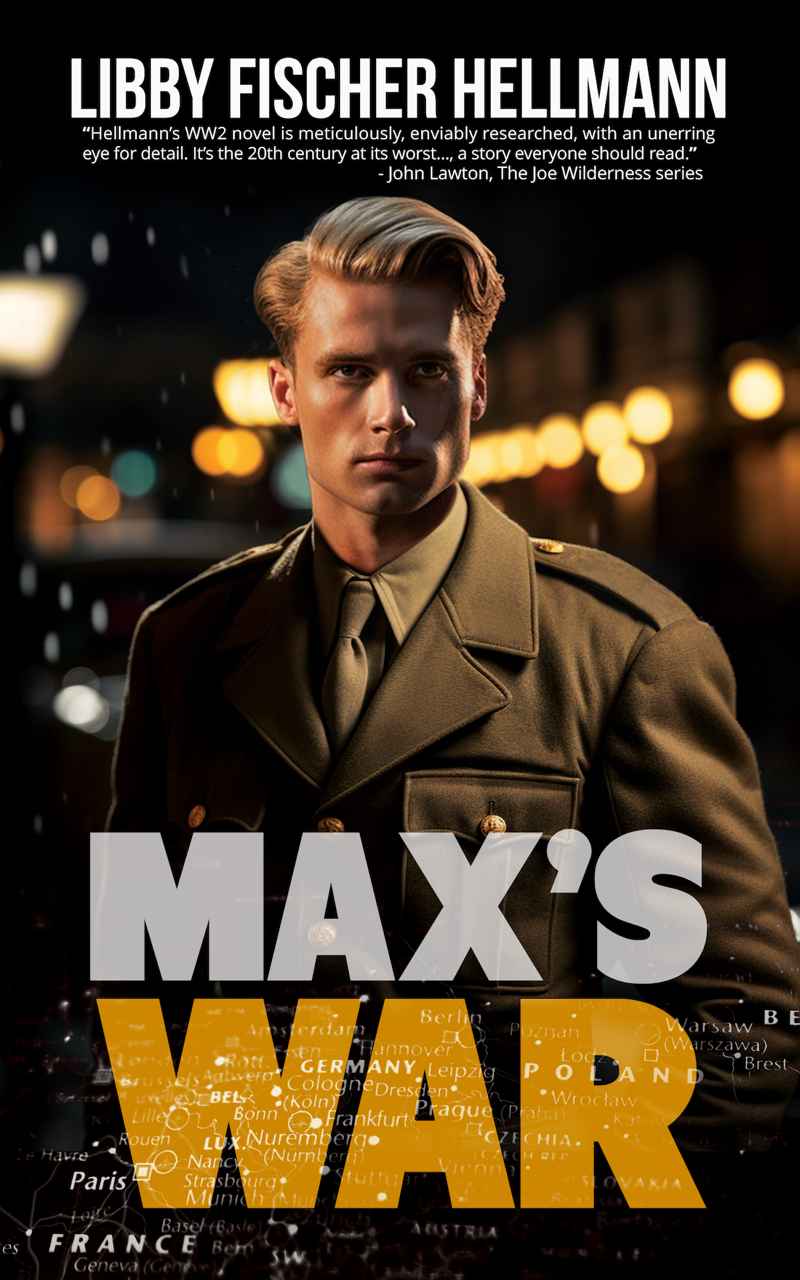
Additional description (If you want it): As the Nazis conquer Europe, Jewish teen Max and his parents flee persecution in Germany for Holland, where Max finds true friends and a life-altering romance. But when Hitler invades in 1940, Max must escape to Chicago, leaving his parents and friends behind. When he learns of his parents’ deportation and murder, Max immediately enlists in the US Army. After basic training he is sent to Camp Ritchie, Maryland, where he is trained in interrogation and counterintelligence.
Deployed to the OSS as well, Max carries out dangerous missions in occupied countries. He also interrogates scores of German POWs, especially after D-Day and the Battle of the Bulge, where, despite life-threatening conditions, he elicits critical information about German troop movements.
Post-war, he works for the Americans in the German denazification program, bringing him back to his Bavarian childhood home of Regensburg. Though the city avoided large-scale destruction, the Jewish community has been decimated. Max roams familiar yet strange streets, replaying memories of lives lost to unspeakable tragedy. While there, however, he reunites with someone from his past, who, like him, sought refuge abroad. Can they rebuild their lives… together?
Buy link:https://www.amazon.com/gp/product/B0CMBK15LM

Libby Fischer Hellmann left a career in broadcast news in Washington, DC and moved to Chicago a long time ago, where she, naturally, began to write gritty crime fiction. She soon began writing historical fiction as well. Eighteen novels and twenty-five short stories later, she claims they’ll take her out of the Windy City feet first. She has been nominated for many awards in the mystery and crime writing community and has even won a few.
She has been a finalist twice for the Anthony and the Shamus; and four times for Foreword Magazine’s Book of the Year. She has also been nominated for the Agatha, the Daphne, and she won the Chicago Writers Association Book of the Year in 2021. She has won the IPPY, Foreword Magazine’s Indie Awards, and the Readers Choice Award multiple times.
Her latest novel is Max’s War: The Story of a Ritchie Boy, the little known group of German Jewish immigrants to the US who escaped Hitler and joined the Army to fight Nazis.
https://www.amazon.com/stores/Libby-Fischer-Hellmann/author/B001HMMDZU


Thank you for being a guest with us, Libby. My husband’s grandfather, a Dutchman, was captured by the Germans twice and escaped by giving the guards who let him go food that he stored to share with his village. I keep thinking I need to write a story based on him, but haven’t got there yet. Your story sounds great!
LikeLike
I often marvel at the luck of writers to find the best stories within their own families. Your FIL’s war years must have demanded the most amazing courage and sheer brilliance to keep himself alive in the given circumstances. It sounds like a great book.
LikeLike
Wow! What a story. You didn’t mention much about your FIL’s personality in this article other than the PTSD, but I am hoping he was as good a father-in-law as he was a soldier. I did a similar approach when I wrote about my mother’s time in Ringling Bros. Circus in Murder under the Big Top during the time of WWII, blending research and facts with my own imagination. Thanks so much for sharing.
LikeLike