The Yard Sale, by Karen Shughart

Ten years ago, we moved from the suburbs of an urban area in Pennsylvania to our vacation home on the south shore of Lake Ontario in New York state. Figuring out what to take and what to leave, combining two homes into one – each with its own distinct personality – was challenging, to say the least.

We knew our life at the lake would be far more casual than the one in a city suburb; we didn’t need the silver serving dishes, warming plates, crystal pitchers and elegant tablecloths that we regularly used before we retired and were entertaining a lot.

As difficult as it was, we got rid of boxes and boxes of books we donated to the library; kept only those that had absolute meaning to us. We sold numerous LP records, something I will always regret now that record players are back in favor. The couple who purchased our house bought much of the furniture; the rest we either sold at a consignment shop or brought with us, just in case we decided to use it.
We kept other items we weren’t sure we’d need but couldn’t bear to part with, storing them in our lake house attic and in Rubbermaid closets in our garage. There was a 40-cup coffee urn, three crockpots, an assembly of pots and pans for cooking and jars for canning, flower vases, a Lazy Susan, bedspreads, throws and decorative pillows; area rugs. And lots of glassware.

Because we’ve never used most of the items we stored away in the ten years we’ve been here, and we are certain our grown children don’t want them, we decided to participate in our village’s community yard sale this year. While I’m glad we did it, it was a lot of work. We chose what we could part with and a storage shed that houses our porch and deck furniture in winter served as a holding center. We determined ahead of time what to charge for each item and affixed a sticker with the price on it. On the day of the sale, we lugged everything out to our front yard in a wheelbarrow and placed compatible items with each other on tables, ladders and drop cloths on our grass.

It turned out to be a good experience. We met nice people who liked what we had to offer, and it felt good to clean out the clutter. Now our attic contains suitcases, a wicker chair that we may use at some point, and our Christmas decorations. There’s not much left to sell for next year’s sale, except for some of those Rubbermaid closets that now stand empty in our garage.

Karen Shughart is the author of the Edmund DeCleryk cozy mystery series, published by Cozy Cat Press. She has also co-written two mysteries; two non-fiction books and is a monthly contributor for Life in the Finger Lakes magazine.  She is a member of CWA, N.A., and F.L.A.R.E. (Finger Lakes Authors and Readers Experience). Her books are published in multiple formats and available at local gift shops, bookstores and at Amazon: https://www.amazon.com/gp/product/B0BZF9TC3W?ref_=dbs_p_mng_rwt_ser_shvlr&storeType=ebooks

Guest Blogger ~ Laura Kelly Robb

The Audiobook Experience

Like nearly every writer I know, I proof my manuscripts by reading them out loud. With my finger poised over the delete button, I find unnecessary words that make a sentence sticky and verb tenses that don’t line up. The process turns up lines of dialogue that sound stilted, as well as gaps in meaning—those leaps in logic a reader would be unable to make without additional information.

My latest mystery, The Laguna Shores Research Club, published by TouchPoint Press in 2022, underwent the same process. The trade paperback version, further copyedited by editor Kimberly Coghlan, was praised for the readability of the prose. I was delighted when TouchPoint sold the audio rights to Tantor Media. The audiobook became available November 2023.

Listening to the audiobook taught me a few things about my editing process.  Something happens when one’s writing becomes performed sound. The story gets a new layer. All the characters gain an additional aspect through the voice the narrator chooses for each one. For instance, the character of the deceased friend, Billie, acquired a West Virginia accent, done very well by the narrator, Amanda Friday.  I had written Billie as having a slight drawl, but I meant only to alert the reader to the fact that she wasn’t a native of Washington, D.C. In Amanda’s narration, however, Billie’s soft, slow pronunciation serves to make her more vulnerable. When I first heard the full recording, Billie’s demise struck me as more tragic than in the written version.

During the process of proofing the manuscript out loud, I had not considered what a performer might add. Knowing what I know now, my instinct will be to give a potential audiobook creator more material to work with—more accents, more quirks of speech, or more variations of disposition that bubble up into the dialogue.

Another benefit that a recording can wring from the written word is to highlight the pacing. Feedback I received from some listeners pointed out that the plot began to gallop in the last quarter of the book and the ending left them breathless. Amanda anticipated the change in the rhythm of the story by speaking in the early chapters in a measured tone.  She saved her variations in intonation for the critical plot developments and final revelations. If I had realized the effect her techniques could have, I think I would have begun the suspense earlier in the book by spreading out the revelations and suspicions of the main character. I’ll be more likely in the future to take the listener as well as the reader into consideration as I structure a plot.

I found one downside to a vocal performance to be the treatment of the dialogue tags. Since we generally read faster than we listen, some repetition in a text is glossed over by the efficient reader. I often included dialogue tags for clarity on the assumption a few extra tags would not tire out most readers. In the audio, however, unnecessary repetitions can weigh down the performance. The narrator often indicates who is speaking through variations in tone and pitch, and the “he said” and “she said” tags become tiresome.  In future work, I will be more attuned to the tags and try to edit them more closely.

As audiobooks become more popular, writers may want to consider producing their own audio versions of their work. I am not familiar with the best ways to proceed, but I know more and more people are wading in. If you are interested, here’s my Mystery and Suspense magazine interview with Amanda Friday about the ins and outs of narration and her work with indie authors.

The Laguna Shores Research Club by Laura Kelly Robb

(ISBN 9781956851311; 328 pp, trade paperback)

Laila Harrow knows the best way to track down anything—or anybody—is to ask Billie Farmer. As the brains of the Laguna Shores Research Club, Billie teaches fellow members how to reach into the ether and pluck out facts.

Counting on Billie’s guidance, Laila promises the St. Augustine Museum a catalogue of Florida Highwaymen paintings that will catapult her standing in the art world. But when Billie dies suddenly, Laila is forced to pull herself out of the darkness and follow the facts. Her investigation turns up up one fact too many: Laila is at the center of a dangerous game.

You can find the audiobook of The Laguna Shores Research Club on Audiobooks.com, AudiobooksNow.com, GooglePlay, LibroFM.com, the free site that asks listeners to post reviews, AudioFreebies.com,and Audible, as well as other platforms such as Spotify. If you have time to take a listen, I would love to hear your thoughts. Reach me at Laura@LauraKellyRobb.com

After studying at the University of Toronto, Laura taught for five years in Spain. Returning to Seattle, she completed a three-week fiction class at Iowa Writers’ Workshop, and published short stories for Foliate Oak, The Nassau Review, and on the RTVE show, Nómadas. She is a member of the Mystery Writers of America. The Laguna Shores Research Club is her second novel.

Social Media Links

Website: https://www.laurakellyrobb.com/

X: @LauraKellyRobb

Instagram: @BookHardy

Adventures in Anthology-Land


by Janis Patterson


I like the anthology format – a short (ca 20K words) length which is appealing to today’s sound-bite sensibilities, several authors, which means several different stories, several different viewpoints, several different styles even if written around the same theme. This broadens the target audience and exposes every one of the contributors to readers they might not otherwise have reached.


On top of my standalone releases I do two Regency-set romance anthologies every year – one with a summer theme and one set at Christmas. Great experience, great publisher, good financial returns – everything needed to give me a totally overblown opinion of my own knowledge and powers.


At an informal gathering of some long-time (multiple decades) writer friends (all working professionals) we were talking about the market and what we could do to improve our sales. Suddenly struck with an attack of the stupids, I suggested “Why don’t we do an anthology ourselves? A mystery anthology?” (Yes, I have seen all the Mickey Rooney/Judy Garland movies where someone always cries, “Hey! We’ve got a barn… why don’t we put on a show?”)


After a lot of chatter and very little good sense, we decided to peg our anthology to underserved holidays. I mean, who needs another Christmas or Valentine’s Day anthology? Who has even seen a Labor Day or Memorial Day or St. Swithin’s Day anthology? It’s practically a virgin field.


We decided to start with July Fourth, each of us writing a story about our choice of the various wars that have defended our freedoms. I – for some unknown and unfathomable reason – chose World War I, about which I knew next to nothing. Now I know a lot, much more than is needed for a 20,000 word novella, but that’s the way things go.


Fortunately, as all of us are long-time professionals, all skilled in the mystery genre, coming up with the ideas and actually writing the stories were not difficult at all. What drew us all up short was the non-writing stuff.
Who is going to do the formatting? We all have different formatters, or do it ourselves. What about covers? Same thing. But those were small problems, easily handled.


It was the business side that drew us up short. Now we have all self-published with varying degrees of success, so the mechanical part didn’t faze us, but the financial part did. The vendors only take one name and social security number, so whomever we used would get stuck with the tax bill. There are ways around that, with a portion of the buy-in to be set aside to recompense that person, but it seemed dreadfully complicated. None of us are particular mathematical geniuses (genii?) so through the kind generosity of several other writers we got names of a couple of companies that did fee-splitting, which relieved our minds immensely. The only sad thing is, by the time we got this far it is much too late to get the July Fourth book release on track for a proper pre-release. The only choices we had were to rush it through and sell a less-than-ideal product or put it off a year so we could give it the professional send off – and offer our readers a professional product.


So what did we do? Of course none of us could face putting out a less-than-professional product, so it should be ready for pre-order next June. You expected something different? Of course, that left the question of what to do between now and then… go back to our individual projects after making a release schedule for the July Fourth anthology? Take a much-needed break from writing at all?


Hey, people, we’re writers. What on earth would make you think we would do anything so sensible?
The new anthology is titled Bloody New Year! and is centered on New Year’s Eve/Day. It will be ready for pre-order 15 November. Don’t forget to get your copy!

Learning and Sharing

I have always been someone who likes to learn. In school even if I didn’t have homework, I would bring home a book from a subject I liked and read the parts in the book that I was most interested in. It was usually either my history book or my geography book. I loved learning about other cultures and areas of the world.

As an adult, I still am interested in those things and have used my interest in the local Native American tribes to share their customs and beliefs and to show they are still a strong people who continue to learn and keep their heritage alive.

Trips I’ve taken have ended up adding more locales and cultures into my books. I like that I can share what I learn with my readers.

In the Shandra Higheagle mysteries, my main character, Shandra Higheagle, is a potter. She uses clay from the mountain where she lives and purifies it to make a quality clay to make her vases out of. I spent an afternoon, learning about the process from an actual potter. I loved the idea of having a character who is part Native American using clay she digs up, cleans, and transforms into beautiful pieces of art. The process is talked about in a couple of the books.

Because I have Indigenous characters in my three mystery series, I try to put in bits about their culture that shows who they are and how their people came to be strong, but since I’m not Native American, I do my best to show and not tell, since it isn’t my culture. I have readers wanting more of the culture, but I only put in what I fell comfortable revealing.

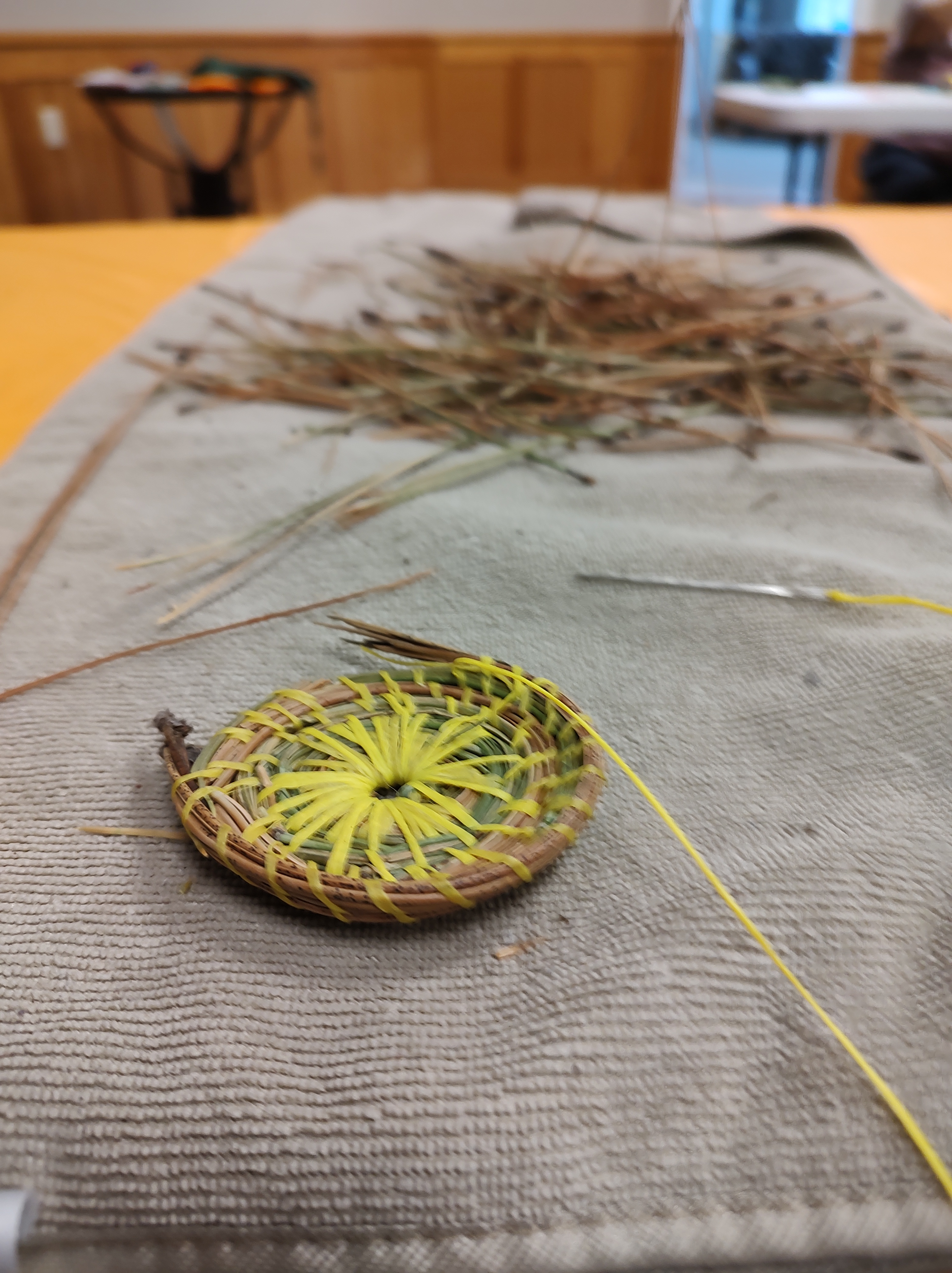
I signed up to learn to make pine needle baskets from a Paiute Elder. Beverly Beers is a fun instructor. She gave us what we needed to know to start and then went around instructing each of us. I started out misinterpreting her instructions and ended up with a larger hole than it was supposed to be. She chuckled and said, “You have made your own pattern.” Which was a kind way of saying I didn’t follow the instructions. 😉

As I sat in the room with the other participants and we all were engrossed in what we were doing a peace came over me that felt good. Stitching each stitch to bind the needles together and adding each new bundle of needles was calming.

I don’t know if it was the tactile closeness to the needles and nature, or the rhythmic stitching, but it felt right and welcome.

Now I’m not saying my hands didn’t start aching from holding the needles tight to put the stitches in, but it was a good ache, if that makes sense. I knew that I was making something interesting and I thought of places I could go to get my own pine needles to try a basket on my own.

I also thought of my character in the Spotted Pony Casino mysteries. She’s a disable veteran who is head of the casino security. She has tragedy in her past and upheaval in her present. She could use a hobby that would perhaps put all her troubles to the back of her mind for short periods of time. As I sat there binding the rows of needles together, I realized this would be a good hobby for Dela. Her friend Rosie, a Umatilla tribal member, could show her how to make pine needle baskets. Dela would enjoy the process, and it would then give her an excuse to go into the Blue Mountains to look for pine needles. While there she could come across an abandoned cabin she’d visited once before and found a journal from the man she believes is her father.

It’s amazing how when your hands are busy and your mind is free your imagination can run amuck and add a secondary plot line to a story. 😉

I will not only share the art of making a pine needle basket, I’ll also move my story along and bring Dela closer to learning the truth about her father. Maybe.

Rejected! (A Fact of Life)

by Margaret Lucke

The other day I received word that a short story I’ve written has been turned down by the publication I submitted it to. A disappointment for sure, but I like the story, and I’m confident I’ll find a home for it. 

In the earliest days of my writing career, I read a biography of the iconic author F. Scott Fitzgerald. It mentioned that Fitzgerald received 287 rejections before he ever sold a word. He papered his bedroom walls with them. This may not be the exact figure, but it’s close, and it’s the number that sticks in my mind. 

Let’s face it, rejection is a fact of life for writers. If we let it discourage us, pretty soon we’d be writing nothing but grocery lists.

Sometimes it’s hard to accept that no means no, straight and simple. When we receive a rejection letter, we try to read between the lines. Was my story rejected because it’s awful and I’m a terrible person who should never set my fingers on a pen or a keyboard again? Of course not, though with my first few rejections it was easy to read them this way. But there are lots of reasons why rejection can happen. Maybe the editor was rejecting everything on the day she read my story because a headache or a fight with her boyfriend had put her in a foul mood. Maybe my story was the twelfth one she’d read that week to feature a four-foot-high green-haired vampire as the detective and she was weary of concept by the time she got to mine.

Being on my way to assembling my own collection of rejection slips, I took heart from this. If a literary icon like Fitzgerald could be rejected that often, and persevere and succeed, then so could I.

I’ve discovered that there are hierarchies of rejection, and I’ve received them at every level. At the bottom of the list is silence. After you submit your work, you wait …and wait  … and wait … for a reply, but you never receive one. Apparently the editor or agent you sent it to is too busy to say a simple no and assumes that if several months go by and you haven’t heard from them, you’ll figure out that they’re not interested. This is rude, in my opinion, but it has become all-too-common practice in today’s publishing world. 

Next comes the basic form letter that says, “We regret that your submission does not meet our present needs.” Maybe that’s true, or maybe the publisher words it that way because it sounds slightly better than “Are you kidding? You were really thinking we’d ever publish something this terrible?” 

Somewhat better is the form letter with the electronic equivalent of a handwritten scribble — the words “thank you” or, even better, a personal note.

At the fourth level is an invitation to submit something else “Try us again.”

If I’m really lucky I’ll achieve the fifth level, getting a comment that refers to details in the story so I know someone actually read it.

At the top of the pyramid is the personal letter so glowing and complimentary I have to read it twice to realize they’ve rejected me. Though I’ve never received one as flattering as this legendary rejection, purportedly sent to a would-be contributor by the China Economic Review:

“We have read your manuscript with boundless delight. If we were to publish your paper it would be impossible for us to publish any work of a lower standard. And, as it is unthinkable that, in the next thousand years, we shall see its equal, we are, to our regret, compelled to return your divine composition, and to beg you to overlook our short sight and timidity.”

At the other extreme, I’ve also never received rejections as chilling as these  letters, cited by novelist Lawrence Block in one of his Writer’s Digest fiction-writing columns years ago. (Note: They weren’t addressed to him; they were examples provided by publishing industry sources.) The first was brief and to the point:

“I regret that I must return the enclosed shipment of paper as unsatisfactory. Someone has spoiled it by typing gibberish on every single sheet.”

The second provided detailed instructions to the writer, who had sent a literary agent a novel that was apparently a vicious racist screed:

“I suggest you take the following steps with regard to your manuscript.  1) Go out in the back yard and dig a hole several feet deep.  2) Place your manuscript at the bottom of the hole.  3) Fill in the hole and firm the soil in place.  4) Do not plant anything intended for human consumption in that portion of your garden for at least seven years.”

These make the standard form letter look good, don’t you think?

It’s time to send that turned-down tale of mine to the next market on my list.