

The Long and Short of It
If writing a novel is a long-lasting love affair—and it better be passionate because there’ll be a lot of time spent in close quarters—what are short stories? A brief encounter burning bright, a summer romance, a little walk on the wild side … It sure feels like that for me at times. Short fiction is a gulp of fresh air after completing a book draft, a welcome reprieve from obsession, and a new way to look at writing when the work-in-progress leaves me so cross-eyed I don’t see anything anymore.
Short stories are like stretching exercises. Tension is released, relaxation ensues.
A character pops into my head, a place triggers an image, a memory surfaces, a sentence rings true, and an idea is born. Could it turn into a book? Maybe, and some have grown wings and gone the distance, but not all stories deserve a 300-page treatment. Often their strength is in the instant. Their intensity cannot be sustained without dilution in a full-length narrative.
“Rabbits”, one of my favorite stories in the Family and Other Ailments collection, is a good example. It is told from the perspective of a twelve-year-old boy who blanked out a dramatic event. We meet him when he starts remembering. There’s fear and confusion, and a growing sense of panic that is more acute and more immediate for being at the core of the story instead of distributed over book chapters.
I love the spontaneity of short stories, and the best ones are written in a feverish rush with very little rework. They scream to get on the page. I often go back for inspiration to Ray Bradbury, who knew quite a bit about short fiction. One of his quotes is printed in my brain: In quickness is truth. The faster you blurt, the more swiftly you write, the more honest you are.
I can ponder a scene in a book for days, finetune and rewrite it endlessly. That kind of needlepoint doesn’t work for my short stories. The struggle doesn’t improve them, it tends to suck all the life out of them. My files are full of false starts and abandoned fragments. No regrets, they just didn’t make the cut.
Then there’s the guilty pleasure of genre-hopping. I write mostly crime, both in short and long form. The rules of the genre are infinitely flexible and accommodate pretty much everything. Yet, sometimes I feel myself slipping into horror or science fiction. I have a soft spot for cool vampires and conflicted androids. They would not fit in my contemporary detective series. Or I may decide to take a stroll in the 1950s because I’m a sucker for fedoras and hardboiled dialogue. Short fiction is like a pastry shop. All these colorful macarons. And there’s no sin in wanting to sample them all.
There are twenty-six tasty treats in my short story collection, Family and Other Ailments. Have a bite and tell me which one makes you want to come back for seconds. The main character of the book’s title story has already earned a return engagement. In a book.
Family and Other Ailments – Crime Stories Close to Home
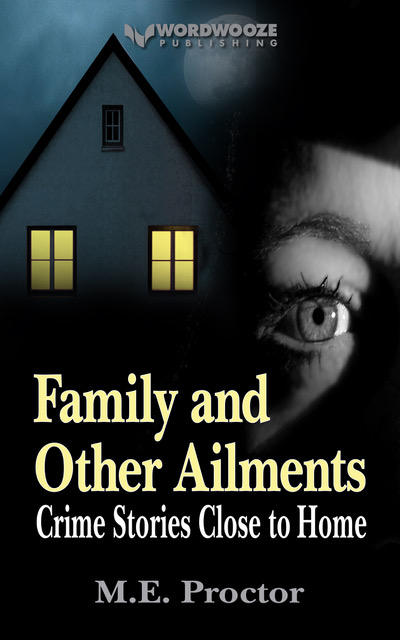
Blood ties. The family we’ve been given, the friends we make, the loves we keep, and those we lost. The twenty-six stories in Family and Other Ailments (Wordwooze Publishing) teeter on the brink, hover at the periphery or even the possibility of crime.
The collection opens with “Spy Head,” a tale of friendship after a crushing trauma. In “Texas Two-Step,” brotherhood leads to a wicked double-cross. “Razorbills” shows a young woman seeking freedom from the prison-like caring of her sibling. “Black and Tan” slips into domestic horror, as does “Mutti,” with a hint of the fantastic. “Hour of the Bat” and “Bag Limit” are deep woods Texas noir, while “A Head for Numbers” and “No Recoil” go west, to the stark unforgiving beauty of the desert.
Buy Links:
Family and Other Ailments is available in eBook, paperback, and audiobook.
All links are accessible here: https://books2read.com/u/3Lx0v5
From reviews:
“Channelling distinct voices, subtle humor, and endings that plant a fist in your gut, Proctor’s Family and Other Ailments is a terrific collection of crime, suspense, and fear. The tales are carefully calculated, with each scene, each piece of dialogue building to that oh so important final strike: a crescendo point that leaves the reader jarred.”

M.E. Proctor was born in Brussels and lives in Texas. Her short story collection Family and Other Ailments is available in all the usual places. She’s currently working on a contemporary detective series. The first book comes out in August 2024 from Shotgun Honey. Her short fiction has appeared in Vautrin, Bristol Noir, Pulp Modern, Mystery Tribune, Reckon Review, Black Cat Weekly, and Thriller Magazine among others. She’s a Derringer nominee.
Author Website: www.shawmystery.com
On Substack: https://meproctor.substack.com
Facebook: https://www.facebook.com/martine.proctor
Twitter: https://twitter.com/MEProctor3

 Ladies of Mystery
I’m writing a short story for an anthology right now and discovering the premise may be too short even for a short story. But I’m stretching it and seeing if it will work. I love this. “Short stories are like stretching exercises. Tension is released, relaxation ensues.”
LikeLike
My stories have a sweet spot, something between 2500 and 3000 words. Occasionally I’ll go longer when the plot demands it. Flash, under 1000, is harder, but it’s a great challenge. I think my writing benefits from the effort, lol.
LikeLike