Let There Be Light by Karen Shughart

My husband and I live in a charming maritime village on the south shore of Lake Ontario in New York, the prototype for Lighthouse Cove, the village where my Edmund DeCleryk cozies are set. This time of year in our village activities surrounding the holidays abound, and there truly is something to do for people of all ages: festivals; tree lightings; parades; caroling; shopping and dining opportunities, and a judged competition for the best outside holiday decorations.

 I especially like writing about the seasons in my books. In my third, Murder at Freedom Hill, the crime occurs just before Thanksgiving with the investigation continuing through the entire holiday season. I enjoy describing how the folks living in Lighthouse Cove celebrate, with light-filled activities that juxtapose the dark, horrific murder that has occurred.

Ed, a retired Navy SEAL and former police chief, now works as a criminal consultant who is hired by the current police chief to solve the crime. His wife, Annie, head of the local historical society and museum, curates exhibits, organizes special events, and because of the historical backstories that frame each crime, often becomes involved in the investigation.

One of these special events occurs early in December, when the days are short and darkness prevails. A Festival of Lights, held on the grounds of the museum, provides diverse groups with an opportunity to showcase the ways in which light plays an important role in their cultures during this time of year:
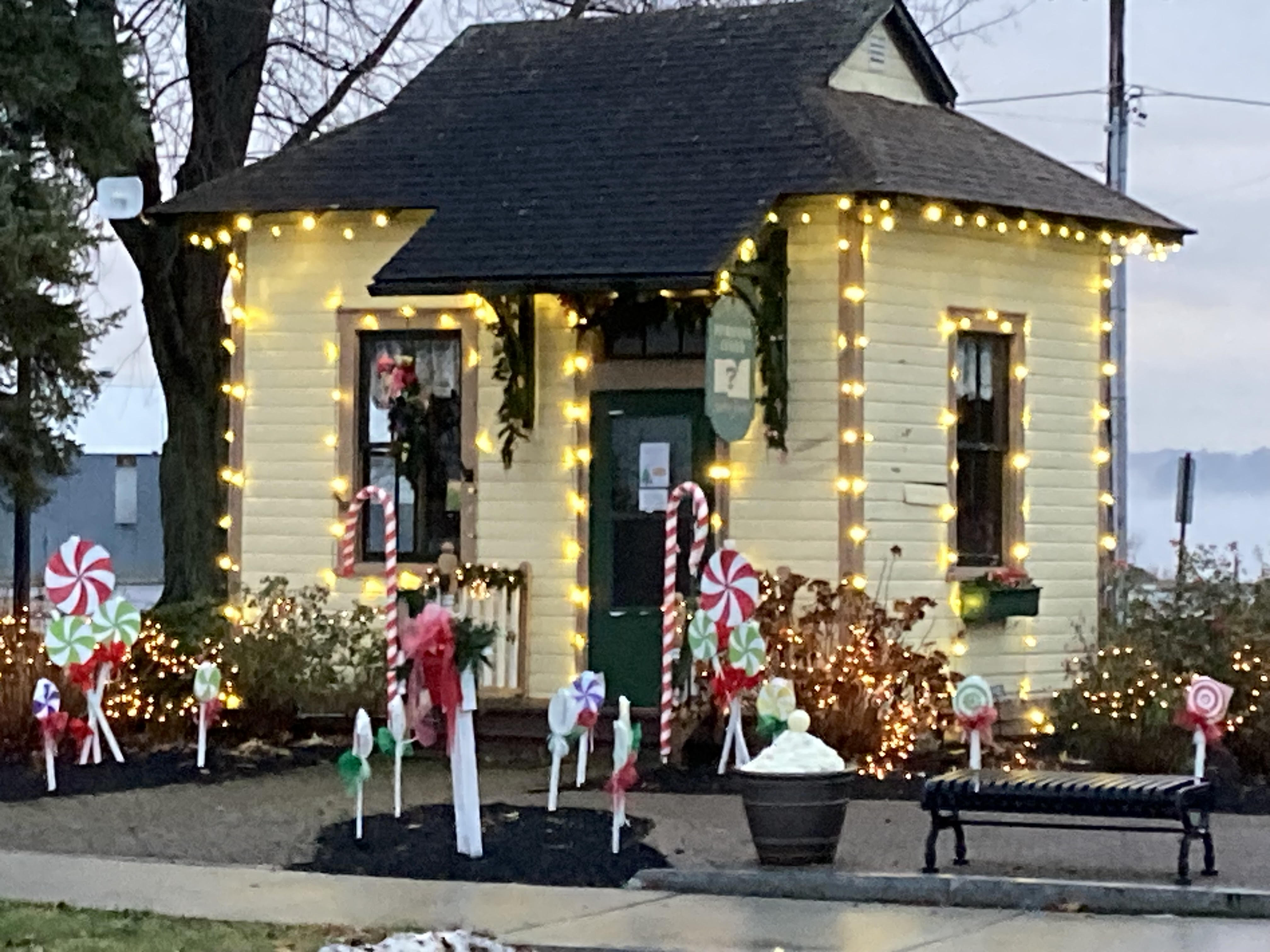
Photo courtesy of Lyle Shughart

“The Holiday Festival of Lights was held in the park next to the museum the following Saturday evening and started at dusk. Tall stadium field lights provided illumination, and the museum staff and volunteers had strung multi-colored holiday lights on bushes and around tree trunks. Several portable fire pits had been placed at strategic spots near park benches to provide warmth.

The Neighborhood Association maintained a booth that offered free hot chocolate and cookies. Other booths, with representatives from local Christian, Jewish, Muslim, and Hindu congregations, offered information about their holiday customs including the significance of light, and samples of traditional holiday food.

Santa ambled through the crowd passing out wrapped red and white candy. A group from near Tug Hill brought live reindeer, tame enough to pet. Children hopped on the back of a fire truck, a huge wreath on its hood, for a ride around the block, speakers blaring seasonal winter songs.

A large evergreen tree located in the middle of the park was festooned with multi-colored lights; a Chanukah menorah, Kwanzaa kinara, and clay diyas—oil lamps representing the Hindu holiday of Diwali—flanked the tree on large tables on either side.

Towards the end of the evening, the high school student chorus handed out sheets for a sing-along and led the community in a diverse selection of melodies representing all the groups at the festival.”

A definition of the symbolism of light from the National Gallery of the UK states: “Across cultures, light is an ancient symbol of understanding and intellectual thought: it is the opposite of ignorance, or darkness. Almost universally, the dark is …frightening and sinister, associated with things we cannot understand. Light is said to conquer darkness and to bring order out of chaos.”

We all need a little light in our lives this time of year, so, let there be light!

Guest Blogger ~ donalee Moulton

In the right place

Céad míle fáilte. This Gaelic expression means “a hundred thousand welcomes.” If you live in Nova Scotia, as I do, this is an expression you will have seen for much of your life. (Pronouncing it is a different issue altogether.) A hundred thousand welcomes in any language speaks to the type of people you are likely to encounter when you come here and the values they place on such encounters.

Riel Brava – attractive, razor-sharp, ambitious, and something much more –

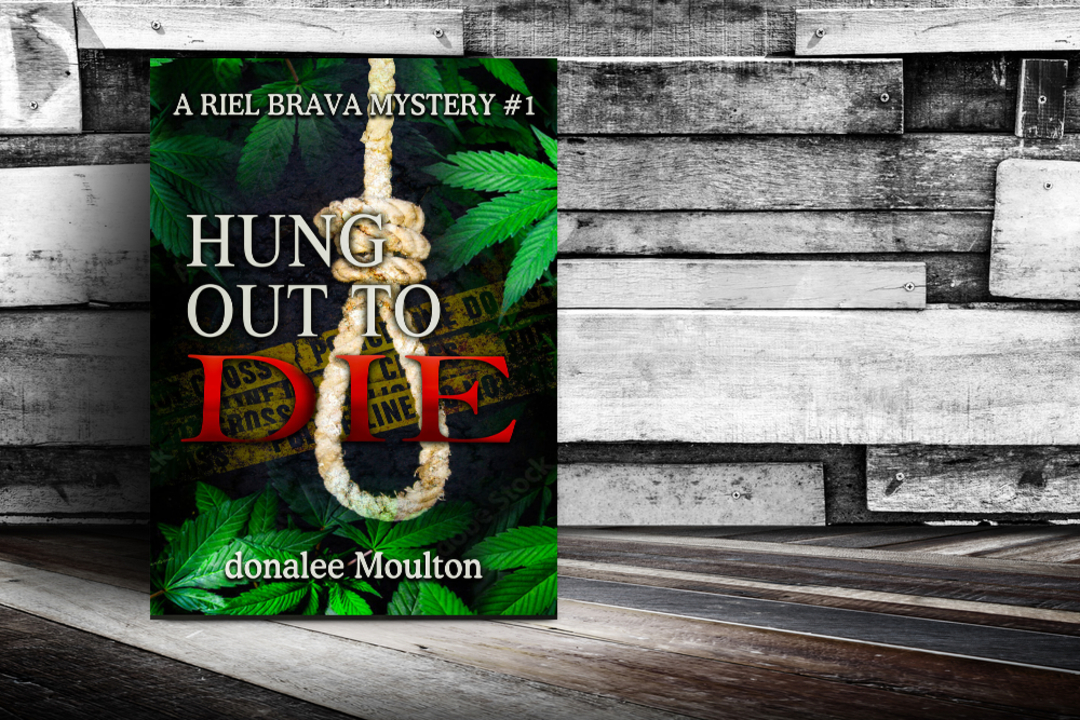
is the lead character in my new mystery, Hung Out to Die. He lives in Elmsdale, Nova Scotia, about a 40-minute drive from Halifax, the province’s capital. In East Coast parlance, Riel is a come from away.

Raised in Santa Barbara, California, Riel has been transplanted to Nova Scotia where he is CEO of the Canadian Cannabis Corporation – one of the estimated four to twelve percent of CEO’s who are psychopath. It’s business as usual until Riel finds his world hanging by a thread.

Riel resists the hunt to catch a killer. Detective Lin Raynes draws the reluctant CEO into the investigation, and the seeds of an unexpected and unusual friendship are sown. Ultimately, Riel finds himself on the butt end of a rifle in the ribs and a long drive to the middle of Nowhere, Nova Scotia.

Fact is, I could have placed Riel in the middle of anywhere. The murder is not location specific. The victim does not fall from the Brooklyn Bridge or mysteriously appear atop Old Faithful, places that are singular. Nova Scotia made sense for me as a writer, and it made sense for Riel as a character. I live here; I know this province better than any other place. I can write about it with ease, and with a personal perspective.

For Riel, who lives uncomfortably in a world where people hug each other because they care and share the pain of others because their brain is wired that way, being in a place where he does not have roots, where he is an outsider, mirrors what goes on within Riel. It’s the right place for him.

Because I am from Nova Scotia, I can also authentically and naturally insert elements of life here. Take the language, for instance. You may discover some new words such as bejesus and tinchlet. There will be expressions common to the area. “Bless your heart” is one you’ll hear a lot in Nova Scotia, and Riel hears it as well.

There is also food that has Nova Scotia marinated into it, as Riel discovers. Turns out Riel is now a donair aficionado. (I am not.)

One of the things I have learned as a writer is that I am in control, and I am not in control. I can decide to situate a character in a particular place, and the character will let me know if that is the right place as the writing unfolds. In the case of Riel, he ends up in the dark of winter at a deserted row of cottages called, what else, Céad míle fáilte.

I did not see that coming. I have a feeling Riel did.

Hung Out to Die

Riel Brava, CEO of the Canadian Cannabis Corporation, just wants to be left alone to do his job and one day run for president of the United States. He has a plan. Murder gets in his way. It isn’t easy being a psychopath.

paperback

ebook

donalee Moulton is an award-winning freelance journalist. She has written articles for print and online publications across North America including The Globe and Mail, Chatelaine, Lawyer’s Daily, National Post, and Canadian Business.

Her first mystery book Hung out to Die was published this spring. Her second mystery, Conflagration, will be published in February. donalee’s short story “Swan Song” was one of 21 selected for publication in Cold Canadian Crime, and was shortlisted for an Award of Excellence. A second short story, also featuring the Iqaluit-based chief of police Doug Brumal, was published this spring in Black Cat Weekly. Her literary short story “Moist” was published recently in After Dinner Conversation and The Antigonish Review.  As well, donalee is the author of The Thong Principle: Saying What You Mean and Meaning What You Say and co-author of, Celebrity Court Cases: Trials of the Rich and Famous.

CONTACTS:

Website: donaleemoulton.com 

Amazon Author URL: amazon.com/author/donaleemoulton

Facebook: https://www.facebook.com/donaleemoultonauthor

Goodreads:  https://www.goodreads.com/donaleemoulton

LinkedIn:  https://www.linkedin.com/in/donaleemoulton/

Twitter: @donaleeMoulton

Instagram: donaleemoulton

A Few Of My Favorite Things

I’m one of those people who loves Christmas music. All of it! From the good old songs by Nat King Cole, Bing Crosby, and Brenda Lee to the new ones by Mariah Carey, Kelly Clarkston, and Cher’s new one. If there are bells jingling, joyful lyrics, or reverent lyrics, I like it all.

Listening to Christmas music while I cook, clean house, and put things away from my recent book selling events, makes the task lighter and more fun. My hubby rolls his eyes as I dance around the kitchen putting dishes away, totally absorbed in the song that is playing. (If I’m absorbed how do I know he rolls his eyes?) Because he makes a noise or says something that draws my attention to him. He isn’t a Grinch, but he isn’t into the holiday as much as I am.

Where I’m going with this is I have learned I may be more auditory than I thought. I started listening to one audiobook so I could see what I would need to produce if I ventured into making my books into audiobooks. I enjoyed listening to a book because my hands were free. Now when I sew, cook, clean house, or drive long distances, I prefer to listen to audiobooks. Except this time of year because I’m listening to Christmas music. Audiobooks have kind of become my addiction because I can listen to them while doing other tasks. My mind can wander into the story while my hands and eyes are doing something else.

Lately, I’ve felt like I don’t have enough hours in a day to read for pleasure. But I can listen and continue doing certain tasks. Even my walks, I can listen to a book and get my exercise and fresh air. Our last trip to see our daughter, while my hubby drove, I listened to a book with my earbuds because his pickup doesn’t have the capability to put it through the radio, but our trip before that with my car, he even listened to the book.

I’m finding at the book selling events I attend that more people are saying they listen to audiobooks. Which is good for me since my three mystery series are all on audio. As a means to get more of the books purchased, I joined a Facebook website group for authors with audiobooks wide, meaning not just published through Audible. This group has proven to be more helpful in teaching me how to promote my audiobooks than any other workshop or event I’ve attended.

Right now, the authors at Indie Audiobook Deals are having a MASSIVE year-end giveaway. If you like audiobooks as much as I do, you might want to enter the giveaway. You can sign up to follow the authors with audiobooks in the genre you like to listen to as more ways to get your name in the drawing.

Five entrants will win a $50 Kobo gift card! Kobo is the premier site to listen to fantastic audiobooks.🎧

We’re picking FIVE winners so make sure to complete all of the extra entries to enhance your chances of winning. Good luck and wishing you a happy holiday season!

Enter here: https://kingsumo.com/g/pt4ez1/win-1-of-5-kobo-50-gift-cards

And if you are a mystery fan who likes books with diverse characters, right now I’m listening to book 2 Peril at the Exposition by Nev March and enjoying it. I discovered Ms. March earlier in the year with her first book that I purchased through Chirp, an audiobook distributor that has sales constantly. After listening to that book, Ms. March had asked a question on a crime scene email group I’m on. I emailed her to let her know how much I enjoyed her book and she agreed to be a guest blogger here in February.

Anyway, I got away from reading about diverse characters. Her first book is set in India in the 1800s. The one I’m listening to now is set in Chicago. The two main East Indian characters left India so they could be married. For some reason I enjoy reading books set there. I also like Sujata Massey’s Mysteries set in 1920 India. When I finish reading the book Blood Sisters by Vanessa Lillie, I will dive into The Mistress of Bhatia House by Ms. Massey.

I believe my interest in other cultures is why I write mysteries with Native American characters. I like to learn about their culture and reveal it to others. Though I reveal it slower than an Indigenous writer would because I didn’t grow up in the culture and have to learn about it and understand it before I’ll put it on a page.

Also this month, I have my audiobook, Murder of Ravens, book 1 in the Gabriel Hawke series for $0.99 at Chirp. Double Duplicity book one of the Shandra Higheagle Mysteries, Double Duplicity is $0.99 at Spotify. Or you can get the first three audiobooks of the Shandra Higheagle Mysteries at Barnes and Noble Nook for $2.99.

If you haven’t already finished your holiday shopping, a book or audiobook is a great gift. The recipient will step into another world and be the better for it.

Happy Holidays!

Paty

The Holiday Season in Three Acts

Having you ever noticed that going through the holiday season is a lot like writing a novel?

Most writers of fiction are familiar with the three-act structure. While there are other models that can be used to construct a book, the three-act structure offers a handy method for building a plot. It works especially well for mysteries. It works like this:

Act 1–The Setup. In this act you introduce your Main Character, and then promptly make something happen that knocks your MC out of their comfort zone. Maybe they receive a mysterious letter, or a dead body shows up on their doorstep, or their kid is accused of a crime. This is called the inciting incident, and it creates a problem to solve, a challenge to meet, or an opportunity to take advantage of. The MC now has a goal.

Act 2–The Development. So the MC sets out to reach the goal, but it’s not easy. A lot of roadblocks, conflicts, and barriers are encountered along the way. The villain is elusive, red herrings steer the MC in the wrong direction, and a lot of questions evade answers. The plot twists and turns, tension tightens, and the suspense becomes unbearable. Will the MC succeed or fail? For a time, all seems to be lost.

Act 3–The Resolution. The big moment arrives. Everything has been building to this point. Now the MC’s ultimate success or failure will be determined. The villain will (hopefully) be vanquished, and all the questions will be answered. Reaching The End, the reader closes the book with a sigh of satisfaction and begins looking forward to the author’s next wonderful novel.

Right now you’re probably saying, “Sounds like a great story. I’d read that. But what does it have to with the holidays?”

Well, it occurred to me recently that the holiday season also unfolds in three acts.

Act 1–The Anticipation. We become aware that the holiday season is approaching. Or maybe it sneaks up on us; most years, that’s what happens to me.

This act can be fun, filled with hope and eagerness. This year, the holidays will go great. We make plans. We make lists. We ask questions: Will we celebrate at home or travel to visit loved ones? Who’s going to host the big dinner? What gift will please the picky nephew? What photo will we choose for the Christmas card? What do I want Santa to bring me? When will we find the time to accomplish everything on our to-do list?

Act 2–The Frenzy. Did I mention time? In this act, time becomes the villain. Too much to do, too little time. Now we’re in a frantic race to get it all done—shopping, decorating, wrapping, addressing, baking, searching for the missing gift tags, dashing from errands to parties to more errands. And all the while we have to keep up everything that makes up our daily lives during the other eleven months of the year. Our goal is to get it all accomplished in time to let us enjoy the rapidly approaching holiday. Will our juggling act succeed or fail?

Act 3–The Celebration. The big day arrives, or maybe it’s a stretch of big days. The frenzy of Act 2 is behind us. We can kick back, pour a cup or glass of our favorite festive beverage, and enjoy the twinkling lights and the smiling faces around us. It’s a joyous occasion, and just as we do when we finish a good book, we give a sigh of satisfaction.

Three acts to a book, three acts to a holiday season.

Whatever holiday you celebrate at this time of the year, may it be filled with joy, peace, and happiness for you and yours.

The Humorous Side of Writing a Mystery by Heather Haven

I don’t always write funny. In fact, some of my books aren’t funny at all. Oh, there might be something humorous said by a character now and then. But for the most part, it’s a straight mystery. However, my most popular series, The Alvarez Family Murder Mysteries, is definitely on the humorous side. My readers tell me they like the uniqueness of the family, a nice way of saying kookiness.

What they seem to also like is that Lee Alvarez, the protagonist, gets in over her head and is often involved in some funny situations. Of course, it doesn’t always have to be her. Sometimes it’s the characters surrounding her who have their lighter moments. However, the mystery itself, the whodunit part of the read, has to be there, regardless. In my humble opinion, the story cannot and should not be sacrificed for a laugh.

When I wrote comedy acts for performers that’s exactly what I did, though, write for laughs, laughs, laughs. But a mystery is a different animal and any humor added should be character-driven or situational. But I often walk a tightrope. How much humor is enough? How much is too much?

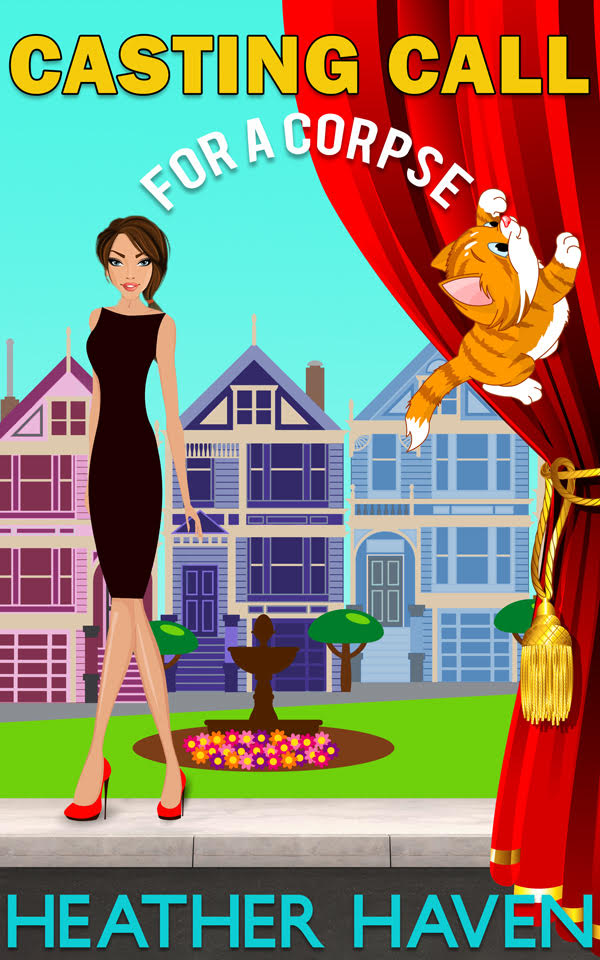
When I write a humorous scene, I try to give new insight into a character or add something to the story. When that happens I am off and away. One of my favorite examples comes from Casting Call for a Corpse, Book 7 of the series. It’s a scene involving a theatrical mishap, a not-too-well-trained horse, and Lee’s new husband, Gurn. Ordinarily, Gurn is a man in control, but at this juncture, he is undercover as a bit player in a new musical and is out of his comfort zone, which is often the key to humor.

Gurn entered from downstage right dressed in a French foot soldier’s uniform. A seemingly unconscious man, also wearing a French uniform, was slung over Gurn’s left shoulder. According to rehearsal, Gurn was supposed to cross to Gaby at center stage, say his lines, and then exit stage left. However, he halted awkwardly midway between stage right and center. When he tried to walk toward Gaby again, he simply couldn’t. Finally, he stood in one spot, looking more or less stupefied.

It didn’t take the audience long to figure out why he couldn’t move any farther. The wrist of the unconscious soldier had become entangled in one of the many pieces of gelatinous barbed wire jutting out from the fence. Whenever Gurn tried to move forward, the other man’s arm would be pulled as far as possible. It was clear the arm was insnared in the fake barbed wire. Any movement was impossible. I don’t think it was Newton’s law of physics, but something close. It became clear that unless Gurn dropped the man to the stage floor, he had to stay where he was.

Gaby, the star of the show and an old trooper, realized something was wrong. Changing her blocking, she walked over to Gurn who looked as if he would pass out at any moment. She fed him his line couched in a question.

“Tell me, soldier, were you going to ask me to please save your friend?”

Gurn opened his mouth, but no sound came forth. He may have seen many tours in Afghanistan as a soldier, but being onstage in front of eight hundred people was a new form of terror for him.

Gaby braved on. “I know if you could but speak,” she ad-libbed, “You would ask me to save your friend. So why don’t you bring him to the field hospital?

She gestured to offstage. Gurn’s jaw worked back and forth several times. He looked out into the audience with rapidly blinking eyes. Still, he could utter nothing.

“It’s right over there. Go,” Gaby finally ordered, pointing to a spot offstage.

Gurn tried to walk in the direction indicated but, once again, had to stop when the other man’s arm was pulled to full extension. Also, the wire seemed to become more tightly wrapped around the “unconscious” actor’s wrist with each tug. The actor began to struggle, trying to get off Gurn’s shoulder. Panicked, Gurn reached behind himself and the man. He gave the offending, taut wire a mighty yank as only a former Navy SEAL can do, who is in really good shape. Which was really bad.

What happened next reminded me of the nursery rhyme, This Was the House That Jack Built:

This was the man

who yanked the wire

That jerked the fence

That pulled the scrim

That toppled the backdrop

That crashed to the floor

That spooked the horse

That hauled the wagon

That galloped onstage

Then raced to the exit

But not before pooping

Downwind of upstage

A bemused audience watched the entire set crash down upon itself behind onstage actors who stood frozen in place. Once the dust settled, Gurn realized he was free of the wire holding him and his companion captive onstage. Lines forgotten, Gurn made a sprint for the wings but not before running into one of Bob the Horse’s deposits. I am not well versed on the subject of horse manure, but from what I witnessed, it can be on the slippery side. Consequently, Gurn glided like an ice skater for a pace or two. Then both feet went out from under him.

Up in the air both men went. But what goes up must come down. So down they came landing squarely in another one of Bob’s farewell gifts. Dumbfounded, the two men sat, unmoving. There was the universal moment of sympathetic silence all human beings feel for any poor sap sitting in the middle of a horse patty. The feeling soon passed.

One or two audience members began to titter. Several broke out into loud guffaws. More laughter followed. Soon no one was holding back, including Gaby. She collapsed to the stage floor, wrapped her arms around herself, and rocked back and forth shaking with laughter.

The curtain rang down. The house lights came up.

There’s more, of course. We have characters reacting to what happened and so forth. I try to have one or two of these scenes in each story. But they can’t be there unless they do one of three things: show another facet of a character, move the story forward, or add relief and/or color.

Comedy writing can be very rewarding and a lot of fun. Seriously.