Counting Our Blessings by Karen Shughart

Sometimes life sends us lemons, lots of them, maybe more than a bumper crop. We can make lemonade, lemon meringue pie, lemon sorbet… but still, sometimes there are too many bitter lemons to use them all up.

Without going into a ton of detail, this past year has been a tough one for me and my family. We’ve had several non-Covid-related deaths; some serious, life-threatening illnesses; surgeries; and other family challenges that at times seem unending. It’s been exhausting, emotionally draining and downright frightening. Then there’s been the pandemic, the terrifying weather events, and the general unrest on so many levels in our society and the world. I expect we are not alone.

How does one survive? Lately, when the stressful occurrences seem to be relentless, it’s been hard to think that any of it will get better. At times over the past many months, I’ll admit I’ve been depressed and angry and more than a little sad.

But then I take a couple big breaths, close my eyes, and remember to count my blessings. It’s a platitude, I know, but I tell myself we’ll get through it; we have the strength.

Photo by Jill Wellington on Pexels.com

I am married to a loving, caring man. We have wonderful children. We enjoy an incredible support system of family members and family of the heart, dear friends who’ve also been there to cheer us up as we’ve needed it. We live in a stunningly beautiful maritime village where we have a roof over our heads, our home is warm in winter and cool in summer. It’s a safe place to live, too, where we’re not scared to walk freely for fear of violence.  It could be so much worse.

 We have plenty of food, transportation to get us where we want to go and medical care. We may not be rich, but we have an abundance of what we need.  So many people don’t. Sometimes it’s easy to lose sight of that.

We adopted a Beagle during the earlier days of the pandemic. She had multiple health issues. With excellent medical care and lots of love, she’s fine now; a happy and healthy little dog who makes us laugh and gives us an immeasurable amount of joy. That’s too, is a blessing.

So, during the month when we are supposed to give thanks, I will. Sometimes it’s easy to lose perspective and dwell on all that’s going wrong, all that’s contriving to decenter us. I’m making a concerted effort to remember what I have and how much worse my life could be. We actually do have enough lemons to make tasty drinks and desserts and even enough to share with others during the darkest days.

Call Out the T-Rex!

by Janis Patterson

Whether a plotter or a pantser or anything in between, I’m sure every writer has reached a point in their current work where they despair. The characters aren’t behaving. An enormous and seemingly insoluble plothole has developed. The timeline makes no sense and crumbles under the slightest scrutiny. The whole project has turned into a dogs’ dinner of a mess and simply doesn’t make any kind of sense.

This kind of despair usually hits in the last few chapters, where the writer is desperately trying to wrap up all the plot threads and create a satisfying ending. Usually at this point the only thing that keeps you from tearing everything up is the sad knowledge that nothing new could be any better. This is why some writers drink. Others, like me, tend to wear out their hot tubs and wonder why they didn’t become a plumber.

Fortunately, though, professionals have learned how best to deal with the situation. I’m not going to say how, because the answer is different for every writer and sometimes for every book. What counts is the result, not the process.

When a writer is brainstorming trying to get past these obstructions, we sometimes have strange fancies. Not too long ago I was trying to finish up a novella that had given me trouble from the beginning. My stories are very character driven, meaning that after the initial set-up what transpires is the result of the characters and how they react/behave. (The opposite is called plot oriented, where the plot is fixed and, however illogically, the characters are required to behave in a way that forwards the pre-determined plot. Both versions have their reasons and their adherents.)

Well, I did have a skeletal story framework (it was an historical romance), but my characters rebelled. Instead of being a benevolent ringmaster guiding the characters through their logical paces, I had to become something between a dictator and a prison warden, forcing my recalcitrant and obstreperous characters to do what they were supposed to do to preserve the integrity of the story. It wasn’t a fault of the plot/story, because that worked out perfectly – in theory. The characters were just acting out and refusing to behave. Yes, for most writers the story develops to a point where the characters take over – and that’s a good thing, most of the time, because it means you have created real people, even if they do exist only in your head. (There is a reason writing has been called controlled schizophrenia for fun and profit…)

Anyway, I had been fighting this kind of rebellion for several days and the deadline was approaching with alarming speed. Had there been more time I just might have started over and locked this story away for a year or two, but that luxury wasn’t available. Finally I just sat back and decided that the best way to solve this was an unexpected ending – I would just have a T-Rex arise from the ornamental lake and gleefully eat all the characters. A nice, clean (except for the resultant and inevitable mess on the lawn) ending that resolved all problems.

Don’t worry – it remained a fantasy, but a most satisfying fantasy. I of course kept at it and finally figured out a way to resolve the problems, bring my recalcitrant characters back into line and end the story as planned. And I guess rather successfully, as the resulting book is one of my better sellers.

This ‘solution’ has been very beneficial, so much so that it has almost become standard in our house. As I near the end of a book The Husband has become canny enough to read my moods – and at certain times generally stay out of my way for his own safety! In these times he asks, “Is it time to call for the T-Rex?” If I say yes, he usually knows that it would be wise for him either to cook dinner or take me out. (I am so blessed to have him…)

As the word of this development spread through the family my nephew (who shares my somewhat skewed sense of humor) gave me a plastic T-Rex about six inches tall. This little gem resides in a small box decorated to look like a lake… until it is time to call him out; then he sits in proud glory on my desk, just waiting to devour any misbehaving characters.

Hey – it works for me, and no one ever said that writers have to be sane all the time!

Not Just a Pretty Face

I’ve been taking online workshops through the International Thrillerfest Online school. While a couple of topics are ones I’ve attended workshops on before, each presenter has their own unique spin they bring to it. Which means, I have picked up a few new tricks and things to try.

The first one was a workshop by Adam Hamdy on Pacing. While I had learned about most of what he talked about before, it was his discussion on how he went from a pantser (someone who just starts writing with no idea where they are headed) to someone who does plot out the book in a basic way. Not an outline or thorough scene by scene . He writes the tag line then expands that a bit, then expands that a bit more, until he has 5-7 lines for each chapter with the action or external plot of the story and maybe some of the internal plot that will play out.

I decided to try this for the latest book I’m working on. I’ve always known my beginning, a couple of plot points in the middle, and my end, but when he said by taking the time to do this step speeded up his writing process, I thought it was worth a try. And the last book I had so many interruptions, I’d repeated myself in several places- which was discovered by a beta reader.

It took me two days to discover what my book was about, write up my suspect list, and write the 5-7 sentences per chapter. This is just the investigation, or external plot, that will be brought up in each chapter. After starting the book, I added in a new secondary character who will help add more dimensions to my main character and also add more internal conflict in House Edge, book 2 in the Spotted Pony Casino Mysteries.

And you were wondering where the title of this post came from… A bonus workshop we received dealt with what mystery/suspense/thriller readers look for in a book cover. I found the information insightful. So much so, I sent an email to my cover designer to redesign the first three covers in the Spotted Pony Casino Mystery series. I have Poker Face published and available to the public but it is the first book. I decided it was best to get it and the next two I’d had made to get a consistency in the series from the beginning.

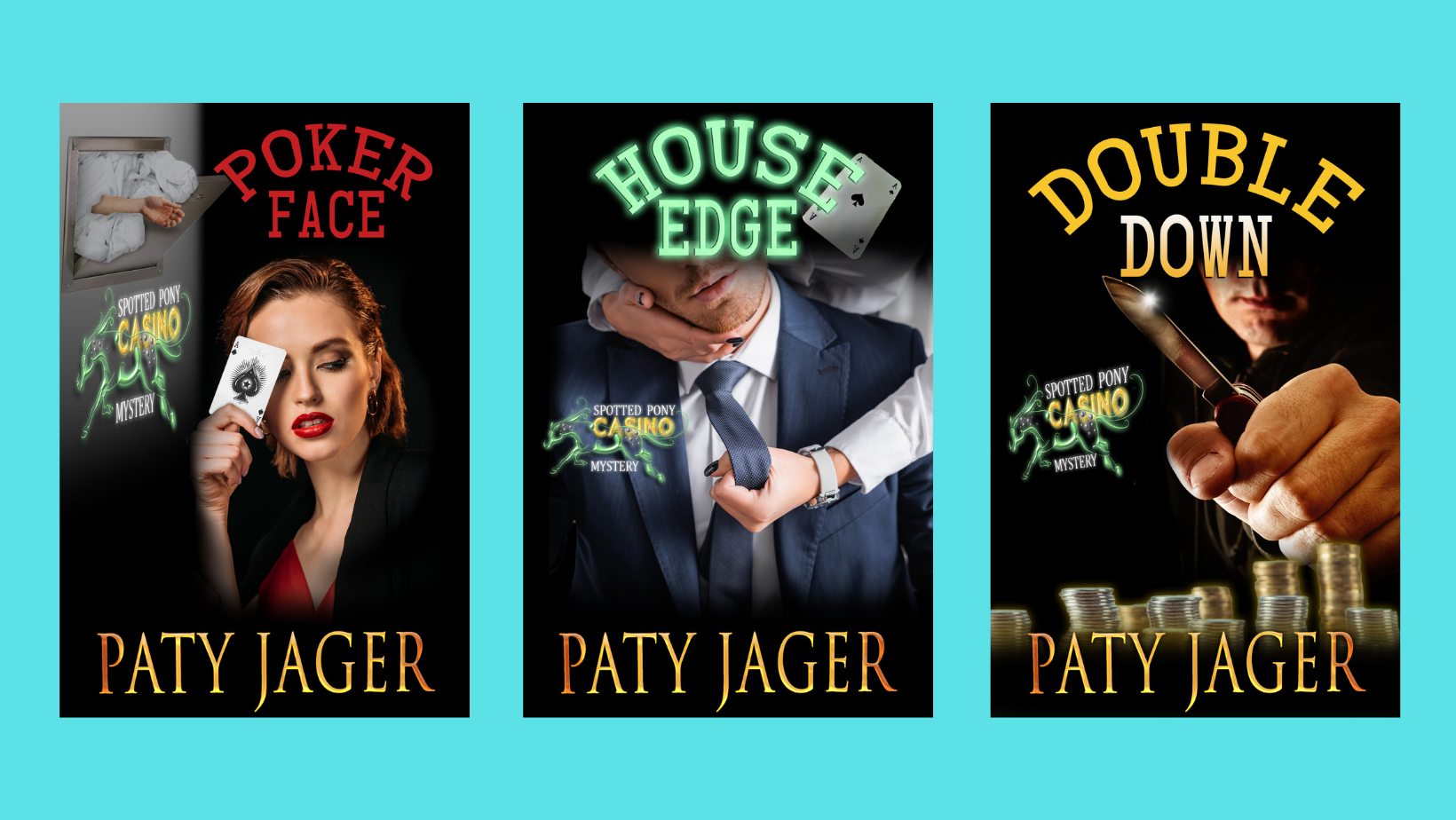
Here are the books I had made before the workshop:

These aren’t bad and convey a bit of the story. However, the survey taken by a marketing firm who works with all the big publishers and some of the larger writing organizations said that mystery/suspense/thriller readers don’t care if the image on the cover is anything like what’s in the book. They read the title first. They want a title that catches their imagination and is a play on words. Check- my titles do that. They don’t like people/faces on the books. They don’t mind shadowy figures and prefer covers that look like a puzzle. They want to see creepy, mysterious, or action depicted on the covers. And they prefer a description of the type of book: Mystery, Thriller, True Crime, Action Adventure, Suspense not A Novel.

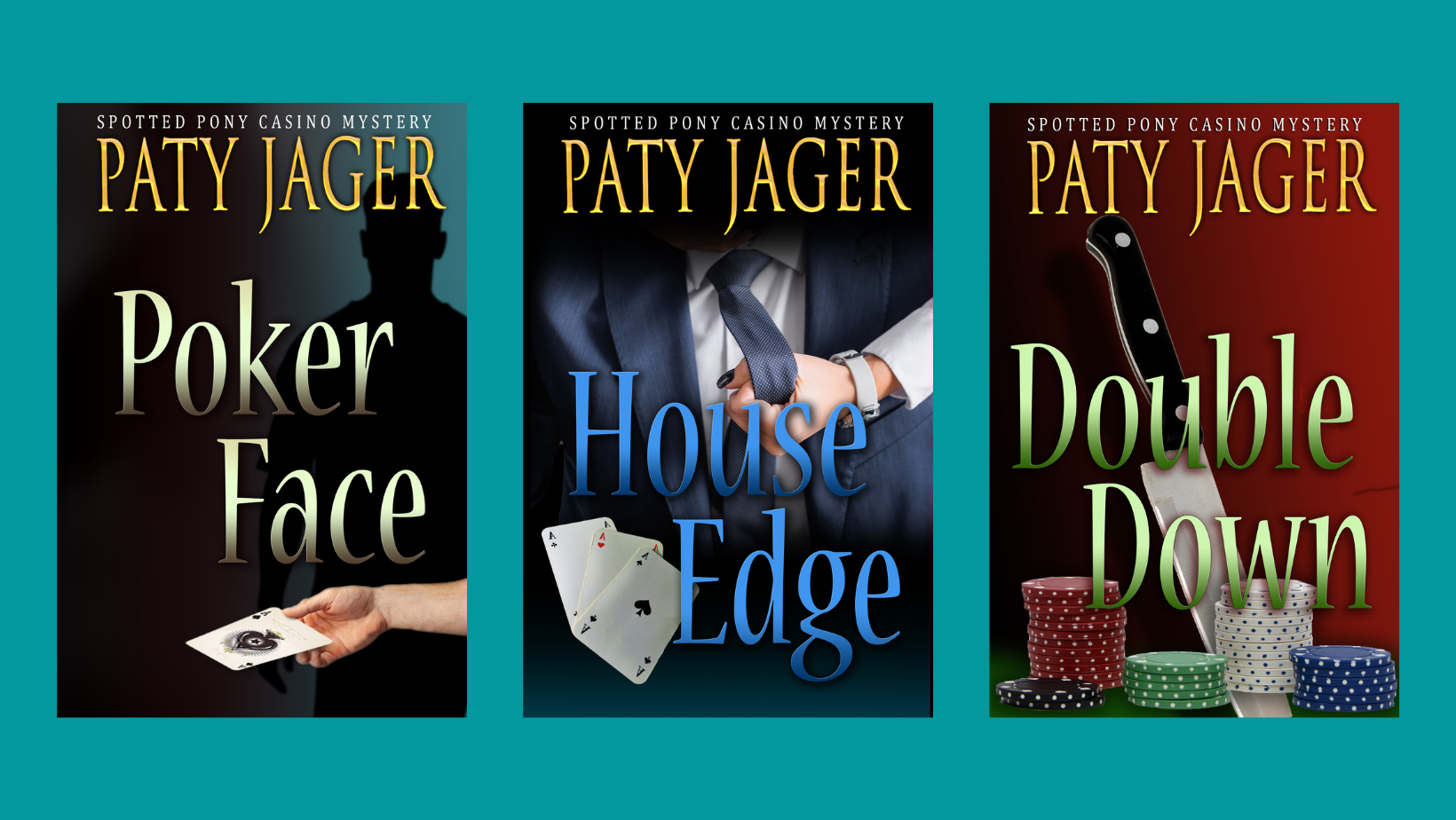
And these are the new covers:

Simpler images, in-the-face title, and the word Mystery is easier to see than in the logo that sweetened the look of the books. These covers also leave more to the imagination.

I’m glad I had this workshop now and not a year from now when the fourth book would be coming out.

And I’m thankful I went with simple covers on the Gabriel Hawke books and I have a play on words for the titles.

It might be just a book cover, but it is the face of the book I want to draw readers into. So while pretty is nice, I want a cover that exudes mystery, intrigue, and a reader can’t pass without at least taking a peek inside.

What do you think of the change of cover?

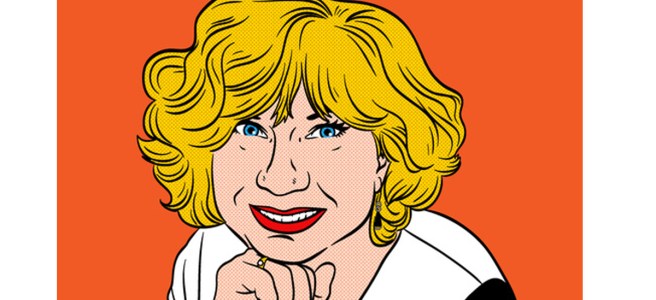
Guest Blogger ~ Lorie Lewis Ham

Why I Write Mysteries

I have been writing in some form for most of my life—poems, songs, short stories, articles, and of course, mystery novels. It was in my mid-teens that I discovered mysteries, thanks to my younger brother who introduced me to Sherlock Holmes and Agatha Christie. From that moment on, I was hooked—not only as a reader, but I knew that was what I wanted to write.

In my early twenties, I took a creative writing class and my teacher kept trying to get me to write Christian romances. I think she saw me as an innocent Christian girl so she felt that was what I should write—but how wrong she was (a story for another time LOL). Not only was I not a fan of romances, but every time I tried to write one to appease her, I ended up killing someone. I think it is important to be a fan of the genre that you write or else you can’t really do it justice.

The reason I write mysteries is the same as the reason I read mysteries. I love the puzzle of them—I love crafting one as a writer and as a reader, I love trying to figure it out. There is also satisfaction in seeing criminals brought to justice—of getting a satisfying conclusion that too often doesn’t happen in real life. In the real world things may be a mess and sometimes there is very little we can do about it—but in a mystery suddenly we have control—we can provide order and justice. Or as a reader, we get to experience it. I believe that is partially why mysteries have been so popular during the pandemic. I get a thrill out of putting together all of the clues and leading my main character, and the reader, to the solution. There is nothing quite like how it feels when it all comes together.

Personally, I also feel that mysteries give you the chance to delve deeper into your characters than you might in a romance because you are seeing more than the good side they may present to win the one they love—you see that no one is black and white. Not even our heroes are all black and white in a mystery—look at Sherlock Holmes—it is the “grayness” of his character that makes him so appealing. To find out what makes an ordinary person commit a crime fascinates me. What in their life, their journey, and their personality led them to this dark place? While I’m sure you can do this in any genre, in a mystery you almost have to.

I guess the bottom line is that a mystery can have everything-romance, murder, even at times fantasy or science fiction, but at its heart, it has to have a puzzle and a search for justice. This is what I love to read and to write.

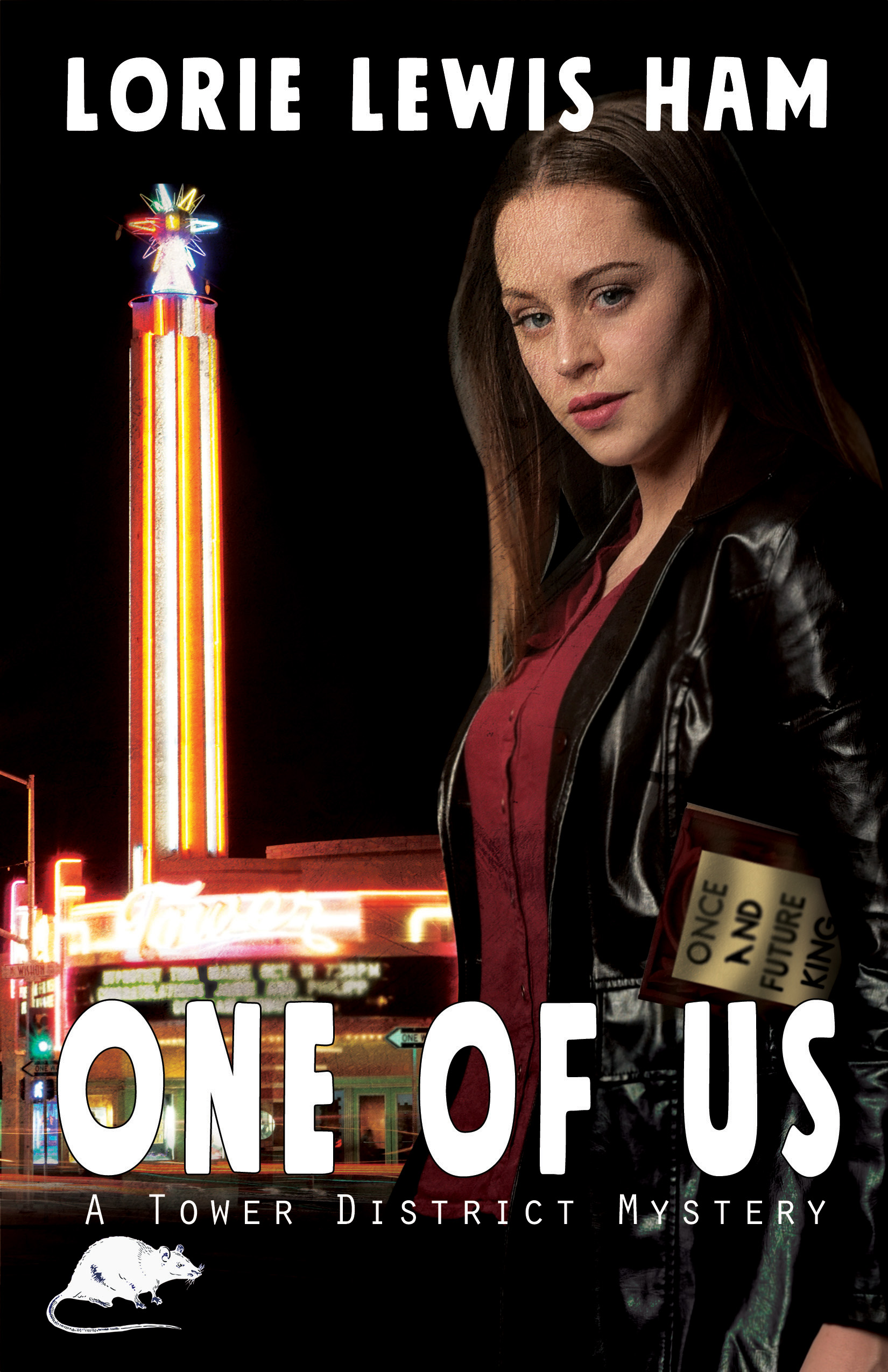
One of Us

At thirty-five, children’s book author Roxi Carlucci finds herself starting over again after her publisher drops her book series. With no income, she has to pack up her life on the California Coast, along with her pet rat, Merlin, and move in with her cousin, P.I. Stephen Carlucci, who lives in Fresno, California. The one redeeming factor is that Stephen lives in the Tower District—the cultural oasis of Fresno. 

Stephen talks Roxi into helping out with a community theatre production, which is also a
fundraiser for a local animal rescue. Then someone is murdered during a rehearsal in the locked theatre, and now she and Stephen are hired to find the killer. The killer has to be one of Roxi’s new acquaintances since the theatre was locked at the time of the murder, but no one seems to have a motive. How can they solve a murder without a motive? Could the local gossip website hold any clues? Can they stop the killer before they strike again?

My new mystery One of Us is available on Amazon, Barnes and Noble online, and Kobo.

Lorie Lewis Ham lives in Reedley, California and has been writing ever since she was a child, and publishing since she was 13. For the past 11 years, Lorie has been the editor-in-chief and publisher of Kings River Life Magazine, and she produces Mysteryrat’s Maze Podcast where you can now hear an excerpt of her new book One of Us. You can learn more about Lorie and the new book on her website mysteryrat.com, where you can also sign up for her newsletter, and you can find her on Twitter @mysteryrat and Facebook.

On Reading Reviews by Heather Haven

Some authors never read their reviews. I am not one of those people. I don’t read reviews often, but I like to go in every now and then and see what’s going on. If I get several people giving the same criticism in their reviews, I check it out. Unless they’ve written I’m terrific. Then I leave it alone. But I have found when the same thing is said, like comments about editing or misspelling, it probably has validity. It doesn’t matter how many eyes have seen the manuscript, one or two things are bound to get by. And they are bound to catch the eye of a reader. Fortunately, these errors are easily correctable. And I correct them as soon as I can.

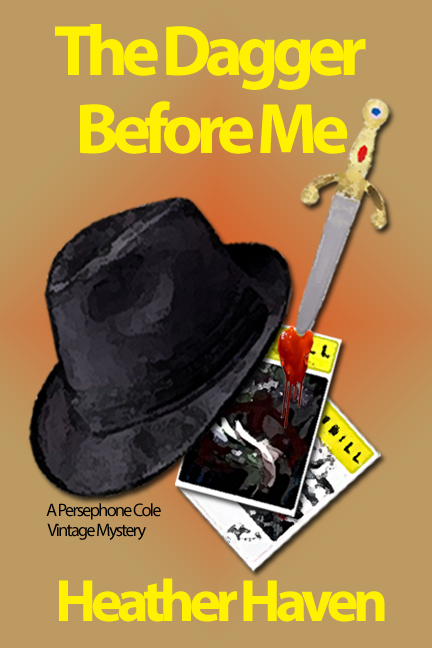
It’s the other stuff. The comments on research or incorrect details. This always sends me running to an encyclopedia, either online or from my bookshelf. I try to get things right, honestly. Nine times out of ten — and I have to say this — the reader is misinformed. For instance, in The Dagger Before Me, book one of the Persephone Cole Vintage Mysteries, I mention a small refrigerator. Mini-refrigerators have been around since the 1920’s, mostly for the rich, but there. So an affluent, Broadway producer having one in his office in 1942 is not out of line. There are a few other reviews where people simply cannot believe some things were invented way back when. Everything old is new again.

The criticism about the mini-fridge is one I came across only a few days ago and prompted this article. I had done my research at the time of writing the novel, but looked it up again to be sure I was right. I was. When the reader is wrong, I chalk it up to human nature. If they are right –which has happened upon occasion — I correct the error and silently thank the person for letting me know. Speaking of being wrong, one time in another book of the Percy Cole series, I mentioned the Macy’s Thanksgiving Day Parade taking place in 1942. It didn’t. True, the parade has been around since 1924, but when the USA entered WWII, the parade was cancelled from 1942 to 1944. I had neglected to catch that. As it was only once sentence in the story, I simply eliminated the sentence altogether. And once again, silently thanked the reader for catching my error.

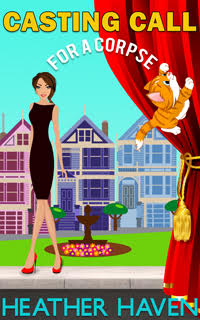
Recently, I got criticism in Casting Call for a Corpse, book seven of the Alvarez Family Murder Mysteries, because I .had called a Scottish policewoman’s hat a bowler. I’m just going to say that in pictures of their uniforms, one of the hat styles looked like a bowler to me. And still does. But not being a hatter, I bow to the reader’s knowledge. And because I had written the word ‘bowler’, the reader gave me only 3 stars and stated that was the reason. As I used the word only one time in the entire novel, I went in and changed ‘bowler’ to ‘hat’. Why? Because it makes no different to the story. Really, truly. If it had been integral in any way, I would have left it alone.

I have my standards. They may be low, but I have them. Deciding what to change, what not to change, when to capitulate, when not to, becomes something most of us writers get used to. For me, it’s just part of the game.