Mud Season by Karen Shughart

If you’ve ever read any of my Cozies, you may have noticed that the month of March doesn’t figure prominently in the narrative. Don’t get me wrong. We live on the south shore of Lake Ontario in New York state, and it’s spectacularly beautiful here almost year ‘round. That is to say: it’s spectacularly beautiful eleven months during the year. Not so much March.

March is the month of transition. One day the temperature plummets into the teens, the next day it rises into the 60s. We can have winds of 50 miles an hour. Then, waves up to 15 feet crash turbulently against the beach, roaring so loudly that they obliviate other village sounds. When the winds die down, there’s an eerie silence, and the lake looks like glass. .

We have snow squalls and rain, sometimes in the same hour. Snow that’s accumulated throughout the winter now starts to melt; quickly, in torrents and rivulets that make our backyard a swamp. I wear my old Wellies to stomp around to view the changing landscape. We don’t have many sidewalks here, and a stroll through the village can be challenging, to say the least. Many of us refer to the month as Mud Season.
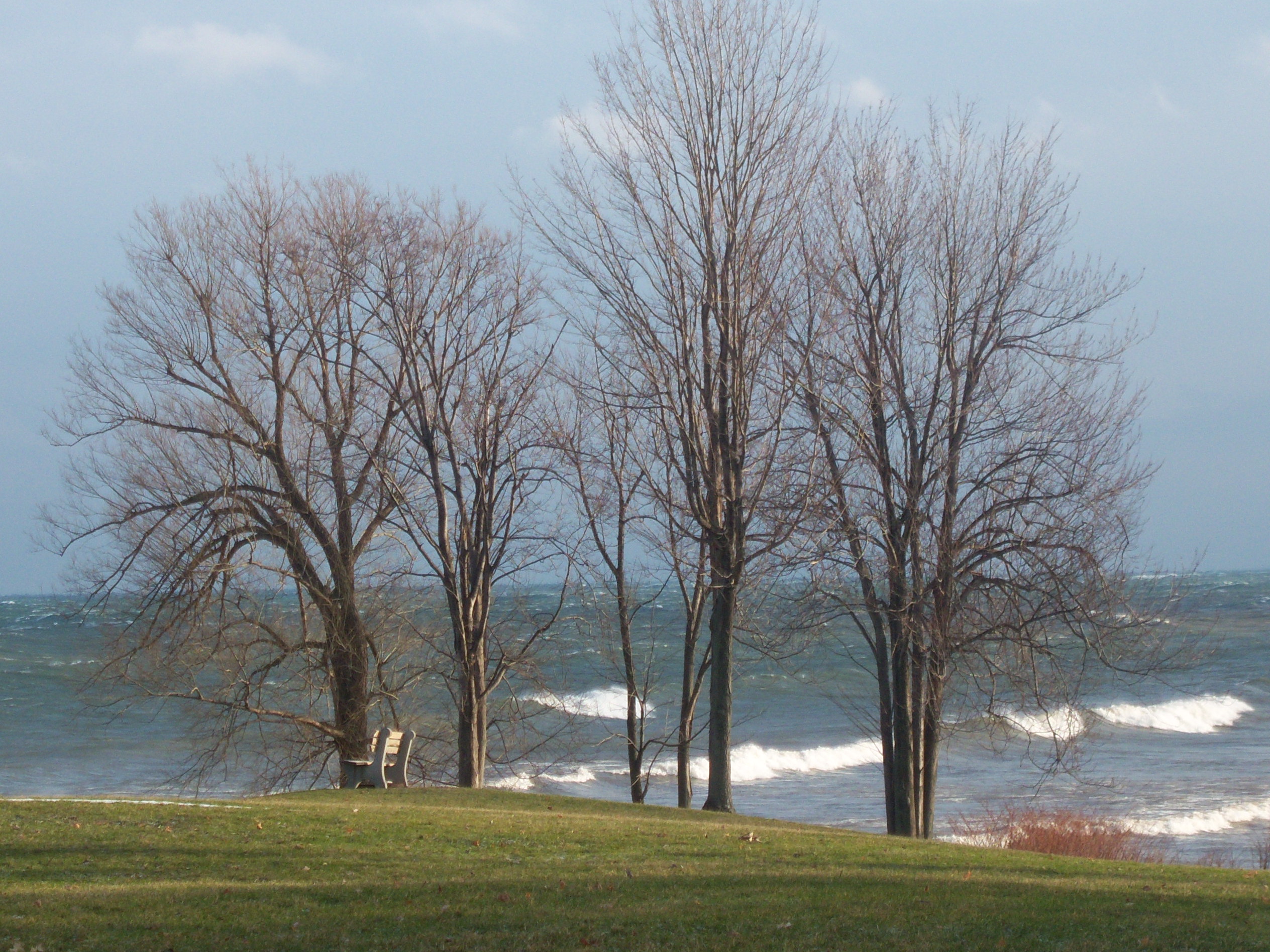
Mid-March along the lake by Karen Shughart

Gray days seem to dominate, but it’s not all doom and gloom. You can smell the ripening as the tree buds start to swell and begin turning red or pale green. Snowdrops bloom, and our daffodils stretch up through the melting snow. The sun rises earlier, casting rose gold streaks over the bay; on rare days it is piercingly bright, with a clear azure sky. Those are the days when our middle-aged dog, Nova, sleeps in sunbeams that move from room to room.

We hear lots of birdsong. Robins live here year ‘round, but mostly in winter they hunker down out of site. Now, they make their presence known. A couple weeks ago, I peered out our living room window and spied two sparrows, a male and a female, chattering away on the winter wreath of twigs, pinecones and berries that hangs on our front door. I believe they were having a conversation about whether to build their nest there. It’s a perfect place, protected from the elements and predators.

They returned to that same spot for several days in a row. Don’t get me wrong, I love the birds. I just don’t want them nesting against our front door. Regretfully, I removed the wreath, to replace it later in the spring with one that’s more seasonal. I expect they were surprised when they returned to find their building site was no longer available.

I’ve purposely not written much about March in my Cozies, but now, after writing about this month of so many moods and faces, I begin to wonder why I’ve been avoiding it. Winter is ending, spring is on its way, and change happens rapidly. Hmm, could this be a metaphor, perhaps, for my next Cozy?

To Gore or Not To Gore… And How Much?

by Janis Patterson

When one writes mysteries, one has to come face to the face with the problem of violence – when, to whom and how much. Almost every mystery – those for grown-ups, that is – includes an assault and/or a death. It is very rare to see a mystery without one or the other and usually both. Dead bodies are pretty much the raison d’etre of a mystery!

The question is, how did the body get dead, where is it found, what condition is it in, and how much – if any – of the actual crime do we show?

What they’re now calling cozy mysteries – the kind with a ditzy amateur sleuth with a terrible love life, a cute job, probably a shoe obsession and perhaps intelligent animals which may or may not solve the actual mystery themselves – usually back away from violence and its aftermath as much as possible. (And yes, I know there are exceptions, but it is the exception that proves the rule!) The dead body that propels the story is so sanitized and occasionally de-humanized that in some stories it resembles little more than a stage prop. Which is distressing but not surprising, as more and more publishers are demanding that the body appear in the first few pages if not on the first page itself. This makes it hard for the reader to regard said dead body as little more than a plot device instead of something that was once a living, breathing complete human being. (In case you didn’t know, this ‘where does the body appear’ thing is one of my hot buttons!)

What we used to call cozies are now in the labeling limbo of ‘traditional mysteries’ which to me means more realistic characters, more realistic actions by those characters, but with only minimal violence. There is blood, but only a tangential mention. My favorite description (taken from one of my own books, of course) talks about the body hastily covered with a now-stained bedspread (at the time of my sleuth’s arrival) with just a lip of wet red peeking out from under the edge. Enough description to evoke a feeling of horror at such a heinous and violent act, but most definitely not enough to revolt or sicken the reader. It’s sometimes a difficult balancing act.

In a hard-boiled or noir mystery, the violence is not only part of but sometimes seems to be the reason for the story. Descriptions of violence, whether or not they result in death, are often and lovingly detailed. Remember how often Mickey Spillane’s Mike Hammer either was beaten up (each blow described) or beat up the bad guy (each blow described.) He wasn’t the only one, either. There are scores of such novels celebrating violence written every day.

My personal bête noir example of gratuitous violence is Robert Ludlum. Yes, his novels are generally classified with thrillers, but in each one there is a mystery, and I’m trying to make a point here. I have publicly called his books ‘the pornography of death.’ Think about it – in sexual pornography nothing is hidden; every moan, every stroke, every touch, every single action is described, usually in loving and minute detail. Ludlum’s (and others’) do the same thing with violence. Every split of skin from a blow. The explosion of skin and the fountain of blood caused by the entry of a bullet… or a spear, or some other penetrating object. The crisping and blackening of skin as it begins to burn. Personally, I find it sickening, but considering how these books sell I’m obviously in the minority!

My feelings toward violence in my books are sort of like mine about sex in my books. They both happen, and we as readers know they happen, as we see the results, but they do not happen ‘on screen’ and there are no overly graphic descriptions.

Once a couple of decades ago I was doing make-up on the set of a horror film. A grizzled old hand and I were watching as an actor was being glued (yes, glued!) into his costume. The gaffer snorted derisively, saying that clump of foam and make-up wasn’t really scary.

Well, it was pretty scary-looking to me! When I told him, he said the purpose of a horror film was to scare people, and not all people were scared by all things. To really scare people, he said, you give a suggestion – a shadow, a hand or a tentacle, and let people create in their own head the thing that scared them the most. “Don’t show the monster,” he said. “Let people create their own monster.”

It’s the same thing with violence. A suggestion – ‘a lip of wet red peeking out’ – can evoke more feelings, more visceral reaction, than an entire thesaurus of detailed description. And that’s why I don’t write overt gore.

I Like Jury Duty by Paty Jager

There are many people who try as hard as they can to get out of jury duty. I, on the other hand, enjoy jury duty.

Where else can a writer see so many different people in a boring and, in the case of a trial, intense situation? There are emotions to study, tics, physical appearance, and even voices. For me it is an overload of images and sounds that I try to capture to use in books.

I don’t write courtroom stories, but I do use a lot of what I see in my mysteries. The way a policeman stares around the room, or the intense discussion between a client and lawyer, even the way two old men gossip in the corner of the room, their voices so loud everyone hears what they are saying. There is so much fodder for this imaginative brain! Even how the potential jurors act while waiting to be picked. It all has a way of speaking to me. I carry a small notebook with me when I go. I use it to jot down things I see that I think will make an interesting character or add nuance to a character.

And then there are the cases. I don’t use exact cases in stories, I use them as a bouncing off point, coming up with my own scenario and interjecting completely different characters than the real people. But it is all inspiration for books or characters or situations to come.

My biggest hurdle is getting onto a jury. Our son-in-law is a lieutenant in the Oregon State Police. When asked about that, there are times I get excused immediately. Just because I see crime from the side of the police, I think. There are also the drunk driving cases, I can’t be open minded on those. My father-in-law was an alcoholic who should have been off the road much sooner than he was. And then he only had his license taken away because my husband asked the courts to take it away, not because the courts were going to do it. Even though he’d been hauled in for DUII a half a dozen times. Yes, I believe the courts need to be stricter with that and anyone who drinks alcohol or does illegal drugs should not be allowed to drive. Take their license away. Sorry, got off on my high-horse there.

I find how the judges present themselves to also be noteworthy. Their demeanor can work for an employer or even a villain depending on how open or dominating he or she may be. Don’t forget the prosecuting attorney and the defendant’s lawyer. Again, how they act and present themselves is all scrutinized by me to find something that might work for a character.

The defendant.. are they nervous, smug, pretending they don’t care but their leg is bouncing or the keep clasping and unclasping their hands? Yes, I study all of this for characterization.

I also listen to what everyone has to say and hope I use an open mind when making a decision. All the while, I’ve scratched my notes and observations in my character notebook.

Do you like to be called for jury duty? Why or why not?

photo source: Depositphotos

The New Nancy Drew… Really? by Heather Haven

Like a lot of mystery writers, I tend to read and view tons of other mysteries, just to see what’s happening and to learn a thing or two. Call it the tools of the trade. Recently, I stumbled across yet another new television series based on the world famous Nancy Drew Series by Carolyn Keene. And there the resemblance ends. I don’t mean to be rude…well, yes, I do… but this is soooooo not Nancy Drew. At least, not the Nancy Drew I grew up with.

As everyone knows, the Nancy Drew of the past is a spirited young woman who lives with her widowed father, Carson Drew, a lawyer, and their trusted housekeeper, Hannah Gruen. These three, despite the generation gap, have a warm and loving relationship. Nancy’s two best friends, George and Bess, as well as her quasi-boyfriend, Ned Nickerson, solve crimes warm and fuzzy. Nancy is a young lady who is strong and self-reliant, with a feel-good crew to back her up. That’s the gal detective I know.

Enter Nancy Drew 2020-21, where these kids look around 26 and act a bad 40. The opening scene of the new television series has her sitting astride her convicted felon boyfriend, Nick, whose real name is Ned Nickerson. They are having sex. Excuse me? After the shock of that, we move onto George. She is supposedly Nancy’s best friend. This George is a belligerent young woman who has just ended the affair she started at 17 years old with a 30-something married man. By the way, she does not like Nancy. They never got along.

Then Bess Marvin shows up. She ‘s in love with a woman posing as a chauffeur who is actually a policewoman. Bess is also a rich family’s poor cousin, literally, but is dying to be a part of this obviously questionable clan. Marvin skeletons are in every closet but they take Bess into the family on the proviso she rat on her new girlfriend. She does.

And these are the lighthearted parts.

Let’s get heavier. Carson Drew, Nancy’s father-knows-best dad, is a dysfunctional man involved in the town’s evil doings and has been for decades. If there’s a murder or dead body, odds are Carson Drew had something to do with it. Just when you hope you might be able to root for him it turns out he’s not Nancy’s real father, but has lied to her about her parentage every step of the way. Add in the paranormal, seances, and some supernatural thing called the Aglaeca, and this storyline gets darker with every episode.

As a writer, I can see how the scriptwriters sought out any idea the protagonist, Nancy Drew, would find challenging. Then they threw it into the story and doubled-down on it. She is betrayed by her father, her lovers, and her friends continually. Even her roadster does her dirty. But to be fair, Nancy may be tortured every step of the way but so is everyone else. They only pause long enough to find a new lover, change partners, or have a séance. Then its off on the next soul-ripping escapade. There is no joy in River Heights, which by the way, has been relocated to Horseshoe Bay… because.

But here’s the kicker. Even though this new series is NOTHING like any Nancy Drew book I’ve ever read, the producers put into the credits the phrase “Based on the Nancy Drew Series by Carolyn Keene.” That started me thinking. What would I do if the producers take the Alvarez Family Murder Mysteries, currently under option, and make them into a television series nothing like the books? They have already told me if the projects goes, the movies will be a little different. But what is a “little?” And will I care? Can I do anything about it if I did care? The answer to that question is a resounding no. I signed certain rights away to see my stories come alive in another media. And I would probably do it again.

But this may be why Sue Grafton said she would never sell the television or movie rights to her books, I’m thinking. It comes down to the written word versus other media forms. The iconic Nancy Drew series is decades old and has been loved for generations. But that makes it vulnerable. Or is it so endeared by all of us, we don’t give a hoot what anyone tries to do to it? We know the truth. And the truth will set us free.

There’s another truth. Once you put your work out there, out there it is. An offshoot of Jane Austen’s Emma turned into the movie Clueless came off charming. But it might not have. The movie based on Janet Evanovich’s book, One for the Money, was a real dud. And nothing like the book. But the end result is rarely up to the author, alive or dead. You are completely at the mercy of a whole other entity. Maybe the Aglaeca. It’s no wonder so many of us writers have a reputation for drinking. I get it now. Pass the vodka.

Unsolved Crimes and Cold Cases

For a writer, there’s something compelling about a crime that’s never been solved, a case that’s still out there waiting for a solution. Since I write fiction, I can resolve the plot myself. Or at least use those old crimes to add mystery to my own writing.

Take the case of the Zodiac Killer. I’m working on a Jeri Howard book, called The Things We Keep. As things are wont to do when you write mystery fiction, a real-life case collides with Jeri’s fictional investigation.

Type “Zodiac Killer” into your search engine and you’ll get millions of hits.

Zodiac Killer Wanted Poster and Cryptograms

Seven known victims, two of whom survived, are attributed to the Zodiac. The murders occurred between December 1968 and October, 1969. Surviving witnesses described the killer as a man in his 30s.

I say known victims, because there are other murders and disappearances attributed to Zodiac, some going back as far as the early 1960s, others in the early 1970s. However, evidence of his involvement in these murders is sketchy and inconclusive.

The killer sent letters to Bay Area newspaper, taunting the police. Some of the letters included cryptograms. One was solved in 1969. One was solved just last year, after 51 years.

After December 1969, communications from Zodiac were sporadic and sometimes considered spurious. Did the killer stop killing, go somewhere else, or die? The police had a suspect but not enough evidence to charge anyone. That person died in 1992.

The case is still open in San Francisco, as well as the other locations where the Zodiac struck. And the California Department of Justice file is also open.

Robert Graysmith’s book Zodiac, the source of the 2007 movie of the same name, is considered the definitive account of the investigations into the murders.

I’m not going to solve this particular puzzle in my novel, but the Zodiac Killer is certainly a looming presence in Jeri’s fictional case.

There’s another unsolved mystery that has fascinated me for decades. From the same era, as it happens.

On March 18, 1969, Thomas Riha vanished. An immigrant from Czechoslovakia, he was an associate professor of Russian history at the University of Colorado in Boulder. He and his wife Hana were in the process of divorcing. She had recently fled their home, claiming that someone was trying to kill her. When Riha disappeared, the house was full of furniture and the table was set for breakfast.

Thomas Riha

The authorities supposedly received assurances that Riha was alive and that he’d left of his own accord. Some people claimed to have seen him in the early 1970s, in Czechoslovakia.

But no one really knows what happened to Thomas Riha, with the possible exception of the CIA, the FBI. And maybe a woman who called herself Galya Tannenbaum.

Galya spun many yarns, claiming to be a secret service agent. She also claimed to know where Riha was. She disposed of his house, car and statuary collection. She was also the beneficiary in the wills of two Denver residents. Both the decedents had died of potassium cyanide poisoning.

District attorneys in Denver and Boulder filed criminal charges against her for forgery. When they searched her Denver house, they found a pound of potassium cyanide—and Thomas Riha’s driver’s license and passport.

Galya had several other names, a prior criminal record for forgery and theft, and a long record of mental instability. In June 1970 a judge found her incompetent to stand trial. She was sent to the state hospital in Pueblo, Colorado.

Eight months later, on March 7, 1971, Galya Tannenbaum committed suicide, using potassium cyanide.

For a mystery writer, this is catnip.

I used a variation of the Riha case in my second Jeri Howard novel, Till The Old Men Die. In that book, a professor at Cal State is definitely dead and Jeri gets involved in finding out who killed him.

Of course, I had to have a mystery woman.

Writing that book scratched the itch, but not entirely. It wasn’t the Riha case, with its echoes of Cold War intrigue and the strange woman who used potassium cyanide. It wasn’t the novel I wanted to write at the time. Real life is messy and sometimes it doesn’t have endings, as a good mystery novel should.

The itch is still there. Thomas Riha and the case of the vanishing professor will figure into a novel sometime in my writing future. I’ve already got a plot in mind!