A Mystery Writer’s Responsibility

by Janis Patterson

We write mysteries. It is our duty to provide our readers with a good story that has an interesting plot, accurate research, believable characters, and a satisfying ending.

It is also our responsibility to be sure that in our quest for interesting and different content we don’t turn our fictional books into training manuals. Yes, we want ways of death that rise above the common and usually sordid killings that regularly adorn our daily news, but we must walk a fine line between creating an interesting fictional killing and providing an instructional blueprint for a real one.

I think this duty of responsibility is why in so many early mysteries and in a few current ones the murder weapon is a common blunt instrument or some exotic, untraceable poison, though exotic, unknown and untraceable poisons are currently somewhat out of vogue. Current mysteries seem to be grounded much more in reality than the ones from the so-called Golden Age.

To illustrate my point, years ago I attended my first NRA convention. (By the way, if your mysteries involve firearms, I cannot recommend highly enough that you attend one – the knowledge and help there are phenomenal! It will be in Dallas next month and I definitely intend on going! I’ll probably be blogging about it.) I talked to a lot of people, getting all kinds of information and contacts for my reference file (you do have a reference file, don’t you?) when I talked to this one man who was simply entranced that I was a mystery writer. Normally I’ve found that people just love to help writers, but this guy was totally over the top. He had worked both as a firearms salesman and in a ballistics lab, and among a lot of other things gleefully told me the way to have a ballistically clean bullet. No striations. No rifling. No marks on the projectile to tell which or even what kind of gun it came from. No information except the caliber. Nothing that law enforcement could trace.

I listened intently, partially fascinated and partially revolted. It was a simple process and could be done by anyone with the IQ of a goldfish. Then he asked if I’d use it in one of my books – obviously hoping that I’d put him in there too. Horrified, I said most certainly not, begged him not to tell this process to anyone else and then explained why. He was suddenly as horrified as I – apparently he had never thought that what he regarded as an interesting curiosity could actually be used to commit a real-life untraceable killing.

And no, don’t ask me what the secret is. I destroyed that part of my notes and have deliberately forgotten how. There is some knowledge that should never be shared.

So while killing people made of pixels can be both fun and profitable, we as writers owe our readers and the world in general a sense of restraint and responsibility. I truly believe that none of us would actually use some of the stuff we know to do harm to others, but we must never forget that our stories are read by all kinds of people, some of whom might wish to do harm or even read us in search of ways to do harm. Never forget that we want to entertain, not instruct. I don’t think any of us want to be an accomplice.
Left Coast Crime Replay by Paty Jager

Last month, March 22-24, I attended the 2018 Left Coast Crime conference in Reno, NV. It was a five and a half hour drive from my home.  A friend and I left Wednesday morning and took our time driving through rain, snow, and sleet to get there.

speed dating
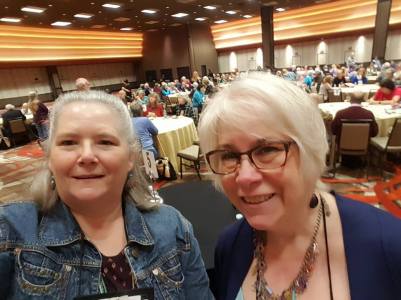
Laurie and I at Speed Dating

Thursday morning started with a speed dating event where two authors were teamed up and we moved from table to table talking about our books to readers who remained at the tables.  There were 20 tables of 6-8 people per tables. It was a lot of fun. My “dating” partner was Lauri Rockenbeck.  She had her first book out, and I was pitching my Shandra Higheagle Series.

I attended a couple of the panels that day and hung out with my friend.

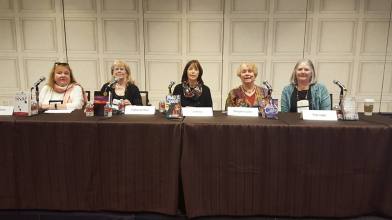
Friday morning I was on the panel “I Still Miss Someone: Ghosts, Hauntings, & Horror” with Michele Drier, Margaret Lucke, Catherine Paul, and Jo Perry.  We talked about the supernatural elements in our books. Michele was the narrator and did an excellent job with great questions and keeping things moving.

Panel 2018
My Panel

After my panel I popped in on a couple others where friends were speaking. Then I had lunch with an up and coming writer, who had contacted me before the conference to see if I would take the time from the conference and talk to her about writing and the business side of things. It was fun to meet Heather and share knowledge.

Friday evening, I attended the interview with William Kent Krueger. He was, as always, entertaining.  He told how he took his 10 year-old grandson with them on a trip to Arizona to learn about about human trafficking and the border wars.  He said while no one would open up to him,when his grandson asked questions, they would respond to him.  And that was how Kent found the information he needed for his book Sulphur Springs which won the Lefty Award on Saturday night.

Saturday morning, I read the first chapter of Artful Murder at a “You Had Me At…” where authors could read for ten minutes and talk about their books or do a demonstration.  After I read, a talk was given by Nancy Tingley on “Art Historians as Detectives”. I found it fascinating and made sure I watched a few more of these types of presentations by authors.

Sundae Social
Sundae Social

Saturday afternoon, I hosted my Sundae Social at Rosie’s Cafe in the casino.  Thirteen readers signed up and twelve showed up. I was excited to have so many come. I purchased vanilla ice cream in dishes for them, and I’d brought along toppings for them to make their own sundaes, while I visited and talked about my books. They all went away saying it was the best event they’d been to during the conference, because they had one on one time with an author and enjoyed ice cream!  I enjoyed each person who came.

I didn’t go to the banquet on Saturday night as a romance author friend who lives in Reno was meeting me for dinner. We had a great time catching up and talking writing.

While standing in line to pay and pick up the silent auction item I won, I started up a conversation with the author behind me (can’t remember his name), and he suggested my Shandra Higheagle books sounded like the the new category Cozy Noir that he’d heard about while at the conference.  Anyone else heard of this?

Sunday morning my friend and I rose, packed up, and headed home.  For this introvert writer, it was an exhausting weekend just having to stay in a open, welcoming mode for the readers and the authors I connected with.

As a reader and/or author are you a person who thrives on the energy of a conference or do you find it exhausting?

SH Mug Art (2)

Pomados for the …win?

Well, hi there.

If you’re a regular reader of this blog, then you’ll know I’m a newbie, in which case, “hi, I’m Jordaina. It’s lovely to meet you”. If you’re new to this blog then “Snap, bro! Me too!”. And, obviously, it’s lovely to meet you as well.

Under the guise of getting to know each other, here are three things you should know about me:

  1. My name is pronounced Jaw-dane-a (this is always the first thing I explain because everyone gets it wrong and then people mumble it or stumble over it and it gets awkward—one guy even tried to spell it with an “f” one time. Like, what?)
  2. Kinda obvious, but I write cosy mysteries with a paranormal twist.
  3. I’ve recently given up my day job/got made redundant/was released into the wild and now I write full-time.

That’s me in a three-fact-nutshell. Sort of. Anyway, probably like every writer I’d always dreamed of fact three. Of being able to give up my job and writing full-time while sitting in a field in a sundress/looking arty in a coffee shop but I have to tell you, the reality is a lot different to the dream.

My job ended at the end of January this year and then I got mega sick for about a month. And then March just came and went and now it’s April. Two whole months have passed since I left my job … and I’ve hardly achieved anything. I had goals and deadlines, but I just can’t seem to get into a rhythm. When I had a full-time job, I’d cram my writing into whatever free time I had and get loads done. But now, I get up, have breakfast and then some weird time warp thing happens and it’s lunchtime. Like, how?

tumblr_mzffbglwoa1tne7pgo1_500

So, after a few weeks of getting nothing done, I started investigating time management techniques.


First I started with the Pomado technique. (It’s actually the Pomodoro technique, but I like calling it “Pomado” because it sounds like “tornado” … small things!) I don’t know if you’ve heard of it, but it means you set a timer for twenty-five minutes and accomplish what you can in that time. Any tasks you have you’re meant to estimate how many Pomados it will take to achieve before you start. It’s great if you have lots of different tasks but what if you spend your whole day writing? If you spend eight hours writing that’s sixteen Pomados. That’s sixteen times your writing flow is interrupted. That’s sixteen times you freak out at the loud, random buzzing. Not exactly conducive to the creative flow.

So, that didn’t work for me. Then I read in some time management book (yes, I am reading self-help books!) that an adult can’t focus for longer than forty minutes at one time and they suggested working in ninety minute blocks with a five minute break in between. Can you see the problem? Forty plus five plus forty does not equal ninety. How much faith can you have in a time management system that can’t even get their maths right? Not to mention my office is in the attic so by the time I’d made it down both flights of stairs, made a cup of tea, had a biscuit and climbed back up to my office I’d be well over that five-minute break.

Since I wasn’t vibing with that idea, I looked for other options and found some research that said you should turn off all distractions (obvious!) because, after an interruption or distraction, it can take up to twenty-three minutes to focus your attention back on that one task. Twenty-three minutes! So every time you start a new task, it takes your brain twenty-three long minutes to drag itself off the previous task and settle on the new one. So that blows the Pomado technique out of the water because that means I’d only have two minutes properly focused on that task. Although, I do like this idea … but I think that’s probably only because I could say I was “Pomado-ing”!

The craziest thing is that I LOVE writing. I LOVE it. So you think I’d find it easy to just sit down and do it but … *shakes head* I just can’t find a way to manage my time effectively enough.

Do you have any time management tips to help me? Because, at this rate, I’m going to get to the end of the year and my editor is going to ask me for those eight manuscripts that are due and … well, that’s not going to be a fun conversation! If you have some tips for me, or anything that works for you, then please let me know about it in the comments.

Until next time,

Jordaina 🙂

PS. If you’re reading this and thinking “This girl is a writer? Man, she can’t spell for toffee” then, and I probably should’ve told you this—I’m English. Yep. We spell lots of things different. (I also sometimes use this excuse to cover my bad spelling!)

Let’s talk about the weather


By Sally Carpenter

Many writers swear by Elmore Leonard’s list of “10 rules for good writing” as definitive guidelines that must be followed at all times. Rule one is “Never open a book with weather.”

Ooops, I broke that rule in my WIP.

I don’t begin with a weather report per se, but the climate does have an impact on the story. Chapter one opens with an actress, the protagonist, performing in an outdoor theater in the rain. The guests watching can’t enjoy the show because they’re cold and wet. The actors on stage must overcome their own personal discomfort to do their best, as “the show must go on.”

The reader feels empathy for the protag working in such miserable conditions while admiring her professionalism and dedication in putting on a good play despite the obstacles.

 Throughout the book we have rain and drizzle off and on as well as a few dry days. Chapter one ends in a thunderstorm in which a dying stranger shows up at the heroine’s front door. OK, using a storm during a scene of high conflict is a bit of a cliché, but in this case it seems to works.

 One of the classic conflicts in literature is “humans vs. nature.” Starting a story with bad weather can be a good thing. A tornado triggers the action in one of the most beloved stories and movies of all times, “The Wizard of Oz.” Having lived most of my life in the Midwest, just the threat of a tornado was enough to get me quaking.

 My guess is what Leonard was really trying to say was not to start a story with lengthy descriptions of the environment, or waxing lyrical with passages that fail to engage the reader’s interest, such as “With rays of brilliant light, the sun was heating the soft ground, recently moisted with a light rain, while fluffy clouds skipped along through the azure blue sky.”

 Of course there’s the favorite opening gambit of “It was a dark and stormy night.”

 Good weather, though, can be used as a way to surprise the reader. “As the lovers were merrily strolling through the field, with a gentle wind kissing their cheeks and the sunshine warming their bare arms, they stumbled over a rotting corpse.”

 Using weather in a story helps to make it authentic. Many TV shows and movies seem to take place in a biosphere where the weather is always 72 degrees, rain and snow never fall and natural disasters never occur. Can anyone remember the Brady Bunch dressing for inclement weather?

 However, an episode of “WKRP in Cincinnati” did have a tornado blow out a window in the studio and injure one of the characters (those tornadoes are everywhere!).

 Likewise, many cozies are set in a “perfect” world with fantastic mild weather year round. Even Southern California gets rain and chilly temperatures! Granted, the entire grounding of a cozy is a fantasy—an amateur sleuth solving a crime that the police cannot break—yet the lack of any deviation in the weather makes the suspension of disbelief even harder.

 Some cozies set in Minnesota do have snow, although I wonder how many include the unpleasant aftermath of slush: partially melted snow that’s dirty and sticky. And how many of these characters try to drive cars sliding around on icy roads or put out their backs while shoveling out their driveways?

 Some New England cozies are set in the cooler days of autumn with the colorful foliage, but do the protagonists take time away from their sleuthing to rake leaves or clean debris out the gutters?

 Writing a cozy doesn’t require the services of a meteorologist, but the author can add some flavor and realism to the story with a touch of weather.

 Please share if you know of any mysteries in which bad weather plays a role in the story.