
 I hope this hasn’t happened to you, but … have you ever picked up the sixth or seventh book in a series you follow and been let down? Maybe the author crushed you with backstory aimed at new readers. Or worse, the author took your loyalty for granted and got self-indulgent with a book full of “darlings” that should have been killed. Series fans, myself included, sometimes forgive all of that and keep reading because they love the characters. New readers who happen to start with a later book in the series won’t be so forgiving.
Authors who handle backstory well (in my opinion) give very little and slip it in only as needed. In one of Nevada Barr’s Anna Pigeon novels, she briefly mentions that Anna acquired her dog, Taco, after accidentally causing the death of her friend who owned him. That’s it. No other details. The story moves on. To me, this was brilliant. The reader knows just enough with this bit of painful background to understand Anna’s feelings about Taco. I hadn’t yet read the earlier book, Blind Descent, in which the accident occurs. When I did read it, nothing had been spoiled.
I’ve started other series late in their progress and quit without finishing due to backstory overload. It wasn’t just dull; it ruined the earlier books for me. Of course, a series character’s personal life changes and grows in each book, and it’s inevitable that book three will give away transitions in the lead character’s love life or family life, but it shouldn’t spoil the mystery plots of books one and two. I suspect that most people like to begin a series at the beginning, but others grab the newest book first. Sometimes the new release in a series is the only thing my library has available in audiobook, so off I drive with no prior familiarity with that author. It’s usually a good experience, but once in a while I get a book that threatens to put me to sleep at the wheel with tedious summaries of the characters’ previous adventures, sometimes in the worst way possible: expository dialogue. “Remember when we solved the mystery of the missing heiress? You saved my life and hers.” “But it was your quick thinking that got us there.” “And then the press made a hero out of her husband, of all people.” On it goes. Both characters were there and know what happened and yet they tell each other so the author can tell the reader. Yawn. Hit eject button. Pull over for coffee. Try a different audiobook.
This experience has motivated me to get a new critique partner for each book in my series. I have long-term reliable partners who know my work and my characters, and who do great plot critiques, but I also need fresh eyes on each book. Because of my aversion to backstory, I include as little as I possibly can. The new person who hasn’t read the prior books lets me know what was unclear, and then I can insert the necessary minimum at the right place. The new reader also will not be as tolerant of scenes that are fun for me and for people who have a long relationship with my characters, but which are slow in moving the plot—symptoms of that other error which can creep into a long series: self-indulgence. My new critique partner will catch it and help me cut the fluff.
I want the person who picks up book five first to have a complete, compelling experience within that story, and to be curious what happened in the rest of series. Also, I hope for the later books in the series to be as alive and exciting for long-term readers as the first book was.

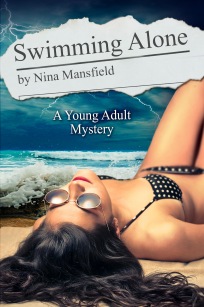 But I did have kids—young teens specifically— on the brain when I started writing my debut YA mystery novel, SWIMMING ALONE.
 The Los Angeles Times Festival of Books was held on April 9th and 10th on the campus of the University of Southern California. It’s a yearly event, the largest book festival in the country. Sisters in Crime/Los Angeles, the local chapter of Sisters in Crime, has a booth at the festival, and I’m a member.
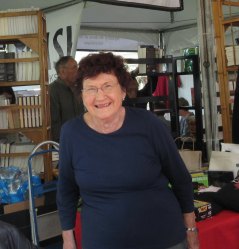 small space incredibly cramped with no possibility that two people could pass one another inside the small area. However, we managed, and the heavy rain finally ceased. In the afternoon we had lots of visitors.
 I spent many years studying Polish history and the Polish political system. I use knowledge I gained in my years at the State Department and National Park Service. I talk with friends and colleagues who are archaeologists, to make sure my recollection of archaeology from my graduate school days is accurate. And I read. A lot.
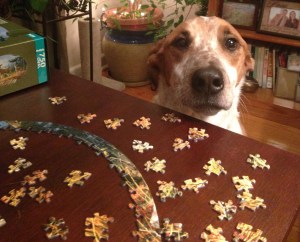 I love it when all the puzzle pieces somehow fit together perfectly. (And, yes, hate it when I have to delete an entire plot thread because, in the end, it just doesn’t work.)
 Ladies of Mystery
You must be logged in to post a comment.