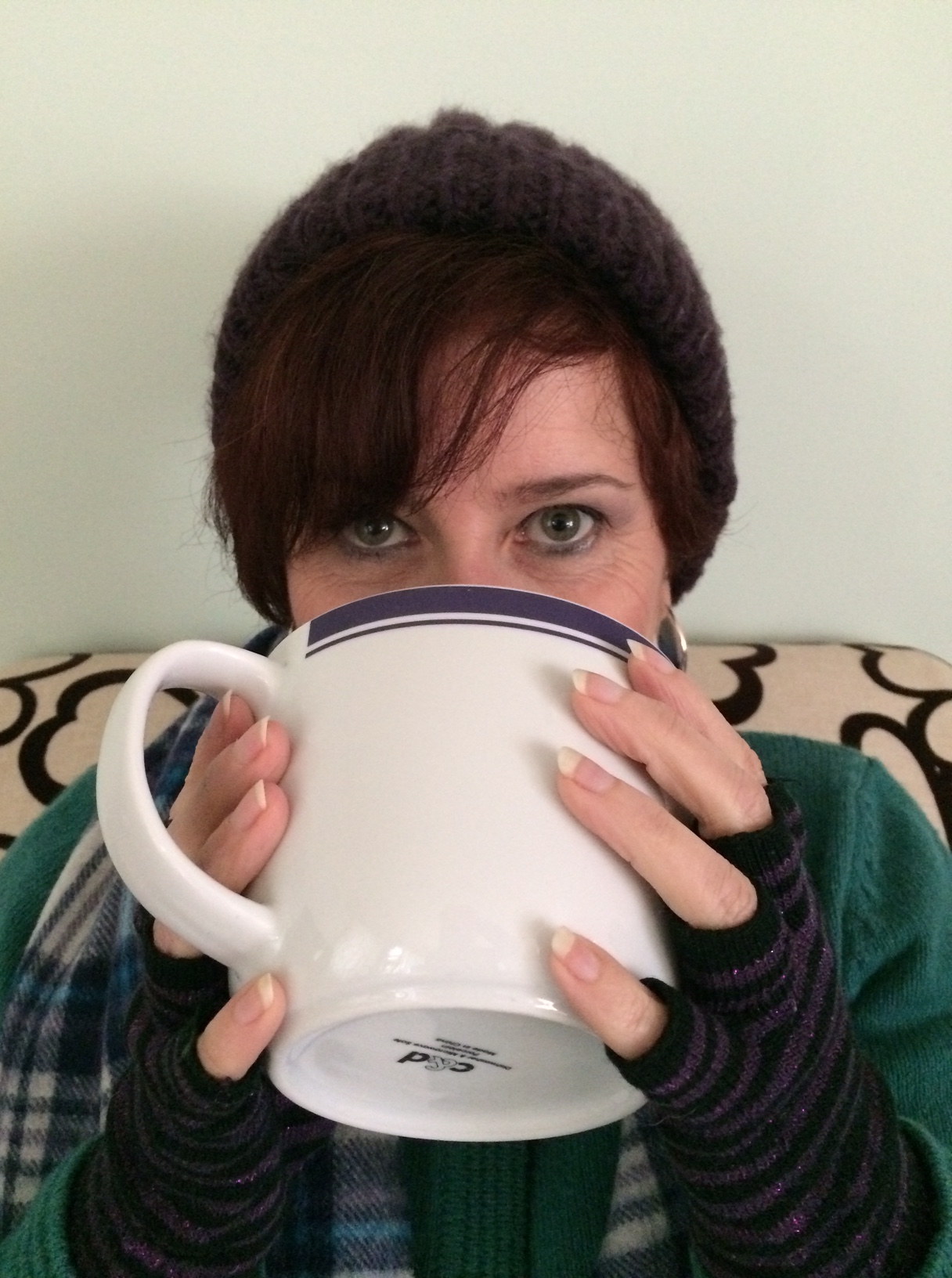
A toast to success!

thumb_IMG_1225_1024

“Ever tried. Ever failed. No matter. Try Again. Fail again. Fail better.” Many of us are familiar with this quote from Samuel Beckett. Many of us feel like we live it every day – well, at least the “fail again” part.

I’ve been reading a lot of columns and blogs on success and failure recently. Perhaps because it’s a hot topic of conversation right now (hey, if Chuck Wendig is talking about it…). Or perhaps because I’m unconsciously seeking them out, trying to figure out my own definition of success. And failure.
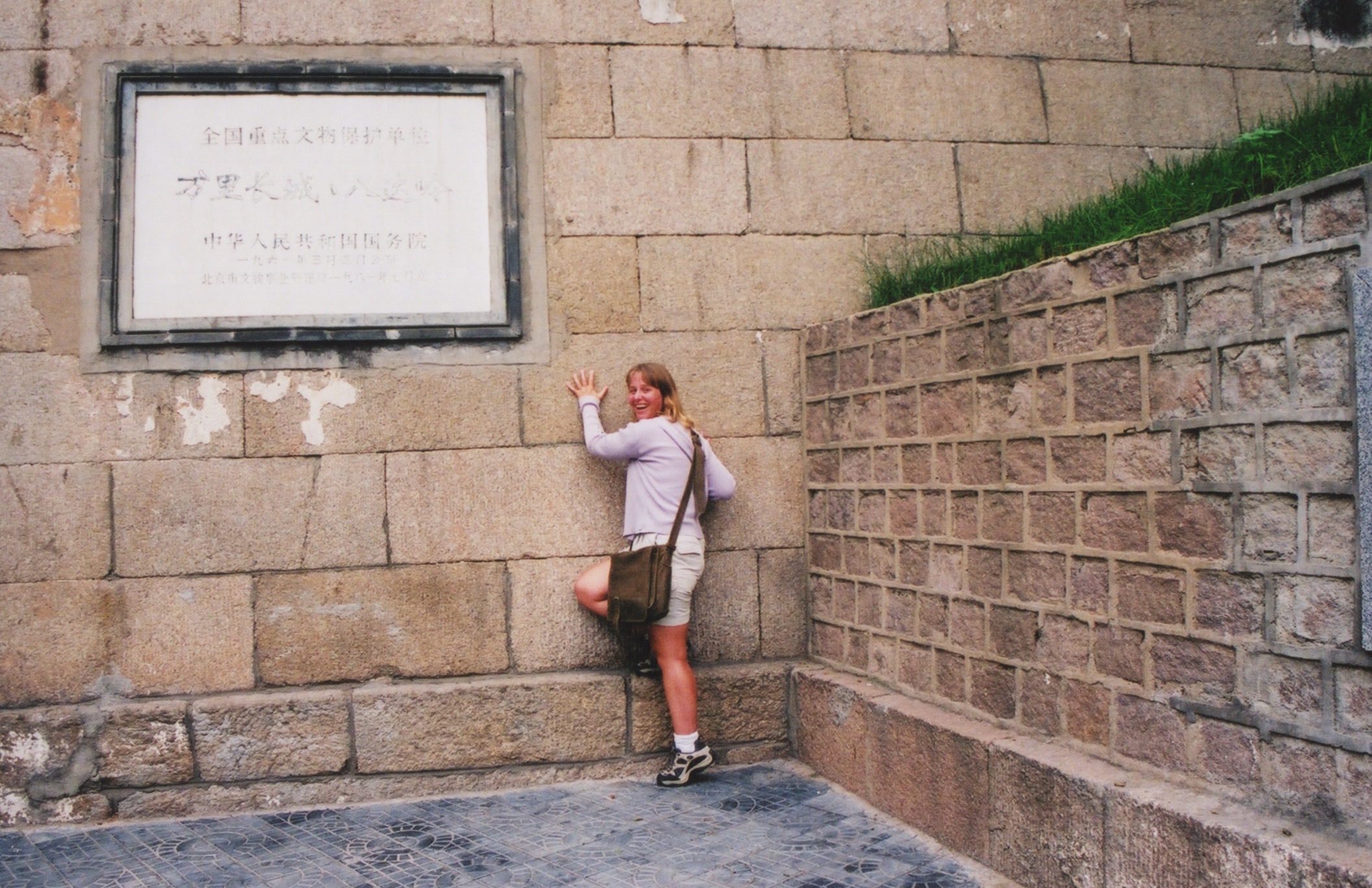
A much younger me trying to scale the Great Wall of China. I did not succeed.

As a writer, it’s my job to make sure failure is part of the story. Do my characters know exactly what they want, or do they have to make some mistakes first, to realize what they need? Does the detective catch the killer with his initial instinct, or does he struggle through a few wrong turns first?

For my characters, the choice is easy. They need to fail. They need to fail repeatedly, in fact, before they’re allowed to succeed. Who wants to read a story about a detective who always catches the killer as soon as he’s on the case? Not a very exciting read, if you ask me, and as James Scott Bell describes eloquently here.

We as readers are eager to read about a few failures before our hero succeeds in his goal. Perhaps because we thrive on the tension that comes with the ups and downs of the hero’s investigation. Or perhaps because seeing literary heroes fail before they succeed gives us hope for our own failures. Because we know that everyone—ourselves included—needs to fail before we can succeed.
A-Blind-Eye-Web-Small

I accept the value of failure in my endeavors, as frustrating as that can be. But I’m still left with a particularly vexing question: how do I define success? Sure, I can learn from my failures, figure out what to change to achieve a different result next time. But what qualifies as success? (Here’s a link to a post I enjoyed on achieving “success.”)

To tell the truth, I haven’t figured that one out yet. Each time I hit a milestone that I thought would define success, I realize there’s another peak ahead for me to climb. Until I figure out what Success (with a capital S) means to me, I plan simply to celebrate the small accomplishments, each baby step that brings me that much closer.

bubblyFor me, my small step toward Success this week is that my first book, A Blind Eye, is now available for pre-order as an ebook on Amazon (it will be available in other formats in September). So if you’ll join me, let’s drink a toast to these, the baby steps.

How about you? Have you figured out how to define success for what you want to achieve?
www.janegorman.com

The Perfect Murder Weapon

by Janis Patterson

We all believe that killing someone is easy as pie (remember, I’m speaking of in pixels only here) but it’s not as simple as it seems. The main trick is doing the deed and getting away with it. I mean, letting your character get away with it. Harder still is to make it so your sleuth can find enough clues to solve the mystery without making your killer seem like an idiot or your sleuth some sort of psychic/savant. What’s really hard is when your villain is so smart you really have to work to make it possible for your sleuth to catch him. I’ve had that problem in my current WIP, so I know whereof I speak!

One of the main things to catching a killer is the murder weapon. Guns and knives have traditionally been regarded as men’s weapons of choice, while poison is regarded as a more of a woman’s weapon, the rationale being that women are dainty little creatures of great sensibility who don’t like to see blood and gore. Really? And they kill people? Give me a break.

One of the main choices of murder weapon is dependent on its availability and traceability. A gun? Who owns it and how did the murderer get it? With the forensic ballistics available today – not to mention the creeping cancer of the gun control nuts – it’s harder and harder to make it believable that a villain can just grab a gun, shoot someone and get away with it. Of course, there are workarounds. The gun could be stolen. The gun could be bought on the black market. The gun could be ‘borrowed’ with the intent of framing the legitimate owner. Something else to be considered is that so much information needed to catch the villain – ballistics, registration, etc – is not available to an amateur sleuth unless they can wheedle it out of a policeman.

Forensics today can trace a knife down to the minutest measurement and shape and, if it is unusual enough, to the brand and store from which it came. If I were going to commit a murder with a knife, I’d go to the local Target or WalMart and buy the commonest knife I could, then afterwards boil it in bleach to kill any blood on it and donate it to some charity or other or leave it in a batch of kitchen utensils at a garage sale – after carefully wiping off all fingerprints. Of course, this is assuming the killer is strong enough both internally and externally to handle the strength necessary and the resultant blood, which is going to get all over his clothes. If you want to see how hard it is to stab someone, take your murder knife and stab a big, thick roast. It’s hard to get a knife deep enough to cause a fatal wound, but not as hard as stabbing a real life person, because the roast isn’t fighting you back!

Then there’s poison. First of all, where does the killer get it? Today so many of our commonly available compounds have had their poisonous elements removed or neutered. There’s nicotine, of course, sold for e-cigarettes, and it’s commonly available, but how do you know how much to use, and then there’s the problem of getting it into your victim. Same with prescription meds, which are generally fairly traceable because of limited availability. There are also the plant based poisons, but first you have to know about them, and again think of how much to use for a fatal does and how you’re going to get the resultant product into your victim Unfortunately for the killer plant based poisons are notorious for being both variable and unreliable. Poison contents vary according to the plant, the location where it was grown, the season of the year – and the phase of the moon for all I know. You never really know if you’ve gauged your dosage correctly until your victim either dies or survives. Also, this is considered rather esoteric knowledge, known to a smallish group of people (other than mystery writers) and fairly easily traceable.

For the hardy, there is always the staple of your two hands and a good old fashioned strangling. Of course, you have to know the victim well enough to get that close to him, and you have to be strong, for he will be fighting you. Strangling takes a great deal of strength as well, which basically rules out the delicately built person strangling a larger one. It also is harder than it seems. Life is tenacious, and it takes at least four minutes if not longer to strangle a person until death is assured, no matter how easy and quick it seems on television. Same objections with smothering. Unless the victim is unconscious your villain will both have to subdue and smother. Not easy.

So – is there a perfect murder weapon? Not that I know of. Every one has plusses and minuses, and in its way that is perfect for the mystery writer. You can choose one that fits your villain and your victim, but each method has built-in clues and difficulties that can, with a little accuracy and lots of creativity on your part, make it possible for your sleuth to capture your killer, no matter how smart that villain thinks himself to be.

Also, if you’d like to read the article The American Research Center in Egypt did on me and my upcoming novel A KILLING AT EL KAB, here’s the link – http://www.arce.org/news/u162

That Could Kill Someone by Paty Jager

paty shadow (1)As a murder mystery writer there are times when I have to acknowledge the fact my brain and actions could lead one to think I’m a psychopath or serial killer. 😉

I’m constantly on the lookout for ways to kill someone that is easy or unusual. Not because there is anyone in particular I’m thinking of offing, but because I need to find unusual and hard to discover mysteries/ ways of murder for my amateur sleuth and detective to come up against.

A recent trip on the Steens Mountains in eastern Oregon had my mind flashing in overdrive with scenarios that could happen on an innocent trek to the wilderness. Around one small lake where people camp and fish the undergrowth was so thick a person could be killed and their body hidden for quite some time before either the smell aroused a curious dog or coyote or kids playing would find it. The body could be hidden for weeks, months, or years, depending on when the killing happened and if there were people around to smell the decaying body. The high precipice where a person can look down over a mile to the Alvord desert is also an innocent, yet deadly spot. The vistas are breathtaking. Someone struck in awe of the sight could easily have a miss-step or push that sends them plummeting to their death.

Another interesting tourist spot is Diamond Craters. These large craters caused by lava tubes and bubbles are deep. The upper edge is lined with uneven, craggy rocks that could easily trip a person to fall head first into the crater and land on large boulders, up-heaved lava waves or a rattlesnake. Once the victim has fallen into the crater and is injured, if no one came along during a hot summer day, and if the injuries from the fall or a snake didn’t get them first, the hot sun and no water would give a person heat stroke.

Even the local historical museum had a storage room of sorts in the back that held antique items that had yet to be put in the museum. There were several long, heavy metal branding irons that could easily be swung with enough force to crack a skull and the body could be shoved behind a large wooden sign leaning against the wall. Or the rusted metal plow hanging from the ceiling could “accidentally” fall on an unsuspecting victim.

Even my own property has several places if not careful someone with a grudge could send a boulder hurtling down the side of the hill to wipe out an unsuspecting victim.

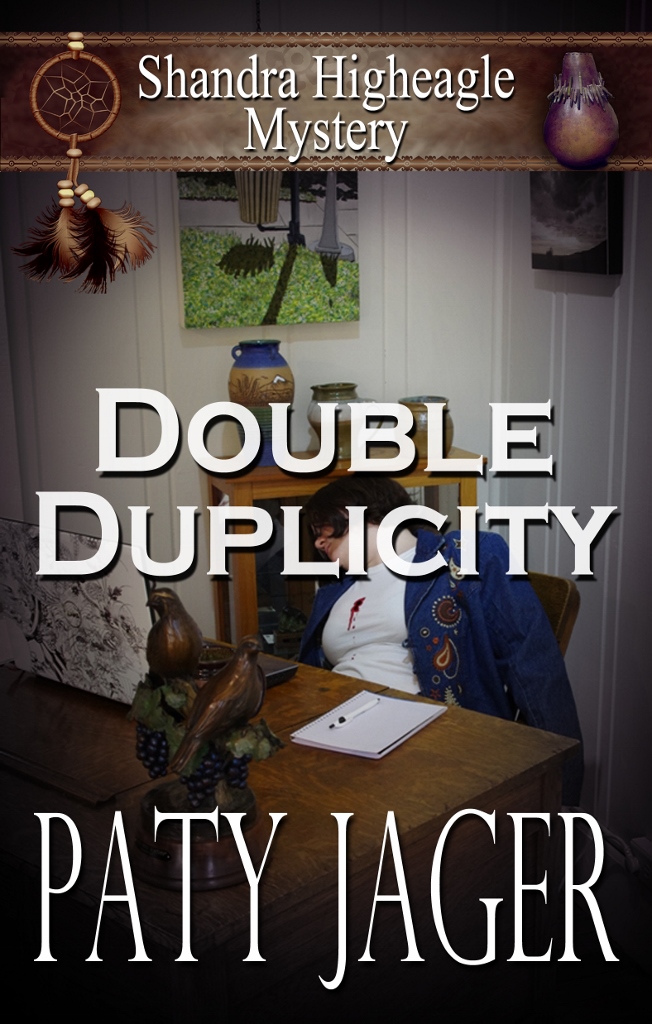
Double Duplicity (652x1024)I’ve always had an imagination that would put my family and friends into danger now I do it with my characters in the Shandra Higheagle Mystery Series.

www.patyjager.net

Writing into the Sunset

Facebook

A Time to Kill

IMG_1610The problem with being a writer is having an over active imagination. Maybe you need the imagination to write, like the chicken and the egg thing. However, once you start to write your over active imagination starts to creep into every day life.

I had a very strange conversation with my son on the drive to work the other morning. We were trying to work out how many bodies you could fit in the boots of the cars as they drove past. If you were looking to dump a few murder victims it would be important to know these things.

Even before I wrote about murder I had a very nervous disposition. I think living with my husband made it worse. He scares the beejesus out of me, not on purpose. He is a clutz. It took four coats of paint to cover the red wine stain on the lounge wall when we redecorated, and we  bought a dark gray carpet for a reason. Every spill, crash, breakage makes me jump out of my skin. I pre-empt him dropping things and he says it makes him nervous and more likely to have a mishap.

Now my over active imagination has me jumping at shadows. I park my car in a multi story carpark. Taking the lift has me thinking it will breakdown and I’ll be stranded. Entering the stairwell sets my heart pounding. The other night I sprinted up four flights of stairs because the door at the bottom banged shut when I was half way up the stairs. I immediately ran for my life sure that it was some crazy man set on doing me in.

Maybe I should write a new genre? My over active imagination would have a new focus and life could be less tense.  If I wrote romance my husband could sweep me off my feet and take me away from all this. How about a book about financial crime? It might give me some ideas about how to make a fortune and give up the day job.

Then again, I kinda like killing people. There is nothing better to do after a hard day at the coal face than coming home and murdering someone. I often joke with my work colleagues that if they make me grumpy I will invent a character with their name and kill them slowly.

Book review: ‘The Mystery of Nancy Drew, Girl Sleuth on the Couch’

Carpenter photo_WEB gif

By Sally Carpenter

What does Nancy Drew have in common with fairy tales, virgin goddess and Jungian psychology? Quite a lot, actually.

I found this book by a happy accident years before I began writing mysteries. I wasn’t even a Nancy Drew devotee. I saw the book on a shelf when I was browsing in Catholic bookstore in Chicago and on a whim bought the book.

The author is Betsy Caprio, a Jungian psychologist. In an engaging manner she examines the psyche of the girl sleuth. Despite Nancy’ constant upbeat manner, she has a dark side that craves adventure and danger. In fact, according to Caprio, Nancy displays many characteristics of an adult child of an alcoholic!

The Drew books play out several universal archetypes: the virgin goddess comprised of strong feminine energy and who is complete without a man; the fairytale princess who is always young, beautiful, and dresses in lovely clothes; the eternal teenager who never ages and is free of the responsibilities of school, job and family; and the paradise setting of River Heights, squeaky clean on the surface but possessing a dark underworld of crime.

Caprio gives a brief history of Nancy’s creation in 1930 by the Stratemeyer Syndicate, the publishing firm that also produced the Hardy Boys, Tom Swift Jr. and more than a hundred wildly popular juvenile adventure series. Over the decades the Drew books have gone through numerous ghostwriters, changes in Nancy’s character and story elements, various cover designs and even complete revisions of the older titles.

Caprio demonstrates how the Drew stories follow the “hero’s journey/quest,” a storytelling format dating back to ancient epics and legends. Simply put, the journey has: Invitation to the Quest (Nancy is asked to solve a mystery); Road of Trials with warnings, foes and helpers; “Death” Experience (Nancy is tied up, imprisoned or stranded), and Rebirth with order restored, a reward/gift for Nancy and glorification of the heroine.

Caprio ends her book by showing readers how they can be a “detective” and search for “clues” in understanding their own life’s journey using Jungian psycho-spiritual development.

The book is full of illustrations from Drew books through the years, showing how the girl sleuth has changed in appearance.

Some fans may not appreciate the negative aspects of Nancy’s personality, but to me this helps to balance the girl’s annoying cheerfulness and incessant do-gooding.

The book is full of insights into the elements that comprise a good mystery and a multi-layered heroine. I plan to reread the book soon to find tidbits I can add to my own writing.

Caprio’s book is out of print, but used and new copies can be found on Amazon and possibly in used book stores.