
 The Short Mystery Fiction Society (SMFS) has been hosting an on-line discussion about whether a writer should begin by writing short stories before tackling novels. Several of the contributors think that writing short stories is a good way to hone writing skills before tackling the longer work. Others say short stories often provided material which later turned into novels, while there are some who feel that these are separate skills to master. I like to write short stories between novels, giving myself a break, developing other characters and situations, but I wouldn’t say I am an accomplished short story writer. Short stories aren’t easy to write. They require at least as much skill as writing novels, maybe more. The idea that an aspiring writer can learn how to write novels by writing short stories doesn’t seem accurate to me. Generally, the best short story writers write only those. I have a tendency to add too much extraneous material in a short story, turning it into not quite a novella but something which is too long for a story and too short for anything else. The short story writer needs to stick to the point of the story, forget the extra material that crops up, and, particularly with mystery short stories, work toward an ending that will at least slightly surprise the reader. O’Henry, of course, was the master of the plot twist, as was Saki, but those are classics, and few of us write classics. But readers often feel cheated if the story ends with a whimper, not with at least a small bang. Literary short stories are different in that they don’t need a surprise ending, but they do need an epiphany of some sort on the part of the protagonist, some change in him or her. Alice Munro, a favorite of mine, writes only short stories, and she is a master. Most of her stories take place in rural Canada, and I identify with her characters and the setting because of years I spent as a child in rural upstate New York. Her stories are long for short stories, encompassing a lot of her characters’ experiences and often their whole lives. But the main character always experiences some change, some new realization in the way she sees the world. Read them all, and you’ll see. Such writing isn’t easy to do. In my opinion, writing short stories requires an equal or greater amount of skill than writing novels. The writer can hone her writing skills on them, but in order to write them well, she needs to master that art. Still, writing a short story from beginning to end can be very rewarding. There’s no need to go back to it day after day, week after week, month after month, as with a novel. Short stories may have a dreaded middle, but it’s a short middle, unlike the middle of the novel. The dreaded middle of the novel occurs when the writer, full of enthusiasm, has set up the premise, developed the characters and setting, told the reader what the conflict is, and has the reader in suspense about how the conflict will be resolved; but there are at least a hundred pages before the beginning of the ending. We’ve all read those: the novel that starts out terrifically with great characters and an interesting plot and setting that then goes limp in the middle. We wonder why we started reading the novel in the first place, wonder if we should just quit, but we can’t just jump ahead because something may happen that makes the ending understandable. The shortness of the story makes that middle not nearly so dangerous. Just make it a shorter story! I’ve had people say to me, “I don’t like short stories because it takes time to figure out who’s doing what and why and then the story’s over, and I have to start all over again.” Those readers like novels. They like to immerse themselves in a world where they’ve met the characters and know the setting, the problems, and the difficulty of finding the solution. Then they can luxuriate in that world for days or even weeks. Others like short stories because they can move quickly into a new setting with new characters, determine the problem and reach the climax, all in a short time. Each story is an exploration of a new experience. What do you, my readers, think? Do you read short stories? Do you like them, or do you prefer novels? Why? Let’s talk.
Month: July 2015
Short Stories v. Mysteries
Review – Lost Cause by JL Simpson
 I’ve slowly started integrating my fellow Ladies of Mystery authors into my “to be read” pile. To let everyone know I won’t give a 5 star review unless I loved the book and if a book doesn’t work for me, I’ll not review unless I liked it enough for a 4 or 5. And again this is my opinion.
I am a picky reader. The characters have to grab me right away and I have to become engaged in the story in the first chapter or I stop reading. I don’t have excess time to read. I have to love a book enough to make time to read. While eating lunch, while cooking dinner, while my husband is watching some TV show I could care less about. I spend most of my day helping on our 280 acres and writing.
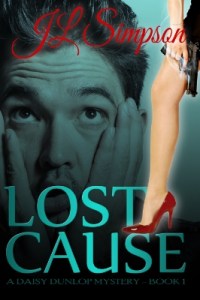 Lost Cause by J.L. Simpson
Daisy Dunlop thinks “heir hunting” is a perfect career. Too bad she has to work with her husband’s best mate, Irish PI Solomon Liffey. They’ve barely spoken since he took her husband Paul’s request to keep her safe far too literally and handcuffed her to the kitchen sink.
Solomon has no interest in babysitting a new partner, especially this one. The woman’s a bleedin’ liability. She has no concept of danger and could flirt for England at the next Olympics. As if that isn’t bad enough, she has a habit of sticking her nose where it’s not wanted, including into Solomon’s very private life.
Determined to keep Daisy safely out of his way, Solomon sets her the task of finding a missing lord. Her investigations land her in the middle of his case. Bullets fly, bombs explode, and the body count rises. When Solomon goes missing, the tables are turned. Now it’s his life that is in Daisy’s hands, and she has two missing men to find before it’s too late.
MY REVIEW – 5 Stars
I loved this book. I made time to read it. Every time I stopped reading I had a huge smile on my face. This book is cheeky, funny, and a well written intrigue.
Daisy Dunlop is a wonderful character. She lights up the page and has a vivid vocabulary. Her love hate relationship with Solomon is witty and well-played. The two make a raucous duo uncovering the mystery and uncovering the secrets in Solomon’s life. What I also liked is while Daisy is working with this woman-killer PI she never once forgets how lucky she is to have a loving husband. The scenes between Daisy and her husband are hot and loving.
The secondary characters were rounded, moved the story along, and well depicted.
If you are looking for a humorous whodunit, this is the book for you!
BONUS! This book is free right now! Amazon
Why We Kill
by Janis Patterson
It is not, as some of my friends have said, because I am an old grump who wants to do away with everyone who annoys me. Not all the time, at least.
That said, however, taking someone whom you dislike intensely, who has been egregiously rude/cruel/unmannerly/whatever, and offing them can be very relaxing and therapeutic. (Of course, I’m talking about killing only in pixels.) It’s cheaper than therapy, can be done multiple times if the first time is not satisfying enough and no one gets really hurt. And, if you’re lucky, you can make a little money.
But why do people want to read about people being killed? After all, killing is messy. It’s permanent. And it’s very very illegal. I think the reasons are as varied as the readers. And the writers. Sublimation. Wish fulfillment. Excitement. The thrill of the chase. All basic human emotions, but I think the main reason is that in a mystery novel we want the assurance that all will turn out right – the murderer will be caught and properly punished. Balance in the world is restored. Justice is served.
I believe every rational person has a deep sense of justice. A lot of times the murder is committed because in some possibly twisted way it fulfills the murderer’s sense of justice – as incomprehensible as it might be to anyone else.
When we write or read mysteries we are not only indulging in escapism, we are shoring up the foundations of justice. The crime is solved. Balance returns. Our inner world is stable once more, even if the real world is far less simple or predictable.
Which means that we as writers are fortunate. I mean, how many people can say that we not only entertain, but we contribute to the happiness and mental health of the world? And all by killing people…
Creating more ‘dramatic’ characters
 By Sally Carpenter
When I began writing in earnest, I was more interested in playwrighting than penning novels. As a kid, I checked out plays from the local library to read instead of novels. Plays read fast (knock one off in an hour!), had lot of white space on the page, and got to the action immediately. Books had hundreds of pages of close-set type, long passages of boring description and slow moving plots.
Now that I’m entrenched in writing cozies, the skills I learned as a playwright are still serving me well. One of the primary tools for character development that I picked up from acting class is major meanings. The following is an over-simplification of the process.
Every person has major meanings in her life. These are the two to three things the person needs to have a fulfilling life. Major meanings are tangible items, not abstract ideas like joy, peace, security and safety (although the major meanings might provide such things.)
The major meanings create tension among each other. When one major meaning is realized, another meaning may be neglected.
An example: a middle age female executive has the major meanings of career advancement, family and sobriety. However, climbing the corporate ladder leaves little time to spend with family. Business lunches and networking parties with an abundance of booze flowing might tempt her sobriety. She may forgo a job promotion so she can care for an aging parent.
Watch the sparks fly when two characters have different major meaning. The wife values peace and quiet but hubby, who loves auto racing, wants his buddies over to watch the Indy 500 on the big screen TV. Resolving the conflict to everyone’s satisfaction (or not—that’s when the murder occurs) is the stuff of good storytelling.
For the writer, major meanings are often not planned in advance and may pop up as the manuscript progresses. The author should never state major meanings outright but let the reader discover them.
When an actor approaches a play, she reads the script until she finds her character’s major meanings and then she internalizes them. She imagines herself as the character living out her major meanings and life history. When the meanings are ingrained, the actress goes on stage and, as she says a line or listens to the other characters, the right feeling and reaction will occur because the major meanings will spring to the surface naturally and in the moment. This provides a more natural performance than for the actor to plan to advance how she will say or react to a line.
In my writing I often imagine myself in the character’s place or “see” the character acting out the scene in my mind. If I’m stuck for what the character will do or say next, I let the major meanings simmer and the character will do the right thing. (Writing is harder work than acting. An actor only had to build one character whereas the author has to do the work for several!)
To put this idea into practice, take a favorite novel, play or movie and find the protagonist’s major meanings. How do these meanings cause the character to make the choices she does? How do the major meanings of the other characters, cause conflict for the heroine?
 Ladies of Mystery
You must be logged in to post a comment.