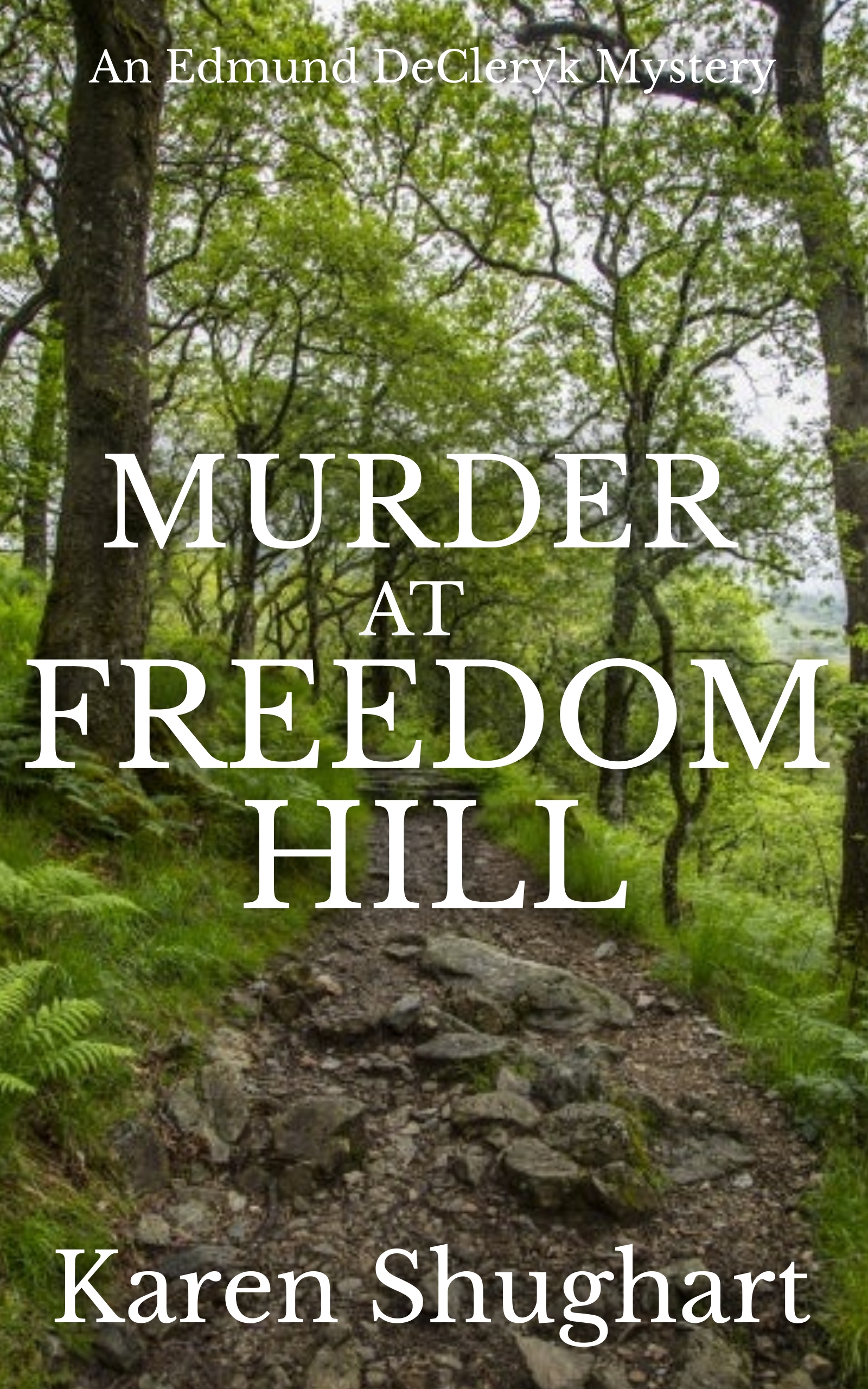
The Peace That Follows Chaos by Karen Shughart

December is chaotic here on the south shore of Lake Ontario in New York state, but in a good way. It’s busy and a lot of fun, but by New Year’s Day we’re exhausted and ready for some quiet time. The season starts the weekend after Thanksgiving, but then the entire month is filled with parties, shopping flings, festivals, gift exchanges, impromptu gatherings, and food – lots, and lots of food – both the cooking and eating of it.

Decorating is big up here, and although we don’t do much of that, just a little festive touch or two both in-and-outside our house, many friends and neighbors go full bore, hoping to win or place in a contest sponsored by our Neighborhood Association for the best outdoor decorating. And many of them do.  Frankly, it’s quite impressive, and more than a little magical.

Now it’s January. The decorations have been stored away for another year, the snowbirds who flew north for the holiday have migrated south again to spend the rest of the winter in warmer, sunnier climes. The days are a bit longer, and while that’s certainly good news, they’re a bit grayer, too, and there’s more chance of snow. While we loved the hustle and bustle of the previous month, we breathe a sigh of relief.

We greet our like-minded neighbors when we walk each morning, but other than the roar of the waves crashing on the beach or the sound of the wind, it’s quiet. A couple restaurants and almost all the shops have closed until spring, and there’s not much traffic, hardly a vehicle to be seen traversing through our streets.

Now our gatherings are small ones: intimate dinners with friends at the restaurants that remain open; a pot of soup or chili with a small group at our house on a Sunday evening; a ladies’ night out; or for my husband, the regathering of his summer golf group for lunch and playtime at a virtual, indoor facility.  I happily resume my yoga classes. We venture to the city to take advantage of the cultural offerings there: a symphony; a Broadway show presented by a traveling touring company; or special exhibits at museums and galleries.

I’d been making good progress with the fourth book of my cozy series, but during December that project was mostly put on hold. This is the month when I commit to moving forward with my writing, and have been spending at least part of each day expanding the story as I continue with the first draft. Then, later in the afternoon, I read, fire burning in the fireplace, a cup of tea in hand.

Some friends and family who don’t live where we do wonder how we manage during this time of quiet and isolation, with weather that’s fickle and can change in a minute or two. For us it’s a time of centering and peacefulness, and it’s very beautiful with white caps on the water, grey skies intermittently clearing for brilliant blue and bright sun, starry nights, and a landscape dotted with wheat, rust, faded green and brown. Because many of the trees are barren of leaves, I can see the lake and bay and the tops of the two lighthouses that flank each end of our village beach from several rooms in our house.

By March, we’ll be ready for a change and begin to search for signs of spring: daffodils peaking above the thawing ground; buds starting to swell on trees and bushes; a greening of the grass. But for now, we’re enjoying the peace that follows chaos.

A member of Crime Writers’ Association of the UK ( CWA), North America chapter, Karen Shughart is the author of the Edmund DeCleryk cozy mystery series, published by Cozy Cat Press, including the award-winning Murder at Freedom Hill.  All books have historical backstories that provide clues to why the crime was committed, and recipes at the end. They are available in Kindle, Kindle Unlimited, paperback, and Audible.

A New Year, A New Me?


by Janis Patterson

Don’t worry – this isn’t going to be an evangelistic paean about how I’ve totally remade myself to claim a glorious and bounteous New Year and the rest of my life. That would be nice, though, but I’ve tried it before and it doesn’t work. For long, at least. I think my record is about two weeks.


No, I’m the same old curmudgeonly, opinionated, workaholic biddy I’ve always been. The only changes are that I am a year older and – for a blessed change – rested. From writing stuff, at least. I finished my 22 novel republishing blitz on 25 October. I was so tired (and cranky, I will admit) that The Husband insisted I take November and December off.
And that proved to be a good thing. I am indeed rested and the creative mind is starting to percolate again. I would like to say that my house is cleaner, but I don’t tell lies. Sadly, it probably never will be, as I totally lack the housekeeping gene… and I thought I’d never marry anyone who was as bad a housekeeper as I, but… A sterling man in every other way, but…


We spent the early part of December in Germany, redoing our favorite Christmas market tour, enjoying good German food and beer and a refreshingly enthusiastic attitude toward Christmas everywhere from the markets to the stores to the street decorations. And the people. Love the people.


It’s a good thing I had no other commitments, as since the third week of December I have been at war with Lufthansa airlines about their last-minute cancellation of the final leg of our inbound flight and the subsequent disappearance of our luggage. My bag was found – in the hands of a thief, no less – but The Husband’s is still among the missing. Not to go into details, Lufthansa has handled the thing very badly and withheld information we need if we are to go forward, information that none of the dozen or so of Lufthansa employees we talked to said we needed. Needless to say, it is going to get very ugly.


Back to writing. Aside from the Lufthansa unpleasantness it has been a lovely two months. Germany was – as always – beautiful and fun. My writing mind is unfolding and starting to bloom. I’ve contracted for two novellas – one a Regency romance for a ‘summer weddings’ anthology, the other a WWI mystery for an anthology centered on July 4th. The other novellas include the Revolutionary War, the Civil War, WWII and Viet Nam.


And that doesn’t address the two nearly-finished books of my own done for my own publishing company and a major new release that has to be stage-managed. I’m even considering releasing a compilation of my blog posts from years past. Plus, we’re off to Egypt again in a short time. This will be my 8th trip and this time I get to see Abu Simbel for the very first time! I’m so excited!


Sounds like I won’t be rested for very long.


A writer’s work is never done. But – it is a lot easier when you are rested both mentally and physically, even if that desirable state only lasts a short time. You have to let the well refill. A happy new year to all of you –

Age or Too Much Juggling?

It’s only the first month of the new year and this is the second group blog I’m on that my Google calendar told me I had a blog today. Yeesh! I have never in twelve years not had a blog already scheduled to go.

In fact, yesterday, Sunday, the day I plan out my week, I wrote down to write my Ladies of Mystery blog post on Tuesday, because, when I looked at January in my date book, which is my bible to keep things straight, I had written down my post was the third Monday of the month instead of the second.

How I managed to do that FOR THE WHOLE year when I received my new datebook in July, I don’t know. All I had to do was look to my left and on a corkboard there is a list of when each Ladies of Mystery author blogs during the month. Now, I have to go back through my datebook and cross out the LOM on the third Monday and put it on the second. And yes, cross out. I use different colored ink pens for different things that are happening.

Orange for the days I post on my Writing into the Sunset blog, Purple for the days I post on here and the other group blog. Bright pink for book specials and events, Blue for when my6 newsletter goes out. And black for personal appointments and events.

I use pencil for guest bloggers on Ladies of Mystery and to keep track of how many words I’ve written.

I also have a whiteboard with three columns where I write the months in one column in purple, the next column is in green and it is the title or number of the book in which series I’m writing, and a column in pink with the title of the book releasing that month.

Then below that, I have a new keeping track project that a very successful Indie author uses to keep track of her specials and events. I decided to use it this year and see if it can help me do a better job of staying on top of promoting my books. It is a 2′ by 3′ write on calendar of the whole year. It is to help me keep track of what book, where, and when I promote it and to keep the promotion flowing all the time. That has been my biggest problem. I start out promoting and then I get caught up in the other sides of being an Indie author and forget to keep promoting. This calendar with everything scheduled is a visual of what I need to do and what is happening. I hope it works.

And again, it is color coordinated. Blue for audiobook promo, green for ebook promo, and pink for special events.

And yet, with all of these reminders, I forgot my group blog post last Monday and today’s for this blog. I’m wondering if I need yet another calendar or whiteboard to keep me in line. What do you think? I’m off to change the purple LOM in my datebook to the second Monday. Have a great day!

Let There Be Light by Karen Shughart

My husband and I live in a charming maritime village on the south shore of Lake Ontario in New York, the prototype for Lighthouse Cove, the village where my Edmund DeCleryk cozies are set. This time of year in our village activities surrounding the holidays abound, and there truly is something to do for people of all ages: festivals; tree lightings; parades; caroling; shopping and dining opportunities, and a judged competition for the best outside holiday decorations.

 I especially like writing about the seasons in my books. In my third, Murder at Freedom Hill, the crime occurs just before Thanksgiving with the investigation continuing through the entire holiday season. I enjoy describing how the folks living in Lighthouse Cove celebrate, with light-filled activities that juxtapose the dark, horrific murder that has occurred.

Ed, a retired Navy SEAL and former police chief, now works as a criminal consultant who is hired by the current police chief to solve the crime. His wife, Annie, head of the local historical society and museum, curates exhibits, organizes special events, and because of the historical backstories that frame each crime, often becomes involved in the investigation.

One of these special events occurs early in December, when the days are short and darkness prevails. A Festival of Lights, held on the grounds of the museum, provides diverse groups with an opportunity to showcase the ways in which light plays an important role in their cultures during this time of year:

Photo courtesy of Lyle Shughart

“The Holiday Festival of Lights was held in the park next to the museum the following Saturday evening and started at dusk. Tall stadium field lights provided illumination, and the museum staff and volunteers had strung multi-colored holiday lights on bushes and around tree trunks. Several portable fire pits had been placed at strategic spots near park benches to provide warmth.

The Neighborhood Association maintained a booth that offered free hot chocolate and cookies. Other booths, with representatives from local Christian, Jewish, Muslim, and Hindu congregations, offered information about their holiday customs including the significance of light, and samples of traditional holiday food.

Santa ambled through the crowd passing out wrapped red and white candy. A group from near Tug Hill brought live reindeer, tame enough to pet. Children hopped on the back of a fire truck, a huge wreath on its hood, for a ride around the block, speakers blaring seasonal winter songs.

A large evergreen tree located in the middle of the park was festooned with multi-colored lights; a Chanukah menorah, Kwanzaa kinara, and clay diyas—oil lamps representing the Hindu holiday of Diwali—flanked the tree on large tables on either side.

Towards the end of the evening, the high school student chorus handed out sheets for a sing-along and led the community in a diverse selection of melodies representing all the groups at the festival.”

A definition of the symbolism of light from the National Gallery of the UK states: “Across cultures, light is an ancient symbol of understanding and intellectual thought: it is the opposite of ignorance, or darkness. Almost universally, the dark is …frightening and sinister, associated with things we cannot understand. Light is said to conquer darkness and to bring order out of chaos.”

We all need a little light in our lives this time of year, so, let there be light!

Motivation

I’ve been working on the sixth Anita Ray mystery since July, and now have 44,000 words. That by itself should tell you that I haven’t been well focused on this one, but I’ve had two epiphanies this month. First, I know what the big crisis will be, and it’s coming up in the next 10,000 words. Second, and much more important, I don’t have to know a character’s motive until I get near the end.

This, the second discovery, surprised me. I’ve struggled with finding motivations for my characters’ behaviors beyond their conduct simply being the result of who they are, their past experiences and hopes for the future. That’s always been true of any character, but when it comes to murder or some other form of violence, I need to see something more in this person I’ve created, something that the reader hasn’t already divined by reading about him or her. 

We stitch together our fictional creations from snippets of real life. Riding on the subway or bus or train brings us into contact briefly with the oddities of our world, the woman who wears orange sandals under a plaid lumber jacket on a sunny day, her jacket covering up fabric of such color we’re dying to get a look at it but she’s buckled up tight. Perhaps the only thing about her buckled up. We overhear snatches of conversation. I still wonder about the meaning behind the casual words of two men in a cafe. She’s always been like this; it was no secret. But he married her anyway? He did. And it isn’t medical? Nope. I really want to know what “it” is. And then there was the package that arrived at a neighbor’s, which she sniffed and shook, and apparently rejected because she left it on the front step. I don’t know what happened to it after that, only that it disappeared.

I’m curious about these people’s lives but if I put them in a story as a killer, I need to know what would make them kill. Being odd or different or cryptic isn’t enough, as every writer knows. We look to the great ones in our genre—Agatha Christie in the traditional mystery, Ray Bradbury in science fiction, or James M. Cain for noir—and think about how they developed their characters’ moves and failures. The motives for crime can be limitless, but perhaps the shortest list comes from Christie: greed, lust, envy. Those cover just about every failing in life.

I’ve been thinking about these for weeks now because even though I have a murder, another crime coming up, a diverse cast of miscreants, and a great deal of stupidity, I still don’t have a motive for the inciting incident. At least, I didn’t. That was part of the second epiphany this month. The characters can have all sorts of immediate short-term motives, but the one that’s driving everything has to be larger, tied deeply and inexorably to the character’s identity. I found it this month, and it has delighted me. It was almost obvious, but not quite. 

The surprising thing to me is that I’ve written half the book without knowing why this is all happening and happening in the way it is. We watch people in life, just as in books, wondering what they’re up to. We’re waiting to cross the street when he see a man on the opposite sidewalk stop and stare in a store window; he peers, he moves closer, he looks around to see who else is nearby, and he stares even harder in the window. When he walks on, looking back once or twice, we cross the street and try to guess what he was looking at. It’s an old-fashioned tailor’s shop with the expected clutter in the undusted window—scraps of fabric, a bolt of cloth, a tape measure, a small cardboard box of pins and other notions. In the unlit interior beyond, we see nothing to catch our interest. So what was he looking at? He wasn’t wearing a fine suit, just a short jacket and slacks; and he wasn’t old enough to have known about regular tailors in this little city. But there is something in that window . . .

I stopped worrying about my characters’ motivations in this particular novel while I wrote, figuring each one would either come to me or it wouldn’t. And I have faith in my unconscious to supply the needful. But I’m also flexible, and if a better one pops into my head, I’ll go with that. This is all part of the path I decided to try with this book. I would write it without guideposts, outlines, clear (or vague) ideas of where I was going. If a character or incident popped into my head, I’d add it. I’d just keep going. It’s very liberating but also a little scary. I’m not sure what I have, if anything, but I do have a sense of things coming together. I’ll let you know in another 20,000 words or so where I am.