Spring Has Sprung

by Janis Patterson


I have never had any trouble being lazy, which is a difficult thing for a writer to overcome. Our careers – to say nothing of our incomes! – depend on us being self starters who have to be responsible for getting everything done when it is due.


And that’s hard to do at any time, let alone when warm weather has finally returned, and the song of the hot tub, or the pool, or the garden is heard in the land. Frankly, I much prefer being on the porch, a glass of iced tea beside me, watching the antics of doves, blue jays, cardinals and lots of little brown birds jockeying for supremacy at the bird feeder, and the squirrels hanging around at the bottom of the pole, hoping for some spillage. Sometimes a hawk will fly overhead and suddenly everyone disappears, either under the deck or into the leafy trees. Then, once the dark shadow is past, they’re back chowing down. There must be some sort of wildlife telegraph about sucker humans who put out free food, because every day there are more. I fully expect the next time I oversleep there will be a delegation knocking peremptorily at the patio door.


See? See how easy it is to wander off into current pleasure – especially when ‘current’ is so beautiful and enticing – when you should be concentrating on immediate deadlines. I have to finish one book, am halfway done on another, really need to do some research on a long-neglected non-fic history, format a special edition paperback for the goody bags at our SCV reunion in July and… I’m sure there are several other somethings, but can’t remember them at the moment. You see, the blue jays and the doves are having a ‘discussion’ about who is next at the feeder.


At least last week I presented my seminar on ‘The Secrets of Republishing Your Backlist’; it was tiring, but received quite well. I am still working on ‘Your Story – How to Write A Memoir’ that I’m giving at the end of the month in Arkansas. I think that’s all of them…


It’s so much more pleasant to sit and watch the Bird Wars, but that does not make a career. I really do have to be more disciplined. When I worked in a 9-5 job I would have fired an employee as easily distracted as I. Successful work depends on projects finished. Well, I do get my projects finished, but not in as timely a fashion as I might wish.
How do you get things done? Do you adhere to a strict by-the-hour schedule, or simply pants it, getting things done even if it means staying up all night, or something else? Let’s face it – no matter what system/systems we use, every once in a while an unkind Fate will dictate that for one reason or another we have to pull an all-nighter. Or two.


But we get it done. We’re writers, and we know what we have to do. Even when there are Bird Wars at the feeder, the temperature is perfect and the hot tub is calling seductively. We are writers.

Adapting Agatha and Other Greats by Heather Haven

Several days after returning from the Left Coast Crime Conference, I came down with one of those upper respiratory bugs that are sent to try us. After making sure it wasn’t Covid or RSV, I accepted and dealt with it. Medicated up the wazoo, bored out of my mind, and feeling sorry for myself, I turned to what I always have in times of trouble – murder and mayhem.

One to never let me down in that department is Agatha Christie. I think I’ve read everything she’s written and loved them all. I even liked The Big Four, considered one of her worst. Frankly, I’m convinced that even her worst novel is better than a lot of other writers’ best, but maybe I am prejudiced.  Whatever, it was Agatha Christie Chicken Soup time.

Assessing the situation, I realized the Kindle was being charged and any reading materials in the bedroom were aaaall the way across the room on bookshelves. Doped up and lazy, I reached for the remote. I managed to stream in a collection of several versions of Agatha Christie’s Miss Marple done throughout the years. I glommed onto Joan Hickson, who I feel is the quintessential Miss Marple, sharp but seemingly befuddled, all-knowing but not pushy about it. And here she was, in one of my favorite Christie stories, Nemesis. I blew my nose, settled in, and went back to jolly old England during the fifties aboard a week-long motorcoach of historic homes and gardens.

Before long, everyone aboard the bus winds up to be a suspect, of course, having either won the tour or offered hard cash to join. Most damning of all, each was a player in a past … secret. But nothing throws Miss Marple for long. She’s there, complete with godson companion, in accordance to the wishes of a recently deceased friend and millionaire, to right some horrible wrong from the past, no matter what the consequences. Thus, the name Nemesis. Guided by a biblical saying “Let Judgement run down as waters and righteousness as a mighty stream,” the story moves forward and pretty much follows the original, Christie plotline which is chilling, fiendish, unique, and satisfying.

I got greedy. Right next to this episode was yet another Jane Marple thespian, Geraldine McEwen, appearing in the very same mystery. I thought, well, why not? The comparison of both might be fun, and Lord knows I’m not very busy. So, hubby brought me a cup of herbal tea, a scone, and I settled in again. Okay, not a scone. It was actually a chocolate croissant but munching on a chocolate croissant doesn’t sound quite right for the occasion.

Ms. McEwen presents an intelligent, twinkling Marple, as if she knows whatever she is saying is clever and important and you’ll catch on in your own good time. I found her Marple charming. I liked her. The storyline, not so much. In fact, I was completely at a loss as to what was going on. It still took place on a bus tour of historic homes and gardens, a few years after WWII, and there were a host of odd characters showing up with familiar character names, but they were nothing like the original ones. In short, there was no similarity on any level to the book or even the 1989 Joan Hickson version.

This version involved missing airmen, whackadoodle nuns, scarecrows, and a bust of Shakespeare used for nobody’s good at all. Even the villain was different and once revealed, was an unsatisfying one, at best. I couldn’t blame the budget. It looked to me as if the same amount of money and attention to detail went into making the 2007 version as it had the one done twenty-years earlier. But this 2007 Nemesis made no sense. I became cynical. Some hotshot somebody or other, under the guise of transporting the work from one medium to another, thought they could do a better job of Agatha Christie’s story than Agatha Christie. As Puck says, “What fools these mortals be.”

Not-so-cleverly segueing over to Shakespeare, here is someone else whose stories are often played with as fast and as loosely as Agatha’s. They have cut, added, rewritten, edited, obliterated, updated, melted down, puffed up, refined, and poured over brine everything he has written. It is rare to see his work performed in any of its original form, especially the same historical period. Too old hat. Others need to put their stamp on it. So if you’re off to see the latest version of Macbeth, it might have a Polish circus or a Macon, Georgia, WWII prisoner of war camp as a backdrop.

Back to Agatha. I remember one horrible adaptation of And Then There Were None in 1989. They called the movie Ten Little Indians. This particular novel has had many titles throughout the years. Namely, different forms of Ten Little Somethings Or Other. Not much worked until they came up with And Then There Were None, which might seem to give the plot away but apparently doesn’t. And it’s PC.

Regarding the plot, the scriptwriters changed the location from an island along the Devon Coast and plopped it amid an African safari at the bottom of a ravine, their idea of remoteness. Here, the roar of a surrounding pride of lions can often be heard but are never seen. I suspect the big cats were too embarrassed to be caught on-camera. Even Donald Pleasance and Brenda Vaccaro could not save one single moment of this dreadful interpretation. And yet I watched every frame, hoping against hope it might save itself. After all, it was Agatha’s work. Maybe somebody in charge got a clue and reverted back to what worked in the first place. Maybe somebody saw the rushes. Maybe the Serengeti rose en masse and took back its own.

Nope.

One reason for the wild takeover of someone else’s work could stem from filmland’s past history. From 1930 until 1968 every single movie, including adaptions, had to follow the guidelines of the Motion Picture Production Code of 1930, also called the Hays Code. The Code was a strict master and you’d better believe it. It didn’t mess around, it didn’t compromise. If the code found one scene didn’t meet those standards, the entire movie could be scrapped. Goodbye production, cast, and crew. Hello breadline. Below is a link to what a studio had to deal with: https://cinecouple.hypotheses.org/files/2017/07/Code_Hays.pdf. That’s still no excuse for some of the stunts adapters pulled throughout the years, even though sometimes rewriting had to be done. Unfortunately, it did give those with power, money, and ego a chance to play around with a genius story until it resembled the original work in title only.

Here’s an interesting fact, though, in the it-pays-to-be-good category. No matter what a screenwriter, actor, producer, or director does – and they can make all the idiotic versions they want – the reality is nothing can diminish the author’s original WRITTEN words. Anyone who wants to know the talent and timelessness of the Bard or the Queen of Mystery and others like them, have but to sit down and read their books. The power of the word. It never goes away.

The Blank Page

Like many writers before me, I get a deadline for an assignment and spend the days, weeks, or even months leading up to it thinking about what I’ll write. If I pick something lighthearted, I have to consider just how far to go in the humor direction. If the topic is serious, I worry I’ll sound earnest (Oh, the shame!). Either way, I let my mind wander, make a few notes as I go along (and try to keep them on the same pad of paper), and sit down to write with ample time to revise and edit. And then on the day when I’m supposed to post, I plan to finish the essay with a light and quick rewrite, just to keep it fresh. I open a new page, and there it is. The blank page. I’m catatonic.

What is it about the blank page that makes my brain go blank as well? I look at that white sheet which now has the vastness and strangeness of the Sahara covered with a blanket of snow, and I haven’t a thought in my head. Not even an idea that I’m looking at a blank sheet of paper on a computer screen. Nothing. 

I had so much to write about this morning at 5:30 a.m. I woke up to the morning sun lightening the New England sky, reminding me that today was supposed to be a nice day, upper 50s along the coast, possibly even hitting 60 degrees. A good day to be outside tackling the weeds and cleaning things up for spring planting. I had the luxury of just lying there thinking about all that I could do today after I posted my blog for the fourth Saturday, my regular day for Ladies of Mystery.  But by the time I got to my desk and laptop, something unbeknownst to me was draining my brain of every idea I’ve ever had.

I’ve thought about ways to cheat the blank page of its power to cripple me. It’s possible that pulling up a page from an earlier post will stimulate my tired synapses to get popping, but then I have to make a decision and choose a page. Nope. Still crippled. I could pull up a page from the novel I’m working on (and have been since last summer—what’s with that?) but then I’m liable to fall right into my usual funk of trying to figure out what’s wrong that scene or the other one in the same chapter. Not good for morale, which I need right now.

If you, reading this, are also a writer, you’ve probably already shut your eyes hard against a painful memory of a blank page, the one that just wouldn’t let you get started on what you hoped would be your greatest ever WIP. This experience drives me to question, what is the purpose of the blank page? And I’ve decided it’s the Universe’s way to test us, to make sure we know what we’re doing. If I pulled up a new page and started tapping out advice for ingrown toenails, the Universe would be telling me I’m in the wrong business—I’m not a writer; I’m a frustrated podiatrist. Perhaps I decide to explore the drawing or designing function on my computer. Okay. Problem. No words. 

The blank page is the test for me every time. I don’t know what I’m going to write. Even if I think I do, I don’t know what’s going to come out. No matter how much I plan, no matter how much energy I waste on sample paragraphs or opening lines, the minute I look at that blank page, I go blank, white, empty, nothing. And then something comes up, something not planned, not expected, not even understood sometimes. There it is, and a wonder among wonders, For me writing is like breathing. I don’t really know how it works, but I know that it does and that’s enough for me. I thank the Gods of Desperation and go on typing.

Facing the blank page forces me back on myself every time—challenging me to trust that whatever shows up, making my fingers wiggle and stretch, spreading those black squiggly things across the white space, has to be what matters to me at that moment. On this I have no questions, which is good because I also have no answers. I take it all on faith.

I write because I have to, and I accept what comes also because I have to. It’s me.

Picking Up Steam by Karen Shughart

I recently received an email from someone who has read all the cozies I’ve written. She said that while she enjoyed each of the books in my Edmund DeCleryk series, she thought the most recent one, Murder at Freedom Hill, was the best; with each book my writing skills have evolved, with layers added to each story. I appreciated her candor, and she probably was correct. My writing has in many ways been like a train, metaphorically picking up steam, and adding railroad cars as necessary to accommodate a growing number of passengers seeking to get to their destination.

With the first book in the Edmund DeCleryk cozy mystery series, Murder in the Museum, I wrote a prologue that introduced a historical backstory that provided clues to why the present-day murder occurred. As the mystery unfolded, the backstory, spanning the late 1700s to the mid-1800s, continued with artifacts found in the basement of the museum and discovery of a memoir written by a man who, in his youth, had made terrible mistakes but who redeemed himself in adulthood. It was a short story within the book.

I continued with the historical backstory concept in my second book, Murder in the Cemetery, after deciding it would always be part of my cozies. But this time after the prologue, I conveyed it with the discovery of an artifact at the cemetery where the victim was killed, and a series of letters a lonely wife wrote to her sister while on a quest to find her husband, who had been transported to England as a prisoner of war during the War of 1812. Instead of one prologue I wrote two, the first introducing the backstory, and the second giving the reader the seasonal setting for the present day murder.

In the third book, Murder at Freedom Hill, I continued with the two prologues and the backstory-a narration for an exhibit at the historical society about the victim’s ancestors, both Black and White-who were involved in the Underground Railroad and Abolitionist Movement. Then I added a subplot that was separate from, but intricately woven into, the main story.

Now I’m working on book four, Murder at Chimney Bluffs. In this one, I continue with techniques I used before: the two prologues, the historical backstory -now rumrunning and the Prohibition era -but the backstory will also be the subplot. And I’ve added a second mystery, a cold case from decades ago that may lead the investigators to the killer.

I’m happy with the progression of these books, it keeps me interested and stretches my brain, but I confess that the writing is taking me a bit longer with each one. Now I’m compiling more notes and have added a timeline and a list of characters, many of whom are recurring; some new. As I continue to write the series I, too, am picking up steam, which will, hopefully, make each book better than the one before.

Karen Shughart is the author of the award-winning Edmund DeCleryk cozy mystery series, published by Cozy Cat Press. She has also co-written two additional mysteries with Cozy Cat authors, and two non-fiction books. A member of CWA, North America Chapter, and F.L.A.R.E., she lives with her husband, Lyle, on the south shore of Lake Ontario in New York state.

Discovering the Setting

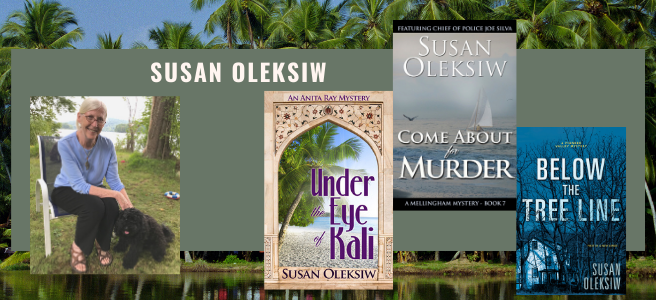
I’m in the middle of the sixth book in the Anita Ray series, which is set in a tourist hotel in a South Indian resort. Over the years the area has grown from a tiny fishing village with a few hotels just up the coast to one of the most popular destinations for Westerners eager for the sun and sand, not to mention the sunsets and the fishing boats bobbing on the horizon at night. I know the area well, having visited it for the first time in 1976 and several times in the 2000s. 

The pathways laid out in the early years are now paved walkways through marsh with little pools covered with lily pads. The paths have been widened in some areas to allow shop owners to hang out rows of brightly colored silk saris and blouses. When I think there’s no more room for another restaurant or shop, I turn a corner and spot five square feet turned into an open-air cafe with the owner stirring a pot on a two-burner cooktop, ready to serve the foreigners sitting on stools before a board table. The food is good, the price is right, and the cook’s son works in one of the high-end hotels. Much of Kovalam has spread on what was once paddy fields that came down to a low berm fronting the beach. All those are gone, and only the rare private home remains, hidden away beneath tall palms.

A reader often tells me they know “exactly where I am” in an Anita Ray story, and that’s because I do too. I have a strong sense of direction in India (and elsewhere), a deep understanding of India (after years of graduate school), and a personal love of the region. All of that informs the Anita Ray stories. What I don’t have is a sense of place in any story if I haven’t been there, walked through a public park, found a typical cafe for the area, and visited a municipal building—perhaps a library or town hall. I can make up a lot of it, but I need to experience the “feel” of the place. 

The Joe Silva series, in seven books, takes place in a small coastal New England town. I know these towns well, having grown up in one. The rocky coast speaks of the “flinty” Yankee, and the harsh winds call to mind the ever-present threat of hurricanes and other storms. Winters may be changing because of climate disruptions, but the birds still come, the land demands careful attention, and life for the fisherman is never easy.

One of the reasons I enjoy reading crime fiction is the other landscapes I get to explore. I’ve been through the Southwest and lived for a brief time in Tucson, so I appreciate any writer who can take me into that world of mountains and deserts, long straight roads, and small adobe houses with gravel yards. The openness of Montana and Wyoming brings out the best in some writers, and I look forward to their stories and landscapes.

Regardless of where we grew up or now live, we are creatures of our environment, and the best fiction uses that sense of place, what is distinctive and unique about one location, to propel the characters and their story. This, for me, is the reward of a reading a novel with a rich, fully developed setting. I come to understand both people and place, and know a part of the world I may never visit a little better.