Let There Be Light by Karen Shughart

My husband and I live in a charming maritime village on the south shore of Lake Ontario in New York, the prototype for Lighthouse Cove, the village where my Edmund DeCleryk cozies are set. This time of year in our village activities surrounding the holidays abound, and there truly is something to do for people of all ages: festivals; tree lightings; parades; caroling; shopping and dining opportunities, and a judged competition for the best outside holiday decorations.

 I especially like writing about the seasons in my books. In my third, Murder at Freedom Hill, the crime occurs just before Thanksgiving with the investigation continuing through the entire holiday season. I enjoy describing how the folks living in Lighthouse Cove celebrate, with light-filled activities that juxtapose the dark, horrific murder that has occurred.

Ed, a retired Navy SEAL and former police chief, now works as a criminal consultant who is hired by the current police chief to solve the crime. His wife, Annie, head of the local historical society and museum, curates exhibits, organizes special events, and because of the historical backstories that frame each crime, often becomes involved in the investigation.

One of these special events occurs early in December, when the days are short and darkness prevails. A Festival of Lights, held on the grounds of the museum, provides diverse groups with an opportunity to showcase the ways in which light plays an important role in their cultures during this time of year:

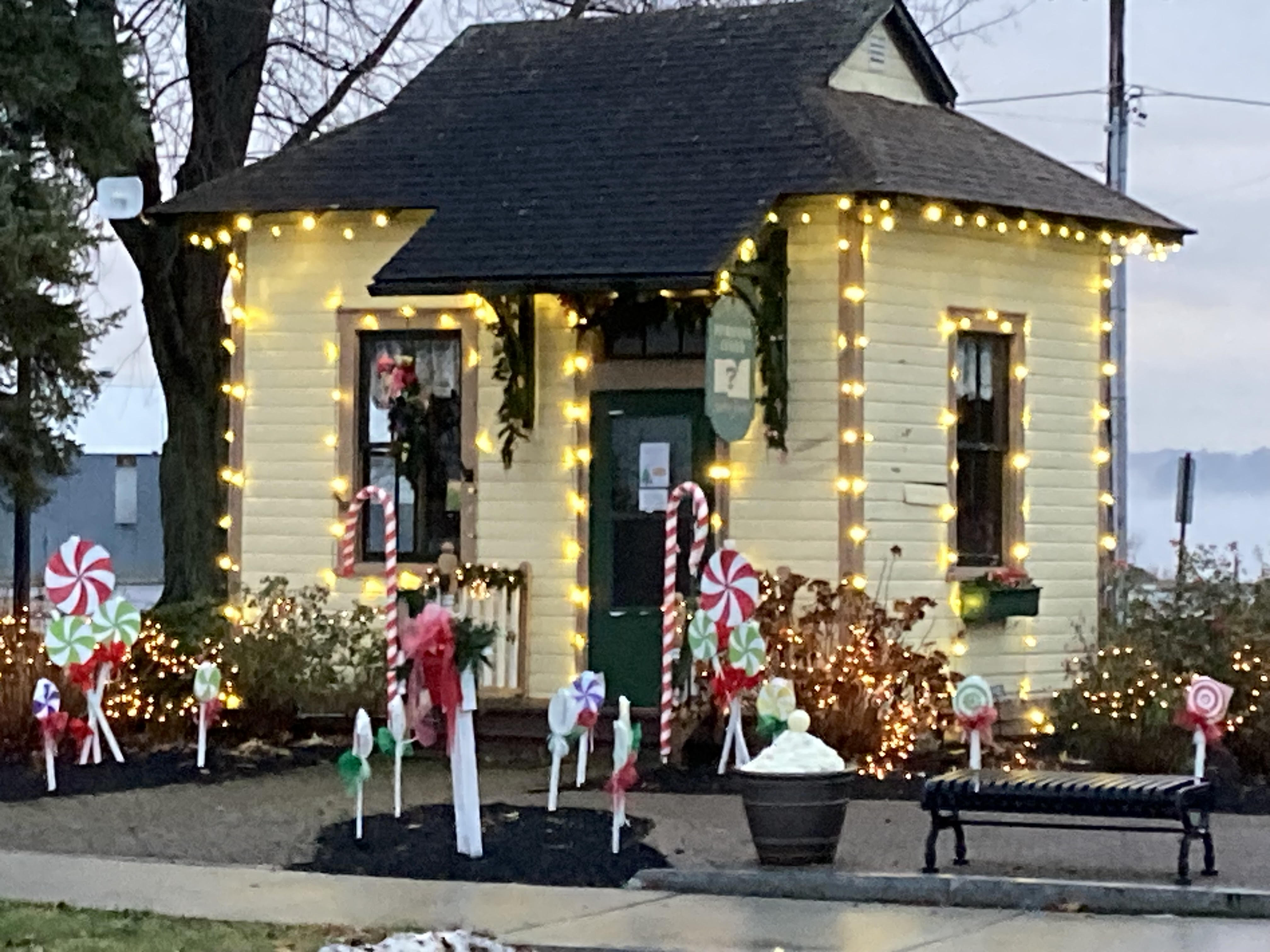
Photo courtesy of Lyle Shughart

“The Holiday Festival of Lights was held in the park next to the museum the following Saturday evening and started at dusk. Tall stadium field lights provided illumination, and the museum staff and volunteers had strung multi-colored holiday lights on bushes and around tree trunks. Several portable fire pits had been placed at strategic spots near park benches to provide warmth.

The Neighborhood Association maintained a booth that offered free hot chocolate and cookies. Other booths, with representatives from local Christian, Jewish, Muslim, and Hindu congregations, offered information about their holiday customs including the significance of light, and samples of traditional holiday food.

Santa ambled through the crowd passing out wrapped red and white candy. A group from near Tug Hill brought live reindeer, tame enough to pet. Children hopped on the back of a fire truck, a huge wreath on its hood, for a ride around the block, speakers blaring seasonal winter songs.

A large evergreen tree located in the middle of the park was festooned with multi-colored lights; a Chanukah menorah, Kwanzaa kinara, and clay diyas—oil lamps representing the Hindu holiday of Diwali—flanked the tree on large tables on either side.

Towards the end of the evening, the high school student chorus handed out sheets for a sing-along and led the community in a diverse selection of melodies representing all the groups at the festival.”

A definition of the symbolism of light from the National Gallery of the UK states: “Across cultures, light is an ancient symbol of understanding and intellectual thought: it is the opposite of ignorance, or darkness. Almost universally, the dark is …frightening and sinister, associated with things we cannot understand. Light is said to conquer darkness and to bring order out of chaos.”

We all need a little light in our lives this time of year, so, let there be light!

Motivation

I’ve been working on the sixth Anita Ray mystery since July, and now have 44,000 words. That by itself should tell you that I haven’t been well focused on this one, but I’ve had two epiphanies this month. First, I know what the big crisis will be, and it’s coming up in the next 10,000 words. Second, and much more important, I don’t have to know a character’s motive until I get near the end.

This, the second discovery, surprised me. I’ve struggled with finding motivations for my characters’ behaviors beyond their conduct simply being the result of who they are, their past experiences and hopes for the future. That’s always been true of any character, but when it comes to murder or some other form of violence, I need to see something more in this person I’ve created, something that the reader hasn’t already divined by reading about him or her. 

We stitch together our fictional creations from snippets of real life. Riding on the subway or bus or train brings us into contact briefly with the oddities of our world, the woman who wears orange sandals under a plaid lumber jacket on a sunny day, her jacket covering up fabric of such color we’re dying to get a look at it but she’s buckled up tight. Perhaps the only thing about her buckled up. We overhear snatches of conversation. I still wonder about the meaning behind the casual words of two men in a cafe. She’s always been like this; it was no secret. But he married her anyway? He did. And it isn’t medical? Nope. I really want to know what “it” is. And then there was the package that arrived at a neighbor’s, which she sniffed and shook, and apparently rejected because she left it on the front step. I don’t know what happened to it after that, only that it disappeared.

I’m curious about these people’s lives but if I put them in a story as a killer, I need to know what would make them kill. Being odd or different or cryptic isn’t enough, as every writer knows. We look to the great ones in our genre—Agatha Christie in the traditional mystery, Ray Bradbury in science fiction, or James M. Cain for noir—and think about how they developed their characters’ moves and failures. The motives for crime can be limitless, but perhaps the shortest list comes from Christie: greed, lust, envy. Those cover just about every failing in life.

I’ve been thinking about these for weeks now because even though I have a murder, another crime coming up, a diverse cast of miscreants, and a great deal of stupidity, I still don’t have a motive for the inciting incident. At least, I didn’t. That was part of the second epiphany this month. The characters can have all sorts of immediate short-term motives, but the one that’s driving everything has to be larger, tied deeply and inexorably to the character’s identity. I found it this month, and it has delighted me. It was almost obvious, but not quite. 

The surprising thing to me is that I’ve written half the book without knowing why this is all happening and happening in the way it is. We watch people in life, just as in books, wondering what they’re up to. We’re waiting to cross the street when he see a man on the opposite sidewalk stop and stare in a store window; he peers, he moves closer, he looks around to see who else is nearby, and he stares even harder in the window. When he walks on, looking back once or twice, we cross the street and try to guess what he was looking at. It’s an old-fashioned tailor’s shop with the expected clutter in the undusted window—scraps of fabric, a bolt of cloth, a tape measure, a small cardboard box of pins and other notions. In the unlit interior beyond, we see nothing to catch our interest. So what was he looking at? He wasn’t wearing a fine suit, just a short jacket and slacks; and he wasn’t old enough to have known about regular tailors in this little city. But there is something in that window . . .

I stopped worrying about my characters’ motivations in this particular novel while I wrote, figuring each one would either come to me or it wouldn’t. And I have faith in my unconscious to supply the needful. But I’m also flexible, and if a better one pops into my head, I’ll go with that. This is all part of the path I decided to try with this book. I would write it without guideposts, outlines, clear (or vague) ideas of where I was going. If a character or incident popped into my head, I’d add it. I’d just keep going. It’s very liberating but also a little scary. I’m not sure what I have, if anything, but I do have a sense of things coming together. I’ll let you know in another 20,000 words or so where I am.

Setting the Scene by Karen Shughart

All the books in my Edmund DeCleryk cozy mystery series are set in Lighthouse Cove, NY, a fictional village on the south shore of Lake Ontario, with the crimes occurring in the present but are related to something that happened in the past. In book one, Murder in the Museum, a map dated 1785 discovered in the historical society museum – led by sleuth Ed’s wife, Annie – and a journal dated 1845 found at an archaeological dig in Toronto, Canada, provide clues to why the victim was killed.

In book two, Murder in the Cemetery, a relic at the cemetery where casualties of the War of 1812 are buried; long-lost letters written by the wife of a patriot transported to England as a prisoner of war during that time;  a missing artifact at an exhibit at the Victoria and Albert Museum in London, England; and a diary discovered at an abandoned farmhouse help Ed and Annie solve the case.

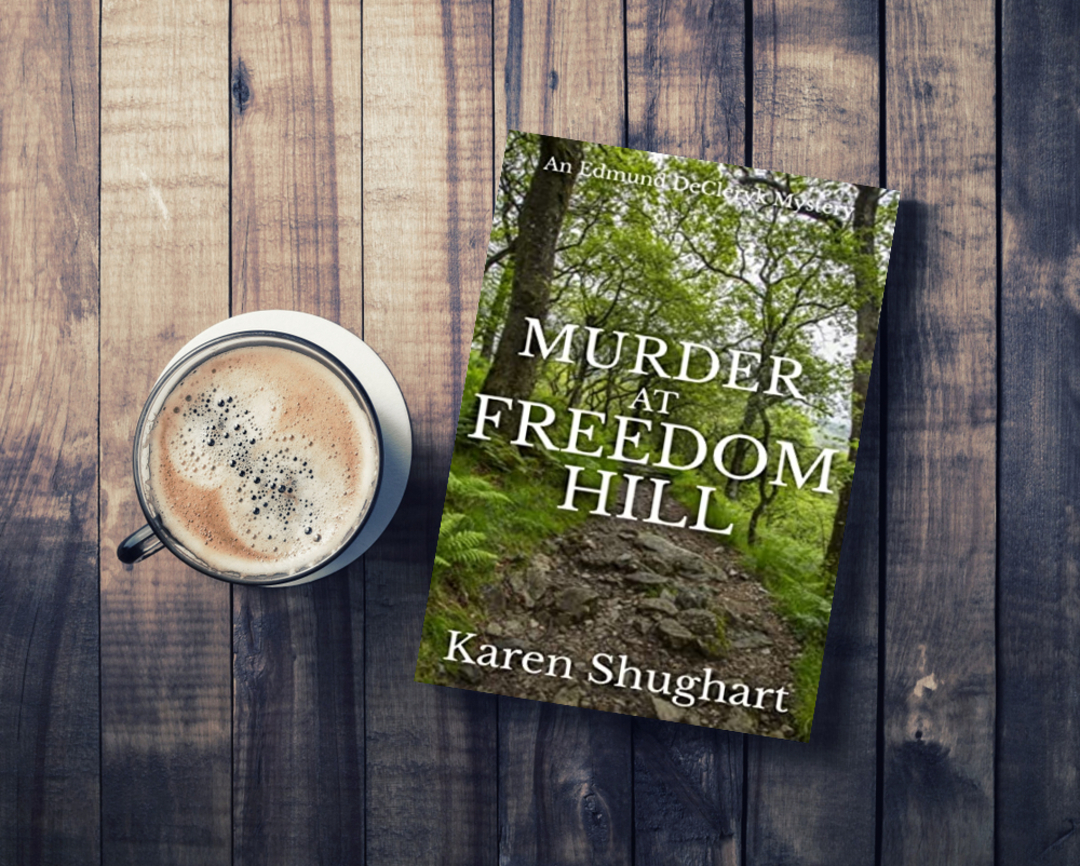
In book three, Murder at Freedom Hill, the crime is thought to be related to the victim’s ancestry, his forebears lived in a settlement where free people of color lived harmoniously with abolitionists who helped transport escaping slaves to Canada across the lake before the Civil War. Another heinous deed, related to that settlement, is revealed during the investigation of the murder.

But what the books also have in common is that I weave into the plot the seasonal setting.  After book one, instead of just one prologue I decided to write two, the first with the historical backstory and the second describing the season.

I continue descriptions of the weather throughout each book, it helps to construct the mood. For example, Murder at Freedom Hill begins in November, before Thanksgiving. In one of the early chapters, Ed discovers that the village mayor has been murdered. A beloved member of the community, the mayor also served on Annie’s board of directors and the two had become close friends. After conferring with Detective Brad Washington at the crime scene, Ed gets into his SUV and drives to the museum to tell Annie about his death. Lots of sunshine and a clear sky start the day, but then the weather changes:

“The brilliant sky at sunrise had made way for clouds the color of brushed pewter that hovered over the roiling silver lake. The day looked like an antique photograph: sepia; gunmetal grey; milky white and black; faded like withered grass. The direction of the wind had changed, picking up speed from the northwest, with fallen leaves swirling around the museum parking lot as Ed pulled into a spot. The temperature had plummeted- winter silently creeping in like a cat about to pounce upon its prey.”

What I enjoy about writing cozy mysteries is the ability to expand description if it fits into the plot, and the weather can either give readers a sense of doom and gloom or provide an interesting juxtaposition to an odious deed.

Karen Shughart’s cozy mysteries are published by Cozy Cat Press. She’s currently working on book four of the series, Murder at Chimney Bluffs.

The Problems of Being Dumfungled


by Janis Patterson

Dumfungled is a Scots word that means to be physically and mentally worn out, which is as good a definition of burn out as I’ve ever heard.


Burn out. It’s an ugly word, and an uglier truth, and right now I’m feeling like a charred match.


It’s been a tough year. On the personal front, I lost three long-time friends to Death, two of whom were younger than I. Now that The Husband is retired we have been traveling more, including a recent expedition to dig for diamonds in Arkansas. Yes, Arkansas. It seems that at a rough estimate 25% of the world’s surface diamonds are in the 40 +/- acres of the Crater of Diamonds State Park. Not that we found any – the only things I found were a couple of muscles I didn’t know I had. Ouch!


On a professional front, in case you’ve been living under a rock this year and missed my continual updates, I republished 22 reverted books – each freshly edited, freshly formatted and most with new covers – one every other Wednesday beginning on 15 January and the last one released 25 October.


That’s a lot of work, and a lot harder than you’d think, and because of it I only wrote two new books this year instead of my normal four or five. Oh, and just in case I get bored four dear friends and I are putting out our own anthology in the spring. (Follow this blog for more information…)


I’m tired.


I have a book that I would like to finish, a book I really like, but when I sit down to write it always seems that suddenly there is something else that absolutely demands to be done at that exact moment, like cleaning the dishwasher’s gasket or paste waxing the top of the dining table. I know, I know… escapism.


However, I’m proud of what I have accomplished. Those books are out there, and they will be there for as long as I want them to be.


And to reward myself, I am taking the rest of the year off. My kitchen and office both need excavating, my wardrobe desperately needs some attention and as I sorely need a distraction The Husband is taking us to Germany in December to see the Christmas Markets. He says I need to see something outside the parameters of my computer screen. I didn’t argue!


So this is my last blog for 2023. I’ll be back in January, probably with lots of tales about Germany, and hopefully with a couple of ideas for new books… and the enthusiasm to actually write them!
Wishing you all a Happy Thanksgiving, a very Merry Christmas and a Happy New Year! See you in 2024!

Before I Begin Writing

During a recent panel discussion at a nearby bookstore, a member of the audience asked the usual question about how we began our books. The three of us answered in various ways, but all of them were what you might call writerly replies. We began with a character or a scene. I said I began with a situation, a scene that came to me that made me curious about the people in it. My beginning is a little more complicated than that in the case of the Anita Ray mysteries.

I first went to India in 1976, for a year, with thirteen return visits since then, but the last one was in 2014. That seems like a very long time, and it is, even though I stay in touch with friends. Family issues have kept me from returning since then, but I’ve kept writing the Anita Ray series. The fifth in the book has come out in trade paperback and Harlequin will publish the mass market paperback soon. Right now I’m working on the sixth book in the series. So, how do I begin a new mystery set in India after not having visited for so many years? Before I begin with a situation, I look at photographs, to get a feel of the country I love and the area I think I know well. The city of Trivandrum has changed enormously over the years, and I notice large and small changes during every visit. Sitting with images of places I know well—certain shady lanes, small corner temples, old traditional doorways—evoke the ways of living that are so different from how I live here in the States and that may play a role in the story I’m working on.

Many of the photographs suggest story ideas, such as the shop selling as well as exporting homeopathic medicines located on a busy street just at the end of the lane where I lived for a year in the 1980s. Every time I return I walk down Statue Road, and there it is, the homeo shop, near the end, and the elementary school diagonally across the street from it.

One of my favorite photographs is of the laundry hanging among the coconut palms. There is a saying in India. If you’ve only been to a city in North India, you haven’t seen India. If you haven’t been to South India, you haven’t seen India. And if you haven’t been to a village, you haven’t seen India. There is truth in this. The village is the heartbeat of the country, a place encompassing great beauty and unconcealable poverty. Cities of India have on display vast wealth, just like other countries, and unimaginable poverty just around the corner. But in the part of the country I write about, old traditions still live. I learn more about a house and its inhabitants by how the gateway is decorated than I can from any of the nameplates we put on our mailboxes in the States. 

These are some of the details I pull together from some of my photographs to get myself back into the setting of my story. When I write, I want to feel I’m there, and I want the writer to feel she is there with me, so I review my pictures, think about the layout of the city, and imagine my characters walking through a village or resort or the capital of the state. A story I’m working on now is based on a festival held in India in late winter. Pongala has been called the largest gathering of women in the world. Over three million women descend on Trivandrum to make an offering to their deity, to bring good health to the family for the coming year. My photographs of this festival will be on display in the Beverly Public Library in February 2024, while I’m working on the story.

In the fifth book in the series, In Sita’s Shadow, Hotel Delite welcomes a tour from the United States, five guests instead of the six expected. Auntie Meena is soon fussing over them, determined to see them happy while in her hotel though she’s a bit confused by their non-touristy conduct. When the tour leader is found dead in his room, poor Auntie Meena is terrified that his spirit will haunt the hotel, and calls her astrologer at once. Anita calls the police, as is expected, and then begins to worry the death is unnatural. Trying to break the news to the members of the tour proves harder than expected. But one tour member seems uninterested in the death, and rarely uses his room in the hotel. This is not what Auntie Mean expects from a proper guest.

Auntie Meena throws herself into the investigation into the tour leader’s death, to Anita’s dismay, in a determined effort to protect one of her guests from the danger Meena is certain is lurking just around the next corner. Nothing good can come from a young male student sparking a friendship with an older foreign woman. Anita, however, is more concerned about the odd behavior of one of the hotel’s suppliers, a woman who makes airy delicious pastries.

https://www.susanoleksiw.com