
Accidents, Agents and Other Disasters

by Janis Patterson

People always ask me why I self-publish. Isn’t it a lot more work?

Yes, it’s a lot more work, but the upside is that I am in control. No more the unholy circus of repeated rewrites and equally annoying ‘minor tweaks’ to fit the visions/prejudices of agents, first readers, secondary editors, senior editors, acquiring editors and God only knows who else. I do have a very good editor (I’m not a fool) but she edits the story I wrote, she doesn’t transform it into what she wants.

These days to sell to New York (to use common nomenclature for traditional publishing) you need an agent, mainly because traditional publishers have gotten too cheap to hire first readers any longer. Agents now serve that function almost everywhere. Getting a good agent is often more difficult than getting a good publisher. Thank goodness we now have choices!

Back when the dinosaurs were browsing outside the cave and I sold my first novel to New York there were still a few houses (and there were a LOT more houses/lines then) who read author-submitted manuscripts, but I was a traditionalist. (I was also very young and foolish…) Real authors had agents, so I set out to get an agent.

I have had surgery. I have had auto accidents. I have even been in a plane crash. I would rather do any of them again than deal with finding, getting or dealing with an agent.

My first agent was okay – not very good, but he was indeed An Agent, and he took me on, so in my rosy ignorance I was happy. He sold a couple of books for me… then he died. I guess I have to give him a pass on the bad agent thing… He was fairly decent and I mean, you can’t blame someone for dying can you?

So after a lot of querying and begging I got a second agent, one who for some reason seemed to be a little higher up the status pole than my first one had been. She was smart, she was connected – I thought I had it made. At least, until I couldn’t get in touch with her. I sent her letters (this was pre-internet days). I even imperiled my continually endangered budget by calling a couple of times, but all I got was an answering machine.

Finally I contacted a friend of mine who went to New York regularly on business and asked her to go by the office on her next trip and see if she could see what was happening. She did. The agent’s name was still on the door, but the door was locked. My friend is a forceful lady (that is what her friends call her – her enemies…!) so she found the super and talked him into unlocking the door.

The office was empty. No furniture. No manuscripts. No nothing, not even dust bunnies. Even the telephone was gone. And no one has heard of her since.

I went back to the search and after about a year signed with an up-and-comer who was supposed to be a firebrand. The third try, I reasoned, has to be lucky.

Wrong. Oh, she was a go-getter. I kept getting reports from her that although my book had been turned down So-And-So had simply loved it. Or Thus-And-Such had thought it spectacular, but they had just spent a lot of money on a similar story. On and on – everyone always loved it, but there was never any specific criticism or reason. This went on for a few months and I was getting suspicious when this ‘agent’ sent me another glowing rejection from an editor whom I knew. I had never sold to her, but as we had both been bouncing around the writing world for a long time we had become reasonably close acquaintances.

So I called her, looking for elucidation on what was wrong with that book.

She had never seen the book, had never even heard of this ‘agent’ and neither had anyone in her office. She got justifiably angry that someone was using her name like that, so she requested the names of my books and the names of the editors involved and went off on her own investigation.

None of them had ever heard of her, me or my books. The whole thing had been nothing but smoke and mirrors. I don’t know why the ‘agent’ did this – this was not a ‘pay upfront for representation’ scheme, so she wasn’t making any money. Maybe all she wanted was the feeling of power and importance. Anyway, she quickly vanished from the scene and was never heard from again.

I must not be very bright, because I tried again, this time with a bright, canny young man I met at a writers’ conference. I was more knowledgeable then, and he said all the right things, so I signed with him. Now this is third hand gossip, so take it for what it’s worth, but the last time I heard anything about him he was serving time in Federal prison for mail fraud. And he never sold anything for me either.

So that’s why I’m self-publishing now. It’s true that there is no one who is as interested in your career as you are, and if you want something done right do it yourself. It’s a lot of work, yes, and my sales are less than they were in traditional pubbing (you can help by buying my books!) but to be honest my income has stayed just about the same because I get to keep more of my money. 60-70% of cover price beats the heck out of 20-50% of net…

To all of you who have good agents, I wish you joy and lots of sales, but while you pretty much have to have an agent to thrive or even enter traditional publishing, you can have a great career as a writer/publisher all by yourself. Like most of life, it’s a matter of choices. Good luck to you, whichever path you choose.

Conformity – Celebration or Curse?

by Janis Patterson

There is a plague spreading through my neighborhood and no, I don’t mean the recent Covid Crazies. This new assault is visible, concrete and sublimely ugly. I live in a nice, mid-century development of nice, middle-class custom homes, mostly single story and at one time all of natural brick. The different hues and shadings of the different bricks were beautiful, and one of the most appealing facets of the area. A former cotton field, this was starkly bare land when my parents first built this home, but as people moved in they planted trees and now we live in a forest of towering trees, mainly oaks and crepe myrtles, some twice as tall as the houses they shelter.

But that is changing, and not for the better. The soaring price of real estate and congruent punishing taxes has priced a lot of the old residents out of their homes, many of which have been snapped up by developers and flippers. (My thoughts on these two categories of humanoids are not suitable for public pixilation!) Sadly, the result is that our neighborhood is subject to both the denigration and degradation of conformity, and the lovely old brick is being covered by thick layers of paint with no shading, no personality and definitely no taste.

Painted almost exclusively a dead flat white or a dark, depressing grey, these once beautiful and individual homes now resemble nothing so much as the love child of Soviet brutalist architecture and a rogue box of Legos. In the setting of gracious old trees and carefully tended gardens the result is not only ugly but jarringly distressing.

One of the flippers proudly said the painted brick trend was new, modern and made a more cohesive neighborhood. He then asked me what I thought of his newly decorated grey lump, whereupon I asked him did he mean other than the fact it was hideous? Hmmm… even in this riotous real estate market the painted brick houses seem to be moving more slowly than the traditional brick. Perhaps the concept of good taste may be taking a beating, but is not yet truly dead.

So, you are doubtless thinking, has this woman lost her mind? What does this have to do with writing?

I fully believe there is such a thing as synchronicity amongst human beings. Bringing individual architecture (and remember, this is a neighborhood of custom-custom houses, each individually designed and built) into a fast (and relatively cheap) homogeneity in order to appeal to the (theoretically) vastest amount of people is a form of seeking the lowest common denominator with no thought or regard for individual tastes. The same thing happened in publishing.

Remember before the tsunami of self-publishing became practicable? Remember the pigeonholes of genre fiction? The ever-tightening pigeonholes as dictated by traditional publishing? If you didn’t write to their exact specifications you didn’t get contracted. They always wanted (and I quote) “… the same as (insert name of currently popular author here) but different…” Forget creativity. Forget individuality. Conformity at all costs. I can remember when some publishers even put out tip sheets, dictating what should happen in a manuscript almost to the exact page.

Now I understand that traditional publishers have to make a profit – that is right and natural – but don’t the readers have rights as well, mainly the right to read whatever permutation of fiction they want? If the trads dictated that Regency romance is to be super-sexy with only the barest nod of the head to history, what happens to the reader who finds written sex boring and is fanatic about historical accuracy? Or vice-versa? What about in mysteries the dictum that a dead body should appear in the first chapter, the closer to the first page the better?

Thus self-publishing was born, and thank God for it! It has freed writers to write what they want and get it before the public, and given readers to find the exact kind of book/genre they want. Sexy psychic vampire nuns on the planet Zeon, anyone?

Yet a certain conformity has crept in there, too, as more and more writers write to market. If talking cats who live in a needlework shop and solve crimes with their telekinetic powers are suddenly big, there are star-chasing writers who will writer them, often with widely varying degrees of both success and ability. At least there will always be variety, no matter if some constantly try to write to market without regard as to if the market is right for them or not.

Also the indie author is getting shafted by more and more pirates/thieves and are even getting short shrift from the sales outlets which make money from their sales. Amazon has a monthly subscription program for readers called Kindle Unlimited, which it pushes far more than books that are ‘wide’ – i.e., available from other retailers. A self-published book written by an unknown can be so far down in the algorithms that even with a search for the exact title and author you might have to go 10 or 15 pages in to find it.

For a self-published author to be in KU they must be totally exclusive to KU, and woe betide any lone outlet which has been neglected to be removed by any retailer, no matter how small, distant or obscure. The writer will have that book pulled instantly from KU and even runs the risk of having his entire account and all his books cancelled.

Nor does it stop there. Unfairly, traditional publishers can put a book into KU even while keeping the title wide. Here conformity only seems to affect the independents. There are also pricing/payment options available to the trads that are denied to self-publishers. I cannot help but wonder if the trad books on Amazon are as plagued by the buy, read, return, refund plague which afflicts self-published books – and their authors’ incomes,  but that is a rant for another day.

We have come a long way from the tastelessness of painted brick to the pitfalls and traps of self-publishing, but it is all part and parcel of the curse of conformity which seems to be infecting our land. America was founded on the right to individuality and self-responsibility, be it business, bricks or reading material. Celebrate this by supporting your courageous and dedicated self-publishers. Go buy one of their books today. You’ll enjoy it.

To ISBN or Not To ISBN – That Is the Question

by Janis Patterson

There is an evergreen discussion that flowers repeatedly on most writers’ loops, especially on those that have more non-professional writers. Do you need an ISBN? Should you buy your own ISBN? Why should you want an ISBN?

The answer to all the questions above is … it depends.

ISBN stands for International Standard Book Number, a number of either 10 or 13 digits that is unique to a certain book/edition/format. Almost every book has one.

I say almost, because there are mitigating factors. You can release a book without an ISBN, but then especially with paper it would be difficult to downright impossible for anyone to order or stock it. Neither would you be able to track any sales you might have.

If you are publishing an ebook with Amazon, or some other online retailers only, you do not have to have an ISBN because almost every retailer has their own internal identifying numbers. Amazon’s (the biggest ebook retailer) numbers are called ASIN.

Let’s be honest – ISBNs are expensive. Prices for one – just one! – start at $125. While much more economical, a hundred still go for close to $600. That’s big money in almost anyone’s wallet, but especially for self-publishing writers, many of whom are just starting out.

There are several ways to get ISBNs. First, and the one I like best, is to buy your own directly from Bowker/MyIdentifiers. Bowker is the only company licensed to sell ISBNs in the United States. (If you are from another country, you will have to check on where and what ISBN prices and availabilities are. I don’t know. I do know that the citizens of Canada get theirs free – if they meet certain criteria – lucky stiffs!) If you buy your own ISBNs you are shown as the publisher.

Second, there are those who will be happy to sell you a couple of single ISBNs for a lot less than Bowker. I advise you not to do that, even though it saves you a couple of bucks. These people are called re-sellers, because they buy large amounts of ISBNs from Bowker, where they are much cheaper per number, and then sell one or two or three to you for a profit.

Now I am a big believer in profit, but this particular ploy comes at a price – namely that you are not listed as the official publisher. When someone buys an ISBN from Bowker, they automatically become the publisher of record. If you buy (or get a free) an ISBN from JoeBlow, Inc., since JoeBlow, Inc. bought the ISBN from Bowker, he/it is now the publisher of record.

At the moment this particular little quirk doesn’t mean much, just a bit of legalese – but my concern is that we don’t know what the publishing laws will be down the road. I wrote the book, so I want to be on record as the publisher of record and be able to control my book throughout its life. More simply, my book is my book.

This same principle applies when some company and/or retailer offers to give you a ‘free’ ISBN if you publish with them. No adult today should believe that anything is ever truly ‘free’ – someone somewhere somehow sometime has to pay for it, and in this circumstance it might be you by losing control of your book. The entity giving you the ‘free’ ISBN is on record as the publisher of record – not you.

So should you pay for ISBNs? If you are writing short little books that you intend to sell as ebooks on Amazon (for example) and on Amazon only – you certainly don’t have to. If, though, you decide to take those ebooks to print or start your publishing career in print, yes, most definitely you need an ISBN.

You should have an ISBN for every version of your book – one for ebook (which should cover all ebook retailers, no matter what Bowker says – remember, they sell ISBNs!), one for print, one for large print, one for audio. Remember, one of the main purposes of ISBNs is to track sales and you don’t want the data on your sales tracks muddied. (And a little hint – if you are doing a paper copy Bowker will try to sell you bar codes for a fair chunk of change. You don’t need to. The publisher – Amazon, Draft2Digital, Ingram, whoever – will put one on for you without charge – just be sure to leave a space for it in your cover design.)

As there are brick-and-mortar stores who refuse to do business with Amazon (a complicated set of affairs I’m not going to go deeper into now) many authors give their print editions two ISBNs. These authors do one print edition through Amazon print and give it a discrete ISBN with limited distribution, which means that book is sold only on Amazon only. Then they go through another publishing venue such as Ingram’s or Draft2Digital for another print version and give it another separate ISBN. Whatever you think of the practice, remember more brick-and-mortar stores will order from Ingram’s (which has the all-encompassing industry standard catalogue) and Draft2Digital and all the others where they will not from Amazon.

Now I am going to talk about pure personal opinion. When you self-publish in any format, you are a publisher. Everyone admits – or they should! – that editing, covers and publicity are legitimate business expenses; you should regard ISBNs as the same thing. If you are going to compete against the biggest traditional publishers you need to play by the same rules. You are a publisher; act like one.

Encore Performance by Sally Carpenter

Carpenter photo_WEB gifOne of the nice things about publishing is the chance to do it all over again and better.
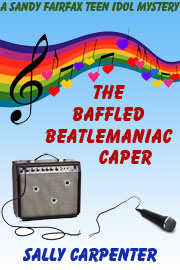
Five years ago my first book, The Baffled Beatlemanic Caper, went out of print. That publisher has since closed its doors, so the book was destined to go OOP eventually. At the time the second book in the series was finished. I was fortunately to find my current publisher, Cozy Cat Press, who was willing to pick up book two.

I had a new front cover made and self-pubbed Beatlemaniac as an ebook. Various NEW Beatlemaniac_final_webonline bookstores continued to sell used print copies, although I received no royalties on them. I was disappointed at having a book go OOP so quickly, but I moved ahead with other writing projects.

Since then, authors I knew, some who had been with large publishers, began reissuing their backlists with small presses. With new covers, their books were back on the shelves.

Earlier this year a reader said some of her friends were looking for print versions of Beatlemaniac. I had just about run out of print copies to hand sell. I was also getting tired of getting no payment for the used copies changing hands.

And I was not happy with the book. As a neophyte writer, I was in a rush to get published and the text had a number of errors. I hated the cover. The back cover was a dog’s breakfast of too many elements, and the front cover was printed so dark that the great artwork was obscured.

Encouraged by the backlist successes of others, I approached my publisher, Patricia Rockwell, about reissuing the book. Since 2013, I’d written four other books, a short story and a chapter for a group mystery novel for CCP—so I had a good track record.

I’m calling this reissue the “revised second edition.” We’re using cover my designer had made for the Beatlemaniac ebook, so we didn’t need new artwork. I like the “new” cover as it’s colorful—more suitable for a cozy, and it “pops” more on the screen/shelf.

I updated my author bio and revised the introduction and acknowledgements. I wanted to include more about how the book came about, but the book was already longer than most CCP books and I had to save space.

The Nancy Drew/Hardy Boys books have been extensively rewritten over the years for new generations. So why not take the opportunity to improve my book?

I carefully read it again. I corrected the misspellings and grammatical errors. I replaced “ands” with periods to alleviate run-on sentences. I toned down the strong language (when I wrote the book, I didn’t even know what a cozy was, let alone the “rules”) and cut a few words from the flashback seduction scene.

I had used the word “towards” a million times. I realized I had overused the phrase “I realized.” The characters also “gestured” frequently. Some gestures I left in, others I changed. After all, real people do “gesture”!

Some of the chapters run long, but making more sections would mean renumbering all the chapters and that can get dicey.

But I didn’t alter the story or the characters. I was surprised that the plot and red herrings worked so well. I have what some editors might consider “info dumps,” but they are interesting details about my character’s life in show biz that most people wouldn’t know and I left them in. It’s also good background on my protagonist that doesn’t show up in the other books.

After writing three other books with my protagonist, it was fun to go back and see where it all started. When book one begins, he isn’t terribly likeable. He’s just hopped on the wagon and is out of sorts. Sandy hates the character he played on his TV show. But by book four he’s comfortable with his sobriety and his alter ego.

BTW, in my book the correct spelling of the East Indian goddess in the Beatles movie Help! is Kaili, not Kali, the real Hindu goddess. Beatles fans would never forgive me if I got that wrong.

A nice offshoot is that I had planned to include a new Sandy Fairfax short story with the second edition, but my publisher said that would make the print book far too long. I have a good finished novelette on hand, so my next project is to write more stories to make a Sandy anthology. Stay tuned . . .


Some Thoughts on Writing and Publishing

by Janis Patterson

It is the best of times to be a self-published author.

We can put our own books out without having to deal with the ‘writing by committee’ mentality that infects the world of traditional publishing. We can reach directly to the reader without having to bow to the whims, prejudices and rules of the traditional publishing gatekeepers. And, as an added benefit, the reader can choose from a vast array of books instead of being held down to the narrow pigeonholes of traditional publishing. Plus, as a self-published author, you get the largest slice of the monetary pie, as opposed to  the minuscule percentages offered by traditional publishing.

It is the worst of times to be a self-published author.

We not only have to handle the necessary quality controls of creating good books – great writing, good editing, great covers, proofing and printing standards – but we also have to deal with publicity, marketing techniques and legal issues. Some writers make enough money to hire all these things done – most don’t, and every minute spent on publishing/publicizing/whatever is a minute not spent on writing.

Moving beyond the personal, there is also the wider world of self-publishing that seems to become more surreal every day. There are always pirates who take books and them put them up for free on the internet without the author’s consent. Their rallying cries are “If it’s on the internet it should be free!” (Wrong!) and “Writers should just be happy that their words are being read!” (Even wronger! Try that twisted logic with your doctor or plumber or just about any professional…) Other pirates take your book and sell it, but without the author’s consent – and without ever sending the author any of the proceeds.

Then there are what I call the literary pirates – the singularly untalented ones who want to be thought of as an author so badly that they take someone else’s book, change the title, the main characters’ names, probably the name of the town and maybe even the occupations, and then publish it as an original book under their own name. Sadly, this criminality is hard to detect, as most of the retailers simply accept books and don’t run any sort of comparison software to make sure it is an original work. Most examples of it are never caught, and the few that have been were brought to the author’s attention by dedicated fans who saw the similarity to one of the author’s books.

Even worse, there is a growing corruption in the self-publishing world. Book stuffing is a big problem at the moment in Amazon’s KU. Some Book Stuffers have used book stuffing to game the system for fantastic amounts of money and driving legitimate authors off bestseller lists, all the while delivering little more than a badly written short story and lots of garbage. Lots of them also use clickfarms to up their pages read count into the realm of KU bonuses, which is what gets them most of the page reads – and the money. What’s sad is that Amazon doesn’t seem to care. They’re getting the money customers pay for these bloated nothings. Although – I have heard that they are meeting with some concerned authors and writers’ organizations – and I hope that is true – so maybe something positive and good for real writers is being done.

Another thing is that even if a book meets the criteria for a real book (actually written by the person claiming it, page count not inflated by rubbish and repeated short stories) it’s really just a bad book. The internet is simply swamped with ‘books’ that are terribly written, worse plotted and which have never seen either an editor or even spellcheck. Some people are so stupid – or who want to be ‘an author’ so badly – that that they think merely stringing X number of words together with a rough semblance of a storyline equates a book. They buy a cheap cover (I don’t care how much it costs, most of them are definitely cheap), stick up the resultant product and wait impatiently for fame and fortune to come flooding in.

Add to that that the market is waaaay down now. Sales are bad. My sales are so low at the moment that if they get any worse I’ll have to start paying people to not read my books!

So perhaps the pertinent question should be, under these conditions, why would anyone become a writer?

The answer is simple – because we can’t do anything else. If we never sell another book, we will still write. If the publishing world turns upside down, we will still write. No matter what happens, we will still write. We’re writers.