

Love Is in the Air – and on the Page

By Margaret Lucke

Happy Valentine’s Day!

Today is the day when everyone’s mind—and heart—turns to thoughts of romance and love. We give people cards with heart designs to tell them we love them. Some lucky people receive roses and chocolates too.

And many people, whether they have personal sweethearts or not, pick up a romance novel to read. Of course, readers do that every day. My fingers are crossed that they might pick up one of mine.

Wait, you say, aren’t you a mystery writer? Yep. Always have been (I wrote my first short story featuring a private detective at age eleven). Always will be, or so I hope.

So, you might wonder, what am I doing as a member of the Bay Area Romance Writers?
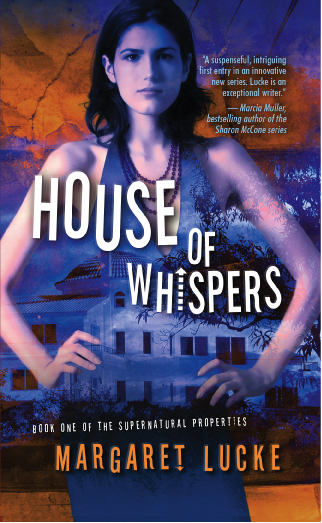
I wondered that too when I first joined the organization. But the publisher of my my first Claire Scanlan Haunted House novel, House of Whispers, was billing the book as a paranormal romantic suspense, and I decided I should find out what that word romantic really meant. The book has a strong romance subplot. Maybe its potential audience extended beyond mystery fans. There are lots of romance readers—maybe one or two of them would enjoy a good love story with ghosts and murder mixed in. I hoped the group would help me figure out how to reach them.

Fact: In the year before House of Whispers came out, 74.8 million people had read at least one romance novel.

Those numbers sounded promising. So I sent in my dues and went to my first meeting not knowing what to expect. Dreamy-eyed writers wearing pink and sipping from china teacups with their baby fingers raised? Not on your life. These women were meeting in a brew-pub. For breakfast. Nowadays they meet mostly on Zoom, but what hasn’t changed is that they are a savvy, supportive, career-focused group. And they sell lots of books.

Fact: Romance fiction racks up $1.44 billion (that’s with a b) in annual sales. Mystery fiction brings in $728 million—just over half as much.

Sales of romance novels have shown a significant steady increase over the past five years. Being in love, it seems, is a more popular fantasy than being involved in a murder.

Fact: There are 39 subgenres and 127 tropes to be found within the romance genre.

I found those numbers on internet sites devoted to the genre. Of course, different sources provide different lists with different numbers, but the point is that the genre can accommodate almost any kind of story—including mystery.

I was surprised to learn how many types of books fall under the romance umbrella. It turns out that two of my favorite novels, Pride and Prejudice and Gone with the Wind, are romances. Books you might think of as mysteries, thrillers, suspense novels, science fiction, fantasy, paranormal are in fact romances. Okay, maybe not GWTW. Spoiler alert: This book falls short of the romance definition in its final pages.

Romance Writers of America has two criteria that a novel must meet to be considered a romance. First, a love story must be central to the plot—two people fall in love and must struggle to make their relationship work. Second, there must be an HEA ending—romance writer shorthand for Happily Ever After. Or at least an HFN—Happy For Now. Either way, the story must conclude on an emotionally satisfying and optimistic note.

But wait—even if a novel doesn’t fit that definition, it may still count as a romance. One of the official subgenres on RWA’s website (www.rwa.org) l is “novels with strong romantic elements”—books in which a romance plays a part even though major aspects of the story take the plot beyond the traditional romance boundaries.

So as long as one of your characters is romantically involved with another, or wants to be, then you too may have a romance novel on your hands. Perhaps Gone With the Wind fits after all. And the list of mysteries that qualify is very, very long.

“Romance fiction is smart, fresh and diverse … Romance novels may have any tone or style, be set in any place or time, and have varying levels of sensuality–ranging from sweet to extremely hot … Whether you enjoy contemporary dialogue, historical settings, mystery, thrillers or any number of other themes, there’s a romance novel waiting for you!” —From the RWA website

I’ll always be a mystery writer. But maybe I’ll get an HEA as an author if I let in a little romance.

I hope that today, Valentine’s Day, you’ll let in a little romance too—hopefully in real life but definitely between the covers of a good book.
Who? When?

by Janis Patterson

If there’s one thing in the writing world you learn very quickly it’s that no matter what you do you cannot please everyone. Sometimes it seems almost impossible to please anyone! Another thing you learn is that the ‘rules’ change almost as quickly as the weather.

Well, I don’t believe in ‘rules’ – other than the hard and fast ones like good grammar and spelling and a cohesive, interesting book, of course. What I dislike are the God-like pronouncements of how a story should be structured. Such as in romance, for example, say you have to have a ‘cute meet’ between the hero and heroine in the first three pages or (in certain kinds of romance) a hot sexual encounter no later than the second chapter. A corollary in mystery is that the body has to appear early in the book – ideally in the first three pages.

Well, being by nature a dedicated contrarian, I find such ‘rules’ to be inimical to the integrity of a story. They smack of ‘writing by pattern’ and while each genre has certain expectations like as a happy ending and justice done such arbitrary ‘rules’ are the antithesis of creativity… and all too often good storytelling.

That said, I have written – sometimes at the ‘behest’ (i.e., orders) of a publisher or out of pure mischief –  some stories that follow these ‘rules’ and some which most delightfully turned them on their heads. One example is a Regency Romance (written as Janis Susan May) where the hero and heroine, though lovers a decade or so before, do not meet in the here-and-now present of the novel until the last chapter. This particular book has won a couple of awards… and been used as an example of how not to write a romance.

On a different note, I once wrote a mystery where the body appeared as demanded in the second or third paragraph, and that was a very hard book to write. Murder is by definition a violent crime, no matter how delicately it is committed, and one should feel outraged that someone – anyone – should have their life taken from them. However, there is almost a prerequisite that to feel sympathy for a character you have to know them, and that’s almost impossible when said character first appears as a lifeless lump on someone’s rug.

How do you create empathy for a character about whom no one knows anything and feels less? This victim, this human, this person, is perforce little more than a stage prop who elicits very little feeling or sympathy. I gave him a name, simply because it was more convenient than calling him ‘the body’ or ‘the decedent’ or ‘the dead guy,’ but although he had the requisite number of arms and legs he never really became a real person – merely a humanoid construct.

I have been dinged and called down because in my mysteries (save that one) the murder doesn’t happen until one-third or one-half through the book. I feel by giving the reader such a delay it creates two mysteries instead of one. The first is, who is going to be murdered? while the second is, who is going to be the murder?

When I write a murder I want the reader to be outraged at the deliberate taking of a human life, no matter how much that person deserved to be offed – and believe me, in my mysteries there are several characters who deserve it. Don’t know why bad people are so interesting, but they are, so I always have several of them… just like in real life.

A murder victim – whether in a book or in real life – deserves to be more than a stage prop.

Where? When?

by Janis Patterson

It is one of the so-called pieces of wisdom in mystery-land the body should appear as quickly as possible, just as in some parts of romance-land the hero and heroine have sex almost immediately after they meet. I’ve even read some stories where they end up in bed before they’ve been introduced!

Haven’t these writers ever heard the phrase “it’s not the destination, it’s the journey”?

This isn’t a new rant of mine – you’ve probably heard it in one form or another before, but I believe it bears repeating, especially in mystery-land. Murder is a terrible crime. It permanently alters everyone even remotely touched by it. It should not be treated as an hors d’oeuvre.

Back when I was traditionally publishing I allowed the house editor to convince me (convince, as in “We won’t publish your book if you don’t!”) to bring on the body as early as possible in the first chapter. I wanted to be published by this particular house, so always an over-achiever I put the discovery of the body on the second page, and it was a grand disservice both to the poor thing and to the story. The victim had no history, no backstory, no personality, and there was no emotion, no sense of loss in his passing. In other words, he was nothing but a stage prop. (“Hey, Fred, put the body down stage left!”) Even a villain – which he was – deserves a more fitting end than that.

Of course, we had learned something about him by the end of the book because to solve a murder you must know why someone would want to kill him, but it was dry and anticlimactic – nothing but tags that eventually pointed the way to his killer.

I am a whole-story kind of person. I believe that to feel the kind of outrage that murder should engender we have to know the people involved in the tale so that when there is a murder we feel a sense of loss, of outrage (even if the character deserved his ignominious and premature death) and a sense of satisfaction when the murderer is finally run to earth and justice is served.

Not everyone agrees with me. I have been severely dinged and chastised for having the murder occur close to the middle of one of my mysteries. It’s a good story, it has a large cast of characters (three of whom are killed) and it is a complex story, with the solution inextricably interwoven with the dynamics among the characters. But apparently that’s not fast enough to be acceptable for some readers. Neither, I hasten to add, was the setting – a scholarly Egyptological conference without a tea shop, a B&B or knitting store in sight. One correspondent was particularly incensed that the entire conference did not shut down in order to bring the murderer to justice. I don’t understand that; yes, everyone is somehow altered when murder enters their sphere, but unless they are close to the crime or the victim few change their entire focus. Most of us would probably cling desperately to what is normal in an effort to bring stability back – unless, of course, the murder affects them personally, which changes everything.

As I’ve said before, murder is an horrific crime. Both it and its victim need to be treated with a certain respect and dignity. To cheapen death is to cheapen life.

What’s Old Is New Again

by Janis Patterson

I don’t have much time to read, but for various reasons not long ago I agreed to review a few books. Two were okay – nothing to write home about, but at least grammatical and spelt correctly, with not-totally-stupid plots. The third… well, to call it puerile and sophomoric would be flattering it. If I hadn’t promised a review on it I wouldn’t have gotten beyond the third page. How can anyone think such a train wreck of a book is ready to be released is beyond me. Either they are supremely ignorant or totally ignorant.

Once my duty was done, though, I needed to clear my mental palate, and thought that something classic might soothe my outraged sensibilities. So I picked up a Mary Roberts Rinehart (one of my all-time favorites) mystery.

I really only intended to read one, but found out that’s sort of like eating a single peanut or potato chip. I happened across an omnibus of all of her long fiction on Amazon – and free, yet! It was a mixed blessing, though. It did contain books I had never heard of, but as I steadily munched through them I noticed a wildly varied level of editing quality. Some were wonderful; some were obviously edited by a set of drunks to whom English was not a first nor even a second language!

That’s neither here nor there, though; in the face of Rinehart’s genius even the editing errors were nothing more than a mild annoyance – and those of you who know how completely inflexible I am about proper spelling and editing will doubtless find that statement amazing if not downright incredible. But in the case of Rinehart’s genius it really doesn’t matter. No matter how badly they are misspelt they are some of the most fascinating books in the language.

Rinehart wrote in a number of fields, including short pulp fiction (by which she supported her husband and family during a time of need) as well as novel-length romance and mystery. I write romance and mystery myself and know how difficult that can be; she made it seem easy.

Her books will not, however, appeal to everyone. Contemporary to the time they were written – just before and just after World War One – they reflect both the style and the ethos of the era. No conscious, mad scientist style murders, no lascivious young lovers experimenting in athletic sex. Most characters are repressed, if anything, obsessively proper and yearning for respectability. A kiss on the hand becomes as emotionally satisfying as a two-chapter roll in the hay out of a modern romance novel. Solving a murder becomes not only a legal imperative, but a moral one as well. What’s worse is her writing style is equally dated, reflecting the usage of the times, and done – most of the times – in a measured and omniscient voice, now sadly unpopular, but one which I have always liked. She wrote from 1908 to the mid-1950’s (she died in 1958) – at least, those are the most accepted dates.

With all these drawbacks, why is Rinehart so prized and such a delicious read?

Two reasons – characterization and plot. Her plots are convoluted and impeccable and delicious. During her career she was called ‘the American Agatha Christie.’ I personally think in many cases she is the superior. Her characters are spot on. There is no endless repetition of hair or eye color, descriptions of physical flaws or rippling whatevers; to be sure there are descriptions, but minor ones, and usually at the beginning of a book. Her characters are not just compilations of attributes, but living, breathing people. I would know them if I met them on the street. Two of the ones I remember the most are a Belgian spy during the trench warfare of World War One, suave, outrageous and highly courage, and the other a teenaged girl of the pre-war period, who can and does cause chaos without ever trying.

Not only was Rinehart a gifted writer, she was an amazing woman. Married to a doctor, mother of three sons in an era when women were not supposed to be much else, she paid her own way (with a car, no less) to the Front in France during the War, where she not only acted as a war correspondent but drove food and supplies for the soldiers to obscure and remote outposts. She also became a well-known New York literary hostess.

It isn’t often I have such public fangurl moments, but it’s better than when I cry with regret or shake with anger that such a consummate craftsman is lost in the dust of history. Now, if you will excuse me, I am only half-way through THE AFTER HOUSE, and just have to find out how she’s going to work her way out of this tangle!

Clues, Magic and Little Cat Feet

by Janis Patterson

I’ll admit I get a little put out when people (including some writers) say “Oh, I could never write a mystery – how do you think of all those clues and where to put them?” Usually, when I’m wearing my romance-writer hat (yes, I write both, along with several other genres), these are the same people who say “Oh, I could churn out one of those stories if I ever had the time.”

Grrrr.

To me that is as stupid as someone saying they can cook a roast but could never cook hamburgers. Or vice-versa. Writing is a learned craft, and the basic tools are the same whether you write confession stories or blockbuster action-adventures or small town cozy mysteries with a bakery shop (sometimes a needlework store) and a romance.

Yes, I am the first to admit that there is an element of magic in writing, of taking twenty-six simple symbols and turning them into a story that will touch and enthrall the reader, but magic – like luck – really does seem to prefer the prepared who have worked like the devil to learn their skills.

But magic aside, writing is a craft. Sometimes when I start a mystery I have a hazy idea of who and why, and that often changes, sometimes several times, but as I write along I leave a strong story behind me. If I may steal Deborah (Debra?) Dixon’s mantra of ‘goal, motivation and conflict’ I’ve found that following that guideline for almost every scene (excluding a very few, very short ones used mainly for transition from one arena of action to another) as well as for the entire book makes it much easier. In real life we sit around, we dawdle, we have purposeless (though sometimes pleasant) conversations, we sit in traffic, we… whatever, but in a book we don’t have that luxury. Every word, every action has to count and either explain why our characters/events are the way they are and/or bring us closer to the climax/resolution.

I’ve told this story before, but in my mystery THE HOLLOW HOUSE for the first two thirds of the book I was absolutely positive I knew who the killer was. Then – boom! All of a sudden I realized that wouldn’t work. Well, it would have worked because I’m the author and what I say goes – sort-of, but dramatically it was a bust. Rather than start over again or back up and throw out great chunks of wonderful, deathless prose <grin> I kept on writing and within a few pages I knew who the murderer really was. Except – another chapter, and the whole thing started over again. He couldn’t be the murderer. Gritting my teeth I forged on.

To make a long story short, if it’s not too late, this process repeated itself five times during the last third of the book. I was getting alarmed, as I was running out of potential villains, and will never subscribe to the ancient trope of a convenient homicidal maniac wandering around who just happened by and had never been mentioned before. Grimly I went on, and in the next to the last chapter suddenly all was revealed to me. I will admit that by this time I had ceased to feel like a writer and more like a scribe, just taking down what I couldn’t control.

But the final solution was perfect. Things could not have worked out better. The only thing that made me sigh with apprehension was that now I would have to go back through the entire manuscript and put in clues. I was as astonished as anyone could be when on rereading I found that they were already there. Who knew? Magic? Anyway, I think I put in two or three more, just so I would have the illusion of being in charge…

So perhaps I should restate my premise – writing is work, writing is a skill is available to just about anybody who will study and practice. And the magic? I think it comes creeping in on little cat feet (sorry, Mr. Sandburg) under the cover of study and practice just waiting to jump out when you expect it the least. And it doesn’t make any difference whether you write mystery or romance or horror or action-adventure or any of millions of other kinds of stories – the building blocks are the same. But you do have to learn how to use them.