Thankful Thursday

I loved the last mystery I read, but I don’t remember who the killer was. I do remember being deep in the story because the author took me on a wonderful journey. The book was set in the 1940’s, and she did such an amazing job of immersing me in the story world. The setting, characters, and storyline were so exquisite that the solving of the crime seemed less important.

Now, I know that those of you who read mysteries for the puzzle might have a different take on this, and sometimes I do too, especially when I’m totally surprised by the killer. But at times, the story journey is so special that the ending is inconsequential.

Today, I’m thankful for all the writers who’ve gone before me. I was a huge fan of Mary Higgins Clark’s books. When I sat down to read one, it was like sitting down with a good friend while they told me something that happened to them. I would get so engrossed in the story I didn’t want it to end. I read her books straight through and was sorry I did because I had to wait a year for the next one.

A few years ago, I took a class on writing from Robert Dugoni. It was such an amazing class by a wonderful writer and teacher. The class was small, maybe twenty people, and I still think about what he taught and how fortunate I was to be there. Robert talked a lot about finding the heart of the story. At the time, I was new at writing novels and even though I loved what he said, I didn’t know how to apply it to my work.

Now, after publishing three mystery novels, I feel like I have a better understanding of what he meant. The main character in my Hood River Valley Mystery Series is a woman detective, Liz Ellisen. Liz is the driving force of the story, but as I thought about this, I asked myself, what about her draws the reader in? What makes them ask for more books about her?

Liz puts her heart into solving crimes, and she wants to find justice for the victims. She can be strong and tough, but she can also be tender and loving. And even though her own life hasn’t always been easy, she wants to make the world a better place for others.

I recently had my books for sale at a holiday bazaar. A lady came in and bought three copies of my latest book, one for each of her sister’s for Christmas. She said, “I loved all of your books, but this one is my favorite.”

As with most writers, I hope that my books get better with each one. But I’ve found that some people like my stand alone novel, which was my first published novel, better than the series. And other people like the series best. It’s such a thrill when someone buys my books for their friends or family because they enjoyed them so much.

I feel that finding the driving force of the story is also about finding the heart of the story. Thank you to Robert Dugoni for sharing that. I would love a sign to put up in my office that says, “What is the heart of this story?” I’m hoping I’ll remember to dig deeper to really find what drives my characters and in so doing, find a way to connect to my reader’s hearts.

So this Thanksgiving I’m thankful for all of the writers, teachers and readers who have brought me such joy over the years. I’m also thankful to each of you for reading this blogpost and to Ladies of Mystery for inviting me to write a post on the blog.

Happy Thanksgiving. May your heart be full of love and may we all find the heart in our stories.

My view as I write. Yes, sometimes it’s difficult to concentrate, but not today. Today it was pouring rain and the mountain was hiding. Blessings, Lana
So long, farewell, auf wiedersehen… by Karen Shughart

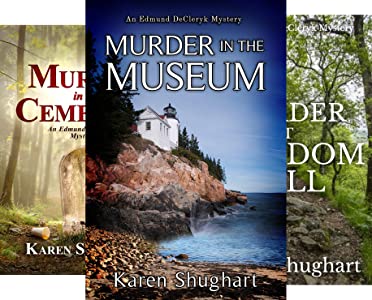
The song from The Sound of Music kept popping up in my head as I struggled to choose a title for this blog, which will be my last for Ladies of Mystery.  I started writing these shortly after the first book in my Edmund DeCleryk mystery series, Murder in the Museum, was published in early spring, 2018, and other than missing one a while back, I’ve managed to write every month for the past six years.

You’ve read not only about my books, investigative procedures and writing processes, but also what it’s like to live in the northern Finger Lakes region of New York, our travel experiences and family gatherings, and even eulogies for those I’ve loved. I’ve enjoyed every minute of it and feel gratified by how many wonderful and positive comments I’ve received as a result, and friends I’ve made along the way.

The decision has not been easy, it’s taken me weeks to feel comfortable with it. As I’ve grown older (and by most standards I’m in the elderly category), simplifying my life and deciding what takes priority seems tantamount to residing in a world that’s become far too complex for me as of late. Family always takes precedence, we’ve committed to spending more time with our children and siblings; also with friends whom we hold dear to our hearts. Some live hours and sometimes a plane trip away.

When I wrote the first book, my publisher asked for a series, and that’s what she got. I’m now working on book four, Murder at Chimney Bluffs, which, like the others, includes a historical backstory that provides clues to why the murder occurred, this time Prohibition and rumrunning. There was much activity between Canada and our side of Lake Ontario during that period of time, with contraband liquor unloaded onto a beach beneath Chimney Bluffs, drumlins that were created from icebergs millions of years ago.

Authoring books is a time-consuming process and one that I integrate into the other facets of my life, which include writing a monthly blog for Life in the Finger Lakes magazine, serving on the board of directors at our local library, and occasionally volunteering for other organizations here. An active social life and attendance at a multitude of cultural events are included in the colorful tapestry of our lives.

I truly appreciate that I, as a newly published author of mysteries, was given the opportunity to show off my writing skills here. Thanks so much, Paty Jager, for your unwavering support along the way and for understanding my decision at this juncture of my life, and to the rest of you who have steadfastly been with me throughout this journey.

 So, for now, so long, good-bye, auf wiedersehen, good night, and may peace and love follow you everywhere you go.

Karen Shughart is the author of the Edmund DeCleryk cozy mystery series, published by Cozy Cat Press and set in the Finger Lakes. She has also co-written two mysteries with Cozy Cat authors, two non-fiction books, and pens a monthly blog for Life in the Finger Lakes magazine https://www.lifeinthefingerlakes.com/.  A member of CWA, North America Chapter, and F.LARE (Finger Lakes Authors and Readers Experience), she lives with her husband, Lyle, in Sodus Point, NY.  Her books are available at local gift shops and bookstores and in multiple formats at  amazon.com

Adapting Agatha and Other Greats by Heather Haven

Several days after returning from the Left Coast Crime Conference, I came down with one of those upper respiratory bugs that are sent to try us. After making sure it wasn’t Covid or RSV, I accepted and dealt with it. Medicated up the wazoo, bored out of my mind, and feeling sorry for myself, I turned to what I always have in times of trouble – murder and mayhem.

One to never let me down in that department is Agatha Christie. I think I’ve read everything she’s written and loved them all. I even liked The Big Four, considered one of her worst. Frankly, I’m convinced that even her worst novel is better than a lot of other writers’ best, but maybe I am prejudiced.  Whatever, it was Agatha Christie Chicken Soup time.

Assessing the situation, I realized the Kindle was being charged and any reading materials in the bedroom were aaaall the way across the room on bookshelves. Doped up and lazy, I reached for the remote. I managed to stream in a collection of several versions of Agatha Christie’s Miss Marple done throughout the years. I glommed onto Joan Hickson, who I feel is the quintessential Miss Marple, sharp but seemingly befuddled, all-knowing but not pushy about it. And here she was, in one of my favorite Christie stories, Nemesis. I blew my nose, settled in, and went back to jolly old England during the fifties aboard a week-long motorcoach of historic homes and gardens.

Before long, everyone aboard the bus winds up to be a suspect, of course, having either won the tour or offered hard cash to join. Most damning of all, each was a player in a past … secret. But nothing throws Miss Marple for long. She’s there, complete with godson companion, in accordance to the wishes of a recently deceased friend and millionaire, to right some horrible wrong from the past, no matter what the consequences. Thus, the name Nemesis. Guided by a biblical saying “Let Judgement run down as waters and righteousness as a mighty stream,” the story moves forward and pretty much follows the original, Christie plotline which is chilling, fiendish, unique, and satisfying.

I got greedy. Right next to this episode was yet another Jane Marple thespian, Geraldine McEwen, appearing in the very same mystery. I thought, well, why not? The comparison of both might be fun, and Lord knows I’m not very busy. So, hubby brought me a cup of herbal tea, a scone, and I settled in again. Okay, not a scone. It was actually a chocolate croissant but munching on a chocolate croissant doesn’t sound quite right for the occasion.

Ms. McEwen presents an intelligent, twinkling Marple, as if she knows whatever she is saying is clever and important and you’ll catch on in your own good time. I found her Marple charming. I liked her. The storyline, not so much. In fact, I was completely at a loss as to what was going on. It still took place on a bus tour of historic homes and gardens, a few years after WWII, and there were a host of odd characters showing up with familiar character names, but they were nothing like the original ones. In short, there was no similarity on any level to the book or even the 1989 Joan Hickson version.

This version involved missing airmen, whackadoodle nuns, scarecrows, and a bust of Shakespeare used for nobody’s good at all. Even the villain was different and once revealed, was an unsatisfying one, at best. I couldn’t blame the budget. It looked to me as if the same amount of money and attention to detail went into making the 2007 version as it had the one done twenty-years earlier. But this 2007 Nemesis made no sense. I became cynical. Some hotshot somebody or other, under the guise of transporting the work from one medium to another, thought they could do a better job of Agatha Christie’s story than Agatha Christie. As Puck says, “What fools these mortals be.”

Not-so-cleverly segueing over to Shakespeare, here is someone else whose stories are often played with as fast and as loosely as Agatha’s. They have cut, added, rewritten, edited, obliterated, updated, melted down, puffed up, refined, and poured over brine everything he has written. It is rare to see his work performed in any of its original form, especially the same historical period. Too old hat. Others need to put their stamp on it. So if you’re off to see the latest version of Macbeth, it might have a Polish circus or a Macon, Georgia, WWII prisoner of war camp as a backdrop.

Back to Agatha. I remember one horrible adaptation of And Then There Were None in 1989. They called the movie Ten Little Indians. This particular novel has had many titles throughout the years. Namely, different forms of Ten Little Somethings Or Other. Not much worked until they came up with And Then There Were None, which might seem to give the plot away but apparently doesn’t. And it’s PC.

Regarding the plot, the scriptwriters changed the location from an island along the Devon Coast and plopped it amid an African safari at the bottom of a ravine, their idea of remoteness. Here, the roar of a surrounding pride of lions can often be heard but are never seen. I suspect the big cats were too embarrassed to be caught on-camera. Even Donald Pleasance and Brenda Vaccaro could not save one single moment of this dreadful interpretation. And yet I watched every frame, hoping against hope it might save itself. After all, it was Agatha’s work. Maybe somebody in charge got a clue and reverted back to what worked in the first place. Maybe somebody saw the rushes. Maybe the Serengeti rose en masse and took back its own.

Nope.

One reason for the wild takeover of someone else’s work could stem from filmland’s past history. From 1930 until 1968 every single movie, including adaptions, had to follow the guidelines of the Motion Picture Production Code of 1930, also called the Hays Code. The Code was a strict master and you’d better believe it. It didn’t mess around, it didn’t compromise. If the code found one scene didn’t meet those standards, the entire movie could be scrapped. Goodbye production, cast, and crew. Hello breadline. Below is a link to what a studio had to deal with: https://cinecouple.hypotheses.org/files/2017/07/Code_Hays.pdf. That’s still no excuse for some of the stunts adapters pulled throughout the years, even though sometimes rewriting had to be done. Unfortunately, it did give those with power, money, and ego a chance to play around with a genius story until it resembled the original work in title only.

Here’s an interesting fact, though, in the it-pays-to-be-good category. No matter what a screenwriter, actor, producer, or director does – and they can make all the idiotic versions they want – the reality is nothing can diminish the author’s original WRITTEN words. Anyone who wants to know the talent and timelessness of the Bard or the Queen of Mystery and others like them, have but to sit down and read their books. The power of the word. It never goes away.

Picking Up Steam by Karen Shughart

I recently received an email from someone who has read all the cozies I’ve written. She said that while she enjoyed each of the books in my Edmund DeCleryk series, she thought the most recent one, Murder at Freedom Hill, was the best; with each book my writing skills have evolved, with layers added to each story. I appreciated her candor, and she probably was correct. My writing has in many ways been like a train, metaphorically picking up steam, and adding railroad cars as necessary to accommodate a growing number of passengers seeking to get to their destination.

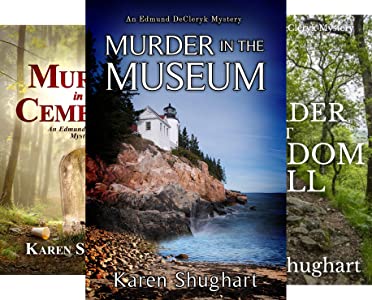
With the first book in the Edmund DeCleryk cozy mystery series, Murder in the Museum, I wrote a prologue that introduced a historical backstory that provided clues to why the present-day murder occurred. As the mystery unfolded, the backstory, spanning the late 1700s to the mid-1800s, continued with artifacts found in the basement of the museum and discovery of a memoir written by a man who, in his youth, had made terrible mistakes but who redeemed himself in adulthood. It was a short story within the book.

I continued with the historical backstory concept in my second book, Murder in the Cemetery, after deciding it would always be part of my cozies. But this time after the prologue, I conveyed it with the discovery of an artifact at the cemetery where the victim was killed, and a series of letters a lonely wife wrote to her sister while on a quest to find her husband, who had been transported to England as a prisoner of war during the War of 1812. Instead of one prologue I wrote two, the first introducing the backstory, and the second giving the reader the seasonal setting for the present day murder.

In the third book, Murder at Freedom Hill, I continued with the two prologues and the backstory-a narration for an exhibit at the historical society about the victim’s ancestors, both Black and White-who were involved in the Underground Railroad and Abolitionist Movement. Then I added a subplot that was separate from, but intricately woven into, the main story.

Now I’m working on book four, Murder at Chimney Bluffs. In this one, I continue with techniques I used before: the two prologues, the historical backstory -now rumrunning and the Prohibition era -but the backstory will also be the subplot. And I’ve added a second mystery, a cold case from decades ago that may lead the investigators to the killer.

I’m happy with the progression of these books, it keeps me interested and stretches my brain, but I confess that the writing is taking me a bit longer with each one. Now I’m compiling more notes and have added a timeline and a list of characters, many of whom are recurring; some new. As I continue to write the series I, too, am picking up steam, which will, hopefully, make each book better than the one before.

Karen Shughart is the author of the award-winning Edmund DeCleryk cozy mystery series, published by Cozy Cat Press. She has also co-written two additional mysteries with Cozy Cat authors, and two non-fiction books. A member of CWA, North America Chapter, and F.L.A.R.E., she lives with her husband, Lyle, on the south shore of Lake Ontario in New York state.

Guest Blogger ~ Heather Ames

THE BOOK THAT DIDN’T WRITE ITSELF

Some books almost write themselves. The plot sails along, the characters all interact as they should. Even the backdrop feels like it’s an impressionist painting that only needs a few brushstrokes to make it shine.

Book 3 of the Ghost Shop series wasn’t that book.

I had trouble finding a title, even though the theme was a haunted vineyard that wasn’t producing anything except anger and bad vibes. Compounding the problem, I wanted all books in the series to have titles starting with the letter T. After mentioning my dilemma to several people, two came up with the same suggestion: Tainted Legacy.

Still not completely sold, I used it as a working title I liked more as the plot struggled along, characters tripping over themselves and refusing to fall in line when I tried to take them in a certain direction, creating strange sidebars that, when I researched them, were grounded in reality.

I’d had a similar problem with book 2 of my Miami-based Swift/Roberts series. A group of friends became suspects of one kind or another in a cold case murder and kept squabbling like an unruly flock of geese, twittering songbirds or more likely, buzzards. I had a great deal of trouble reining them in. After opening one chapter in particular, I’d stare at it, then close it again without changing a word. Finally, with 4 drafts completed, the squabbling stopped and everything fell into place.

Tainted Legacy felt like a rerun with different players. Since I don’t outline my books, surprises are lifeblood for me. They fuel my imagination and reveal things about my characters I could never envision with the rational side of my brain. But when one of those characters presented me with a pivotal scene during what should have been the final 4th draft, I balked. That draft is supposed to be a read-through. An opportunity to catch those last few errors that typically occur, regardless how many times a manuscript is polished. I remained stuck, unable to work on the file for 2 weeks. My version of writer’s block. Something I had never experienced before.

Finally, I wrote The End, but was it? I hadn’t made any significant changes to that scene. It flowed too well. Now, I had to go back and read through the entire manuscript for a 5th time. If I changed my mind about that chapter, the entire storyline would have to be revised. The manuscript wouldn’t be ready for publication in time for a shipment of books to arrive before the Portland Holiday Market, the biggest show of the year for NIWA (Northwest Independent Writers Association,) and my unofficial book launch for Tainted Legacy.

I took a few deep breaths, got back in my office, and swiftly completed that 5th draft/read through. The plot worked. The character who had thrown that pivotal scene at me stood back and smirked. It had to be there. It complicates the relationships between the main protagonists when they should have cleared a major hurdle. It forebodes trouble of a possibly monumental degree in the books that follow.

This year, I’m planning to work on the 4th books in both my series. I have titles and rudimentary plots, big steps toward meeting that goal. Without encountering angry wine or squabbling teenagers, Maine Issues and Trick or Truth will both be available before the end of 2024.

Tainted Legacy

A barren vineyard in Dallas, Oregon. Two deaths. An unexpected heir who wants a quick sale. Is it a bargain, or an invitation to become entangled with the misfortunes of the Taricani family?

Sinister winery owner Vincente Valderos calls in psychic Sunny Weston and her partner, retired detective Ash Haines, to solve the mystery and save their souls…until the next time he summons them.

https://www.amazon.com/TAINTED-LEGACY-Ghost-Shop-Book/dp/B0CMCDCYP1

Heather Ames writes two mystery/suspense series, one with a paranormal twist, standalone suspense, romantic suspense, and short contemporary romances. When she’s not writing, she’s either thinking up new plots, traveling the world, or dreaming up new adventures.

Website:

https://heatherames.weebly.com

Amazon Author Page:

https://www.amazon.com/stores/Heather-Ames/author/B00ITGYJ86?ref=ap_rdr&store_ref=ap_rdr&isDramIntegrated=true&shoppingPortalEnabled=true

Social Media links:

https://www.facebook.com/p/Heather-Ames-Writer-100063683733057

https://www.facebook.com/heather.ames.75

https://www.instagram.com/bostonbrit1/?hl=en

https://www.goodreads.com/author/show/5367400.Heather_Ames