
A Love Letter to Libraries

By Margaret Lucke

“I have always imagined that Paradise will be a kind of library.”
Jorge Luis Borges, author

A public library is an amazing place. You can choose a book or a DVD and take it home–for free. If you need a computer, you can use one there–for free. You can attend a concert, or hear an author speak, or take a child to listen to stories–all for free.

A library offers a wealth of education and entertainment at no charge. As it happens, though, it costs a lot of money to do that.

“A library is not a luxury but one of the necessities of life.”
Henry Ward Beecher, social reformer
Friends of the Library 25th Anniversary celebration

I’m on the board of my local Friends of the Library, which recently celebrated a milestone—our 25th anniversary. The library staff and another library support group honored the occasion by throwing us a wonderful party.

For nearly four decades, my town had no public library. It was the second largest city in California without one. When the state’s voters approved a bond for library funding in the late 1990s, local leaders decide to apply for some of that money. Some civic-minded folks got together and set up the Friends group to demonstrate to potential funders that building a library here had strong community support.
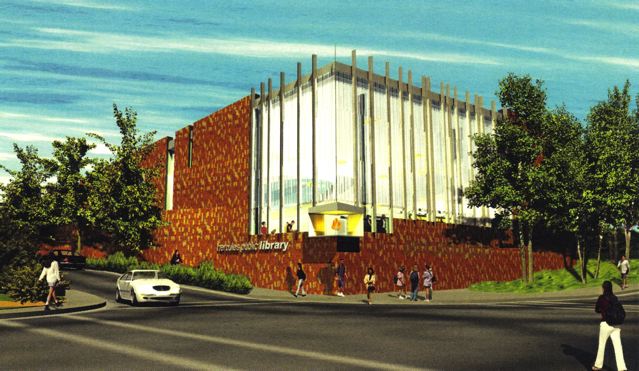
Hercules Public Library

There was a huge celebration when our beautiful new library opened in 2006. Our Friends group was proud to present to a check for $25,000, raised by sales of used books donated by the community, for the Opening Day Collection.

The enthusiasm continues. The library gets close to 25,000 visitors every quarter. Last year more than 10,400 people attended nearly 326 free programs, and patrons checked out 86,400 books and other materials. In many ways the library has brought the community together and become its heart.

Some people would have you think that in this era of Internet access and high-tech gadgets, public libraries are obsolete. Not so. They are well used though, sadly, not always well funded. The Friends are doing our bit help. To date, we’ve raised $350,000 to expand our library’s collections and support its programs.

“A library outranks any other one thing a community can do to benefit its people. It is a never failing spring in the desert.”
Andrew Carnegie, industrialist and philanthropist
Andrew Carnegie portrait

Steel magnate Andrew Carnegie (1835–1919), one of the richest men in the world in his time, was a big believer in libraries. At age 12 he emigrated with his family from Scotland to Allegheny, Pennsylvania, now part of Pittsburgh. Though the move ended his formal schooling, he was much impressed by a local businessman who, every Saturday, opened his personal library so workers could borrow books, thus allowing Carnegie to continue his education.

Carnegie vowed if ever he had any surplus wealth he would use it in lending books to others. Years later, he made good on that promise by giving some $56 million (a lot of money in those days) to build 2,509 public libraries worldwide, including 1,679 in the United States. He shaped the concept of public libraries in this country. If you have one in your community, you have Carnegie to thank.

“The best thing about the library is that it is available not only to me, but to everyone. It does not discriminate.”
David Horowitz, political writer

Libraries are among the most democratic of our institutions. The access they provide to computers, books, films, and music is invaluable, not only to individuals but to our society. Libraries bring people together. They enlighten and inspire. They open the doors to the world.

Some years ago I was hired by two Bay Area library systems to write the documents that would present their new strategic plans to their communities. Both of the planning task forces grappled with how to define the audiences they served. One opted to list the possibilities: “The Library welcomes all members of the community regardless of culture, ethnicity, age, gender, sexual orientation, physical ability, or socioeconomic status.” The other wrestled with the question for a while until one member said: “Doesn’t ‘everyone’ mean everyone?” So their statement simply says: “The library systems … promote[s] learning and enjoyment for everyone.”

Everyone is welcome. How many of our institutions can make this claim?

“Libraries are places where the imagination begins.”
Heather Barbieri, author

Have you been to your local library lately? I urge you to pay a visit and see all that it has to offer. While you’re there, check out some books, because funding is often based in part on circulation numbers. Join your Friends group. Make a donation. Vote for tax or bond measures that will secure its funding. Your library deserves your support.

“Libraries are a public good and a civic responsibility. They are about our future as much as they are our past.”
Andrew Lopez, university librarian

Books… And More Books… And Still More Books…

by Janis Patterson

Books are most definitely a leitmotif in my life. I have always loved to read. Even in my toddler days I would on an almost daily basis pull every book I could reach off the shelves and sit happily among them, turning the magical pages. Mother said I never got one upside down and nor ever tore a page, which I find remarkable as it took me much longer to master the skill of walking.

My parents discovered that I was reading when I was three, when I sat them down and read a short story from the newly-arrived Saturday Evening Post (the original version, remember that?). No one ever knew how or when I learned to read.  I had free rein in the family library, reading Boswell, all of Ellery Queen and most of Pearl Buck before starting school, but it was Shakespeare which fascinated me the most. The language! The imagery! The flow of those incredible words that drew you into a different time and place, a world of magic…

I had so looked forward to school, where I hoped to talk books and characters and reading, hopes that were dashed the first day. Not only did my classmates not even know the alphabet, the teacher took my copy of Shakespeare away, telling me I was naughty for stealing it. I had to prove to the principal that it was my book – it had my name in the front, too – by reading aloud and explaining a full page of the play I was currently reading. It was Troilus and Cressida, and it was such an infuriating and humiliating experience (resulting in an irrational dislike of that play which lasts to this day) that I loathed school from then on. Even before starting school I was not too fond of libraries, either, after a supercilious librarian insisted I could not look through the adult section, but would have to stay in the young children’s department where there were only pamphlet-thin and distressingly simplistic (if not downright idiotic) stories that had no real action or character development and a stunted vocabulary that should have shamed a retarded parrot.

I know now I was blessed to grow up in a house with books and respect for books. It took me a long time to realize that not everyone grew up immersed not only in books but love and respect towards books. Then it was just the way things were. I did not realize, however that some blessings can be an overabundance. After my mother passed away, I was clearing out her house preparatory to our doing some remodeling and long-deferred maintenance before moving in. There were books everywhere. Not only did the house have a dedicated library, there were bookshelves in every room. I called The Husband in tears when, after thinking the books were all taken care of, I discovered six big boxes of books under the guest room bed!

I quit counting my parents’ books at 12,000, but there were more. Trust me, there were more. Lots more.

Nor was that our only problem. Mother passed away just 3 weeks after our wedding, and The Husband and I were still trying to blend our possessions. In his house he had most of a bedroom devoted to bookshelves. In my 1,000 sq ft condo I had 19 floor-to-ceiling bookcases, most of them double-stacked.

We gave away LOTS of books. The Husband had a big pickup, and we took the bed brimming full twice to a charity shop. We gave books away to friends by the boxload. We even recycled some which were in too poor a condition to be read. Now, admittedly, most of these were paperbacks, but a paperback still qualifies as a book. We packed away about 10-12 banker’s boxes of books for storage in the garage for which there was no room in the house. Don’t know why, but for whatever reasons we simply could not get rid of them at the moment. A lot of them are wonderful fiction that is currently unavailable. Some I’m hoping to scan some of them. Someday. Of course we kept our lovely collection of reference works on the various subjects in which we’re interested, and the choice assortment of autographed and first editions that were my grandfather’s and then my parents’.

While remodeling we converted one of the bedrooms into another library, one with shelves on all four walls as well as over the windows and doors. The parlor, very Victorian in tone, has a tasty selection of glass-fronted antique bookcases, making it a sort-of third library. Not that any of this did any good. It’s a little known fact that, like brown cardboard boxes with mysterious contents, books tend to breed. We have stringently limited our trips to our local bookstores to one every couple of months, but still books appear, rising in drifts in the corners and lurking in clumps under the furniture. I do try, though, and do probably 99% of my reading of what I call ‘disposable fiction’ (the kind you read once and then get rid of) on my phone. If we had hard copies of every one of those books the house would be so full that we would have to live in a tent in the back yard. We are, however, talking about possibly creating a fourth library in what used to be the garage. We need it.

On Facebook there is a recurrent meme that says “It’s not hoarding if it’s books.” Yes it is. It most definitely is. But it’s wonderful, too.