Endings

Beginnings and endings are the hardest part of writing for me. (That’s today. On other days it’s the muddled middle.) Some writers have arresting, captivating openings that grab the reader and carry her along into a ninety-thousand-word novel. I’m not one of those, but I can eventually get a few words on the page to get the story moving. For me the greater challenge is endings.

Some years ago I listened to Andre Dubus III talk about his new book, House of Sand and Fog, which led him to talk about how he’d grown as a writer. He didn’t like his first book, Bluesman, because he considered it sentimental. His disdain for this failure in craft was obvious, and when I met him at a writers’ event years later, the subject came up again. As I listened to him touch on the challenges in his work, I understood that for him an ending that is sentimental is also in some ways dishonest, an inability to reach deeper for something that was true. I had just purchased TheGarden of Last Days, and read it with that in mind. There is nothing sentimental in that book, least of all in the ending.

Several critics have explored the link between the traditional and cozy mystery and comedy; noir crime fiction has been linked to tragedy. At the end of the cozy mystery, the world is set right again; the villain has been identified and brought to justice of some sort; the lesser crimes of other characters are brought to light and justice is visited on them in various ways, perhaps public censure or shame or remorse; and the minor romance barely acknowledged sometimes comes to light and there is a new beginning for a young couple. All is right with the world. From Restoration Comedy to Agatha Christie and writers today, it is hard for a reader of cozies or traditional mysteries to be satisfied with less. An unrequited love or an unchallenged con artist will annoy some readers as much as a dangling participle will menace the peace of mind of a copy editor. And I understand this. There is something deeply satisfying about the comedic ending, a moment that reassures us that the world aslant can be righted, that our inchoate ideals can be realized.

So how does a writer of traditional crime fiction compose an ending that is both true to the story being told and unsentimental? Sometimes I think this question is just one more obstacle to writing a satisfactory ending, and all I’m doing is complicating matters, making life harder for myself. I’m not unsatisfied with the ending of Family Album, the third in the Mellingham series, but I acknowledge that it is a tad sentimental (maybe more than a tad). But readers loved it because it fulfilled one of the hints at the beginning of the story, and a promise fulfilled, particularly about a possible romance, always brings a frisson of delight. But it was sentimental. At least it wasn’t mawkish.

I don’t remember most of the endings in my books and stories but some stand out, for me at least. The ending of When Krishna Calls in the Anita Ray series required research, rethinking, and stepping back. A woman sentenced to prison looks out on her new world, listening to another prisoner, and is satisfied with the choices she has made. She won’t forget why she is where she is, and she won’t regret it. The ending of Friends and Enemies in the Mellingham series required several versions before I finally landed on the one that worked and fit with the rest of the story. An editor who read the ms and considered acquiring it mentioned how much she liked it (but not enough to take the book). Another ending that satisfied me is that in “Coda for a Love Affair,” in Devil’s Snare: Best New England Crime Stories 2024. The ending is simple, clear as cut glass and sharp.

Endings are hard because the easy ones come fast, are easy to write, and sit well on the page. And that’s the problem. They tempt us to take them, give a sigh of relief, and pat ourselves on the back for coming up with (rather than running carelessly into what looks like) the perfect line or paragraph to close out three hundred pages. Depending on how tired we are of the story and working on it, that ending will appear reasonable, acceptable, or a gift from the writing gods. So this is where I step back and wonder what Andre might think. I don’t have to get far into that mental exercise to admit that the first or even the thirtieth ending is not what I want. 

If nothing else, writing keeps us humble. In our heads we hear perfect dialogue, snatches of prose so brilliant we’ll never need the sun again, but on the page, our pen does not cooperate (or the computer keyboard), and we end up with the mundane, the ordinary, the usual. I keep working on endings but I know I fall short most of the time. As do we all. It’s encouraging to know that greater writers have the same struggles, the same challenges, the same doubts. With one eye on writers whom I admire, I keep at my own work, striving to meet my standards even if that means sometimes disappointing some readers. If I want better endings, I just have to keep at it until I get there.

Age or Too Much Juggling?

It’s only the first month of the new year and this is the second group blog I’m on that my Google calendar told me I had a blog today. Yeesh! I have never in twelve years not had a blog already scheduled to go.

In fact, yesterday, Sunday, the day I plan out my week, I wrote down to write my Ladies of Mystery blog post on Tuesday, because, when I looked at January in my date book, which is my bible to keep things straight, I had written down my post was the third Monday of the month instead of the second.

How I managed to do that FOR THE WHOLE year when I received my new datebook in July, I don’t know. All I had to do was look to my left and on a corkboard there is a list of when each Ladies of Mystery author blogs during the month. Now, I have to go back through my datebook and cross out the LOM on the third Monday and put it on the second. And yes, cross out. I use different colored ink pens for different things that are happening.

Orange for the days I post on my Writing into the Sunset blog, Purple for the days I post on here and the other group blog. Bright pink for book specials and events, Blue for when my6 newsletter goes out. And black for personal appointments and events.

I use pencil for guest bloggers on Ladies of Mystery and to keep track of how many words I’ve written.

I also have a whiteboard with three columns where I write the months in one column in purple, the next column is in green and it is the title or number of the book in which series I’m writing, and a column in pink with the title of the book releasing that month.

Then below that, I have a new keeping track project that a very successful Indie author uses to keep track of her specials and events. I decided to use it this year and see if it can help me do a better job of staying on top of promoting my books. It is a 2′ by 3′ write on calendar of the whole year. It is to help me keep track of what book, where, and when I promote it and to keep the promotion flowing all the time. That has been my biggest problem. I start out promoting and then I get caught up in the other sides of being an Indie author and forget to keep promoting. This calendar with everything scheduled is a visual of what I need to do and what is happening. I hope it works.

And again, it is color coordinated. Blue for audiobook promo, green for ebook promo, and pink for special events.

And yet, with all of these reminders, I forgot my group blog post last Monday and today’s for this blog. I’m wondering if I need yet another calendar or whiteboard to keep me in line. What do you think? I’m off to change the purple LOM in my datebook to the second Monday. Have a great day!

What Makes A Mystery?

by Janis Patterson

We talk a lot about writing mysteries, reading mysteries, enjoying mysteries, but it’s seldom discussed what a mystery is. Leaving out the religious definitions, Dictionary.com says

  1. any affair, thing or person that presents features or qualities so obscure as to arouse curiosity or speculation
  2. a novel, short story, play, or film whose plot involves a crime or other event that remains puzzlingly unsettled until the very end
  3. obscure, puzzling, or mysterious quality or character

So at heart a mystery seems to be an obfuscation, either deliberate or accidental. I can deal with that. It isn’t easy, but I can deal with it. It comes down to making the unknown known, and the writer has the unenviable task of revealing it piece (clue) by piece. That is after he created the story and then covered it up! It is a delicate balance.

Taking a ‘mystery’ and making it into an enjoyable and reasonably coherent novel is a daunting process, whether it’s the question of who took Aunt Ida’s coconut cake to finding a vicious and seemingly omnipotent serial killer. The process is – or should be – the same. Even if it isn’t the first scene in the book, when you’re plotting you need to start with an action by an unknown – i.e., the crime, be it coconut cake or murder. Then you must follow the carefully laid clues but seemingly random clues found by the sleuth, be he amateur or professional detective, and by examining these clues eventually uncover the truth. Don’t forget to complicate the process with a fair amount of believable red herrings and some conflicts/problems caused by the people involved.

The trick to doing this is not to be too obscure or too obvious. And I’m a firm believer that your sleuth has to work at finding these clues and therefore find the solution to the mystery in a logical and sort of organized form. You should also put in enough clues that the reader, if so inclined, has a decent chance of solving the mystery. Now I’m perfectly aware there are mysteries which are widely read and even some celebrated writers who break these rules. The most famous example is Raymond Chandler, who admitted that sometimes even he didn’t know how his sleuth solved the mystery – it just happened. Raymond Chandlers are few and far in between, though; the quality of his writing was so good that neither readers nor critics seem to care. Don’t try to duplicate this. Odds are you can’t.

Another rule-breaker is often the currently popular ‘fluffy’ cozy mystery. The sleuth is usually a woman and she usually has a ‘cute’ job – owning a bakery or specialty coffee cafe or floral shop or something similar. She has or wants a boyfriend, who often turns out to be a policeman of some sort, and a bunch of ‘zany’ or ‘quirky’ friends. All too often in this kind of story the mystery is of secondary importance to personal relationships and the personal life of the sleuth. It’s an overdone trope, but some sleuths still express a passion for shoes which takes up a lot of the story space. Which is fine, as long as that is the sort of story is what the reader wants.

What is not acceptable, however, is when in whatever kind of mystery the sleuth does little to no sleuthing. Clues seem to appear with no effort on the sleuth’s part. The solution is highly reminiscent of the deus ex machina so beloved of Greek and Roman playwrights. I call that a cheat. A mystery shouldn’t need a god to step down from Olympus to unravel a story so complex it is beyond the ken of mere humans.

It is good that there are so many variations of mysteries – puzzles, non-lethal crimes, capers, murders, serial killers, fluffy cozies, traditional cozies, hard-boileds… there is a style of mystery for every reader. I only hope they follow the rules that make a mystery a good story.

The Road to Writing is Paved with Good Intentions

Photo of Sea WavesMy book, Murder in the Museum, was published in the spring by Cozy Cat Press. I resolved to spend at least twice a week promoting it and several more hours writing the second book in the series, Murder in the Cemetery.  I was feeling positive about my progress. The first, in all formats, was selling well, and I had written 15 chapters of the second book. Then spring turned into summer, here on Lake Ontario a season that starts with the July 4th holiday. And that’s when my resolve crumbled.
You must understand that we live in a resort area where summer days are long and the sunsets, spectacular. Where our days are filled with fishing, boating, beachcombing, golfing, swimming, festivals, parades and fireworks. Oh, and did I forget to mention the parties and picnics?  And the intimate get-togethers with friends at waterside restaurants? And outdoor concerts and theatre performances? And gardening?  And farm markets? This summer I also coordinated multiple events and activities for a family destination wedding that was held here, and we had three weeks of non-stop company. Get the picture?

I wanted to enjoy the beautiful weather and activities with friends and family, and that was the point when my resolve to write and promote on a regular basis crumbled. But I wasn’t feeling very good about it. I felt guilty and was losing sleep. Then one night, while tossing, turning and fretting, I took a deep breath and acknowledged that I was putting too much pressure on myself. I calmed down and faced reality.

The reality was that while not doing as well online, book sales were brisk at the multitude of seasonal gift shops, museums, visitors’ centers, bookstores and other outlets in our village and nearby communities. The reality was that I’d enjoyed several successful book signings and, as a local author, had been asked to attend various book group meetings.   And when I thought about it a little more I realized that life’s experiences make us better writers. Good and bad, they help us craft our stories with authenticity and richness. When I sit down to continue writing the second book, I’m sure I’ll include some of this summer’s celebrations in the story.

So, I decided to stop fretting and enjoy this bountiful season. I understood that it was okay for me to take some time to not only smell the posies I’d planted or cultivated over the years, but also weed them and feed them. And to do the same for myself.

Summer is now almost over, and fall is on the way. Soon I’ll settle down and get back to work on a more consistent basis. But I’m also going to enjoy the bonfires, apple-picking, grape harvests and wine tastings, festivals, hikes and cozy dinners with my husband, friends and family.  And I’ll weave these experiences into my stories, as well.

Guest Blogger – Wendy Tyson

Why I Write The Greenhouse Mystery Series
My husband and I are passionate organic gardeners. A few years ago we started our own small vegetable farm in Bucks County, Pennsylvania, with the intention of developing it into an organic CSA (community supported agriculture). Unfortunately, things fell through with the land we were leasing and the farm never made it past its first season.

garden 2017
Wendy’s garden this year

About a year later, my husband and I had driven to a solo signing at a bookstore in a small town in the Smoky Mountains of North Carolina. I was about a year into this whole publishing journey—my first novel, Killer Image, had been released on October 1, 2013, and the second in the series, Deadly Assets, that past July. I was still naïve enough to think, “If you have one reader, then they will come.”
Only they didn’t. My publicist and I did our best to get people there—advertised the signing on Facebook, tweeted every day leading up to the date, created an invitation, and posted the event on my website. Still, it was me, the lovely and engaging shop owner, my husband, and a plate of cookies.
I might have felt discouraged, except that a wonderful thing happened. I saw firsthand that small rural town in action. Others with shops along the quaint town center stopped in to chat with the bookstore owner. Their kids popped over after school, ate a few cookies, and then quizzed the store owner and me about the latest books. There was a buzz in the air, and despite the town’s remote location, I felt a worldly attention to life beyond its mountainous borders.
I was moved by these interactions, by the comfortable pace of life and the warmth I saw between townspeople. It dawned on me that a version of our small farm could live on—in a fictional small town in my home state of Pennsylvania. I’d been looking for a way to weave my family’s passion for organic farming and sustainable living into my novels, and here it was, served to me after a long, peaceful day in the picturesque mountains of the South.
And thereafter, Washington Acres Farm and the fiction town of Winsome, Pennsylvania were born in the form of the Greenhouse Mystery series.
I’m no stranger to small towns. I grew up outside of Philadelphia, but I spent most of my youth and young adulthood in one small town or another. Even now, I live in a small town in the Green Mountains of Vermont. But there was magic in that charming Southern small town. I wanted to share that magic.
I’m thankful for that failed book signing experience.  It was a splendid reminder that sometimes we get what we need, not what we think we need.
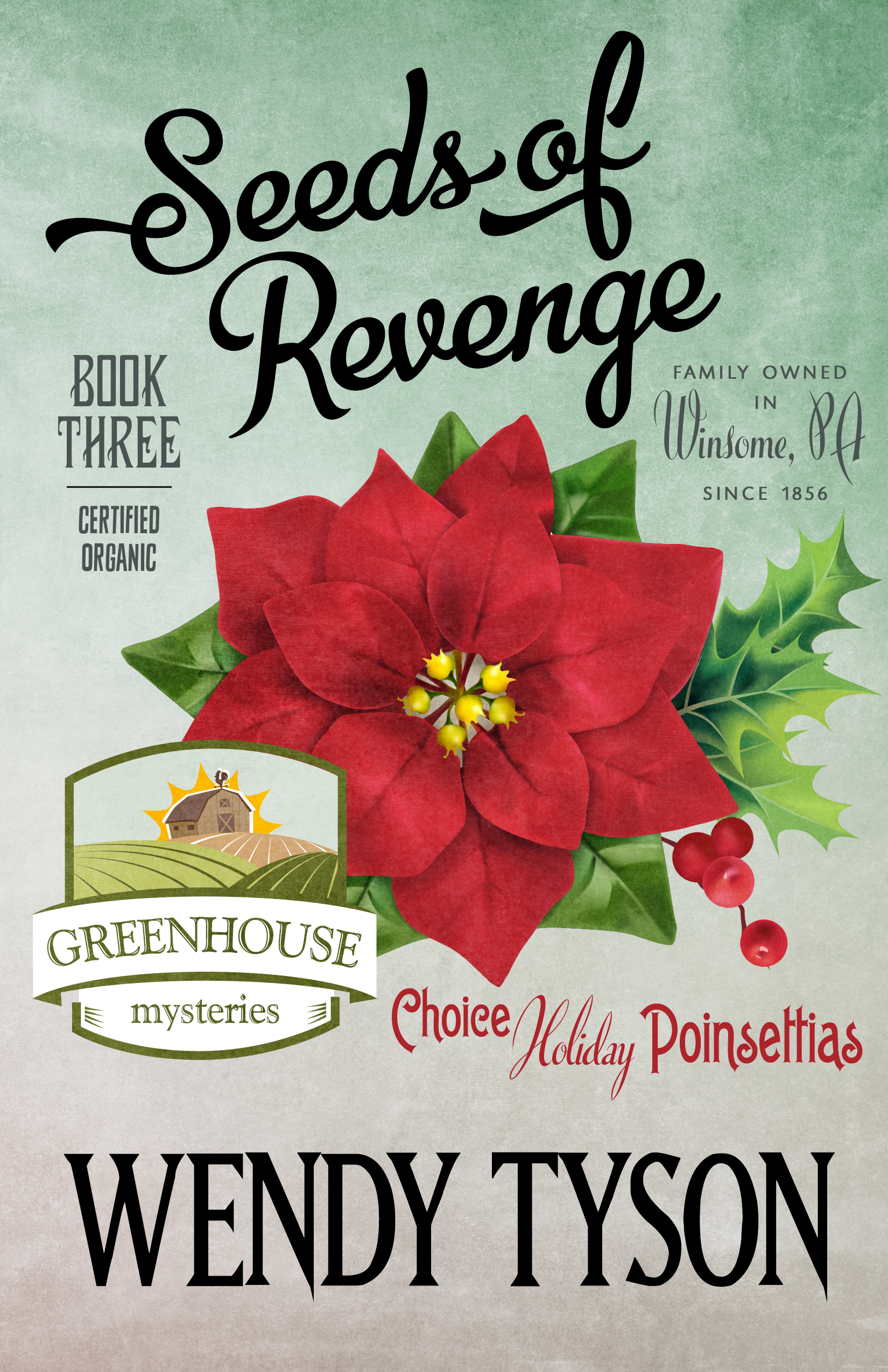
Seeds of Revenge CoverBlurb for Seeds of Revenge
It’s time to cuddle up with a holiday whodunit. Smell the crisp pines and baking cranberries as you sip your hot apple cider. It may be the season, but the mood in Winsome is anything but jolly. Megan Sawyer is determined to farm year-round. So much so that she braves a December snowstorm to pitch her fresh greenhouse greens to Philadelphia chefs. And then she sees a stranger stranded on the side of the road.
But this woman is no stranger to Winsome. It’s Becca Fox. A love chemist (you read that right). She’s headed to her aunt’s house to sell her love potions at holiday events. Or so Becca thinks.
Her sneaky aunt only invited Becca home to reunite her with her estranged father. It sounds noble and kind-hearted, until the man ends up dead. Megan soon finds herself in the middle. She realizes Becca’s not the only one getting iced over. Megan’s own aunt, the famous mystery author, is dragged into the drama. Her novels implicate her and she’s in trouble.
Now it’s personal. Our Megan must follow a cryptic trail of literary clues, all while sifting through the victim’s sordid past. She gets closer to the truth as the murderer gets closer to her. How’s that for a ho ho ho? Don’t let your fresh apple crisp burn in the oven because you’re lost in this holiday homicide.
Buy Links:
wendy-tyson-pic_origWendy Tyson’s background in law and psychology has provided inspiration for her mysteries and thrillers. Wendy’s short fiction has appeared in literary journals, and she’s a contributing editor and columnist for The Big Thrill and The Thrill Begins, International Thriller Writers’ online magazines. She is the author of the Allison Campbell Mystery Series and the Greenhouse Mystery Series.