The Secret

Many of us in the writing community have a secret, and it’s not exactly the same secret. We write our books, talk about our characters, whom we love, and gnash our teeth over the plot holes, the ever-jiggling middle that refuses to settle down and dash forward, and the ending that leaves us dissatisfied, rewritten three or thirty-three times. You know this because you read us here. None of this is kept secret from anyone who reads a writer’s blog. And then we have to edit the soggy mess, find beta readers, edit it again, and then pop over to our editor, if we have one, or switch hats and become our own publisher.

Somewhere in this scenario is one step that every writer loves. We each have our own. Which one is mine? Those who know me can probably guess.

When I was in college I was the editor of the student humor magazine, which meant handling proofs and working with the printer. I loved working with the printer, seeing those strips of paper with types-set pages on them with little red pencil marks and handing them over to the printer. For some reason I prefer to forget, I always seemed to get him at dinner time. Yes, I love the publishing/printing process. And that brings me to the topic of today—Crime Spell Books.

CSB is the third publishing venture I’ve undertaken with friends or colleagues. What may seem daunting to others has an irresistible pull for me. Two other writers and I began Crime Spell Books after the new editors/owners of Level Best Books, another venture I began with another two friends, dropped the anthology for New England mysteries. They lived in the DC area, so it was understandable. But New England needed its own anthology, so Ang Pompano and Leslie Wheeler and I grabbed the opportunity, and published our first in 2021.

Devil’s Snare: Best New England Crime Stories 2024, now availables is our latest offering, with twenty-four stories, in every sub-genre. We post a call for stories in January, and we read every one that comes in over the next several months (to end of April). We rank the stories 1, 2, or 3 on our own lists, and then we share them to see what we have. It’s always gratifying to see how close we are on most of them. When we decide how many stories we want, we begin discussing the remaining stories that came close, and work for agreement.

Anthologies are among the best works we in the writing community can produce. They show a variety of writers and interests. They require strong collaboration. Each editor loves certain stories and not others, and here we rely on a deep respect for each other’s experience and taste so we can come to agreement. Not every story I love gets into the anthology, and the other two editors probably feel the same. But the result—a list of excellent mysteries and crime stories by known and unknown writers—is something we’re all proud of. And then we come to my special love/hate experience—formatting. I do this because I think there is something wonderful about holding in our hands a finished book that we made, with the chapters and lines of text laid out properly—no unruly paragraphs or rebellious headers or recalcitrant page numbers. Everything is in order and proper and beautiful.

So that’s my favorite part, as much as anyone might question that statement while I’m working on it. The end is worth the frustration, gnashing of teeth, moments of panic, and sheer terror that one wrong punch of a button will send the whole thing to oblivion. And then it’s done. The proof comes in the mail, and then the final copy. And I look up from my desk and there it is. Beautiful. Finished. I can rest of my masses of edited copy and have another cup of tea.

Adventures in Anthology-Land


by Janis Patterson


I like the anthology format – a short (ca 20K words) length which is appealing to today’s sound-bite sensibilities, several authors, which means several different stories, several different viewpoints, several different styles even if written around the same theme. This broadens the target audience and exposes every one of the contributors to readers they might not otherwise have reached.


On top of my standalone releases I do two Regency-set romance anthologies every year – one with a summer theme and one set at Christmas. Great experience, great publisher, good financial returns – everything needed to give me a totally overblown opinion of my own knowledge and powers.


At an informal gathering of some long-time (multiple decades) writer friends (all working professionals) we were talking about the market and what we could do to improve our sales. Suddenly struck with an attack of the stupids, I suggested “Why don’t we do an anthology ourselves? A mystery anthology?” (Yes, I have seen all the Mickey Rooney/Judy Garland movies where someone always cries, “Hey! We’ve got a barn… why don’t we put on a show?”)


After a lot of chatter and very little good sense, we decided to peg our anthology to underserved holidays. I mean, who needs another Christmas or Valentine’s Day anthology? Who has even seen a Labor Day or Memorial Day or St. Swithin’s Day anthology? It’s practically a virgin field.


We decided to start with July Fourth, each of us writing a story about our choice of the various wars that have defended our freedoms. I – for some unknown and unfathomable reason – chose World War I, about which I knew next to nothing. Now I know a lot, much more than is needed for a 20,000 word novella, but that’s the way things go.


Fortunately, as all of us are long-time professionals, all skilled in the mystery genre, coming up with the ideas and actually writing the stories were not difficult at all. What drew us all up short was the non-writing stuff.
Who is going to do the formatting? We all have different formatters, or do it ourselves. What about covers? Same thing. But those were small problems, easily handled.


It was the business side that drew us up short. Now we have all self-published with varying degrees of success, so the mechanical part didn’t faze us, but the financial part did. The vendors only take one name and social security number, so whomever we used would get stuck with the tax bill. There are ways around that, with a portion of the buy-in to be set aside to recompense that person, but it seemed dreadfully complicated. None of us are particular mathematical geniuses (genii?) so through the kind generosity of several other writers we got names of a couple of companies that did fee-splitting, which relieved our minds immensely. The only sad thing is, by the time we got this far it is much too late to get the July Fourth book release on track for a proper pre-release. The only choices we had were to rush it through and sell a less-than-ideal product or put it off a year so we could give it the professional send off – and offer our readers a professional product.


So what did we do? Of course none of us could face putting out a less-than-professional product, so it should be ready for pre-order next June. You expected something different? Of course, that left the question of what to do between now and then… go back to our individual projects after making a release schedule for the July Fourth anthology? Take a much-needed break from writing at all?


Hey, people, we’re writers. What on earth would make you think we would do anything so sensible?
The new anthology is titled Bloody New Year! and is centered on New Year’s Eve/Day. It will be ready for pre-order 15 November. Don’t forget to get your copy!

Guest Blogger~ Tilia Klebenov Jacobs

Character Matters

by Tilia Klebenov Jacobs

The prep stage of writing can be a time of enchantment when characters and motivations emerge like flowers blooming.  As I laid the groundwork for a story that would eventually be called “Perfect Strangers,” I felt as though I were not creating so much as discovering the answers to key questions.  Specifically, what kind of person creates multiple identities in order to rob a marijuana dispensary?

Authors say there are two kinds of writers, plotters and pantsers.  Plotters write outlines, sketch character bios, run their stories past lawyer friends to see exactly what kind of trouble they’ve gotten their protagonist into, and generally research down to the last stray molecule of information.  By contrast, pantsers prefer to fly by the seat of their…trousers. 

 I am a plotter.  This may have something to do with my days as a middle school teacher, when I would routinely tell my students that failing to prepare is preparing to fail.  Mostly, though, it just has to do with being me.  I like knowing where I’m going before I set off, and I like knowing who I’m writing about before we embark on mayhem together. 

For “Perfect Strangers,” I filled in a bio sheet that I’ve developed over the years.  I started with the basics:  name, age, sex/gender identity, job; and went on to such details as education, hobbies, and living and work spaces.  I decided how many kids were in the family of origin, whether the parents were married, and if so whether it was a happy marriage.  I described my character’s religion, ethics, and politics, and added a brief timeline of his life up till now.  Thus did I make my protagonist, Gershom McKnight, a recently paroled convict.  He was born in Providence, Rhode Island, the single child of unhappy parents who did not encourage their son’s talent in visual arts (useful for a career as a forger later in life).  He was a juvenile delinquent who became a felon at age eighteen, and his best friend is his cellmate.

My biographical information on Gersom also told me how he sounded.  My notes under “Tone and Narrator” read as follows:

Narrator has spent 10ish years in prison.  S/he, but probably he, is smart, resilient, and resourceful, but at best an autodidact. Can have plenty of humor, but not lotsa highfalutin’ vocab and descriptions.  Tone is conversational, a cross between boasting and confiding.  He knows stuff, and how to do stuff, and is proud of it.

Suddenly, I could hear my fictional character talking.  I knew his voice, his sense of humor, his wry asides.  Now he and I could tell his story.

Many of the details I come up with never appear in the story they undergird.  For example, Gershom’s family life is never mentioned in “Perfect Strangers.”  However, all these data points serve me in the aggregate by giving me a precise picture of who I’m dealing with, what they sound like, and how they will behave once the action starts.  For me, it is a joyful process of discovery.

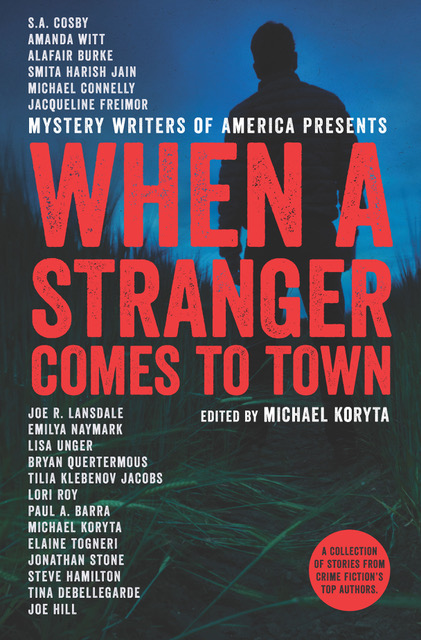
Mystery Writers of America Anthology

“It’s been said that all great literature boils down to one of two stories — a man takes a journey, or a stranger comes to town. While mystery writers have been successfully using both approaches for generations, there’s something undeniably alluring in the nature of a stranger: the uninvited guest, the unacquainted neighbor, the fish out of water.  No matter how or where they appear, strangers are walking mysteries, complete unknowns in once-familiar territories who disrupt our lives with unease and wonder. In the newest collection of stories by the Mystery Writers of America, each author weaves a fresh tale surrounding the eerie feeling that comes when a stranger enters our midst, featuring stories by prolific mystery writers such as Michael Connelly, Lisa Unger, and Joe Hill.”

IndieBound / Bookshop.org / Barnes & Noble / Amazon / Books-A-Million  / Audible.com 

Tilia Klebenov Jacobs is the bestselling author of two crime novels, one middle-grade fantasy book, and numerous short stories. She is a judge in San Francisco’s Soul-Making Keats Literary Competition, and a board member of Mystery Writers of America-New England. HarperCollins describes her as one of  “crime fiction’s top authors.” Tilia has taught middle school, high school, and college; she also teaches writing classes for prison inmates.  She lives near Boston with her husband, two children, and pleasantly neurotic poodle.

Website:  http://www.tiliaklebenovjacobs.com/

FB Author Page:  https://www.facebook.com/Authortiliakj

Twitter Handle:  @TiliaKJacobs

The long and the ‘shorts’ of it all

By Sally Carpenter

A short story anthology is like a box of chocolate—you never know what you’re going to get.

Like all small presses, Cozy Cat Press doesn’t have a big advertising budget, so publisher Patricia Rockwell is always looking for new ways to promote her authors. One year the authors joined together to write a group mystery, “Chasing the Codex” (I wrote chapter 3). Another year CCP published a cookbook.

This year Patricia wanted to release an anthology to showcase the writers. Instead of paying for one author, the reader gets 25 different voices to sample.

Submissions to the anthology were voluntary. Some writers had other commitments and some chose not to take part.

The anthology doesn’t have a theme because that proved too limiting. Some authors wanted to use an old story they had sitting in a drawer. Others wanted to write about their CCP series characters. Others wanted to pen something different than their books. In all, an eclectic mix.

This year I’ve been working on a novel to launch a new series, so it was fun to revisit Sandy Fairfax, the star of four books of his own. He has such a distinct personality that I jumped back into his voice with no effort.

The story takes place on a children’s TV show, an idea that sounded fun but not meaty enough to stretch into a 200-page novel. Besides, I’d already written two books set on a studio lot, so I wasn’t interested in rehashing that idea for another book. So the kids’ show was a simple concept suited for a short story.

In late spring/early summer this year I wrote “The Puzzling Puppet Show Caper.” My books follow chronologically, so this story immediately follows book four. I wanted to reuse a character from book two, but in reviewing that book I discovered the character couldn’t make a comeback. I created a new character to take its place. I’d forgotten how book two ended, so it’s always good to reread ones books now and again.

I manage to sneak in a recurring character, Sandy’s agent, who appears in all four books, and his girlfriend, who arrives in book two. Short stories have no room for subplots, so none of Sandy’s family members show up.

The time frame is shorter. The novels cover one to two weeks. The short story is set in one day.

Like the books, Sandy involves himself in a murder investigation and gets caught in a “death trap” at the end. He’s been in more cliffhangers than the Perils of Pauline.

Enough about me. I ordered the book because I’m eager to read how the other authors put a story together.

The other authors in the anthology are Amy Beck Arkawy, Allen B. Boyer, C.F. Carter, Linda Crowder, Glen Ebisch, Bart J. Gilbertson, Helen Grochmal, Lorrie Holmgren, Bret Jones, Mary Koppel, Elizabeth Lanham, Owen Magruder, Jane O’Brien, Joyce Oroz, David Pauwels, Emma Pivato, Joe and Pam Reese, Megan Rivers, Patricia Rockwell, Rita Gard Seedorf, Rae Sanders and Annie Irvin, Lane Stone, Margaret Verhoef and Carmen Will.

The print version is a larger size than the regular CCP paperbacks in order to accommodate all the stories—340 pages!

So if you’re looking for a tasty story this holiday season for yourself or as a gift, dip into the “Coy Cat Shorts” smorgasbord.


Christmas is Coming

by Janis Patterson

For once I’m way ahead of a deadline. It’s a situation that doesn’t happen very often, and I’m going to enjoy every bit of it!

A couple of months ago a couple of mystery writer friends and I were having lunch and somehow the subject of holiday anthologies came up. They seem to be a popular genre and – as all of us are always interested in upping our sales – the idea of us doing a Christmas anthology of murder mystery stories appeared (sorry, gang – I don’t remember whose idea it originally was) and everyone loved it.

My mind – like most writer’s – is a strange and fearsome place. Immediately a story began forming in the swirling and dangerous depths of my imagination and in spite of a looming book deadline, a much-looked-forward-to and lengthy trip to Atlanta to the NRA convention coming up and a vicious case of food poisoning (the worst I’ve ever had) I started writing immediately, much to the detriment of my current work in progress. Some stories just need to be told immediately.

Christmas is supposed to be such a happy time of family and presents and religious devotion, but it seems like I remember reading somewhere that more people commit suicide at Christmas than any other time of the year, which is horrifically sad. Even though I can’t call up the statistics, it seems I also remember there is always a jump in murders and assaults during the holidays as well – which is sad too, but it makes the season a natural for tales of murder and dark deeds.

I have always believed that stories should be just as long as they need be to tell the story. Our group had decided on novellas rather than full novels, and as novellas go, mine is short – truly a novelette (does anyone use that term any more?) at just over 15,000 words. But the story is a very small slice of time and a very concentrated tale with a sparse cast of characters, so that’s all it needed. I could of course pad the word count, but that would dilute the story.
The story? It’s a delicious mix of a family Christmas in a snowbound mansion and a horrible relative who is found dead on Christmas morning. He has been stabbed… and garroted… and poisoned. I have always believed in overkill. The title is, appropriately enough, KILLING HARVEY.

Anyway, the story was finished before we left for the NRA convention – for which I’m glad, as the convention gave me so much information and so many story ideas that my head is about to explode.

If all goes as planned, our anthology should be for sale online sometime mid to late November. If the project falls apart, I’ll release the story by myself. So – be warned : either way KILLING HARVEY will be available, so please plan to buy lots of copies. It will be the perfect virtual stocking-stuffer.

Now as my original deadline approaches with the speed and grace of a runaway train, I must get back to my work in process.