ChatGPT and This Writer

For the last several weeks much of my reading has been about AI and ChatGPT, learning as much as I can about this new technology. Thanks to a good friend from graduate school (back in the Dark Ages of landlines and library card files), I’ve learned a lot about AI and what it could mean in areas beyond writing, such as automotive, medicine, and hard science. But the only area I’m concerned with here is the AI directed toward producing word texts—articles, essays, stories, memos, ad copy, and the like. 

When ChatGPT appeared on the scene for the general audience, in 2022, most people were caught off guard and stunned at what it could do. Writers, understandably, and myself among them, were horrified that a machine would soon be producing texts. What would that mean for our futures? (The writers in California are striking over the same issue.) This anxiety has not declined; some even speculate that this new technology could soon make human efforts obsolete and even lead to our end. Like the dinosaurs. 

During a webinar held by the Authors Guild on Thursday, July 20, 2023, one of the participants made some important points about language, so that if nothing else, we understood what we were talking about. ChatGPT is one application of AI. It is called a large language model, borrowing some terminology from linguistics and the work of Noam Chomsky. But this is where it becomes misleading. ChatGPT requires large amounts of data—copies of the written word—in order to produce texts on demand. The designers of the application have scoured the Internet for documents to feed into their computer. Books are found on pirate sites that are often fending off take-down notices from writers (I’ve sent some of those notices). With these texts, the machine is trained to recognize acceptable sequences of words and when their use is most relevant to the question presented. Think “keywords” lined up.

The user of ChatGPT can type in a request, and the software will type out an answer. If you want an outline for a novel, type that request with some details to guide the machine such as setting, characters, and time period, and the machine will send back an outline in conformity with your guidance. The designers of ChatGPT describe the answer as being generated, as a generative text. But this isn’t accurate, as one of the webinar participants pointed out. The machine cannot generate. The machine cobbles together bits and pieces according to patterns, and spews out the result. The text is derivative; it is derived, taken from documents fed into the machine. As the participant went on to say, the result is plagiarism of someone’s work, and in fact of many works by many someones. 

Why does this matter?

We are writers. Accuracy matters. As George Orwell demonstrated only too clearly in 1984, words lead us and determine how we think (or don’t think), and so we as writers should always be accurate in how we present our ideas. 

The work that AI designers insist on describing as training is in fact copying, copying of a copyrighted text without permission, which is an infringement of that law and also known as plagiarism. The text derived and reproduced by the machine does not carry any acknowledgment of this fact.

The purpose of the Authors Guild webinar was to bring members up to date on their efforts to protect and maintain the rights of writers. They are lobbying for several goals: First, payments and damages for training/copying already done. Second, AI content clearly labeled as such (The White House meeting on AI this week includes a request for a watermark or something like it, to indicate an AI produced text). Third, disclosure by AI companies of what work has been used already. (A list of ISBNs used has been made available, but when I tried it there was no way to search it, though a tool is sometimes available.) Fourth, expanding the right of publicity law from name, image, etc., to include style (a writer’s or artist’s style). 

The Authors Guild is also talking with publishers about contract clauses that allow the writer to deny AI companies the right to copy the text or other contents of a publication for training or any other purpose without permission.

Some writers are already adding a clause to the standard copyright statement. “All rights reserved. No part of this book . . . ” To this, authors are adding “This work may not be used in AI training without written permission by the author,” or similar statements.

AI ChatGPT has many supporters as well as detractors, and I continue to learn about it. And no, I haven’t tried to use it for my work but a friend asked it for a summary of my first novel, Murder in Mellingham. The summary was atrocious, and included a character name I’ve never used. 

My firend also used ChatGPT to produce a letter requesting that OpenAI stop using my material in its training. I’ve sent the letter and am now waiting for a reply. I’ll post about it when I get one.


On Becoming a Virtual World – Beneficial or Tragic?

Lately I’ve been hearing and reading a lot about virtual environments and experiences. One friend pointed out that flying to Africa and going on a safari there had a tremendous negative impact on the environment, and wonderful safari videos were available online, so why not just watch those instead? I constantly see ads on streaming video showing all the “virtual worlds” people can create for themselves on the internet, and showcasing all the benefits of doctors being able to “see” inside a virtual replica of a human body to learn and diagnose. And then, of course, there are all those AI applications, which can be viewed as virtual writers, editor, artists, programmers, and so forth. (Don’t get me started on “customer support” AI helpers.)

We seem to be evolving into a world that is created by software or recorded from the past rather than a world that is immediate and natural. Is this incredible or horrific? Most of the time, I just can’t make up my mind.

You see, I’m a Nature lover and very much a fan of celebrating the present and being there to actually see, touch, hear, and feel all things real. I don’t even listen to music or ebooks while out walking because I want to hear the birds and the rustle of leaves in the trees. My Sam Westin Wilderness Series and my Neema the Signing Gorilla series are very much reality based. I find the idea that virtual reality or recordings from the past could replace real-time experiences very disconcerting. If nobody ever encounters an elephant or a ptarmigan or a dolphin in real life, will anyone care about saving them? For me, watching a video never inspires the wonder and delight that experiencing nature does.

On the other hand, we all know that our planet is likely to become a very different place in the future. Today, there are already too many humans crowding the wildlife out of their environments, and more humans are born every minute. People will likely need to make severe compromises to keep our planet habitable. This probably means that in the future, fewer people will have the amazing experiences I’ve had scuba diving, hiking, snowshoeing, kayaking, traveling, etc., and they will probably rarely encounter any sort of wildlife except for insects. But at least they will be able to have virtual encounters of all sorts.

In my younger years, I and many of my peers wished we had the holodeck pictured in the Star Trek series. In the holodeck, a person could create any sort of environment she or he wanted, have any sort of experience that was desired. But in the television show, the holodeck provided a great escape because the starship crew could not step explore space and time without the aid of software. Is this our future? Should we celebrate it? The changes seem inevitable. Will the next generations feel deprived or enriched? I do love movies and nature documentaries, and I suppose that reading might be considered a “virtual experience,” and I definitely support all of those.

Personally, I’m glad I won’t live forever. Tomorrow, I’m going hiking in the mountains, and I hope to see mountain goats and ptarmigans as well as beautiful scenery. I will kayak on the weekend and watch for harbor porpoises and many types of water birds. And in December, I will fly to Tanzania to encounter a wide variety of exotic animal species in person, and feel only slightly guilty for increasing my carbon footprint. I chose not to have children, and I do many things to help save the planet now, but I can never give up real experiences in my lifetime.

What’s Your Method? By Karen Shughart

I recently read an article about renowned American author, John Steinbeck, who gave six tips on writing that were included in a letter he wrote in 1962 to a friend. These caused me to reflect on how I write my cozy mysteries, and I was astonished to realize how much of his advice applied to me. Below are the tips with my italicized notes beside them:

  1. Abandon the idea that you are ever going to finish. Lose track of the 400 pages and write just one page for each day, it helps. Then when it gets finished, you are always surprised. I don’t write every day, but when I do I try to write at least a chapter or two. I don’t have pages in mind; instead, I aim for 60,000-75,000 words, the length for cozies.
  2. Write freely and as rapidly as possible and throw the whole thing on paper. Never correct until the whole thing is down. Rewrite in process is usually found to be an excuse for not going on. It also interferes with flow and rhythm which can only come from a kind of unconscious association with the material. This one hit home. I write the entire story and revise and expand afterword, my first draft is typically too short.
  3. Forget your generalized audience. In the first place, the nameless, faceless audience will scare you to death and in the second place, unlike the theatre, it doesn’t exist. In writing, your audience is one single reader. I have found that sometimes it helps to pick out one person—a real person you know, or an imagined person and write to that one. Instead of picking a person, I write towards a targeted audience, mainly women (and some men) who are middle-aged or older. Cozies are called “clean” novels because they do not contain graphic language or violence or explicit sex scenes, something that appeals to my readers.
  4. If a scene or a section gets the better of you and you still think you want it—bypass it and go on. When you have finished the whole, you can come back to it and then you may find that the reason it gave trouble is because it didn’t belong there. I do this a lot. See below.
  5. Beware of a scene that becomes too dear to you, dearer than the rest. It will usually be found that it is out of drawing. I have a slash and burn mentality when it comes to writing. I may fall in love with a scene, but I’m brutal about cutting it if it doesn’t fit.
  6. If you are using dialogue—say it aloud as you write it. Only then will it have the sound of speech. I do this with every character. Sometimes when I’m writing dialogue for a male, I check with my husband to see if it sounds authentic.

So, there you have it. I hope you authors reading this blog take time to reflect on your own writing methods. For those of you who are our readers, perhaps you’ve gained a little insight into the writing process, at least for John Steinbeck and to a lesser extent, me..

Guest Blogger ~ June Trop

Ancient Roman Forensics

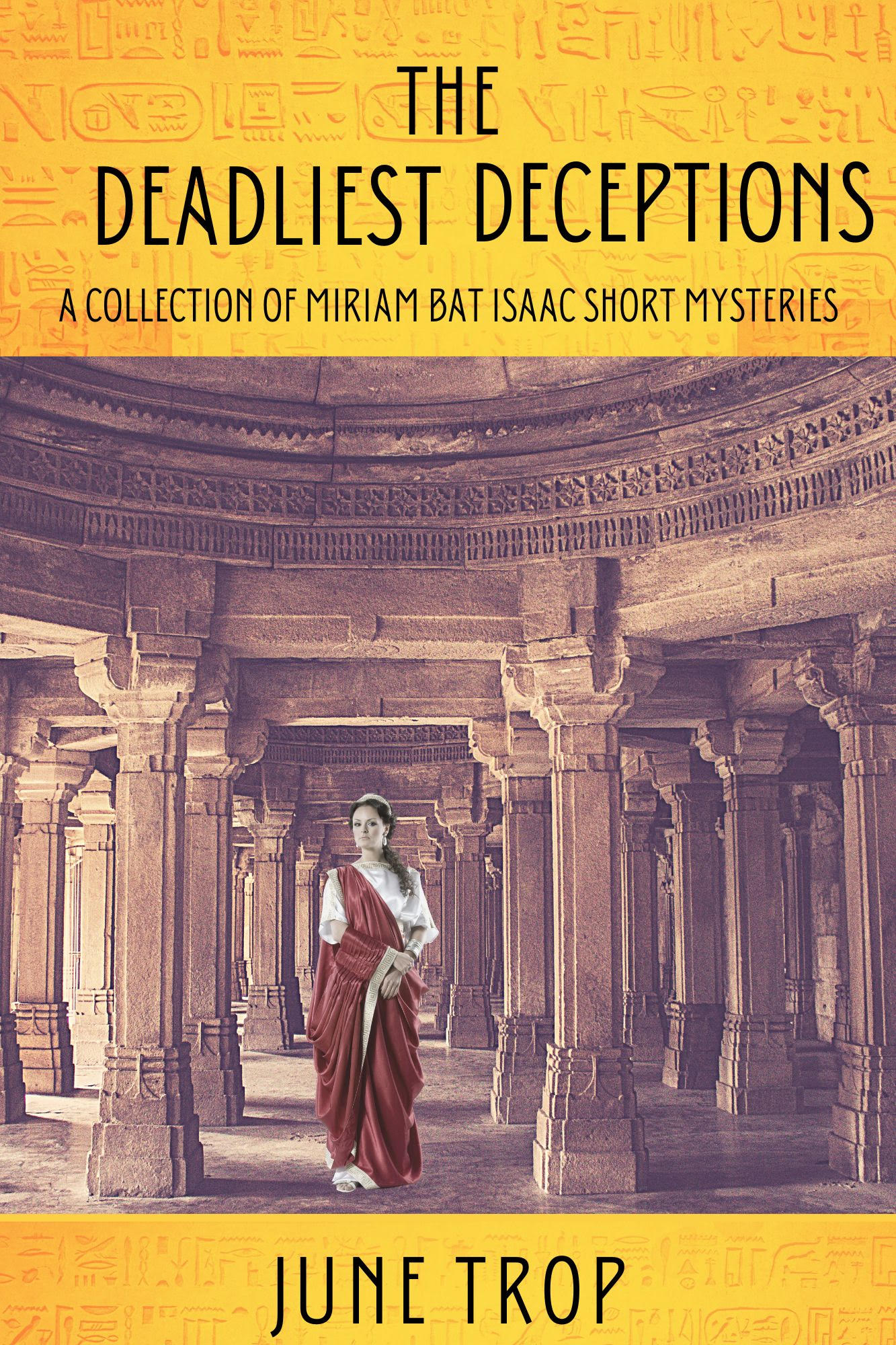
As the author of the Miriam bat Isaac Mystery Series set in first-century CE Roman-occupied Alexandria, I regularly research the investigative techniques used in Roman times. In writing my latest book, The Deadliest Deceptions, a collection of short mysteries ranging from cozy to noir, I found myself focusing on Roman forensics. No, the Romans didn’t know about fingerprints and DNA, but in time, their courts accepted evidence based on blood spatters, dental characteristics, and pattern recognition.

Perhaps the most famous case based on blood spatters was “The Wall of Handprints”, in which a blind son was accused of killing his father for his inheritance. The prosecution argued that the father was asleep with his wife, his son’s stepmother, when his son stabbed him to death. Furthermore, the father died instantly without having awakened his wife, and the son left a trail of intermittent handprints and blood spatters on the wall from their room back to his own.

On the other hand, the defense attorney claimed that it was the stepmother who killed her husband. Upset that she would lose the inheritance, she framed her stepson. The lawyer successfully argued that the son, being blind, would not have left intermittent prints. Rather he would have dragged his hand along the wall. So, despite their lack of knowledge about the components of blood, the Romans used its prints and spatters to reconstruct the crime.

Julia Agrippina, a.k.a. Agrippina the Younger, used dental characteristics to confirm that Lollia Paulina was dead. Having ordered Paulina’s suicide, Agrippina confirmed her rival’s death by asking for Paulina’s head and inspecting the teeth herself. She must have been satisfied because she did not have anyone else killed for five more years.

Pattern recognition marks convinced the Roman emperor Tiberius that his praetor’s wife died by murder rather than suicide. He saw drag marks and other signs of a struggle to contradict the husband’s claim that his wife had jumped out the window while he was sound asleep. Tiberius referred the matter to the Senate, but alas, the praetor opened his veins instead.

        Roman forensics may date back two thousand years, but even modern evidence from blood spatters, dental characteristics, and pattern recognition can be wrongfully interpreted. Just not in my stories. You can depend on Miriam bat Isaac and her assistants to look at wounds, loss of body heat, skeletal proportions, blood spatters, foot prints, and disturbed foliage to assess a crime correctly.

THE DEADLIEST DECEPTIONS

Enter the world of first-century CE Roman Alexandria and participate in the perilous adventures of Miriam bat Isaac, budding alchemist and sleuth extraordinaire. Join her and her deputy Phoebe as they struggle to solve nine of their most baffling cases beginning with the locked-room murder of a sailor in which Miriam is baffled by not just who killed the sailor but how he could have died and how the killer could have entered and escaped from the room.

But be careful as you accompany them into the city’s malignant underbelly. Whether or not you can help them solve the crimes, your blood will flow faster as you escape to that world of adventure we all long for.

BUY LINKS:

Amazon for Kindle    https://www.amazon.com/Deadliest-Deceptions-Collection-Miriam-Mysteries-ebook/dp/B0BT3W7V1B

Amazon for Paperback   https://www.amazon.com/Deadliest-Deceptions-Collection-Mysteries-Mystery/dp/1685122752

June Trop and her twin sister Gail wrote their first story, “The Steam Shavel [sic],” when they were six years old growing up in rural New Jersey. They sold it to their brother Everett for two cents.

“I don’t remember how I spent my share,” June says. “You could buy a fistful of candy for a penny in those days, but ever since then, I wanted to be a writer.”

As an award-winning middle school science teacher, June used storytelling to capture her students’ imagination and interest in scientific concepts. Years later as a professor of teacher education, she focused her research on the practical knowledge teachers construct and communicate through storytelling. Her first book, From Lesson Plans to Power Struggles (Corwin Press, 2009), is based on the stories new teachers told about their first classroom experiences.

Now associate professor emerita at the State University of New York, she devotes her time to writing The Miriam bat Isaac Mystery Series. Her heroine is based on the personage of Maria Hebrea, the legendary founder of Western alchemy, who developed the concepts and apparatus alchemists and chemists would use for 1500 years.

As an award-winning middle school science teacher, June Trop used storytelling to capture her students’ imagination and interest in scientific concepts. Years later as a professor of teacher education, she focused her research on the practical knowledge teachers construct and communicate through storytelling. Her first book, From Lesson Plans to Power Struggles (Corwin Press, 2009), is based on the stories new teachers told about their first classroom experiences.

Now associate professor emerita at the State University of New York, she devotes her time to writing The Miriam bat Isaac Mystery Series. Her heroine is based on the personage of Maria Hebrea, the legendary founder of Western alchemy, who developed the concepts and apparatus alchemists and chemists would use for 1500 years.

June, an active member of the Mystery Writers of America, lives with her husband Paul Zuckerman, where she is breathlessly recording her plucky heroine’s next life-or-death exploit.

Facebook    https://www.facebook.com/profile.php?id=100044318365389

Website       https://www.junetrop.com/

Hobbies and Homicide

by Janis Patterson

Hobbies (and crafts, though for brevity’s sake I will use ‘hobbies’ to cover both) serve several but very disparate purposes in cozy fiction, all in a kind of situational shorthand.

Although a surface read of the cozy genre seems to indicate that the protagonist/sleuth’s hobby is solving murders, there is more to the inclusion of a sleuth’s avocation. Often having a hobby gives the sleuth a sort of ‘leg-up’ on the modus operandi and eventual solution of the crime that the police do not necessarily have.

For example, a hobbyist needleworker might notice that the knots tying the victim are unique to a certain form of embroidery… or the same could be said of a model ship builder who sees the esoteric knots as being nautical.

A baker or cook or even a nurse or pharmacist might notice certain ingredients laid out that have no place in the recipe the decedent was baking at the time of death… or notice the distinctive scent of an obscure ingredient in a finished product that, combined with another ingredient, could cause an allergic reaction in some people, which of course the victim is one.

A hobbyist jeweler might notice that the garotte was made of a rare form of tiger tail (a coated wire often used in stringing heavy necklaces) instead of the common guitar string the police mistakenly believe it to be.

The use of this special, hobby-related know-how is a quick and believable way of giving the amateur sleuth a depth and breadth of knowledge that would be cumbersome and difficult to explain otherwise. However, this is a trope which can be easily overused. I mean, wouldn’t you quickly tire of mysteries where the same sleuth is always an expert regarding the widely varying ways and means of the way a murder was committed? Or that multiple murders by multiple murderers are serendipitously committed using the same unusual means?

To continue the above examples, it is unacceptable that bakers/cooks can solve only baking/cooking related mysteries or needleworkers needlework mysteries or… you get the idea. To say the least such narrow specialization would be pretty much unbelievable for an amateur sleuth cozy mystery, as well as totally destroying the idea of a series featuring the same sleuth. How many people can you believably expect to be murdered using needlework techniques? Excepting, of course, an obsessed serial killer, which is a totally different genre and therefore is another topic of discussion altogether.

Back to specialization. If there is a series where the sleuth has a useful and universal-ish hobby, as the more general the hobby the more believable multiple solutions become. For example, if the sleuth is an expert in 15th century Swabian poetry, how many mysteries can logically (or even semi-logically) be created to fit in such a narrow framework? On the other hand, a sleuth whose hobby is making ship’s models, the world of potentially solvable crimes expands. There can be mysteries about full size ships, doll house miniatures, history of both (and more)… all of which are basically related and could be easily lumped into one general hobby-related knowledge base.

Aside from the story uses of hobbies, avocational pastimes are wonderful as character revealers. When creating a character writers have to be careful to make each one an individual, a person you should be able to recognize if you met them on the street. Nothing can kill a book (no pun intended) faster than a cast of characters with all the depth and believability of paper dolls.

Real people are not so easy to pigeonhole. That sweet gentle man down the street whose garden is a dream was also a bad-ass Army Ranger in his youth. The doting mama who makes glorious ceramics in her garage kiln used to sing grand opera in Europe. That cherubic young man who builds model airplanes and helps elderly neighbors carry their groceries inside also sets fires for amusement. Humans are not single-note creatures, and neither should our characters be. Hobbies – even those which do not help solve the mystery – are a useful tool in creating believable characters.

And not just sleuths/protagonists/sympathetic characters. Remember, villains need to be well-rounded people too, perhaps even more than heroes. The mustache-twirling villain who does evil for the pure sake of doing evil belongs in bad cartoons, not in cozy mystery fiction. Sleuth, victim or villain, everyone is the hero of their own story. Although it might make no sense to us that the villain cultivates a lovely garden of poisonous plants so he can wipe out those who want to make a parking lot where a field of wildflowers bloom, we have to be able to see why he believes his actions are necessary. Even though we don’t believe in what he is doing we have to be able to see why he is doing it in order for our sleuth to obtain enough proof to solve the case.

Just remember that the hobby-related clues – like all clues – should not be obvious from the first. If a victim is killed by a salad containing some of the nightshade grown by the grumpy old woman down the street and she is the actual poisoner, that is not much of a mystery. On the other hand, if the killer is the sweet grandmotherly lady at the other end of the block who is always baking treats for her neighbors is using the grumpy one’s nightshade to get rid of those whom she doesn’t think are worthy of living in her neighborhood while trying to cast suspicion on her grumpy arch-enemy, that is a mystery. Or perhaps there is a third player, the man who amuses himself by drawing pictures of plants and hopes to get rid of both old ladies so he can buy their houses and….

You see? The possibilities are endless. Just make sure that when you create your characters – both sleuths and villains – that their reasons are valid to them even if not to us, that they are believable and (this is important!) accurate. If your character has a hobby, it doesn’t have to be yours – you just have to know enough about it to get it right. Otherwise those who do know about it will descend on you with righteous criticism and both your book and your sales will suffer for it.

(P.S. – for those of you who are following my republishing blitz, I am happy to report that it is going perfectly according to schedule – a book, freshly edited, freshly edited and as often as not with a new cover – released every other Wednesday since the middle of January! TIMELESS INNOCENTS (#14) released the 5th of July, and THE EARL AND THE BLUESTOCKING (#15) will go live on 19 July. Plus – drum roll here – my second audio book A KILLING AT EL KAB and my third CURSE OF THE EXILE are now available at Amazon and Audible!)