The Writer’s Retreat

Last evening I attended a small theater production on the grounds of what had once been a dairy farm and is now a location for modern dance and other events, owned by the late Ida Hahn, an “icon of the modern dance world.” The setting of Windhover, her Performing Arts Center that grew from a summer program for girls in the arts into a well-known center for modern dance and other mediums. After Ida Hahn’s death in 2016, her daughter, Lisa, has carried on the work.

I’m thinking about this now, despite many visits to Windhover over the years, because my companion and I both had the same thought. The scattering of small shingled buildings in a rocky pasture surrounded by woods and only a short walk from the ocean would be the perfect location for a writers’ retreat. The buildings are rustic, but their lights glow through the windows in the late summer evenings as artists and dancers wind down from the day. This is the time for creatives to get together to talk about their work and plans for the day.

The idea found a warm reception in both our minds, since we had both attended writers’ retreats in the past. My friend had experienced more than I have, but our feelings about them are the same. A good retreat lets the writer set aside the usual thoughts about managing life during the day and focus solely on work that too often gets shunted aside for more pressing, usually mundane matters.

In a short memoir about spending a week in a Provincetown dune shake, Thalassa (Haley’s, Athol MA, 2011), the author Allen Young describes his week in an isolated, rustic shack, his preparations and plans for coping and how he spent his days. I’ve long been intrigued by the dune shacks and the idea of spending a week in one, but the National Park Service recently announced that it was no longer going to allow this, and so memoirs like Young’s will be an historical record rather than a call to others for adventure. (The eight historic dune shacks are now being leased for a ten-year period, with the lessee responsible for all care and maintenance. I don’t know if subleasing is allowed; if it is, the dune shack experience may remain an option for others.)

Another writer invited to MacDowell went with his new, incomplete manuscript, eager to work and write what he assumed would be pages and pages every day. Instead, he found the hours alone with his WIP opening up doors he hadn’t expected, doors into rethinking his entire project and its direction. He shuffled pages, rewrote outlines, and although he would have felt this a poor use of his time at home he reported feeling he had come away with something fresh and new. I remember this story so well because he could have ignored the ideas and doubts taking form in the back of his mind and continued on with a perfectly acceptable story for an editor already interested in his work. 

We gain different things from a writer’s retreat. For some it’s the essential time to write. But for others it can be the opportunity to sit quietly with ourselves and listen to inchoate thoughts take form and gain clarity, leading us in a new more fruitful direction. And sometimes, it’s just the experience of being with like-minded people that can give us the energy we need to continue with a novel that is challenging. 

The season is ending in October for Windhover. The buildings lack central heat, so there’s no chance of gathering writers there this year. But I plan to write the director, Lisa, and invite her to consider adding this opportunity for writers to her schedule for the coming year or beyond. And I’ll continue to visit Windhover to enjoy other creative productions.

EGGCORNS, MALAPROPS, AND MONDEGREENS – A Guest Post by Author Jeanne Matthews

As a child, I recited the words of the Lord’s Prayer as I heard them. “Our Father who art in heaven, how Lord be thy name?” It made sense that you wouldn’t say an ordinary “Hi” to the Lord, and the word “hallowed” wasn’t yet in my vocabulary. Turns out, there’s a linguistic term for my mistake. I had committed an “eggcorn.”

A woman who misheard the word “acorn” inspired the coinage. “From little eggcorns mighty oaks do grow.” My favorite eggcorn is a twist on the idiom “raked over the coals.” Recounting the story of a bad day at the office, a friend informed me that she’d been “raped over the coals.” I figured it was probably a mistake, but she worked for litigators. It wasn’t impossible.

The difference between an eggcorn and a malapropism is plausibility. Mrs. Malaprop, a fictional character in a 1775 play by Richard Sheridan, was forever inserting a nonsensical, out-of-context word in place of the similar sounding correct word. Malapropisms are constantly creeping into political discourse. Former Chicago Mayor Daley touted “Alcoholics Unanimous” and Australia’s Tony Abbott reminds us that “No one is the suppository of all wisdom.”

Misunderstood song lyrics are called mondegreens, a word derived from an old Scottish ballad. “They hae slain the Earl O’Moray and laid him on the green.” The writer Sylvia Wright heard it as “They hae slain the Earl O’ Moray and Lady Mondegreen.” Credence Clearwater gave us a memorable mondegreen in their hit “Bad Moon Rising.” Was that last line “There’s a bad moon on the rise” or “There’s a bathroom on the right”?

Jeanne Matthews is the author of the Dinah Pelerin mysteries.  Her most recent novel is Devil by the Tail, an historical mystery set in Chicago just after the Civil War.

Let It Go by Karen Shughart

There’s a certain amount of pressure for all authors, regardless of how they’re published, that’s self-imposed. We set out to write a book and determine the time frame for finishing it, and therefore must adhere to some sort of schedule. And for those of us who are with traditional publishers, there’s the added pressure of submitting our book at an agreed upon deadline,

When I started writing my Edmund DeCleryk cozy mystery series, I wrote every day. I didn’t set a specific number of hours but instead spent time at the computer until I was either so exhausted that I literally couldn’t see straight or was happy with the advancement of the plot. In the past this has worked well for me, but this summer it didn’t.

Let me explain.  We live in a resort village that is a bustling hive of activity during summer months. Our beautiful scenery, gorgeous waterways, pristine beaches, and a multitude of activities centered around what we call Summerfest results in visits from family and friends, picnics, cookouts, concerts, festivals, outdoor movies, yoga classes, boating excursions and, on cool nights, time spent with friends drinking wine around a blazing fire pit watching the stars.

This year in particular, I was also happily bombarded with invitations to do book talks and signings, sometimes more than one a week. In addition, we took three short trips: to visit family; for a couple’s getaway; and when I participated as a panelist at a  mystery lovers’ conference in another state.

I must admit, at first I felt anxious about my inability to carve out time to continue writing my fourth novel, Murder at Chimney Bluffs, after making good headway last winter and spring.  Then I took a deep breath and thought. ‘It will be done, and isn’t a big part of life enjoying experiences that could help make my writing be even better? Let it go.’

And I did. When my publisher emailed me to get a sense of when she could expect my next book, I responded that I thought I could submit it to her a year from this coming November or maybe even December, but not before. She thanked me and said no problem. When I gave talks and attended signings, which I really do enjoy, I wasn’t the least bit anxious about not writing.

At the entrance to a town a little west of us there’s a huge sign that announces “Where Life is Worth Living”.   And that’s certainly true about this place we call home.  I finally conceded to the pressure to write and allowed myself to enjoy every minute of every day and relax about not keeping to a schedule. I’ll get it done, I know. There’s something to be said for letting go.

Karen Shughart is the author of the Edmund DeCleryk cozy mystery series published by Cozy Cat Press. She lives on the south shore of Lake Ontario in a village in New York state that’s the prototype for Lighthouse Cove, the s fictional setting for her books.

Guest Blogger ~ Kathleen Kaska

Another Hotel, Another Murder, Another Sydney Lockhart Mystery

My idea for my Sydney Lockhart mystery settings came from historic hotels my husband and I have frequented. These old hotels are usually in the town center and are often community gathering places. Having cocktails in the lounges allowed us to meet the locals who would often share the most entertaining, unique, and unusual places to visit, which was excellent fodder for additional scenes in the books.

The series is set in the early 1950s. Sydney is a sassy, determined young woman trying to make it as a private detective in a man’s world. Her journey begins when she checks into the Arlington Hotel in Hot Springs, Arkansas, only to find a dead man in her bathroom. The man had been murdered, and she is the main suspect. I chose the Arlington as the first location because it is like my second home. Adding up all the nights we’ve stayed at the Arlington equals about four months. I’m familiar with all the nooks, crannies, and hidden places the average hotel guest is unaware of. Many local business I mentioned in the book have been in operation since the 1930s and are still open today. And with Hot Springs’ notorious history of gangsters running the city, it was easy to create a feasible plot. In fact, Al Capone once lived in the Arlington Hotel.

Since then, I’ve used the Luther Hotel in Palacios, Texas, the Galvez Hotel in Galveston, Texas, the Driskill Hotel in Austin, and the Menger Hotel in San Antonio. They all possess a unique history, which I weave into the stories.

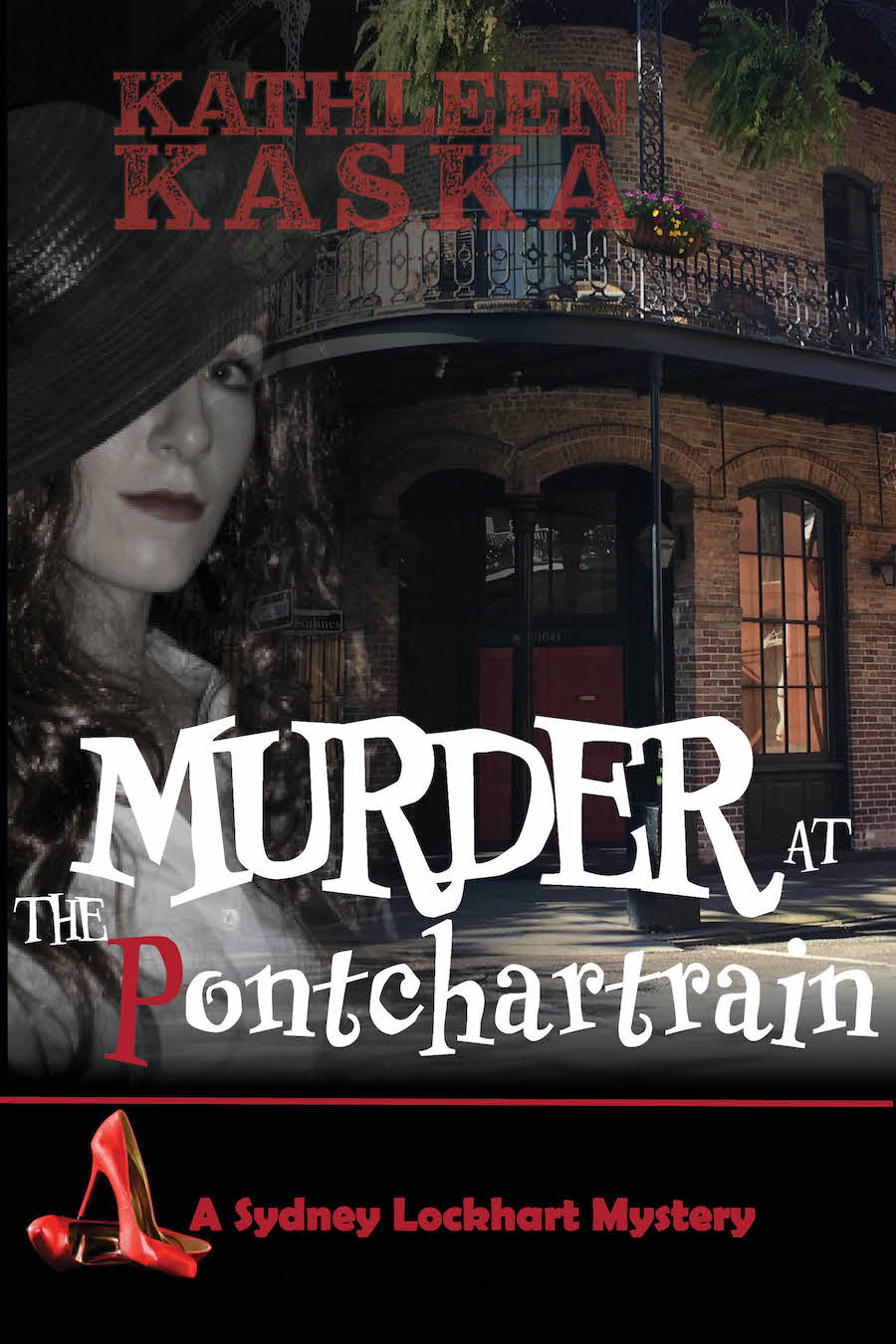
My latest mystery, Murder at the Pontchartrain, which was release on June 28, occurs in one of my favorite cities, New Orleans. The Pontchartrain, located in the Garden District, was opened in 1927 as a luxury apartment building. In the early 1940s, it was turned into a hotel. This is where Tennessee Williams wrote his classic play, Streetcar Named Desire. This vibrant, exotic city begs to have a mystery set there. Just ask Anne Rice.

I brought Sydney to New Orleans because she and her fiancé/partner in crime, Ralph Dixon, had some unfinished business to attend to. But in less than twenty-four hours, someone is murdered in their hotel room, and Dixon is arrested. Sydney is in a race to solve the murder and free Dixon before she ends up in a cell next to him. When word back home in Austin gets out, Ruth, Sydney’s bubble-headed blonde cousin, and Sydney’s twelve-year-old charge, Lydia LaBeau, arrive to give Sydney a hand. Ruth is assigned to snoop around the hotel. At the same time, Lydia appoints herself as the investigator of the French Quarter, where she ends up helping out at the Voodoo Shop and making friends with Pat O’Brien’s head bartender. Yes, I know the girl is only twelve, but age has never influenced what Lydia does.

While wandering the streets in New Orleans, I envisioned Sydney darting down the back alleys of the French Quarter, tracking a suspect near Audubon Park, and almost meeting her demise in the Lower Ninth Ward.

If readers know of great hotels for my future setting, I love to hear about them. The requirement is that the hotel was in operation in the early 1950s and is still in business today.

I’m Sydney Lockhart. I solve murders, most of which I’m the primary suspect. My fiancée, Ralph Dixon, and I came to New Orleans to get married. Instead, he’s been arrested for a double murder, and I’m hunting for the real killer. Assisting me are a twelve-year-old voodoo queen, a ghost detective, and my crazy cousin Ruth. Wish me luck. I’ll need it.

https://www.amazon.com/Murder-Pontchartrain-Sydney-Lockhart-Mystery/dp/1941237940

Kathleen Kaska is the author of the awarding-winning mystery series: the Sydney Lockhart Mystery Series set in the 1950s and the Kate Caraway Animal-Rights Mystery Series. She also writes mystery trivia. The Sherlock Holmes Quiz Book was published by Rowman & Littlefield. Her Holmes short story, “The Adventure at Old Basingstoke,” appears in Sherlock Holmes of Baking Street, a Belanger Books anthology. She is the founder of The Dogs in the Nighttime, the Sherlock Holmes Society of Anacortes, Washington, a scion of The Baker Street Irregulars.

Social Media Links:

http://www.kathleenkaska.com

Bookstore

https://twitter.com/KKaskaAuthor

http://www.facebook.com/kathleenkaska

https://www.instagram.com/kathleenkaska/

https://www.bookbub.com/search/authors?search=Kathleen%20Kaska

https://www.amazon.com/author/www.kathleenkaska.com

A Tale of Time and Trials

by Janis Patterson

I’m sorry! Mea culpa! Last month… Well, I admit somewhat shamefacedly that I simply forgot. Life just got too complicated. If you’ve been following my newsletter or personal blog (on my website) you know the month of July was very busy – I had three releases instead of two in my republishing blitz and my husband and I were out of town for most of the month in four different trips. We were at a weeklong reunion at the historic Arlington Hotel in Hot Springs, Arkansas – and believe me, you can sometimes have too much ‘historic-ness,’ especially when you get stuck in an antique elevator… twice! After the reunion was over I taught two writers workshops (one in Murfreesboro, one in Fayetteville), we were kept from digging for diamonds (yes, diamonds in Arkansas) by a hurricane-like storm and I got to spend several days with my longtime friend – my sister-by-choice – whom I hadn’t seen in far too long. All of it wonderful, but so very tiring.
And I forgot the August blog entirely. Sorry.
Right now I’m working on my contribution to the Dreamstone Christmas anthology – and is it hard to concentrate on snow, and cold, and Christmas when outside it’s so high in the triple digits it feels as if the sky is on ‘broil.’
However, this too shall pass, and someday when there is snow on the ground and we are swaddled in multiple sweaters we’ll look back nostalgically on the warm days of summer.
One terrible thing, perhaps close to the worst thing that can happen to me, was I came home and immediately went to check the hot tub, planning to get in that night when the temperature dropped… Imagine my surprise when I opened the cover and instead of clear blue water I had a tub full of thick green… stuff. It was thick and gelatinous enough I could have scooped up handsful of it. In fact, I wouldn’t have been all too surprised to have it start pulsating and then slither out of the tub towards me.
Of course I immediately drained the water, which left a slimy mess in the tub that would have to be scrubbed… but not when it was triple-digit hot. It has stayed triple-digit hot and I refuse to go out and scrub in the dark in the wee hours of the morning – which is the only time the temperature outside is bearable – so … sigh. Just sigh.
So… all that is my rationale for missing the last blog. But – like most of life’s lessons – this can be applied to writing. Basically, it means that life happens. There are more things in life than writing. A member of one of my writer’s groups has a husband in the hospital. Her main concern? How taking care of him is cutting into her writing time. REALLY? And they have what most people would call a good marriage.
So I guess the lesson is – in both learning and in life – is don’t sweat the small stuff. Do the best you can, be honest, work hard and don’t cheat or lie. There aren’t any guarantees any way you go, but to me at least that seems the best way to go.
And I promise to be better!

For those of you following my republishing blitz, all is going just as planned. I think we’re all defeated by the heat, so both September’s releases are Christmastide Regency romances – yesterday’s was a called THE RESURRECTION OF REGINA and CHRISTMAS TANGLE comes out on September 27. Believe it or not, this blitz is almost over – next month is the end of it.