Expositions Are Like Prunes by Heather Haven

A writing teacher once told the class, “Get off the front porch.” What she meant by that was to stop explaining the who, what, why, and get to the story. As every writer knows, this can be tricky. You have to ground your reader. You have to let them know where they are. But you don’t want them to get lost in nothing but details. Or bore them to death, either. You have a story to tell. So get off the front porch and tell it.

Naturally, I forgot the teacher’s advice. Again. In rereading the first draft of The Drop Dead Temple of Doom, Book 8 of the Alvarez Family Murder Mysteries, I couldn’t believe how much backstory and explanation I’d put in. I even had the effrontery to open the book with three pages of a case Lee, the protagonist, just finished solving.

Really, Heather? The reader is interested in three pages of gobbledygook about a case that has nothing to do with the ongoing story? I don’t think so. What I was trying to get across was the protagonist had had a bad three weeks and was exhausted. All she needed in her life was to go traipsing off to the Guatemalan jungle.

Okay, why didn’t I just cut out all the junk and say that? Because sometimes we writers get caught up in how much exposition is enough and what is too much. That’s why I say they’re like prunes. Are five enough? Are six too many? It’s what writers grapple with continually. Expositions, not necessarily prunes.

Opening paragraphs set up the story, too. Or should. That’s where we make our contract with the reader. They are going to know right then and there what kind of a read they will have. Naturally, the writer has to live up to that contract. We can’t promise them an easy, breezy cozy with a happy ending and then hand a child or the family dog off to an axe murderer never to be seen again. A writer like Ruth Rendell has a different kind of contract. When she writes, “It reminded Burden of a drowned face he had once seen on a mortuary slab. They put the glasses back on the spongy nose to help the girl who had come to identify him” we know right where we’re going.

Within the first couple of paragraphs of my latest wannabe book I wrote, “The most vengeful I get is wanting CEO and mother, Lila Hamilton-Alvarez, to have the frizzies for just one minute of her life. Then I’d hand her some anti-frizz conditioner saying, welcome to my world.” These lines may stay or they may not. This is after all, only a draft. But it certainly does set up what kind of read follows. Within the first few opening paragraphs, the reader’s appetite is whetted for what’s going to come, how it’s going to come, and how much they are going to love it. Heady stuff.

This is not only about justifying the $ they spent to buy the book (I could have used more dollar signs, but my books are on the cheap side). Mainly, it’s because we want them to keep on reading. Not just this book, but all our books. And in order to do that, we have to make things clear, bring the reader to the starting point, but get on with the story.

After I reread the beginning of Drop Dead Temple, I wound up taking over half out of the first three chapters, in particular, the opening pages. I realized — again — it needs to start with the current problem and just a hint of why we are where we are. I am also in the process of taking out much of the backstories of my continuing characters. I will, of course, be sneaking some back in further on down the line. This is not only for newbies or because I try to make each book of a series a standalone, but as reminders to my ongoing readership. But this is after the story is moving, the reader is invested, and when they want to know more. Hopefully, after fourteen books I will know what I need to share and when I need to do it. But there are no guarantees. It changes with every book.

It’s a tricky bit of business, this exposition stuff. Please pass the prunes.

Confessions of a Paper Magnet

I have been doing a major decluttering job on my office. In fact, I wonder if it will ever be over. It’s the very definition of ongoing.

Decades, anyway. I’ve lived in this condo for nearly 30 years. And I’ve been accumulating stuff for longer than that. And no, we won’t talk about the walk-in closet that I’m afraid to open for fear of what might fall out.

I confess. I am a paper magnet. Show me a writer who isn’t. We collect ideas for stories and nuggets of research and stash them away like squirrels gathering nuts for winter.

Because I might use that piece of paper one of these days. It’s a plot point, a character study, an interesting setting. Or it’s just the intriguing bit of research I need to bring that scene to life.

Case in point. About fifteen years ago, I clipped a short, intriguing article out of the San Francisco Chronicle. It told the story of wallets found discarded in the heating ducts of an old military barracks at Camp Roberts, wallets with cash missing, but in many cases, personal items such as IDs and letters left inside.

Camp Roberts, World War II

Camp Roberts, which straddles the Monterey and San Luis Obispo county lines in central California, was a military base back in World War II. At the time, it was the largest military training facility around, with thousands of soldiers passing through. The base was deactivated after WWII, then reactivated during the Korean War. Nowadays, Camp Roberts serves as a base for the California National Guard.

As for those wallets, the theory was that they had been stolen from soldiers in the barracks, the valuables taken. Then the thieves tossed the wallets into the heating ducts, where they were found decades later, when the building was torn down.

A National Guard officer at Camp Roberts was taking steps to see if he could locate the wallet owners, using what papers remained. Later articles outlined some success in doing that.

I clipped that article out of the newspaper and kept it on my desk for several years. I was sure I would use it, someday. I was right. Those stolen wallets at Camp Roberts turned out to be an important plot point in Bit Player, a Jeri Howard novel.

One newspaper article leads to another. In fact, it led me to the Bancroft Library at Cal, where I looked at the Camp Roberts newspaper during the war years. I found out what movies were playing at the base theater and what a fried chicken dinner cost at a local restaurant. And the cherry on top? Bing Crosby and his band played a gig at Camp Roberts at the time I was writing about. That’s just the sort of detail I love, one that adds flavor and spice to my writing. Of course, that mention of Bing wound up in the book.

I used to clip articles out and leave them in folders, part of a work in progress. I still get vital information for my plot from various newspaper. Though these days, I don’t save the print copy of the article, Instead, I save the URL, or cut and paste a copy into a Word document. Or the pertinent piece of paper can be scanned and saved electronically.

Much less clutter. Paper clutter, anyway. Then there’s digital clutter, which is a topic for another day.

Waiting, Hoping for Things to Get Back to Normal

During this stay at home time, I’ve written and published two books, have another written waiting on critiques, and started another.

What I haven’t done is gone to writing and mystery conferences, book and craft fairs, held in-person book launches for my newly published books–and I know my fellow authors haven’t either as all these things have been put on hold.

One of my favorite writing conferences put on by the Public Safety Writers Association is planning on having their conference in July of this year in Las Vegas. https://policewriter.com/. And yes, I’ve signed up for it and will be helping with the pre-conference writing workshop.

I’ve also been thinking about planning a book talk,/signing, in my little home town. I do have a place to hold it, just need to decide the best time to have it.

Whether or not his will all happen, I have no idea–but I’m hopeful.

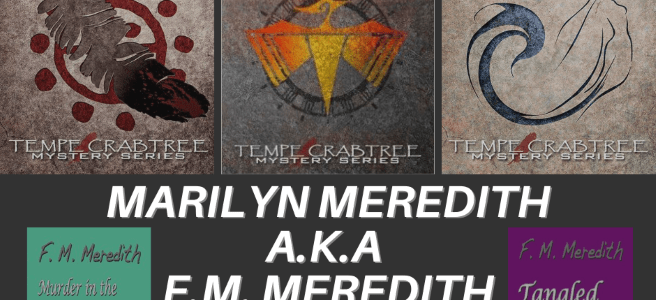
My two newest books are NOT AS WE KNEW IT (The Rocky Bluff P.D. series wirtten as F. M. Meredith ) and END OF THE TRAIL (The Deputy Tempe Crabtree mystery series.)

What about you? Is anything happening to give you hope that thing are getting back to normal?

Marilyn

Hemingway and Me

The multi-part series “Hemingway” by Ken Burns was required viewing in my household. I was glad to learn he wrote every morning, liked learning that not every story he wrote worked, and listened carefully to how he incorporated material and people from his life. But I especially liked getting a look at his edited pages. Unfortunately, even on pause I couldn’t get close enough to read what he crossed out and revised.

Some years ago I was able to see an edited page by F. Scott Fitzgerald, where he changed two words. Two words? I had to believe that the page on view was close to the final edit, and not the first draft.

Hemingway’s edited pages grabbed my imagination because I have a suspicion that any page of mine that isn’t heavily edited isn’t finished, and is not worth reading. Over the years I’ve always wanted to write a perfect paragraph and then another and then another after that and on to the end of the story. But it has never happened. During a workshop years ago the leader asked us to write one perfect paragraph, which I did. It was so good in her view that she sought me out afterwards to talk. I still have the paragraph—unattached to anything else. Any effort to try to use it as the opening of a story has failed miserably. After literally decades, it sits “perfect” in its own little world. I don’t know why, but I suspect it is because the emphasis was on the writing and not the story. The character, whose presence is limited, goes nowhere because the paragraph isn’t about her. It’s about writing.

Every story I write, short or long, seems fabulous as I write it. Then I finish it and read it over, and conclude that it is unarguably horrible. So begins the rewrite. By the time I’m finished I’ve been through ten or more drafts and I’m still not confident that I’m really finished, but it seems time so I send it out. I confess to a tendency to send out a story too soon, but it gets it off my desk and makes me think about it. When it is rejected, as is most likely, I reread it and figure out a better ending. Endings are a trial for me, but if given sufficient time to think about whatever one I’ve settled on, I can generally improve it. I have greater confidence then, after messing with the thing for a couple of months, and send it out again. This can go on for quite a while, but each time the story gets better.

I tried to explain this once at a library talk. People nodded—they’re invariably polite at these events. But then I pulled out the edited pages—several versions—of the first chapter of the mystery I was currently working on so people could see what an edited page looked like. Their eyes popped open. They got it.

No story of mine is going to work unless it is revised and rewritten almost a dozen times. And after watching “Hemingway,” I’m glad to know I’m not alone among writers. 

On Writing and Liberation

During a recent zoom meeting with other writers, we discussed a new toy I bought that frees me from losing the notebooks that I use. The group of four split in half over the writing process. Two did everything on the computer, and two used paper and pencil in the form of the small spiral-bound notebooks for plot notes while writing. Clearly, I was one of the latter. Which got me thinking about the act of writing a book.

It is as individual as the writer. For instance, those who write historical fiction split into two camps, as well. One camp does all their research upfront, adding to it as needed. Others get the idea, plunge in, and do the research as they roll along, adjusting as need be. There may be a third camp of folks who immerse themselves in the period, then let rip.

Three of these books had title changes.

Some writers are uncomfortable knowing the ending because then there is no point in telling the story.  Some wouldn’t start a book without knowing exactly how it ends. Some writers never talk about a book while writing it because, once told, the ink is gone from the bottle.

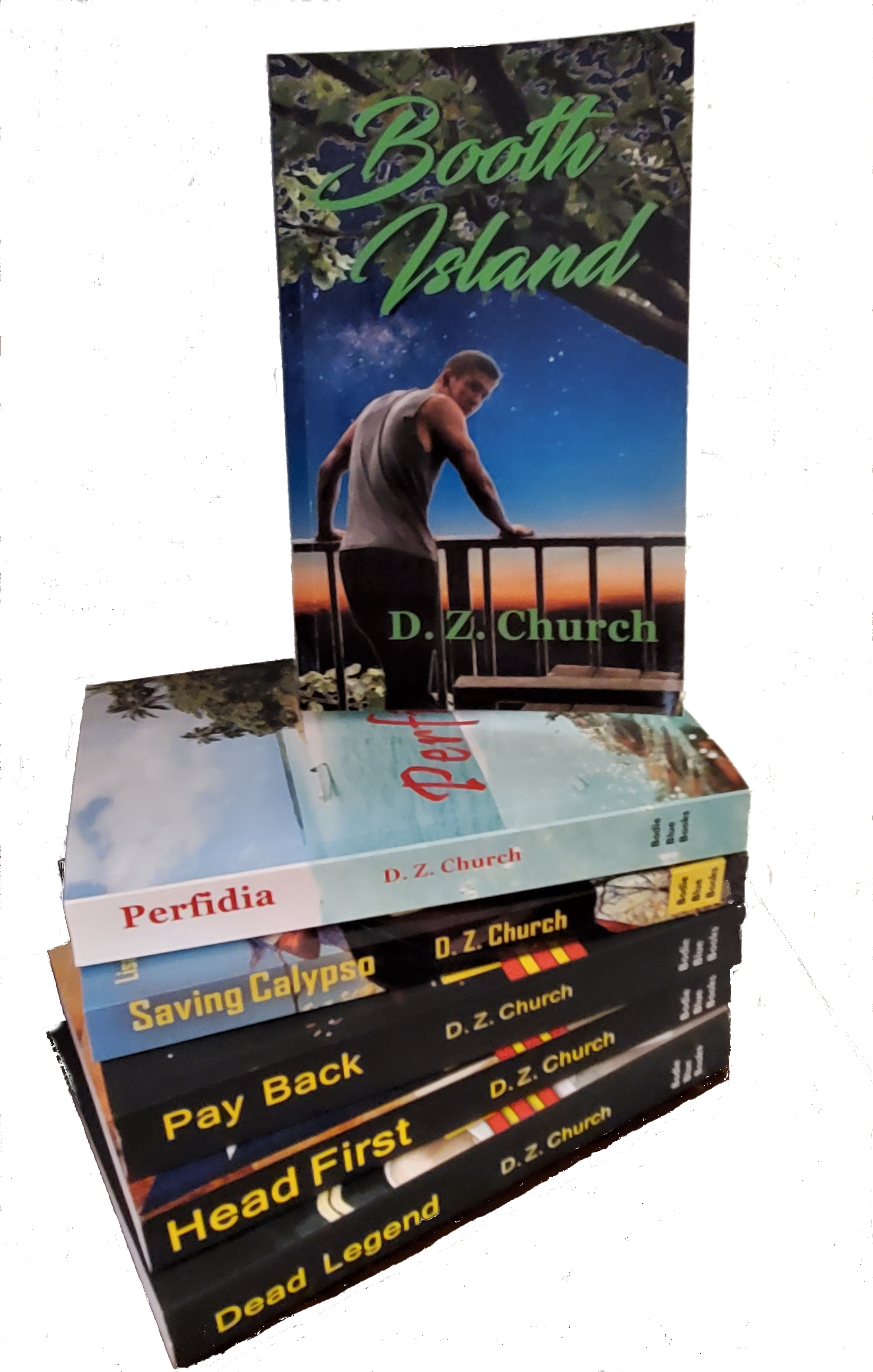
Some know the title and write to it. Some let the book title itself. Which is how a book titled Gridlines ends up Saving Calypso.

Some writers outline: for others, the first draft is the outline. I suspect writing an outline first is the professional way to attack it, especially with a series. But there is also a lot to be said for letting the characters tell their own story. Admittedly, you don’t always end up where you thought you would. Characters have a habit of misbehaving.

Your characters should be breathing before you begin to write, in my world anyway. If you know them, and they know you, you can rely on their help to get out of tight jambs. And, if in your mind they walk the earth, each character will have their own voice and pitch. Writers split on character building, too.  Some use templates that provide essentials about their characters, and some use notebooks as the characters grow and change. It happens, the good guy becomes the bad, the bad guy—good, the slimy one the romancer, the romancer the killer. Writing is a messy business. Though I suspect for some, it is well ordered, precise, and disciplined. Not me. I am admittedly messy.

I do know if you have a story that you think is worth telling, a mystery in your heart dying for the light of day, or a newspaper article that sets off a chain reaction like a nuclear plant melting down, then the first step is to apply the seat of your pants to the seat of the chair. The daily discipline of writing is how you get 70,000 and 100,000 words between a printed cover.

Once you are seated, you can draw, outline, noodle in notebooks, talk to a recorder, or just open a blank page and start typing. The point is there is no right or wrong way, only getting started. Like a lot of writers, I’ve been struggling recently to write anything at all. During the telephone call above, my writer friends confirmed that they, too, were in the same fix until now. What changed? We are all vaccinated. The world feels a little freer; no more worries every time you step outside your bubble. It turns out in addition to applying your bottom to a chair, feeling safe frees the inner storyteller.

For more on each book, http://dzchurch.com or https://www.facebook.com/mysteryhistorysuspense.