Using Weather in Writing

A few years ago, after a surprisingly heavy snowfall (for my coastal area), I decided to pull on my hiking boots and stroll the 1.5 miles to my favorite park while the scenery was coated in white.

The trail was only a bit slippery and the frosting of snow made thick woods and waterfalls completely enchanting. The winds were calm, and the temperature hovered around the freezing point, hardly life-threatening. I was deep into my beloved woods when I noticed that other aspects of my walk might be more than a little hazardous.
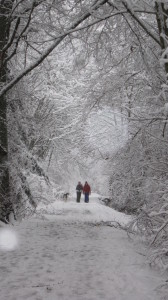
BellinghamSnow2014 022

Branches overhead were so burdened with wet snow that every few minutes I heard a loud CRACK! Then a branch would crash to the ground, sometimes from as high as fifty feet in the air. I spent a fair amount of time hugging big trees as I waited for plummeting snow and debris to settle around me. The situation added an unexpected element of suspense to my outing. As in: I could die here today! At least one person dies every year in my state from falling limbs.

This was a good reminder of how much weather conditions can add to any story and help set the mood. I decided that the falling tree limbs would make a great addition to one of my next novels; now I’ve got to find an appropriate place to put that scene.

Weather can set the mood and intensify the feelings an author wants to provoke in readers. Although it might be a bit cliché to set your big suspense scene during a thunderstorm, flashes of lightning and claps of thunder can add a lot of tension. Delve into your memory and sort through all the weather situations you’ve experienced in your lifetime, and you’ll think of interesting weather elements to add to scenes. Because I’m a hiker, kayaker, snowshoer, and scuba diver, I’ve had a lot of run-ins with dramatic weather over the years.
Gathering storm clouds

I included a thunderstorm in my novel Endangered, but the main threat in that Utah setting is peripheral to the storm: when it’s raining on the high plateau, a flash flood could soon be roaring through the slot canyons. An earthquake opens my romantic suspense Shaken, and my heroine Elisa is pinned to the ground by a falling tree. But again, the earthquake isn’t the real threat; it’s the cool damp weather, and because she is trapped, she soon has to battle hypothermia as well as a broken leg.

Pouring rain and driving snow lessen visibility and can add suspense when a character needs to be on the move outside, or if that character is on guard against a threat coming from outdoors. If your characters are indoors, bad weather outside can make a scene feel more “cozy” and romantic.
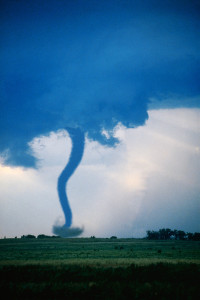
Tornado

Tornado conditions are always anxiety-provoking: I grew up in Kansas and Oklahoma and once had the occasion to watch as the change in air pressure caused the giant plate glass panels at the front of a store to bow inward. (Fortunately some doors flew open and equalized the pressure before the windows shattered, otherwise I might not be here to write this.)

Sunshine and gentle breezes can add to a pleasant scene. Relentless baking sun and drying winds are a different story.

You see what I mean. The snow is all gone from my neighborhood now, but I want to add those cracking limbs to a future book. And maybe I’ll find a place for those dramatic bowed windows, too, although I no longer live in tornado country. There have been a lot of avalanches in the west this year, so of course my next novel features one.

woman celebrating the sun

In real life, we all deal with the weather every day. And you don’t have to be out camping in the wilderness to deal with weather-related disasters. I often think about all the people trapped in 2012 in high-rise buildings in NYC during a blackout caused by the flood after a hurricane–remember that? Personally, I can’t think of anything worse.

So when I feel the story I’m writing is lacking in some respect, I try to think about how I could use the weather to add drama.
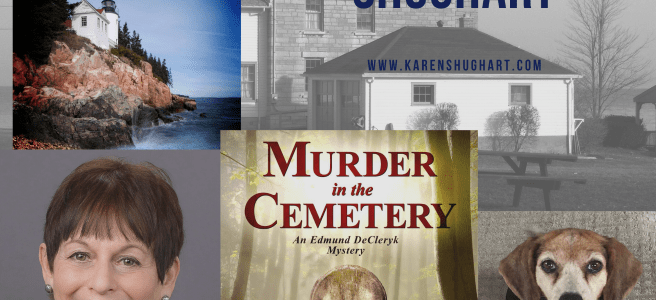
City Mouse or Country Mouse by Karen Shughart

Are you a city mouse or a country mouse? Does the thought of rural life make you yawn? Or does the idea of living in a city send electric shocks of anxiety through you?

I grew up in Pittsburgh. I enjoyed concerts performed by the symphony orchestra and boarded a streetcar with my mother for shopping excursions and lunch at downtown department stores. Our family went to the zoo, visited museums, and in the summer enjoyed the rides and games at big, regional amusement park. A branch of the Carnegie Library was within walking distance to our home.  I remember attending a live performance of what was the forerunner to the Mr. Rogers TV show. I loved the energy of the city, the hustle and bustle, the diversity of people and activities.

One set of grandparents lived in a small, rural town in Ohio. From their front porch you could see the Ohio River, and there were meadows and fields at the end of their road. We weren’t allowed to swim in that river, but I do remember hikes and picnics in sun-kissed fields, crowded with delicate Queen’s Anne Lace, purple thistles, and sunflowers. You could hear the train whistle and wave to the conductor from their backyard. I loved those visits, too.

 My children grew up in a mid-sized town in central Pennsylvania: safe, secure and with plenty of space to roam around, but we lived within proximity to major metropolitan areas. We exposed them to museums, concerts, historic sites, and a variety of restaurants that served food unlike the types available in our town. Those experiences impressed them, and as adults they have chosen to live where gridlock traffic is juxtaposed with economic and cultural opportunities.

There’s energy in a city that you don’t find in a rural setting. Where you can walk or hail a cab or call Uber to get just about anywhere in minutes. Where GrubHub is takeout. When visiting our children, I sometimes long for that lifestyle. But then, after a few days, I yearn for the solitude of the place we call home.

This image has an empty alt attribute; its file name is 3439-1.jpg

We retired and moved from central Pennsylvania to a bucolic village in the Finger Lakes region of New York on the south shore of Lake Ontario, not too far from several large cities and on the other side, Canada. It’s a big lake, with beautiful beaches and waves that look and sound like the ocean.

Quiet three seasons, in summer restaurants, shops, and museums fill with visitors, and outdoor activities abound. Cars line our street for Sunday concerts in the park, and our July 4th celebration attracts crowds from miles away. You wait in line at farm stands and for tastings at wineries. It’s exhilarating and enervating at the same time. I hold my breath, not fully exhaling until September.

So, what am I? I’d say I’m a country mouse who likes best to feast on the grains of quiet and solitude but occasionally ventures into a city to forage for more exotic fare. What about you?

Guest Blogger ~ Roxanne Dunn

Writing: nudging words into sentences, then sentences into paragraphs that sound pleasing to the ear. An excruciating process that takes massive amounts of time.

For years, my husband and I worked in Seattle and lived aboard an elegant, old, wood motor yacht. We spent our free time cruising to other harbors, eating, drinking, and playing with other boaters.

But whenever I had a few minutes alone, I wrote.

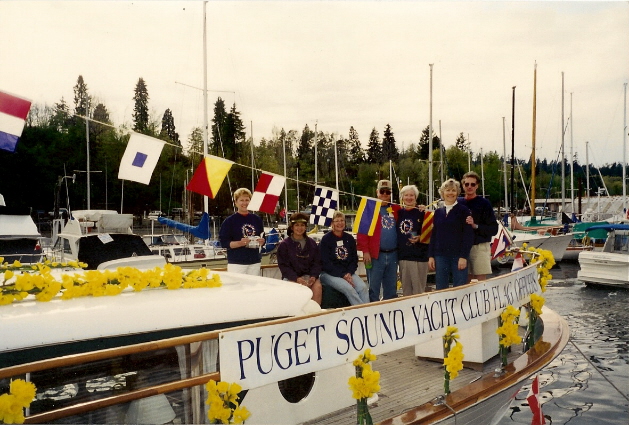
Every spring, our yacht club flocked to Tacoma to participate in the Daffodil Marine Festival. This weekend event culminated in a parade of boats decked out with thousands of daffodils, brightly colored flags, and all hands sporting white pants and navy blazers.

The Tacoma Yacht Club spring parade.

One year, while everyone else roamed up and down the dock drinking margaritas and meeting old friends, I sat in a corner of the saloon and struggled with my assignment for a creative writing class. And hoped I didn’t look too antisocial.

The day before the parade was crammed with activities, including a Jeopardy trivia game. Each club selected a token to represent their group. My husband was ours. I was still typing, putting words together, ripping them out, and starting over, so several of the women carted him off to the local thrift store to find a suitable outfit.

He came back dressed in an iridescent purple strapless dress, a hot pink feather boa, and white roller skates with huge pink pom-poms. I have to say, he looked stunning. Someone whipped out a black lipstick, carefully applied it to his lips, and he was ready.

As I recall, our club didn’t score all that well, but my husband was a big hit. He practically floated around on his roller skates, flicking his pink boa from side to side, and pirouetting with élan and grace.

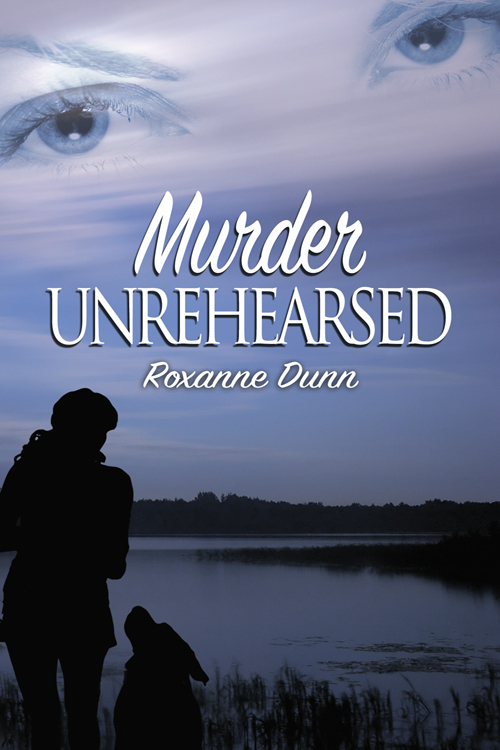
Since then, I have rewritten the assignment I was working on too many times to count, but it finally became part of Murder Unrehearsed, my debut novel, which made it to press last August.

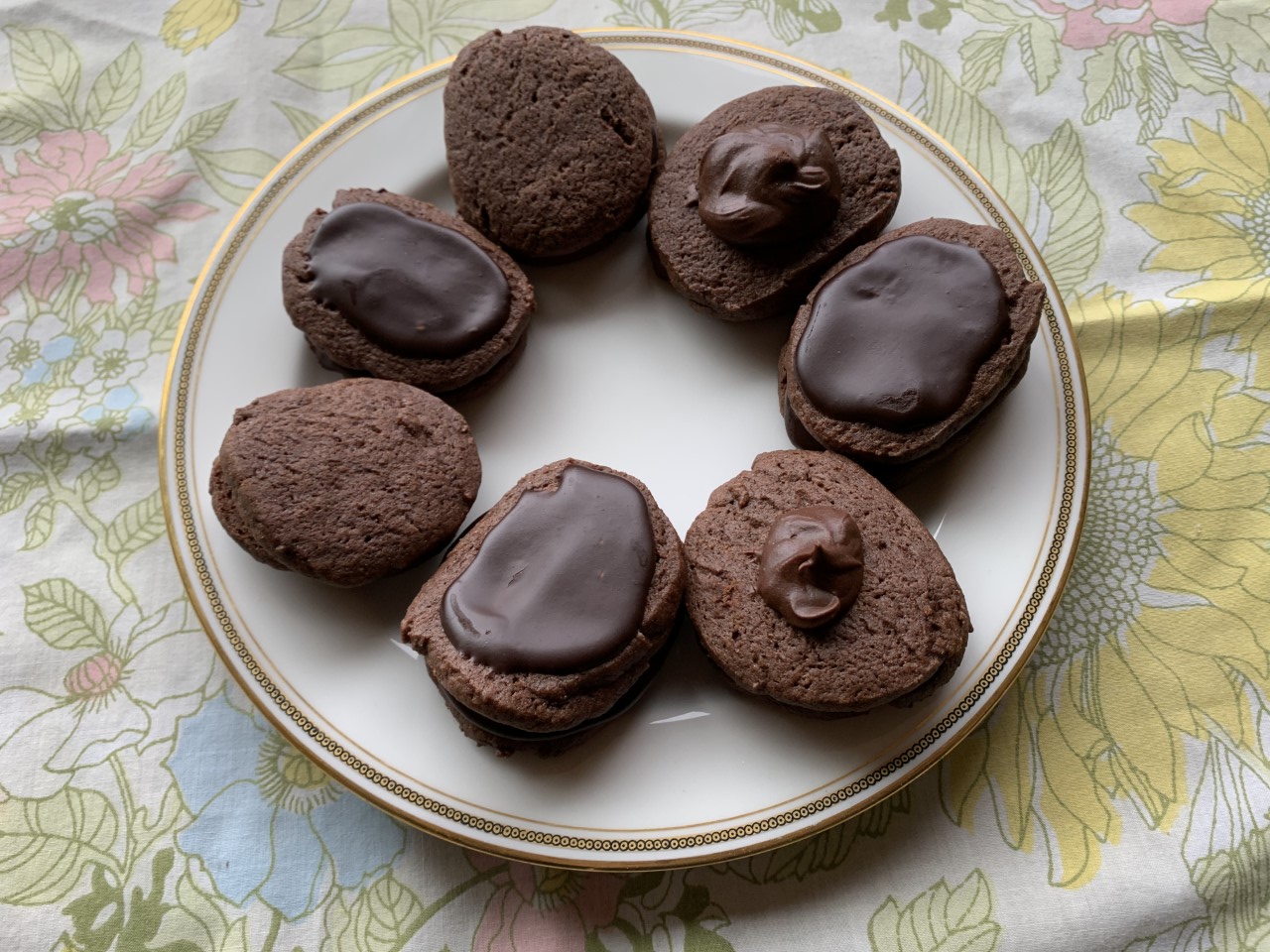
You’d think that after all that time, my characters wouldn’t be able to surprise me. But in the final draft, one of them, hottie lawman Matt McCrae, did. He insisted on getting up early, mixing a batch of dough for baguettes, and baking his special chocolate sandwich cookies while the bread dough was proofing.

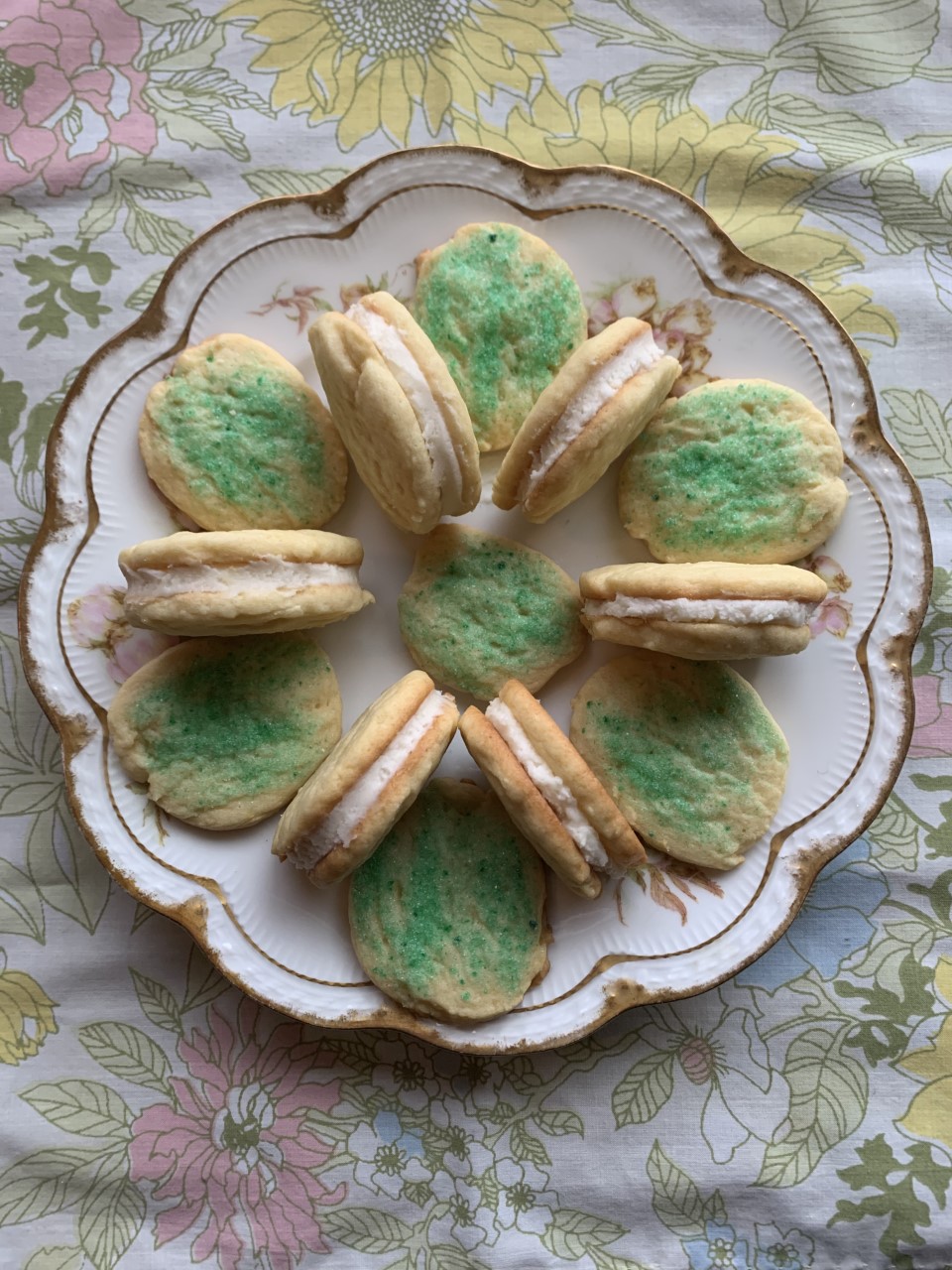
So, I put on an apron, got reacquainted with my mother’s aunt’s sugar cookie recipe, and made several variations. Although the chocolate cookies filled with chocolate ganache are Matt’s favorite, the lemon version with lemon buttercream is a close second. Their delicate, buttery flavor married with the sprightly taste of fresh lemon is perfect for spring. I’m baking some now.

In the end, his love of baking didn’t make it into the book, but the recipes are posted on my website. I hope you enjoy them.

Murder Unrehearsed

When aspiring young actress Heather Shelton jumps in the car with her dog, Bear, and flees to her family’s mountain cabin to escape an untidy romance, all she wants is peace and time to study for auditions. What she gets is murder. The only witness of a savage killing – and squarely in the crosshairs of a ruthless assassin – she is injured and left for dead.

Heather knows handsome men are bad news, but hottie lawman Matt McCrae’s smile gets her every time, until he leaves her hanging out as bait to trap the killer. McCrae promises to protect her, but fails, and she faces killer alone, with only Bear to help.

Kindle:
https://www.amazon.com/dp/B08DHJ6TG7/ref=dp-kindle-redirect?_encoding=UTF8&btkr=1

Barnes and Noble:
https://www.barnesandnoble.com/w/murder-unrehearsed-roxanne-dunn/1137387167?ean=2940162985846

Kobo:

https://www.kobo.com/us/en/ebook/murder-unrehearsed

https://seaportbooks.com/

https://www.thewildrosepress.com/books/murder-unrehearsed

and via my website: www.roxannedunn.com

Roxanne Dunn has studied writing in Paris and Seattle, and writes the galley column for Pacific Yachting magazine. Murder Unrehearsed is her debut novel.

She is a retired physical therapist, a foodie, a fanatic about good chocolate, and a private pilot. She lived aboard an old wood motor yacht for seventeen years, and in her dreams, is a pianist of renown, an acceptable water color artist, and a globe-trotting yogini.

Links:

www.roxannedunn.com

https://www.facebook.com/roxanne.dunn.127

https://twitter.com/roxanne_dunn

The Murder House

by Janis Patterson

In the real world most murders are common, unimaginative things – shooting, stabbing, strangling, blow(s) from a blunt or not so blunt object, occasionally a drowning. Pretty much routine and little finesse.

In a fictional world, however, writers have to be more creative than that. Readers want style and creativity, and most of them marvel at the variety of murder weapons that exist. Exotic poisons, strange firearms, garrotes of unknown material… all so exotic that they are easy for the police or private detective to track down and say, “It was so-and-so who killed him in the library with a whatever…” Then the reader wonders at how could anyone live where the tools of such murderous mayhem are common.

They never stop to think that the average American home is an arsenal of very practical murder weapons. Right – even right now in your own home. Obviously every house has large knives in the kitchen, screwdrivers and shovels, scarves or pantyhose or even curtain-pull rope lying around; some have guns. But even those are all pretty mundane. There are even more murderous riches if one thinks creatively.

(These are only informational examples for writers and mystery readers – please don’t try these at home!)

Grind up a piece of crystal ware (the thin kind works best) until it is a fine powder, then add it to someone’s food.

Certain over-the-counter pain relievers can, if given in specific quantity over a limited amount of time, can cause catastrophic organ failure. (And no, I’m not going to tell you which ones – I repeat, this is purely an informational think piece, not an instruction manual!)

Even a ball point pen jabbed into the neck or groin can cause a rapid and fatal exsanguination if it breaks one of the arteries, but this implies a certain knowledge of anatomy, which can be a clue to the perpetrator.

The water in a vase which held a large bunch of narcissus stems for a fair length of time can be fatal if ingested, but as with all organics getting the right (i.e., strong enough to cause death) dosage can be difficult to estimate.

Certain flowers chopped up into a salad can be fatal, but see the warning above.

There’s the classic case (from Hitchcock, I believe) of the wife who beat her husband to death with a frozen leg of lamb, then cooked it and served it to the policemen who were investigating her husband’s death. Considering the outrageous price of lamb these days, I assume a large beef or pork roast (preferably bone-in for more heft) would work just as well.

If it’s winter and you have a wood-burning fireplace, a log can be effective as a weapon and then burnt. It can be wrapped in something (perhaps a towel and then a garbage bag?) to keep trace evidence of the wood from adhering on or in the victim.

Plastic wrap from the kitchen or from a dry-cleaners’ bag or a garbage bag can suffocate a victim most efficiently – just be sure to get rid of it thoroughly.

Every household is just full of poisons – for the garden, for bugs, for cleaning, etc. – but one must be careful to get the right dosage and then get rid of the container – or have a very good excuse why it’s there. There’s more to a successful poisoning than just dumping a couple of tablespoons into Uncle Whoever’s morning oatmeal!

Relatively bloodless crimes are always preferable if committed in the home – there is no way to get rid of all blood traces. No matter how much you clean, no matter how much you bleach, there is always the inevitability of a single drop going someplace and that can be enough to convict you.

Even cars are not safe. Don’t simply cut a brake line – a clean straight cut can be obvious even if the car burns. Instead take a sharp rock and pierce the line, allowing a little of the fluid to leak out at a time and making it look as if the line was damaged because of a road hazard. Just be sure to get rid of the rock and don’t touch the line or car’s undercarriage – fingerprints and smudges in the existing dirt are sure signs of tampering.

Got a smoker in the house? Soak some tobacco in a small amount of alcohol (vodka will do) and the liquid becomes a nicotine extract. Internally it will kill; depending on the toxicity, it can also be fatal when applied externally to the skin. Just be sure to not get any on yours!

Certain nutritional supplements can be ground up and added to food – some are incredibly toxic, others take a time of assiduous application to work. The best kind are the ones that occur naturally in the body and – unless there is cause to think this might have been an unnatural death they will not be tested for in an autopsy… because they occur naturally in the body!

A final thought – if you’re going to commit murder in what you think is an untraceable or exotic way, you might consider doing it in a county that has a Coroner instead of a Medical Examiner. MEs are physicians who can sometimes spot a suspicious death even if the evidence is slight – and they can do an autopsy. Coroners are usually not physicians and are elected and a lot of the time won’t call it murder unless there are obvious holes from blade or bullet or crushed body parts. If you are planning an away-from-home murder, you might want to do some discreet research!

Feeling unsafe now? This is just the tip of the informational iceberg. I’ve barely touched on the lethal objects that a clever murderer can use. The trick in a book is to choose something relatively simple and readily available that the readers will understand and can relate to. (Though not too closely, I hope!) I’ve read mysteries with exotic poisons from ones that come from plants which will grow only on some remote tropical island to the skin secretions of jungle frogs. They’re fascinating, but the question that beggars any semblance of reality is how do ordinary people get ahold of such things? When greedy John wants to do away with rich Aunt Jennifer he’s much more likely to grab a crystal glass to crush or a tin of ant poison rich with arsenic than track down an exotic poisonous frog. And if he happens to work with exotic reptiles, I sincerely hope he’s not so stupid as to ignore the fact that if Auntie died of tropical frog poison he’s going to be the prime suspect!

Although, (sound of mental wheels turning) it would be a lovely red herring and a way to frame John by his up to now goody two shoes cousin Jim who secretly has massive gambling depts… though the question would still be how did he get the stuff? What if…

Help. Stop me before I plot again.

My Voice by Paty Jager

From the first writer’s meeting I attended decades ago I heard people talking about voice. My first thought, being a newbie writer, was, “What is voice?”

No matter how many people explained it in various ways, I couldn’t grasp what they were talking about. But writer’s voice is the writer’s influences into the story. The writer’s feelings and emotions that are shown through the characters in the book. How the syntax and phrases flow in the story.

It has taken me over a decade to see my voice in stories. Where readers think I did a good job describing setting, I think it might have been sparse but it was as I saw it in my mind. My writing has always been, what I’d call sparse. When I first started writing, historical romance books had to be 90-100,000 words. I struggled to get to 90,000. I’ve always been a minimalist with it comes to words, in writing and when talking. 😉 However, I do try to make the few words I use have an impact. Whether it is setting, a character, or dialog.

When I come up with new main characters, I don’t just sit down and start filling out a chart or character sheet on them. They live in my head for several months or a year, living a life outside of their books. When I sit down and write their books, I’ve been thinking about the book, the title, what they will encounter and how they will react before the book starts.

With my mystery main characters, who are Native American, I read all I can by and about their tribes. I want to try to see and feel things as they would, not as a not quite senior citizen white woman would see it. I’ve always been interested in other cultures and felt anger over how so many races have been mistreated. I use this as my catalyst to feel and hopefully show the correct emotions when I write.

My latest project has been something I knew I would write the second I’d decided to write the Gabriel Hawke novels. I have heard and seen so much about the Missing and Murdered Indigenous Women cause that I had a desire to tell the story and hope that it would open more eyes to the problem.

Where does this come in with my voice? My voice in my books, is not only concise working and phrases, it is the need to show justice can be found and a need to show where there is an injustice. My beta readers, line editor, and final proof reader all say this is my best Gabriel Hawke book.

The woman, Kola Shippentower-Thompson who worked with me to make me see how things worked on the reservation when a tribal member is missing gave me this review: “The story was captivating, I couldn’t put it down. So many memories were brought to surface, so many emotions, like this has been lived before, because it has, this is a glimpse into our reality in the Reservation. Thank you for seeing us & helping tell part of the story.” She is the Co-founder & Director of Enough Iz Enough, a non-profit organization that works to teach women and children how to be vigilant and safe and who support the MMIW cause. Proceeds from the sale of this book will be donated to the Enough Iz Enough organization to benefit the MMIW movement.

When Kola was reading the book, she told me she had to stop at one point because it brought back so many sad memories. She has lost multiple family members and has never received any answers about what happened to them.

My hope is that this book will enlighten more people to the plague of violence they Indigenous women, children, and even men have been enduring. The ebook is available for pre-order publishing on May 18th. The print books should be available by the end of the month.

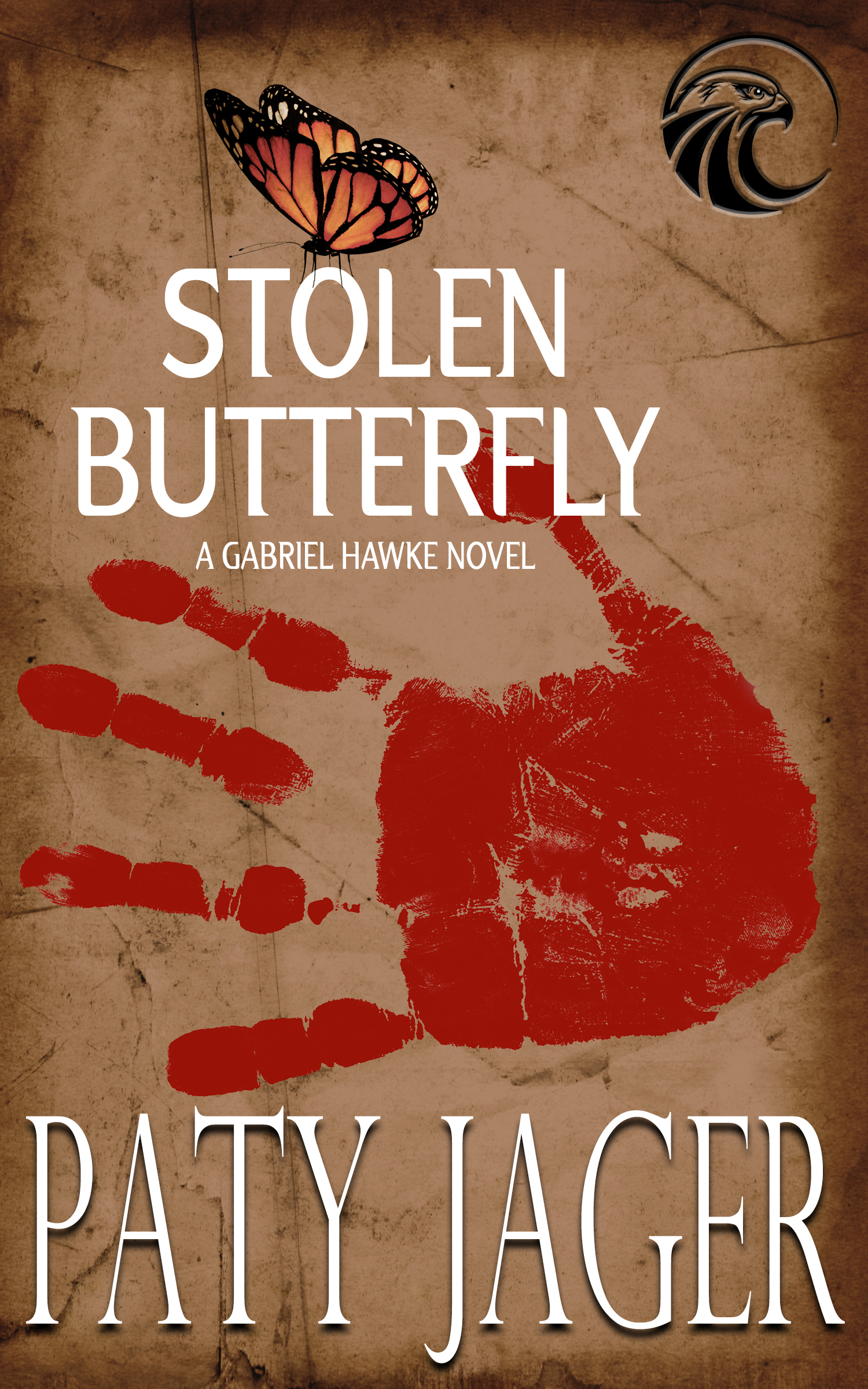
Stolen Butterfly

Gabriel Hawke Novel #7

Missing or Murdered

When the local authorities tell State Trooper Gabriel Hawke’s mother to wait 72 hours before reporting a missing Umatilla woman, she calls her son and rallies members of the community to search.

Hawke arrives at the Confederated Tribes of the Umatilla Reservation and learns the single mother of a boy his mom watches would never leave her son. Angered over how the local officials respond to his investigating, Hawke teams up with a security guard at the Indian casino and an FBI agent. Following the leads, they discover the woman was targeted by a human trafficking ring at the Spotted Pony Casino.

Hawke, Dela Alvaro, and FBI Special Agent Quinn Pierce join forces to bring the woman home and close down the trafficking operation before someone else goes missing.

Pre-order purchase link: https://books2read.com/u/baZEPq

This also happens to be my 50th published book! I’m having a 50 Book Bash event at Facebook and this week I am featuring my Mystery Books. So come on by, learn about my mystery books, leave comments and get in the running fore the daily prizes. Here is the URL: https://www.facebook.com/events/299774331600785

Adding my voice to my books wasn’t a matter of me finding my voice. It was a matter of me realizing what my voice was. Can you tell an author’s voice when you read a book? Or do you just enjoy the characters, the narrative, and the dialog and afterword, just smile, knowing it was a good read?