The Murder Person

by Janis Patterson

After the wonderful reception of my last two blogs on the Murder House I couldn’t stop thinking that it was foolish to limit our villain just to the interior of an average house. Murder can be just as deadly and diabolical with what our villain has on his person. Of course, it will require more knowledge, more planning, even more daring than in the theoretically private environs of a house, but a canny villain can be just as deadly with what is on their body.

Of course, there are the obvious things – a belt or scarf or even a necklace for a garotte or perhaps in the right circumstances smothering, a concealed knife or gun, even a blunt instrument such as a few rolls of coins in a sock or scarf – the ‘cosh’ so beloved of old-style gangsters. However – while effective, those tools are crude and totally lacking in imagination. The canny mystery writer wants something more stylish, more imaginative… and less traceable.

The first thing that comes to mind is those sky-high stiletto heels worn by young fashionistas. Properly applied to a suitably vulnerable portion of the anatomy – say the nasal cavity into the brain, or the temple, or with the right knowledge of anatomy the brain stem or any of the major arteries, especially in the neck or groin – they can be very deadly. That is, once our murderer is sure they can walk in them without falling or attention-drawing staggering – something I was never able to master even in my youth. Another drawback is the relatively short space between the heel tip and the beginning of the sole – usually no more than 2 ½ – 3 inches. That would constrict the field of effective use and rule out punctures to the heart.

A nice touch would be to have the murderer be a man dressed as a woman who immediately divests himself of the female clothing – where it could be neither found nor traced to him, a challenging exercise in itself. I’m sure a clever writer could overcome that, though.

Let’s get more creative. Remember a generation or so ago a man was killed on a London street by the means of a small (I mean really tiny) ball filled with ricin (made from the castor bean plant, remember?) injected from the tip of an umbrella by a seeming passer-by? That’s very convoluted and unless the killer is a scientist very dangerous way of getting rid of someone, but it worked. As I remember it took the authorities years to figure it out. However, it has been proved to work and if it fits your scenario, go for it.

More workable are more common poisons, and unless the murderer and victim meet quite often so a long-term poisoning is feasible, they have to be fast-acting. Again there is the crushed OTC pain reliever which will kill over time after one dose by creating a cascade liver failure. This has the benefit of death occurring long – sometimes weeks – after the murderer has dosed the victim, but one drawback is that the resulting necessary powder is a fairly large amount and the taste is quite bitter. However, if the murderer is clever, he can carry a lethal dose on his person, give it all to the victim in some innocuous fashion and, once sure the victim has ingested it all, get away scot-free.

One of the classic means is the poison ring. After all, if it worked for Lucretia Borgia, it should work for our villain. An anecdote – my father was a wonderful and intelligent man who had the same wacky sense of humor as I. Our family had just come back from a trip to Mexico, where Daddy had bought me a poison ring, which I still have. It was a cheap tourist thing, with an obvious hinge on the side of the stone that wouldn’t fool any reasonably alert person. Daddy used saccharine tablets in his coffee, and in play – since he could never remember to bring his tablets with him – I started putting them in my poison ring. Instead of giving them to him, I simply started dumping them into his coffee cup, which Daddy and I both thought highly amusing. (Yes, we were easily amused!) My mother’s thoughts on our charade are not suitable for public pixilation, but she was a very starchily correct lady. How she must have suffered with my father’s and my antics!

Anyway. One day we were having lunch at our club and Daddy was involved in a conversation with a colleague when the waitress came by to fill his coffee cup. As was our custom I reached over, opened my ring and dumped two saccharine tablets into his coffee. The colleague’s eyes widened and – ostentatiously accidentally – he managed to knock the cup off the table, spilling it, before Daddy could take a sip. No one ever said a word – except Mother, who said a great deal of them to Daddy and me later – but we didn’t do the poison ring thing again. Sigh. It was fun while it lasted.

However – you don’t need a real poison ring to get the benefit of similar surreptitiousness. The good ones are incredibly expensive, too. All you need is a (hopefully cheap, since your villain will probably be discarding it right after) large costume jewelry ring where the base of the stone sits high above your finger creating a fair-sized gap big enough to hold a sufficient amount of poison.

Now this is important. It is a terrible fashion faux pas to wear rings on top of gloves, but you have to protect your skin from accidental absorption of the poison. Put a circle larger than the base of the ring of Liquid Glove or NuSkin (there are other brands, too – these are the only ones I can remember at the moment) to create a barrier between your skin and the poison. Depending on the size of the ring and the situation your villain will have to practice to be able to get the poison from under the ring into something your victim will ingest without drawing undue attention.

Now this is important. Once the poison has been delivered, your villain must get rid of the under-ring barrier. As it contains both poison and your contact DNA and possibly your fingerprints, that little circle of fake skin – probably between the size of a quarter and a half-dollar – is a conviction ready to happen, so you must be very careful of how it is disposed of.

For Heaven’s sake, do not eat it – there might be enough residual poison to do your villain a mischief. Don’t just throw it away in a handy waste can, either; destroy it. Cut it into teeny-tiny pieces and flush it, making sure all of it enters the sewer system. Burn it and if there is an ash residue, flush it. Whatever you decide, just make sure it is thoroughly, completely destroyed with no hope of being reconstructed. How many villains have been caught because of inadequate aftercare?

By now you have probably decided that I am thoroughly warped, and you might be right. However – this post has gone on much too long and I haven’t finished. So – if you are brave, or equally warped, think about coming back next month when I (hopefully) finish up with The Murder Person.

Shove Everything To One Side – And Write

That’s what my mother used to say, back in the era when I had a day job. Time to write was limited. So I got up early in the morning and wrote before heading off to the day job.

I also had deadlines. Which would make me crazy. I felt as though I never had enough time to devote to the writing, what with said day job and the day-to-day at home. Vacuuming, decluttering, and other delights of caring for my home, as well as keeping ahead of the weeds in my garden. Exercise, yes, doing that as much as possible. And keeping up with friends and family, the social connectivity that is important in my life.

Back when I was working, I would lament the approaching deadline and the things that crop up demanding time and attention. Mom would say, “Just shove everything to one side and write.”

Okay. I shove. And I write.

That’s why the cat hair is getting thick on the carpet right now and the pile of mail remains unopened. When we went into pandemic lockdown, I swore I was going to clean out the closets and drawers. I still haven’t gotten to that.

Meetings I used to attend in person, of the local chapters of Mystery Writers of America and Sisters in Crime, were replaced by Zoom. Logging into that wasn’t as time-consuming as driving to wherever the meeting was to be held, but it still took time and I got burned out on the online meetings.

I am publishing my own work now, so the deadlines are self-imposed. But they are deadlines nonetheless.

At the end of June, I returned from visiting family in another state. Waiting for me were several commitments. One included providing feedback on several stories I’d agreed to read. Another was sending along a photo, bio, and other information to the host of an upcoming podcast. That done, I focused on the monthly newsletter I do with fellow Ladies of Mystery writer D. Z. Church. And this blog, which goes up on the first Monday of each month.

And the biggest self-imposed deadline of all—the next book.

The day job no longer consumes time and energy. But still, I feel like there is never enough time to write.

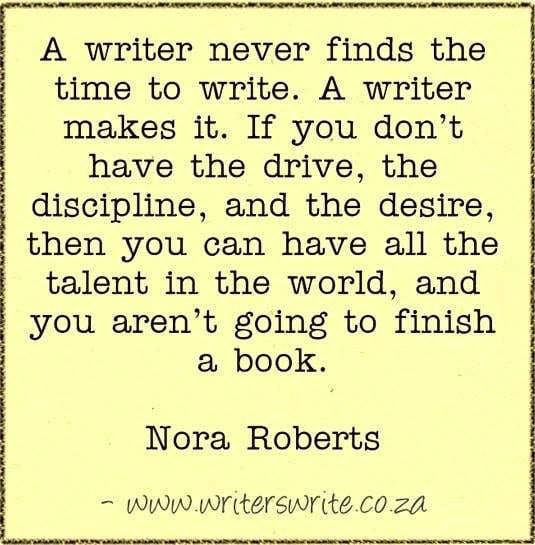
Unless I make it. Here’s what prolific author Nora Roberts says. And I concur.

On Writing by Heather Haven

People often ask me how one goes about writing a book, be it a novel or a memoir. How do you get started? How do you finish? I don’t have a lot of answers but I do know one simple fact: you can’t be a writer if you don’t write. Below are a few things I’ve learned along the way to get me writing. Not foolproof, but helpful, I think. Now and then, I revisit these few rules. I don’t want to make my craft so complicated or get so lost in it I forget the basics.

1 – Give yourself permission to write. Many people think they can’t or shouldn’t write something. Maybe it’s not the time. Maybe other things are more important. Not so! If you want to do it, it’s important. Don’t let family, friends, or circumstances discourage you. If writing is something you want to do then do it! Giving yourself permission is the first step.

2 – Think about what it is you want to write, what you want to say. Fiction or non-fiction? A short story or novel? A memoir, biography, autobiography? It doesn’t have to be big, maybe a couple of pages to start you off. Then put pen to paper, so to speak. Following through is a big part of success in any field.

3 – Find the right set up. You’ll need a quiet place where you can work undisturbed. To be literary for a moment, Virginia Woolf makes this point in A Room of One’s Own. It doesn’t matter if it’s an office with a computer desk or a kitchen table and a tablet. Whatever and wherever you choose, make it your own. Claim it, at least for the span of time you’re writing.

4 – Have the right tools on hand. Notepad, pencils, pens, computer, printer, paper, etc. Be ready for the job of writing. Remember, it’s your job. Approach it that way.

5 – Set up a schedule for yourself and stick to it. Find or make the one time of day when you can concentrate on what you’re doing — writing. Try to choose the same time of day, every day, but if it can’t be that way, go with it. Let everyone around you know this is the time to give you some space. Make it a habit, whether it’s fifteen minutes a day, one hour, or six. Writing is a lot like playing tennis. The more you do it, the better you get. Practice, practice, practice.

6 – Explore the craft of writing. Take classes, read books on subjects that interest you, go to a few lectures. Join a writing group, join a reading group. Make it a living, breathing, attainable craft. Writing can be yours. It can also be a gift for future generations and your family. But most important, it’s what you want to do.

Happy Writing!

What I Like and Dislike About Writing

Writing is something I’m compelled to do. I’ve written in one form or another since I was around four. The first of my telling stories was in a series of pictures about the soap opera my mother listened to on the radio every morning—My Gal Sunday. While mom worked in the kitchen with the radio tuned in, I sat at a little table with a tablet and crayons, depicting what I heard.

During my grammar school days I wrote lots of stories, some were my versions of “Little House on the Prairie,” and an old series of books of my mother’s about the life of Elsie Dinsmore. I also wrote and illustrated a fairy tale my mother sent off to a publisher. She must’ve thought it was good—the publisher sent back a nice rejection letter.

My junior high years I wrote plays for the neighborhood kids to star in and a magazine which I sold to my friends for a nickel. I wrote essays, stories and poems during my high school years. I married young and was kept busy running my household and raising five children. My writing turned to newsletters for PTA and plays for my Camp Fire Girls to perform. I did write two novels during that period of my life and have no idea what happened to them.

My sister labored on our family’s genealogy and when she was done, I used it as a guide for writing two historical family sagas—a huge undertaking requiring lots of research. Both books, after a lot of criticism and work, were published. And I was hooked.

I love the writing process. Because I love to read mysteries, I started writing them. Being inside another place, seeing exciting events through the eyes of imaginary characters became my obsession. Planning the mystery, where it would take place, who would be the detective, deciding who should be a victim and who might want to see that person dead, how the person was killed, all became part of the enjoyment of writing.

I do like the editing part—though I confess to missing mistakes and I’m grateful to my editor for finding plot holes and typos.

Even after all the editing, I don’t like it when a reader lets me know about a mistake she’s found. Oh, I’m glad she pointed it out because it can be fixed, but I’m unhappy because the mistake was missed during the editing process.

Researching is often fun: talking to people in law enforcement, going on ride-alongs, attending mystery and writing conferences, meeting other writers and readers.

What I dislike about the whole business of writing is planning promotional events: making the phone call or going in-person to ask to hold a book signing in a particular place. Though I do enjoy talking to readers, I’m not happy with trying to convince someone to buy a book. If they aren’t interested after I’ve told them about it, I’m not going to push.

I like being on panels at writing or mystery cons, but what I don’t like is when one author tries to hog the whole time period for him/herself.

Though I do like some ways of promotion, I’m not fond of any that takes a lot of time away from writing and costs a lot of money. Anything effective seems to do both.

No matter, when I’m finished with one book, an idea for another is usually rolling around in my brain.

Okay, I’ve had my say. I’d like to hear from my author friends, what do you like best about writing? And what don’t you like about the process?

Marilyn

The Other Reason I Write

This is an exciting time. Crime Spell Books has just announced the list of stories and writers that will appear in its first Best New England Crime Stories anthology. This is the nineteenth such anthology after Level Best Books announced it was discontinuing the series last year.

Last fall two of my colleagues and I agreed that the cessation of the annual anthology by Level Best books was a sad end for a publication we all loved and two of us had worked on. Leslie Wheeler and I had been editors and Ang Pompano had published stories in the anthologies. But I had another reason for being disappointed.

I was one of the original founders of Level Best Books, along with Kate Flora and Skye Alexander. There’s something wonderful in creating something that lives after you—and doesn’t need you to prosper. That was the Level Best Books anthology.

In 2003, when we began, print-on-demand hadn’t yet taken hold and become the easy, accessible (and cheap) process that it is today. As the first editors, we chose paper, dealt with printers and shipping, and hand delivered books to bookstores and events. We advertised and promoted. And that came after reading and selecting stories, editing and proofreading. And back then proofreading meant reading the printed text against the paper manuscript, looking for errors in composition and type setting, not in the writing of the story. The process is so much easier today that any writer can put together a collection of stories and publish it digitally and through POD with or without technical help.

Creating this new anthology satisfied something in me that I don’t usually find elsewhere. I love the process of making something. Yes, I write stories and novels, and have a number of both out circulating with editors. I cannot imagine a life without writing, and indeed I’ve never had one without it since I was a teenager. But the finishing process has its own special appeal—there’s a tactile pleasure in putting together the front matter and back matter, arranging the parts felicitously. I get some of the same pleasure from matting and framing a photograph for the few times I’ve done an exhibit of my work. That form of satisfaction is probably why I do needlepoint and embroidery, and used to sew all the time. Sometimes I arrange tools and equipment in the garage or cellar for their appearance rather than practical reasons. I may end up a sculptor making assemblages or found art pieces. I love using my hands. But I’ll still be writing.

The point of all this, I suppose, is to share with all of you those aspects of my writing self that don’t often come out. I talk so much about writing—how to do this or that—that I sometimes forget that each of us who writes has more going on and other ways of being creative and finding a sense of accomplishment than the one part we talk about on line. The beginning of the resurrected anthology is one of them for me. So while all the writers are celebrating having their stories in the new anthology, which I fully understand, I’m celebrating making another object that will satisfy another part of me.