”What’s in a name?” by Heather Haven

To complete the quote from the Bard’s Romeo and Juliet, “That which we call a rose by any other name would smell as sweet.” For many of us writers it could be paraphrased, “What’s in a title? That which we call a book by any other other name would be as read.”
Of course, the answer to that is probably no. The title of a book, as with the cover, tends to draw in many a reader, especially if you’re not well-known. It took me a while to get that. Sometimes the obvious has to come over and kick me in the knee before I realize what’s going on. Death of a Clown, my docu-fiction noir about Ringling Brother Circus circa 1942, was on the market before I got feedback on just how many people fear and dislike clowns.
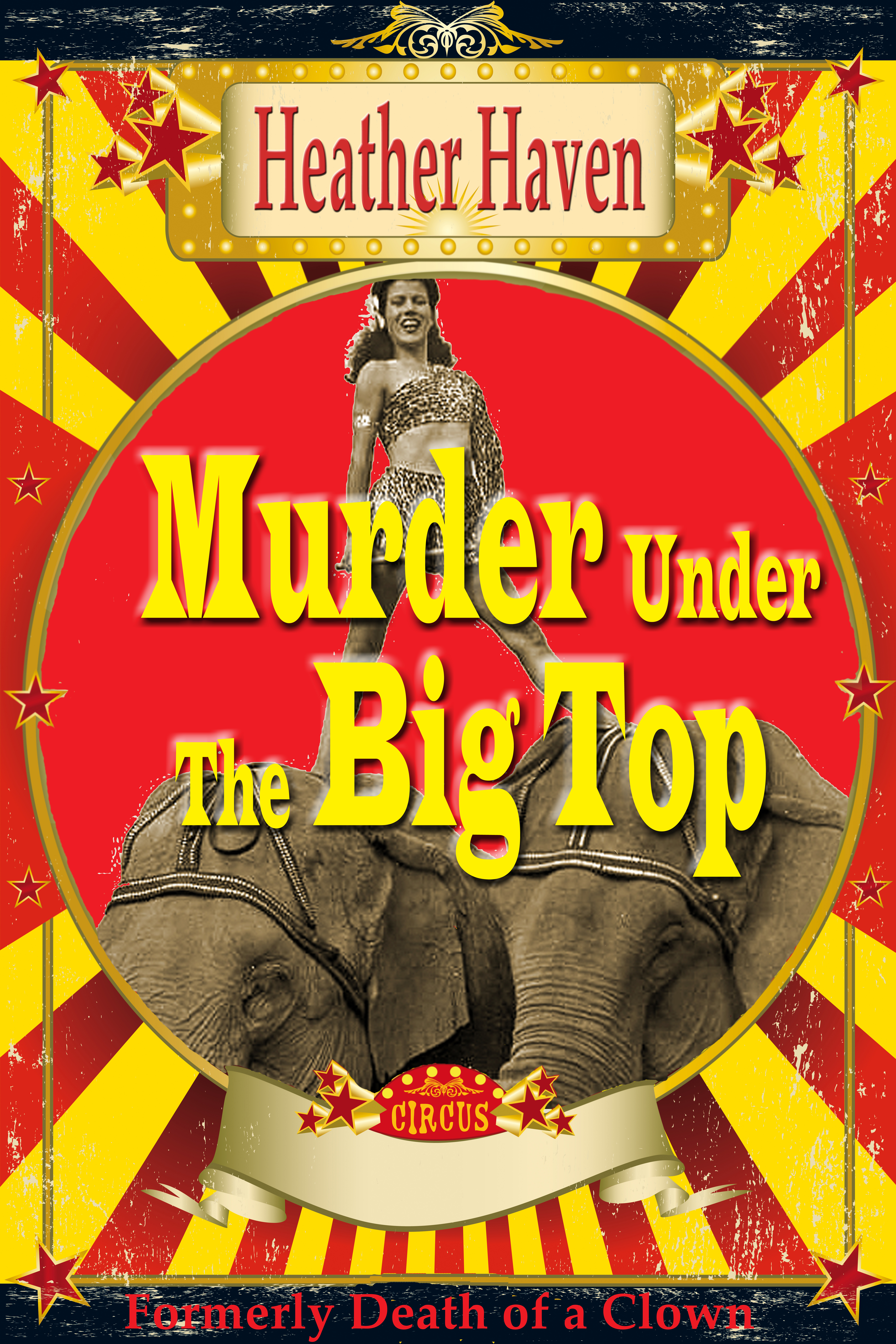
There are actually people who will not under any circumstances even touch a book with the word clown in the title. Even though it won a fairly prestigious award, some readers still hesitated to buy and read it. So after a few years, I bit the bullet and changed the title (and the cover) making it Murder un the Big Top. Not one word of the story was changed, just the title and cover. It took some doing, a lot of official documents, and buying yet another ISBN number. Murder under the Big Top still isn’t my biggest seller by a long shot, but at least people don’t send me the I-would-never-read-that-book hate mail. Well, not hate mail, exactly. Dislike mail.
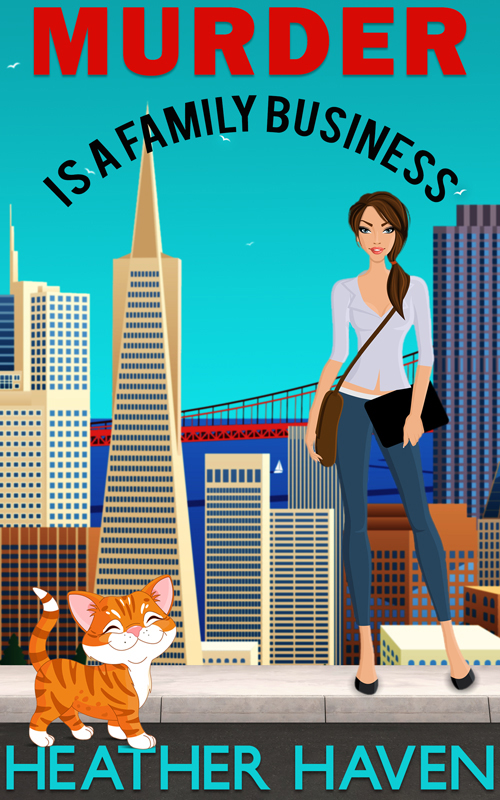
The first book of the Alvarez Family Murder Mysteries is called Murder is a Family Business. If I had to do it again, I wouldn’t call the book that. The title seems to indicate a more serious work to some, especially males, and has fooled many of them. They were expecting something more along the lines of “The Sopranos.” When they got a load of the family-oriented detective agency complete with a kitten and designer shoes, they were not happy. I didn’t change the title, but did create a cover that leaves no doubt this is a cozy. Between the title and cover, I think you can let a reader know that. But once again, if I had it to do over again, I would choose another title for the book.

I got better at it as I went along, but still had much to learn. Take the second book of the series, A Wedding to Die For. If I knew then what I know now, I wouldn’t have chosen that title, either. Now I would put the proposed title into Amazon and see what other books come up. If I had done that with Wedding, I would have seen three other books had the same title. But as that’s the book under development by a major streaming service and production company, I’m leaving it alone. But another lesson learned.

There are some very clever titles out there, especially in the cozy mystery field. Just this year we are offered: Penne Dreadful By Catherine Bruns, Wonton Terror By Vivien Chien, and Death Bee Comes Her By Nancy Coco. For my part, one of my favorite titles for my books is The CEO Came DOA. Although the latest book of the Alvarez Family Mysteries, The Drop-Dead Temple of Doom, is a very fun title. I don’t think any guy is going to buy it thinking it’s mob related. Although, gentlemen, never trust a protagonist who knows Karate and carries a Glock 19. Even if she does wear designer shoes.
ONCE AGAIN THANKSGIVING HAS COME AND GONE

For years, I’ve been the one to do most of the cooking for Thanksgiving dinner, with others helping with some of the side-dishes.

Before the pandemic, our grandson, Nathan, invited us to his home in the foothills (about two and ½ hours away) to enjoy Thanksgiving. The cook was his father-in-law, a master chef. This year we’re invited there once again. My contribution is always a Honey Baked ham. We couldn’t go if it wasn’t for my daughter Lisa who drive us (and her hubby comes along too.)

Yummy appetizers awaited us to eat while we waited for the main course.

The day was glorious and most of the guests ate outside. (One year, tents were set up over the tables—a good thing because it poured.)

Besides eating the delicious food, we get to see a lot of relatives and others, and the one I looked forward to seeing the most was Scarlett who has just turned one. She is Nathan and Amanda’s youngest. Two other great grands were there, Nick and Crystal’s boys, Julius and Nathaniel  plus great granddaughter, Kay’Lee.  We many great conversations.

Thanksgiving always being back memories of past Thanksgivings—those my grandmother prepared, and later my mother, and then me. Believe me, at this stage in my life, I am quite happy to leave the cooking to someone else.

However, the next day I cooked a turkey breast which we ate with granddaughter Jessi’s  leftovers. (She stayed home because she wanted to cook Thanksgiving dinner for her family for the first time.).  

I have so much more to be thankful for: still having my husband of 70 years, four of my five children still living, many grandchildren, great-grands, and six great greats, with another expected early in 2022, to love and enjoy, the continuing ability to write and read, and so much more.

Here’s hoping you all had a great Thanksgiving, and best wishes for the coming Christmas season.

Marilyn

The Season of Gratitude

This time of year publications on and off line are full of essays on gratitude, each writer searching for a unique expression that would set the writer apart. Having said this, I too am offering one of those essays. 

Some years ago I listened to a speaker on meditation talk about online meditations on various topics including gratitude, and how it changed his thinking. That sounded promising for someone who is often grateful for finding a parking space in Boston or catching the last train out or something else equally pedestrian. I decided to give the meditation on gratitude a try.

The instructions began with a sitting meditation of about ten minutes. After that we were instructed to begin listing the things for which we were grateful, and to keep going for another ten minutes. You might think ten minutes isn’t very long, but it is in fact a very long time, especially when you think you should be able to answer the question and then get on with it. (Obviously I hadn’t yet benefited from the practice of meditation.)

I began the list of gratitudes with the usual–my family, my health, my friends, the colleagues who read the first draft of my first mystery and didn’t tell me to get a day job. Then I scrounged around for things like our garden, the gifts from my family, the quiet streets of my neighborhood, and the like. I kept on going, even though I was feeling a little desperate and telling myself no one would know or care if I quit right then–at the three-minute mark. I passed through gratitudes for having a nice home, enough money to pay the bills, a husband who loved me (he got listed several times in different categories). 

The pressure was mounting. I still had several minutes to go. Without thinking (which is actually the same as thoughtlessly minus the emotional baggage), I began free associating. We had a dog, so I thanked him for bringing me close to broken bones every time he leapt to play with another dog. I thanked the person I offered to help when I saw him struggling with a bureau trying to get it into a truck, and he told me what a handsome dog I had. I was thankful for the mailman who came every day without complaint about our old porch stairs. 

By the end of the ten minutes I was ready to go for another as I thought about all the people I met and spoke with or somehow interacted with, and the feelings they’d left me with. I was grateful for the human qualities that are so often the source of pain and shame and disappointment. And even those qualities and others like them I was grateful for because they reminded me that I was human, and that was glorious.

Recently I read an explanation of why we have fantasies, daydreams, and the rest of it. The reason is, in that particular person’s view, a way to escape ourselves, that we humans will do almost anything to avoid spending time in true communion with our true selves. I don’t know if that’s true or not. But I do know that if you want to really know who you are, try a ten-minute meditation on gratitude. The discoveries are definitely worth the initial discomfort and awkwardness. Skepticism dissolves and something close to identity emerges.

Saying Goodbye to a Series

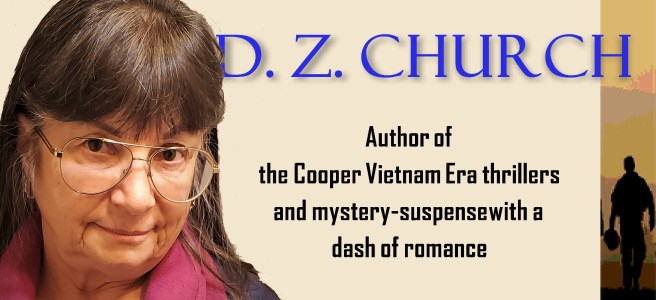
First off, Happy Thanksgiving to all! It is a bit bittersweet for me, as I find myself oddly at a loss with the publication of Don’t Tell, the final book in The Cooper Quartet. I suspect all authors suffer the same symptoms when a series ends.

  • I miss the Coopers, Laury, Byron, and their cousin Robin.
  • I keep wondering if I should write the one book I didn’t and fill in a big relationship blank. The book would take place in 1970 between the first and second books. If I did, The Quartet would become a Quintet. Then what?
  • Am I the only one who cares that these fighters are now on their own without me guiding them through further adventures?
  • Did I do what I set out to do: get one military family through the tumult of the Vietnam War while exorcising my own ghosts of the same period?
  • Did I manage to show the dichotomy of military women’s lives at that specific time in history when women’s roles were changing so rapidly?
  • Now what?

I suspect that some series go on and on because the author just can’t say goodbye to the main character, and as long as fans can’t either, that’s a good thing. I admit to an adoration for the MacDonald’s, Ross and John, whose detectives mirrored the society in which they existed and who grew and changed over the books. Travis McGee, in particular, begins like Mike Hammer with all women objects and ends understanding a world where women are not only not objects but are equals. Still, too often, series drag on, the protagonists don’t grow, readers learn nothing new … blah, blah, blah. I stop reading those after about the third book.

I didn’t want to be one of those authors who just yamity, yamity, yams unable to say goodbye to their own creation. So, I planned The Cooper Quartet as a trilogy. It became a quartet when Don’t Tell demanded I write it as the finale to the series. The procedural plot of Don’t Tell happened to me, as I note in my acknowledgment, except no one died. However, it was the reason I left the Navy. So, Robin became my vehicle to tell the world what happens to good people caught in a rigid system, even as the world rotates in their favor.

I’m happy to leave the Coopers, truly. Mostly. Am I in mourning? Yes, a bit. Okay, more than a bit. I have strong feelings for Laury Cooper, Chloe Minotier, her brother Pierre, and Dan Cisco. And, of course, my alter ego, LT Robin Haas. But I set out to write a family saga told via four military thrillers with the climax of the arc the third book and the denouement the fourth.

The first book in The Cooper Quartet, Dead Legend, takes place in 1967-68 during the hardest fought period of the Vietnam War and looks at what grifts war can hide. The second, Head First, occurs during the Christmas carpet bombing of 1972 and touches on the plight of Amerasian children. Pay Back deals with the Fall of Saigon and the corruption of the war, and Don’t Tell covers the fallout of all three prior books and the societal changes that occurred while our protagonists battled through the era. And, yes, I suppose, if there was a clambering to know why Chloe Minotier has such a soft spot for Laury Cooper, I’d write number five.

The books in The Cooper Quartet (Dead Legend, Head First, Pay Back and Don’t Tell) are available on Amazon in all formats.

Postscript:  For those who have asked me about my use of the red and yellow stripes that tie the four covers together. Here is the answer. The flag of South Vietnam has three horizontal red stripes on yellow like the horizontal stripes on the books in The Quartet, and the Vietnam Service ribbon has three vertical red stripes on yellow (green at each end). But do you know what I’ve learned? Other than Vietnam Era veterans, absolutely no one remembers the ribbon or the South Vietnam flag. And though I am aware that the U.S. wanted nothing so much as to leave the distaste of Vietnam behind, it is still stunning how completely it was accomplished. (Thus ends my rant)

Guest Blogger ~ Jennifer Worrell

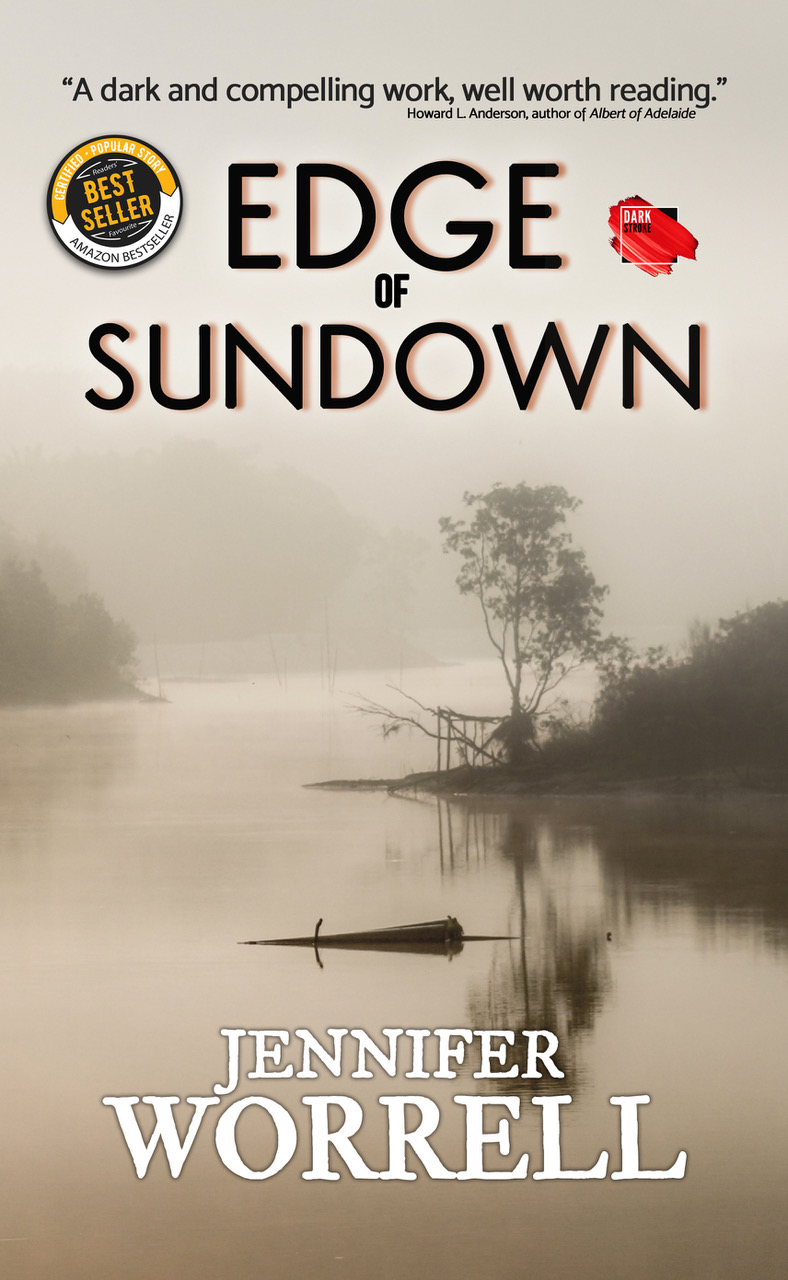
Atmosphere is the most delicious aspect of any book. I connect strongly with stories that envelop me into its world and make me feel like I’m living it along with the character.  I like to unsettle readers and immerse them in the same way, so they feel there’s no escape until they reach the last page. 

I wanted to write a modern noir inspired by the black and white movies and dark fiction of the 40s and 50s, The danger lurking in the quiet corners, the unspoken emotions, the dialogue delivered in short patter, hits all the right buttons for me.  So I was pleased as punch that someone called it “Midwest noir” in a review. 

My protagonist, Val, came from my enjoyment of reading characters that are a little off-center.  People who are not so nice, with twisted thoughts and less-than-savory motivations, yet not quite villains.  Characters who are less than successful, especially when they don’t realize how much.  They feel more like real people than we’d maybe care to admit. 

His love interest, Sandra, as well as his agent, Graham, are both antagonists as well as the story’s brighter characters.  Though I consider Sundown pretty dark, they counteract the shadows with a little lightheartedness.  Sandra’s dry wit was fun to write, and Graham is the type of friend anyone would be grateful to have in their corner.

The idea for the plot came from asking “what if” to things I was seeing on the news at the time.  Val (a much more successful author than I am) decides to write a dystopian conspiracy thriller about the crime rate in his city, with a nameless society covertly ending the lives of its residents when they no longer serve a purpose.  Being an older gent himself—Val’s personal “last chapter” looming closer than he’d like to admit—this concept feels urgent and chilling.  Unfortunately for him—and quite a few other people—the idea isn’t new.  It isn’t fiction.  And the members of this society are prepared to do whatever it takes to keep Val’s book from hitting shelves and revealing their secrets.

One of my favorite subgenres to read is the fugitive story.  Although Edge of Sundown doesn’t qualify in the traditional sense, a few of the final chapters have that feel, and they contain some of my favorite scenes.

I’m pleased to announce there’s a promotion going on until November 15.  Click here for a chance to win a $260 Amazon gift card.  Later this month, Edge of Sundown will be discounted to celebrate my publisher’s tenth anniversary.  Subscribe to my newsletter for an update.

Val Haverford’s sci-fi and western novels made him a household name. But that was then. A decade of creative stagnation and fading health has left him in the literary wilderness. Attempting to end his dry spell and secure his legacy, Val pens a dystopian conspiracy theory set in a tangential universe where alien invaders eliminate ‘undesirables’ perceived as drains on society. But as he digs deeper into violence plaguing his adopted home of Chicago, he discovers unsettling similarities between his work in progress and a life he thought he left behind. Soon he finds his fictional extremists are not only real—they’re intent on making sure his book never sees the light of day. As he pieces together haunting truths about his city and his motives, Val realizes his last chance to revive his career and reconcile the past could get him—and the people he loves—killed. Will he make the right choice? Or will it be too late? Edge of Sundown is a provocative story that shows how the desperation of lost opportunity can lead to drastic and unexpected consequences.

If Jennifer were to make a deal with the Devil, she’d ask to live—in good health—just until she’s finished reading all the books. She figures that’s pretty square. In case other bibliophiles attempt the same scheme, she’s working hard to get all her ideas on paper. She writes multi-genre fiction and is currently working on a sci-fi novel and a handful of picture books that may or may not be suitable for children. Edge of Sundown is her first novel. Her short fiction and essays appear in Write City MagazineWriting DisorderRaconteurLittle Old Lady Comedy and Beneath Strange Stars.

Socials: Facebook, Instagram, Twitter, Website

Buy link: mybook.to/edgeofsundown