Accuracy – Getting it Right

The historical mystery looked promising on the library shelves. I checked it out and started reading. A few chapters in, a glaring historical inaccuracy pulled me right out of the narrative.

The book takes place in 1855, in a New England town. In one scene, the protagonist goes to the post office—which has a sign reading “United States Postal Service.”

No. No. No. Definitely no.

The United States Postal Service didn’t exist until 1971, after former President Richard Nixon signed the Postal Reorganization Act of 1970. Before that, it was known as the Post Office Department, or simply the Post Office.

I had a similar experience when reading another historical mystery set in 1950. The protagonist mentioned having read a world-famous novel in the early 1940s. That would have been nearly 20 years before the novel was published.

I found myself thinking that a good editor—or copyeditor—should have caught that. Of course, editors these days were probably born after the Postal Reorganization Act went into effect.

I realize I’m writing fiction, a delicate balancing act between plot, characters and setting. It’s that framework we call willing suspension of disbelief. I write a good story and readers accept that reality and those characters who move around my plot and setting. I want readers to believe that a private eye named Jeri Howard and a Zephyrette named Jill McLeod can solve crimes and catch killers.

When writing my novels, whether set in the present (with historical references) or set in the past, I strive for accuracy. To be fair, I may get it wrong. But I’m careful.

I knew that was important for the Jill McLeod California Zephyr series, set in the early 1950s. There are train buffs call railfans, a natural audience for the books, since my protagonist is a Zephyrette, a train hostess and a member of the onboard crew. I knew that if I made any mistakes, I would hear about it from the railfans.

I was quite chuffed, as the British say, when I did a book event for the first in the series, Death Rides the Zephyr, at the Western Pacific Railroad Museum in Portola, California. One of the volunteers, an older man, approached me. He said he’d read the book and he wanted me to know that I got it right, both the train stuff and the history.

Music to my ears. I want readers to get caught up in my stories. I don’t want to make errors, however small, that that pull readers out of the story. They might not return.

Let’s Begin

January. The beginning of the new year seems an appropriate time to talk about beginnings. Such as, how to begin a novel, or story.

Where is the beginning? Is it where the protagonist enters the action? Or at a point deep in the back story, a place that can be glimpsed in a prologue?

The decision of how best to start a writing project is a personal one that varies from writer to writer.

Kindred Crimes, the first Jeri Howard novel, introduces my Oakland-based private investigator. I toyed with several different beginnings and wound up with the traditional private eye opening scene: Jeri meets with her new client in her Oakland office. The man is looking for his missing wife. Seems like a straightforward case. Or is it? All is not as it seems. That much is revealed in the first two paragraphs. And as Jeri delves deeper into the case, she discovers much more.

Man, woman, and child posed in front of a thick green Christmas tree, its branches laden with silver tinsel and gold balls. He stood behind her chair, hands resting lightly on her shoulders. Her blond hair fell in waves past the collar of her red dress. In her lap she held a cherubic toddler. They smiled at the camera, the image of a perfect middle-class nuclear family, caught forever in a five-by-seven glossy.

“When did she leave?” I asked.

The second Jeri Howard book, Till the Old Men Die, took me in a different direction. An earlier version began with a scene in which a woman with a shady past shows up at the history department office at the California State University branch in Hayward, California. The shady woman wants the papers belonging to a professor who was murdered some months ago in what appears to be a random mugging. Upon reading that version, a fellow writer commented that it was a shame reader didn’t get a glimpse of the murdered man while he’s still alive. I obliged, in a brief prologue that gave readers a look at how the man was killed.

I also included a prologue in Take a Number. It wasn’t back story. Instead, it was the only time Jeri meets the man she’s investigating, Sam Raynor. Jeri’s client is in the process of divorcing this abusive man. As he talks with Jeri, he tries to charm her. When she calls him on his bullshit, he reveals his nasty, manipulative personality. The next chapter backtracks, describing how Jeri got involved in the investigation. We meet her client and get some background on the case. The husband has money but known that California is a community property state, but he’s hiding it from his wife.

Then, of course, he winds up dead. His wife is the most immediate suspect, but Jeri discovers a long list of people with motives to kill him. As Jeri says:

Sam Raynor was the biggest slug who ever oozed across my path. Anyone who wanted to kill him would have to take a number and get in line.

With the Jill McLeod series, featuring my traveling Zephyrette in the early 1950s, the first two books, Death Rides the Zephyr and Death Deals a Hand, start out in a chronological fashion, with Jill on one of her train runs aboard the train. The third book, The Ghost in Roomette Four, starts with the ghost. How could I have a ghost and start any other way? It’s late at night and Jill sees something she can’t explain. A spectral presence, or maybe she’s just tired.

I am not seeing this, Jill McLeod told herself. But she was.

Light shimmered at eye level, about ten feet in front of her. The apparition seems to have no source. None, anyway, that Jill could discern. What’s more, she could see through it.

Jill took a step toward the light. It brightened, then dimmed. She took another step. The light flickered and moved into roomette four.

For my recent Kay Dexter mystery, The Sacrificial Daughter, I went back to the client-in-the-office beginning. Kay is a geriatric care manager who helps people care for elderly family members. As the book starts, she’s meeting with a prospective client who is having a difficult time with her mother. This first chapter introduces Kay and her profession and gives the reader an idea of why someone would hire a care manager.

“I’m at my wit’s end,” Sheryl Garvin said.

I could see that.

She had the stretched-too-thin aura of someone who wasn’t getting enough sleep. Her voice sounded tired.

Beginnings. One hopes that they lead to endings. I’ve got a good start on the book I’m working on. Now that January is here, it’s time to get to work and finish it.

Guest Blogger ~ Melissa Yi

War and Drink by Melissa Yi

“I could make Hope a custom gin.” —Nathalie Gamache, artisan distiller and board-certified gynecologist

Nathalie’s offer to create a gin for my main character, Dr. Hope Sze, delighted me. I’m an emergency doctor myself, and when we met online through a physician group, I felt that Nathalie understands Hope’s courage and fears as a resident doctor who solves crimes.

In honour of a custom gin, though, I’d have to focus on alcohol in my next medical thriller. And I hardly drink!

However, I was soon fascinated by the history of booze and crime. I began reading Frenchie, the story of a Quebec man who joined Al Capone’s gang in Chicago for 8 years.

I discovered that Montreal, the main site of my Hope Sze series, was a vacation magnet during Prohibition, as Americans flowed north for “giggle water” (liquor), jazz, and “pro skirts” (prostitutes in 1920’s slang). Unfortunately, buildings from the era were destroyed to make way for new construction.

Luckily, la Maison de Bootlegger is still standing in Charlevoix, Quebec. This building was a speakeasy, a place where they illegally sold alcohol, so you had to “speak easy,” or softly, about its location. Now it’s a restaurant with a nightly rock and roll show. Make your dinner reservations early so you can get the tour. I enjoyed tiptoeing into hidden rooms, observing hidden booze shelves, and creeping through a secret passageway in Elvis Presley’s footsteps.

Seriously, Elvis was here. He even left his signature!

Much further east, at the Age of Sail Museum in Nova Scotia, I noted the Family Temperance Pledge in their Bible and realized that of course the Maritime provinces, right on the sea, would sail liquor to the U.S. I read later that the income was a boon to Nova Scotia fishermen, suffering from a regional recession in the 1920’s. But as the Temperance movement pointed out, that money came at a social cost: alcoholics beat their families and spent their money on drink instead of food.

So there was no shortage of writing inspiration for me, both in terms of liquor and of crime. But how could I weave it all together in my novel, White Lightning? Especially when I took a side journey researching 19th century England, how could I draw it all together into a thriller featuring my thoroughly 21st century heroine, Hope Sze?

The solution: more research.

Hope visits the Rumrunner’s Rest, a Prohibition inn inspired by la Maison de Bootlegger, but in Windsor, where 75 percent of alcohol flowed across the Detroit River onto U.S. soil. To maximize the chaos, Hope also has to navigate a con filled with people dressed up like fictional villains from the The Wicked Witch of the West to Children of the Corn.

I literally played with the historical elements: I wrote the 19th Century portion first as a play called “The Climbing Boy” in a playwriting class at George Brown College, which was turned into a Lego stop action movie at the digital Winnipeg Fringe. I folded “The Climbing Boy” into White Lightning thanks to some inspiration from author Simone St. James.

In other words, in White Lightning, I tried to capture the glamour as well as the murder and treachery of Prohibition.

As William Faulkner pointed out, “War and drink are the two things man is never too poor to buy.”

So let’s raise a glass and grab a book as we turn the page on a new year!

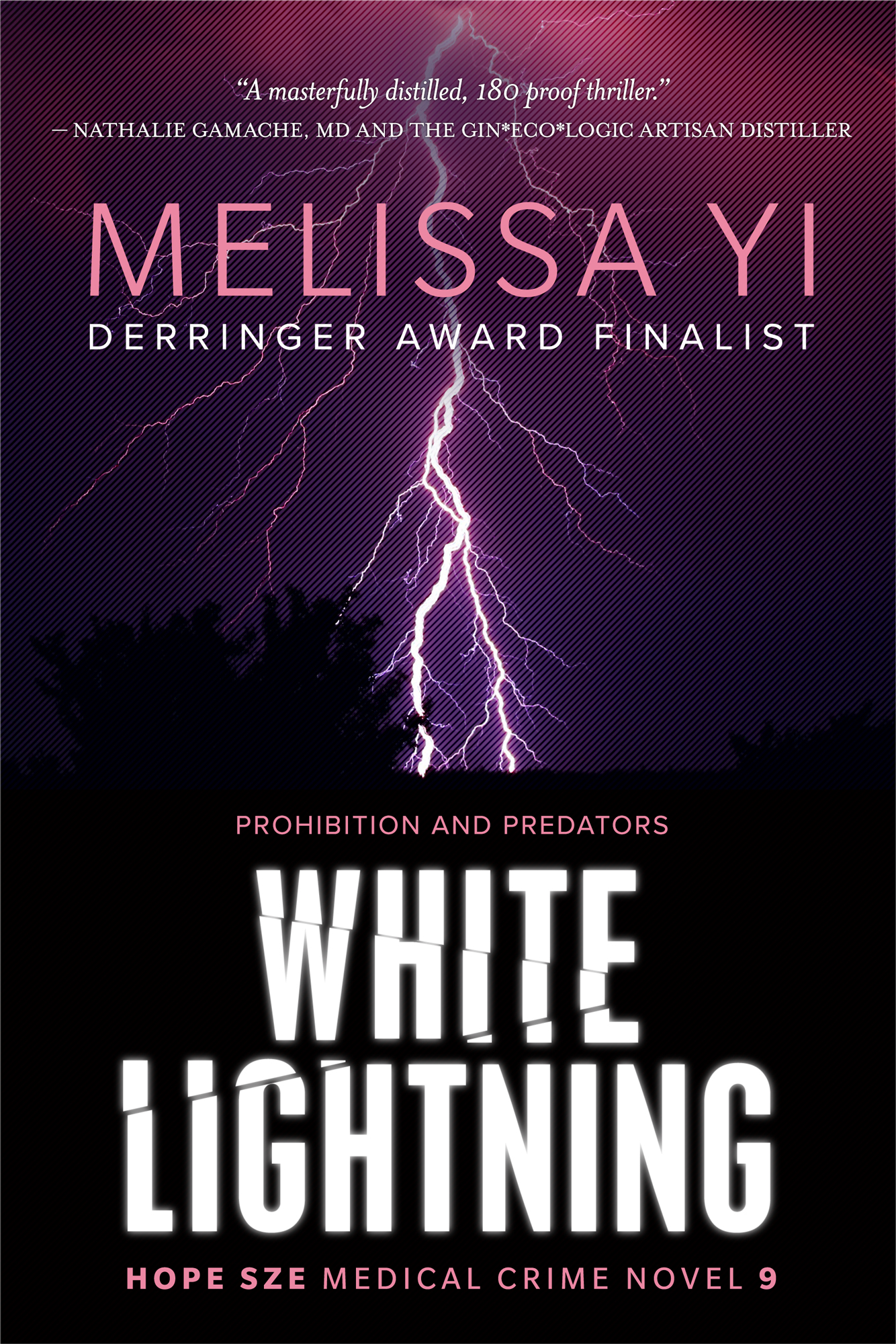
White Lightning

Hope Sze Medical Mystery Book 9

Prohibition and Predators. 

Hope Sze escapes for a romantic weekend away at the Rumrunner’s Rest, a Roaring Twenties inn once celebrated both for Prohibition’s best alcohol and the smoothest jazz bands north of the Detroit River.

Then a convention of fictional villains overrun the tavern, her friend glimpses a ghost, and Hope uncovers a grisly surprise in the fireplace that may be related to Al Capone.

Tonight, unless Hope unravels a century’s worth of clues, death will collect several more lives. Including the one she holds most dear.

Buy links: https://windtreepress.com/portfolio/white-lightning/

Direct links: https://books2read.com/whitelightningyi

amazon.com short https://amzn.to/3n5kuIl

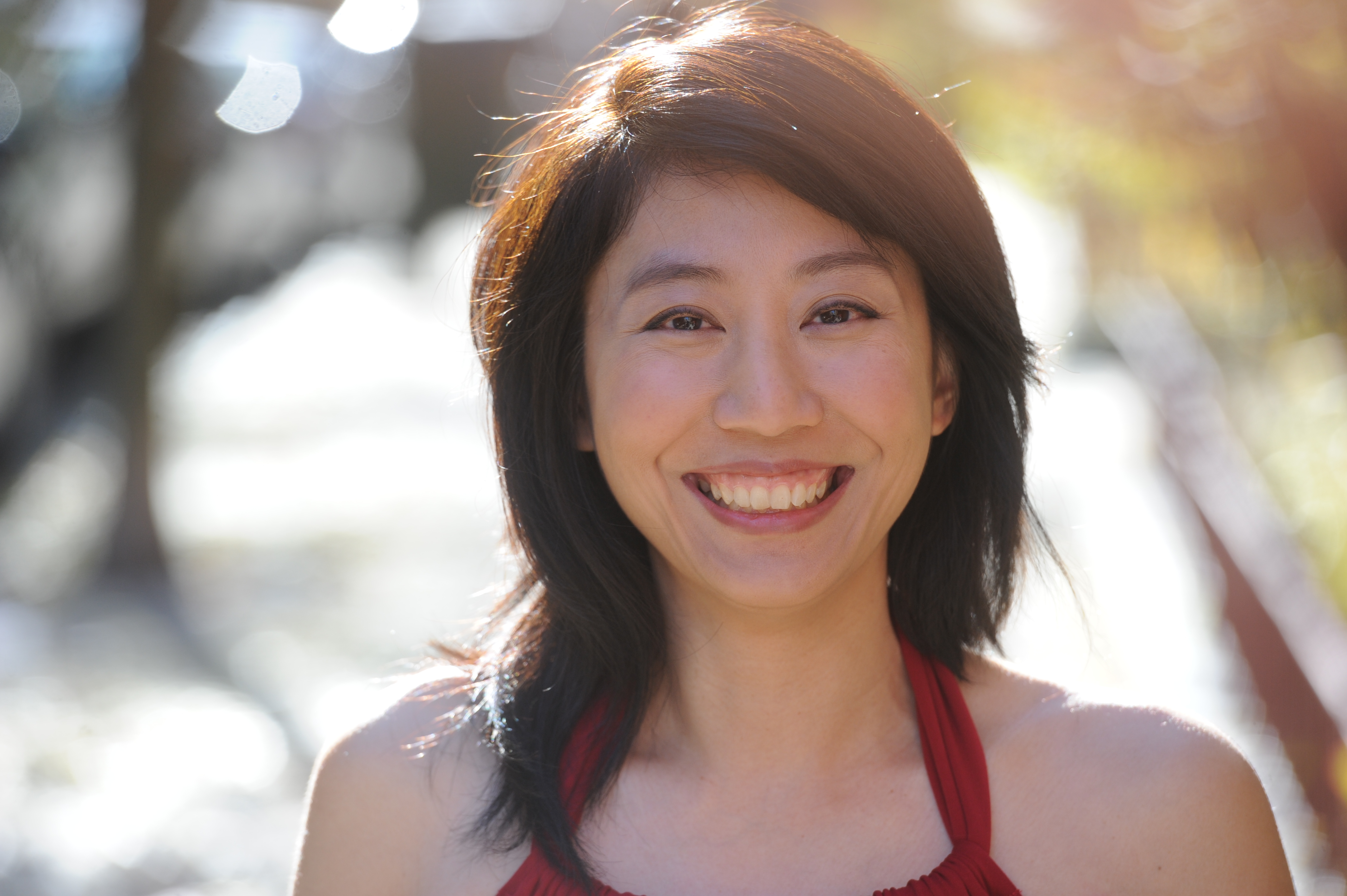
Melissa Yi, also known as Dr. Melissa Yuan-Innes, studied emergency medicine at McGill University in Montreal. She was so shocked by the patients crammed into the waiting area, and the examining rooms without running water, that she began to contemplate murder. And so she created Dr. Hope Sze, the resident who could save lives and fight crime.  Her most recent crime novel, White Lightning, is already up for many awards. She appeared on CBC Radio’s Ontario Morning and recently had so many print interviews that an addiction services counsellor said, “I see you in the newspaper more often than I see you in the emergency room.”

Dr. Melissa Yuan-Innes applied to medical school mostly because she wanted to save lives, but also because she’s nosy. Medicine is a fascinating and frustrating window into other people’s lives. She shares her sometimes painful, occasionally hilarious stories in The Medical Post, Chicken Soup for the Soul, and in her essay collections The Most Unfeeling Doctor in the World, FIfty Shades of Grey’s Anatomy, and Broken Bones.

Website: http://www.melissayuaninnes.com/

Twitter: http://twitter.com/dr_sassy

Facebook: 

https://www.facebook.com/MelissaYiYuanInnes/

Bookbub: https://www.bookbub.com/authors/melissa-yi

Goodreads: goodreads.com/author/show/4600856.Melissa_Yuan_Innes

Youtube: https://www.youtube.com/c/MelissaYuanInnes

Instagram: https://instagram.com/melissa.yuaninnes

Author central: amazon.com/author/myi

Pinterest: https://pinterest.com/melissayi_

TikTok: @myi_books

MY LAST POST FOR 2021

This past year has flown by. Christmas is over except for the memories. So what are your plans for the New Year?

Unlike some long-ago past New Year’s Eves, we won’t be doing anything special except for having tamales for dinner and toasting with hot cider. Our big celebration is on New Year’s Day. I always make my version of Seafood Gumbo and various members of my family turn up to eat crab legs and shrimp in a tasty broth served over rice. Afterwards we usually play a rollicking game of Estimation.

What about the rest of 2022?

First, I’m surprised I’m still here to see it.  My hope is to finish the book I’ve been working on.

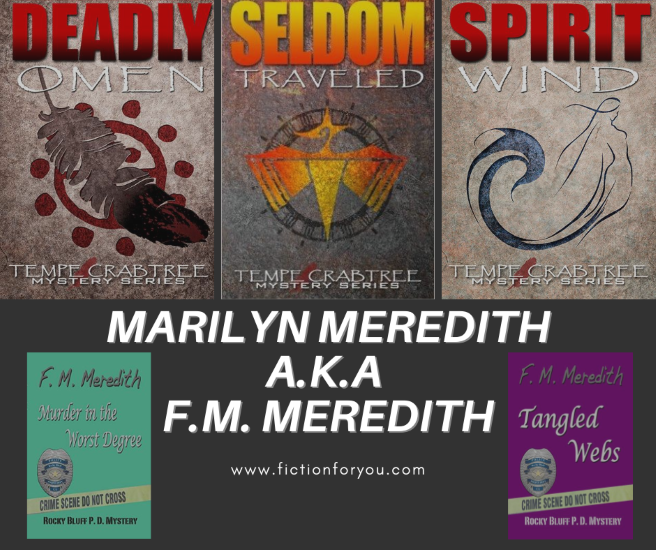
I’m also having a .99 cent sale of a Kindle copy of Invisible Path, a Deputy Tempe Crabtree mystery, from January 17 to January 21.

Like many, I’m hoping times will get back to normal—or at least a near-normal. A few days ago I had lunch with two of my writing buddies, and we decided to do it once a month. It was great to be together again. We are also contemplating setting up a book signing event.

Though I am no longer on the Public Safety Writers Association’s board of directors, they’ve asked me to attend their next meeting in February, sort of a transition. Since it’s in Vegas, I’m going since I’ll also be able to visit my sister who lives there. And I’ve already signed up for the PSWA writing conference in July.

I have an in-person event scheduled for April—we’ll see if that actually happens.

Though no one ever really knows what will happen in the future, it’s always fun to plan.

What are your hopes and plans for 2022?

And to all of you, I’m wishing for a happy and most wonderful New Year.

Marilyn

The Sounds of Christmas

When I noticed that my post was due on Christmas morning, my first reaction was to cringe and wonder, What on earth could I talk about that wouldn’t seem banal on such a morning? Not sure what to do, I do what I always do. I put the worry aside and took the dog for a walk. 

The various churches in our area often play recorded music. There is little live bell ringing in churches today, which is a loss. As a former bell-ringer, I miss the sound of bell music. When I was barely twelve years old, I was part of a group from my school that performed for the mayor of Boston (in a public concert) during the holiday season as well as for my community. When I hear bell ringing now I actually listen as though I understand what I’m hearing—the different bells, the timing, the way a ringer has to pitch and snap the bell forward, etc. 

On my walk I heard the recorded music from a small nondenominational church nearby, and let my mind drift. In the distance a dog barked and I knew another dog walker was out and about. Briefly a car with the bass ramped up sped by, crushing the bells and the dog. I registered all this and more as I waited for the world to fall quiet so I could enjoy the bells again.

This was one of those moments when a writer recognizes the obvious. In my recent work I’d forgotten the sensation of sound—the music that alters how I feel, the pain of shouting voices, the laughter that starts me smiling and makes me curious, the chorus of dogs barking in response to each other, and the snatch of conversation from two people walking past. The world is one long musical composition of which we hear only bits and pieces. But what if we listen?

The morning of a holy day is a good time to begin to listen well and carefully, to set aside the urge to add a comment or tell a story. Now is the time to listen to the world around us, the sounds we screen out instead of embracing as part of the fullness of life. There is a rhythm to movement and the noise it creates, and if we listen carefully and long enough we’ll see people walking up the steps in time to the beat of a car coming around the corner, or the landing of birds while a tree branch bends. If we listen we can hear the rhythm that holds us in sync with each other, each sound a grace note of life. 

May your holiday be rich in all the best ways.