My window into other worlds

I don’t know how many of you get giddy when you can visit or see the settings from books you’ve read. But as a reader, I have always enjoyed being taken to settings or worlds I haven’t been and may never be able to see. Books have always been my window into other worlds.

A few weeks ago, my hubby and I made a trip from SE Oregon to Killeen, TX to see his sister and her husband and deliver boxes of belongings to our oldest granddaughter now living in Arkansas. On the way over we drove through the four corners and the towns of Flagstaff, Tuba City, Windowrock, and Gallup. The settings of author Tony Hillerman’s novels.

My husband just shook his head as I said the names of places that I’d read about in those novels. I could envision Leaphorn, Chee, and Bernie Manuelito driving around on the dirt roads I saw from the freeway.  Seeing First Mesa on Hopi land and the hogans on the Navajo land… It stalled my breath to see places and things I’d envisioned as I read or listened to Mr. Hillerman’s books but had used my imagination at what it would look like.

In case you haven’t figured it out already, I have been a huge fan of Tony Hillerman’s books since reading the first one. While he has more Native American life, traditions, and legends in his stories than I have in mine, he was my inspiration to have a Native American character as the main protagonist in my three mystery series. 

He lived on or near the four corners area where the Hopi, Navajo, and Pueblo tribes live. He had many contacts among these tribes to help him show more of the culture than I’ve been able to cultivate living a distance from the reservations and tribes I write about in my Gabriel Hawke novels, Shandra Higheagle Mysteries, and Spotted Pony Casino Mysteries.

I aspire to write as intriguing and thrilling reads even though they aren’t as steeped in the culture and lives of the people.

The next Gabriel Hawke book, I’m having Hawke and Dani, his significant other, attend Tamkaliks. A powwow held every July in Wallowa, Oregon. I attended it this past year for the third time and am now feeling confident I can give my two Nez Perce characters the experience they would undergo having been away from their culture for decades due to their careers and trying to fit into a culture other than their own.

However, with the return of Hawke’s sister to his life, she is showing him how good their culture is for their wellbeing. That will be a subplot in the book to his investigation into a decades-old body he discovers while patrolling the Snake River in the Hells Canyon.

I‘m hoping my contact within the Nez Perce community and the Fish and Wildlife Trooper helping me with the patrol of the river will give my story more realism.

Speaking of realism, I took a trip to the Oregon Coast last Spring to research for my newest release, The Pinch, book 5 in the Spotted Pony Casino Mystery series. In this book Dela Alvaro, head of security for the Spotted Pony Casino is at a tribal-run casino on the Oregon Coast helping them beef up their security. While there a child is kidnapped and she runs into an old friend.

The Pinch

Dela Alvaro, head of security for the Spotted Pony Casino, is asked to do a security check of a casino on the Oregon Coast. She no sooner starts her rounds at the casino and a child of a dubious couple is kidnapped. Special Agent Quinn Pierce of the FBI has been out to get the father for some time.

One of Dela’s best friends from the Army is also at the casino and they catch up. The next morning, Dela finds her friend strangled. As Dela struggles with the violent death of yet another best friend, Tribal Officer Heath Seaver arrives and the two begin untangling the lies, kidnapping, and murder.

As Heath carries the kidnapped child to safety, Dela must face a cunning killer alone.

Pre-order now, releases on February 22nd. https://books2read.com/u/38Y787

I hope you enjoy this latest book and follow my books to learn more about the Nez Perce, Umatilla, and Cayuse tribes as my characters, Hawke and Dela begin to, in Hawke’s case become reacquainted with his roots and Dela is just beginning to learn she may have a Umatilla heritage.
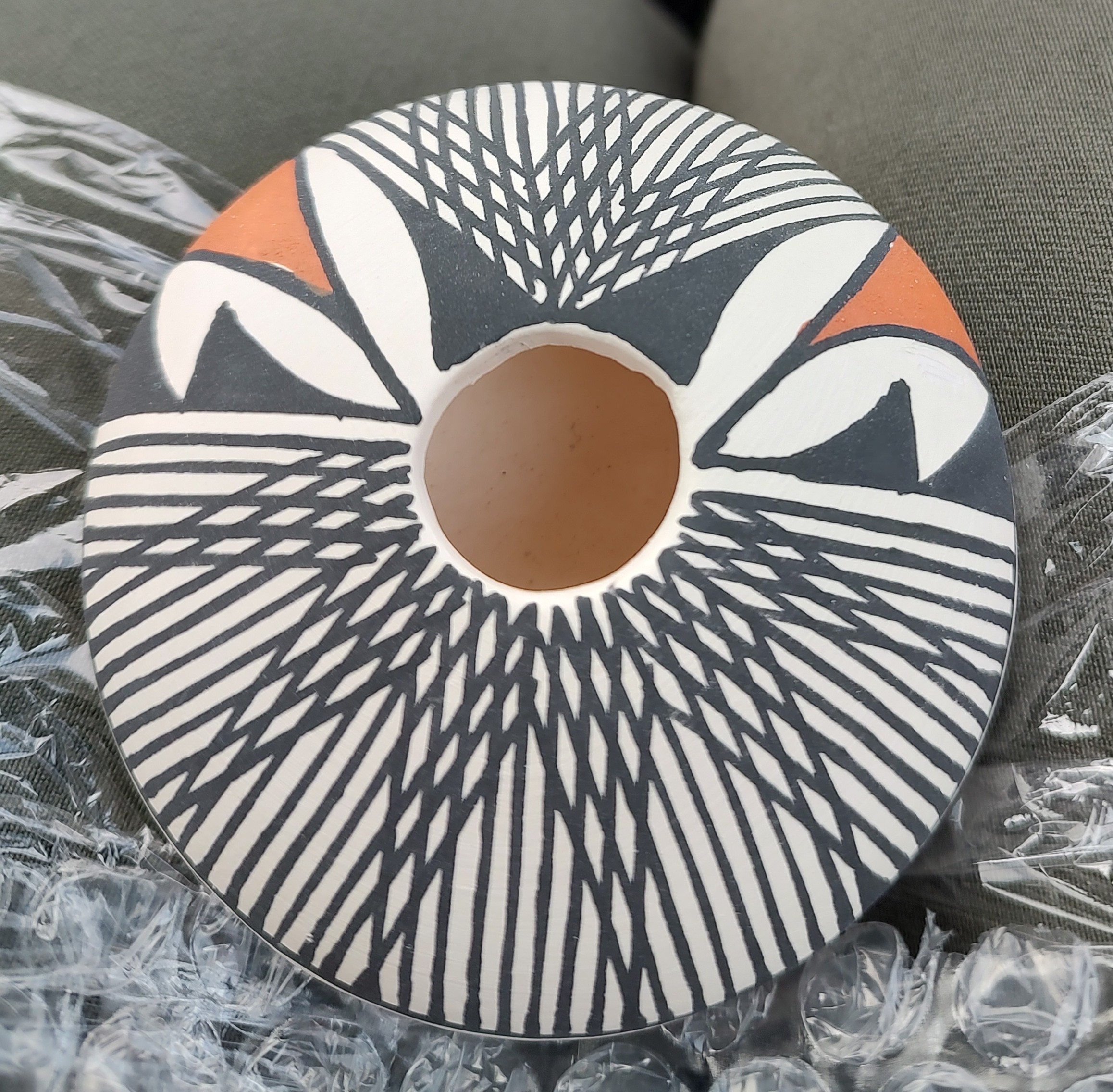
I purchased this seed holder pot from a Pueblo woman in front of a market on the reservation. She told me she was Acoma (Ah-kuh-muh) Pueblo with the Bear Clan. She showed me her name and a bear paw on the bottom of the pot. She then told me the solid black on the pot represents mountains and land, the orange sun, and the thin lines rain. I enjoyed my visit with her.

That is the thing I love most about reading, writing, and traveling. I learn new things and broaden my horizons.  

Guest Blogger ~ Erica Miner

Prelude to Murder: Bringing Murder and Music Together

Everything about my journey to the mystery genre was connected to my love for writing and my life as a violinist with the Metropolitan Opera in New York.

Though I had played the violin most of my life, I had started writing before I began studying the instrument. In grade school, at the age of 7 or 8, I was placed in an afterschool program for Creative Writing. I don’t remember much of what I wrote (it was about 100 years ago!). But I do remember loving the entire process: creating characters and plot lines and weaving them all together to tell stories. Then I discovered I also had a talent for the violin. That fiendishly difficult instrument monopolized my creativity, though my passion for writing never left me.

Eventually I ended up in the orchestra of the most prestigious opera company in the world, where I was part of a uniquely exciting, glamorous subculture. What I hadn’t anticipated was the hotbed of intrigue behind that famous “Golden Curtain”—an operatic Tower of Babel with clashing egos, rampant jealousies, and nefarious happenings. I then realized an opera house was the perfect place for mischief and mayhem. Why not bring murder and music together in that milieu? My Julia Kogan Opera Mystery series was born.

When it comes to the old adage “Write what you know,” I was not immune. My main character, Julia, is a young violinist much like me when I first started out at the Met: a starry-eyed neophyte who knows nothing about the backstage conflicts that take place between the fascinating but maddening characters who work there. In the first book of the series, Aria for Murder, on the night of Julia’s debut performance at the Met, an unthinkable tragedy occurs, and suddenly she becomes entangled in a murder investigation. Julia’s sleuthing makes her the target of the killer, and she uses her own ingenuity to survive.

There was little research involved in my Met Opera mystery, since I had been there for 21 years; but Prelude to Murder, the recently released sequel, takes place in a totally different atmosphere: Julia goes off to the desert to perform with the Santa Fe Opera. I had never been to Santa Fe, so I visited the area to do copious amounts of research on its history and culture. It was a revelatory experience, and the book is infused with rich details. Of course, no sooner does Julia arrive in Santa Fe than operatic chaos ensues, and she finds herself involved in yet another murder investigation, this time with the added element of Santa Fe’s ghostly activity. Her wits carry her through, and in Book #3 she goes to San Francisco for more operatic mayhem.

Though I find the mystery genre the most difficult to write, it also is the most challenging. The potential for murderous intrigue against the background of a theatre, where the turmoil behind the scenes is often more dramatic than what occurs onstage, is limited only to the number of opera houses in the world—and to my wicked imagination.

Prelude to Murder

Young, prodigious Metropolitan Opera violinist Julia Kogan, having survived her entanglement in an investigation of her mentor’s murder on the podium, and a subsequent violent, life-threatening attack of a ruthless killer, is called upon for a key musical leadership position at the Santa Fe Opera. But at the spectacular outdoor theatre in the shadows of the mysterious New Mexican Sangre de Cristo Mountains, she witnesses yet other operatic murders, both onstage and off. Dark and painful secrets emerge as, ignoring warnings from her colleagues and from Larry, her significant other, Julia plunges into her own investigation of the killing. Ghostly apparitions combine with some of the most bloody and violent operas in the repertoire to make Julia question her own motives for searching for the killer. But this time the threat to her life originates from a source she never would have imagined.

Buy links:

Amazon: https://www.amazon.com/Prelude-Murder-Julia-Kogan-Mystery/dp/1685124429/ref=monarch_sidesheet

Barnes and Noble:

https://www.barnesandnoble.com/w/prelude-to-murder-erica-miner/1144067662?ean=9781685124427

https://www.thirdplacebooks.com/book/9781685124427

After 21 years as a violinist with the Metropolitan Opera, Erica Miner is now an award-wining author, screenwriter, arts journalist, and lecturer based in the Pacific Northwest. Her debut novel, Travels with My Lovers, won the Fiction Prize in the Direct from the Author Book Awards. Erica’s fanciful plot fabrications reveal the dark side of the fascinating world of opera in her Julia Kogan Opera Mystery series. Aria for Murder, published by Level Best Books in 2022, was a finalist in the 2023 Eric Hoffer Awards. The second in the series, Prelude to Murder, published in 2023, glowingly reviewed by Kirkus Reviews (https://www.kirkusreviews.com/book-reviews/erica-miner/prelude-to-murder/), finds the violinist in heaps of trouble in the desert at the Santa Fe Opera. The next murderous sequel takes place at San Francisco Opera. As a writer-lecturer, Erica has given workshops for Sisters in Crime; Los Angeles Creative Writing Conference; EPIC Group Writers; Write on the Sound; Fields End Writer’s Community; Savvy Authors; and numerous libraries on the west coast.

https://www.facebook.com/erica.miner1

https://twitter.com/EmwrtrErica

https://www.instagram.com/emwriter3/

AUTHOR WEBSITE:

https://www.ericaminer.com

A Few Of My Favorite Things

I’m one of those people who loves Christmas music. All of it! From the good old songs by Nat King Cole, Bing Crosby, and Brenda Lee to the new ones by Mariah Carey, Kelly Clarkston, and Cher’s new one. If there are bells jingling, joyful lyrics, or reverent lyrics, I like it all.

Listening to Christmas music while I cook, clean house, and put things away from my recent book selling events, makes the task lighter and more fun. My hubby rolls his eyes as I dance around the kitchen putting dishes away, totally absorbed in the song that is playing. (If I’m absorbed how do I know he rolls his eyes?) Because he makes a noise or says something that draws my attention to him. He isn’t a Grinch, but he isn’t into the holiday as much as I am.

Where I’m going with this is I have learned I may be more auditory than I thought. I started listening to one audiobook so I could see what I would need to produce if I ventured into making my books into audiobooks. I enjoyed listening to a book because my hands were free. Now when I sew, cook, clean house, or drive long distances, I prefer to listen to audiobooks. Except this time of year because I’m listening to Christmas music. Audiobooks have kind of become my addiction because I can listen to them while doing other tasks. My mind can wander into the story while my hands and eyes are doing something else.

Lately, I’ve felt like I don’t have enough hours in a day to read for pleasure. But I can listen and continue doing certain tasks. Even my walks, I can listen to a book and get my exercise and fresh air. Our last trip to see our daughter, while my hubby drove, I listened to a book with my earbuds because his pickup doesn’t have the capability to put it through the radio, but our trip before that with my car, he even listened to the book.

I’m finding at the book selling events I attend that more people are saying they listen to audiobooks. Which is good for me since my three mystery series are all on audio. As a means to get more of the books purchased, I joined a Facebook website group for authors with audiobooks wide, meaning not just published through Audible. This group has proven to be more helpful in teaching me how to promote my audiobooks than any other workshop or event I’ve attended.

Right now, the authors at Indie Audiobook Deals are having a MASSIVE year-end giveaway. If you like audiobooks as much as I do, you might want to enter the giveaway. You can sign up to follow the authors with audiobooks in the genre you like to listen to as more ways to get your name in the drawing.

Five entrants will win a $50 Kobo gift card! Kobo is the premier site to listen to fantastic audiobooks.🎧

We’re picking FIVE winners so make sure to complete all of the extra entries to enhance your chances of winning. Good luck and wishing you a happy holiday season!

Enter here: https://kingsumo.com/g/pt4ez1/win-1-of-5-kobo-50-gift-cards

And if you are a mystery fan who likes books with diverse characters, right now I’m listening to book 2 Peril at the Exposition by Nev March and enjoying it. I discovered Ms. March earlier in the year with her first book that I purchased through Chirp, an audiobook distributor that has sales constantly. After listening to that book, Ms. March had asked a question on a crime scene email group I’m on. I emailed her to let her know how much I enjoyed her book and she agreed to be a guest blogger here in February.

Anyway, I got away from reading about diverse characters. Her first book is set in India in the 1800s. The one I’m listening to now is set in Chicago. The two main East Indian characters left India so they could be married. For some reason I enjoy reading books set there. I also like Sujata Massey’s Mysteries set in 1920 India. When I finish reading the book Blood Sisters by Vanessa Lillie, I will dive into The Mistress of Bhatia House by Ms. Massey.

I believe my interest in other cultures is why I write mysteries with Native American characters. I like to learn about their culture and reveal it to others. Though I reveal it slower than an Indigenous writer would because I didn’t grow up in the culture and have to learn about it and understand it before I’ll put it on a page.

Also this month, I have my audiobook, Murder of Ravens, book 1 in the Gabriel Hawke series for $0.99 at Chirp. Double Duplicity book one of the Shandra Higheagle Mysteries, Double Duplicity is $0.99 at Spotify. Or you can get the first three audiobooks of the Shandra Higheagle Mysteries at Barnes and Noble Nook for $2.99.

If you haven’t already finished your holiday shopping, a book or audiobook is a great gift. The recipient will step into another world and be the better for it.

Happy Holidays!

Paty

Guest Blogger ~ Roxanne Varzi

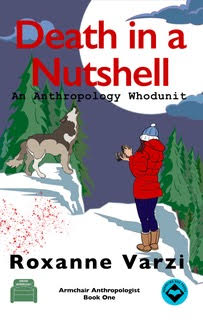
“Very few of us are what we seem,” the thematic essence in Agatha Christie’s stories, is not only the kernel of a good murder mystery but also the raison d’etre of an anthropologist. We anthropologists go to our field site (where we will study culture, people, rituals, or phenomena). We participate in daily life there, while observing and asking questions. Then, we return home, puzzle over, and try to piece together all the information we have collected that will solve the mystery to a cultural question. In my protagonist’s case in Death in a Nutshell: “Why do people immigrate to Bozeman, Montana?” And then, we write up our findings as an ethnography.

Anthropologists and detectives (and mystery writers) work hard at decoding (creating) symbols and looking for (planting) clues to explain why people do what they do, how they do what they do, and why they persist in doing what they do. Hypothetically, detectives are Anthropologists, Anthropologists are detectives, and mystery writers are a little of both. This fluidity is why writing Death in a Nutshell: An Anthropology Whodunit, a murder mystery that embeds anthropology, was not a huge leap for this anthropologist.

As a child, I was also told that just as “You are what you eat,” “You write what you read.” So, it should have come as no surprise to me, given that my youth was spent in the world of cozies with amateur sleuths (Nancy Drew, Ms. Marple, Harriet Vane, etc.) that while on a winter vacation in Montana five years ago, an idea for a murder mystery surprised me. It came to me, initially in the form of a single character in a singular setting: a nature photographer in Yellowstone Park.

I returned home with a burning desire to write, but a raging fever kept me in bed the last week of winter break. I was unable to write more than a few pages of notes. My teaching quarter began, and the mystery faded into a file folder where it would mostly remain for the next two years.

In early 2020, the pandemic hit, and a few months into the lockdown, I carefully re-opened the file, not because I had more time (teaching on Zoom coupled with a unique homeschooling experience was more challenging), but precisely because entering into a cozy world of my own making was the only salve and form of control, I had in a world that was out of control and facing new and inexplicable dangers.

While delving back into the world of fiction, I noticed that I was not the only one having difficulty handling reality. My university students were slipping away, and just like my young learner with dyslexia at home who had escaped to a world of fantasy novels, they also needed a more inventive, sensorial, and creative way to engage the material I was attempting to teach them.

At home, my goal was to make education more accessible, often involving using stories to deliver information. I was already doing this with complex theoretical knowledge at the college level in the form of a novel and plays, so why not a murder mystery? And why not for everyone who enjoys a good mystery and is fascinated by the study of human behavior, the kernel of any good mystery?

Anthropology is often described as a discipline that aims to make the strange familiar, and the familiar strange. There was no better time than during the early months of the pandemic to witness the familiar turning strange and the strange slowly becoming daily life. The world needed, and still needs, a little anthropology to help navigate difficult cultural transitions. But that does not mean it should be devoid of its mysteries or that we should seek to control all that we cannot easily explain.

One of the joys of writing fiction is how a book unfolds despite its author. As my book slowly came along, my characters, as characters in fiction often do, began to take on a life of their own. My protagonist acquired dyslexia, which was no surprise given that I had spent the better part of the last decade researching dyslexia, advocating for students with dyslexia, and learning about my own dyslexia. What was serendipitous and quite surprising was when, on one pre-pandemic afternoon, my son returned from an after-school program at Chapman University and demanded: “Where are my fossils?”

Why would he suddenly need his fossils?

“I need to take them to Chapman next week.”

What did fossils have to do with an after-school program that paired younger students with dyslexia and other learning differences with college students and faculty mentors?

“Our professor mentor is a paleontologist!” My aspiring paleontologist son answered in frenzied excitement.

The paleontologist was none other than Jack Horner, a pivotal figure in my novel, whose exhibition I had encountered during that fateful Montana vacation. People, indeed, are not what they seem. I had no idea Jack Horner was a person with dyslexia when I slipped him into Death in a Nutshell. Or that we would meet one day through my son and our shared dyslexia. Nor had I known that Agatha Christie–the author who would become such an influential figure in my writing–was also a person with dyslexia.

It’s moments like these, when the unseen mysteries that connect us come to light, that I most enjoy as a writer and anthropologist—and writing mysteries in particular are the best way to keep me digging for a good story.

Alex is on the verge of dismissal from her anthropology doctoral program when her luck turns, and she lands a fellowship with a dioramist at the Museum of the Rockies. The only problem is, Alex hasn’t a clue about dioramas or dinosaurs, and, as she will soon find out, she’s not the only one faking it in this frozen landscape.

From New York City to Yellowstone National Park, we follow Alex, a whip-smart dyslexic-ADHD Margaret Mead cum Ms. Marple, as she explores friendship, identity, globalization and a murder against the stunning backdrop of the Rockies in winter. 

            A murder mystery embedded with forays into visual anthropology … we find that in an era of fake news and science denial, a little anthropology goes a long way.

Universal Book link: https://books2read.com/varzi

Roxanne Varzi  is an award-winning author, filmmaker, playwright, Fulbright scholar, dyslexia disruptor. She has a PhD from Columbia University and is a full professor of Anthropology and Visual Studies at the University of California Irvine. Her writing is published in The London Review of Books, The Detroit Free Press, The LA Times, The Guardian, and Le Monde Diplomatique and three anthologies of Iranian-American stories. She is the author of Warring Souls, and Independent Publishers Award Gold Medalist Last Scene Underground: an Ethnographic Novel of Iran. 

https://faculty.sites.uci.edu/professorvarzi/

https://www.linkedin.com/in/roxanne-varzi-b178417a/

https://www.facebook.com/roxannevarziauthor/

Happy Dancing

I don’t know about other authors but there are times my husband and family give me a look that says, they wonder about my sanity. 😉

Last month, I drove to Wallowa County where I set most of my Gabriel Hawke Novels. He is an Oregon State Trooper with the Fish and Wildlife division. The reason for my trip was to:

1) Do reconnaissance of the area where Hawke finds an unconscious woman in the wilderness.

2) Discover why Starvation Ridge was named that.

3) Attend a powwow in Wallowa County so I can have Hawke and his partner Dani attend one in the next book. I also wanted to see if I could connect with a Nez Perce tribal member who would help me add more of the culture to my books.

As usual, I dragged my sis-in-law and brother into my hijinks. Thankfully, my brother being an artist, he understands my need to see things for my books. And I’ve taken my sis-in-law along on other research adventures. First, we made the trip out Starvation Ridge so I could see it better. I’d used Google Earth and an Oregon Gazetteer to try and come up with a plausible explanation for the car stuck between two trees in the middle of forest service land. But I wanted to see the terrain better and I’m glad I did! The way I had my character discover the vehicle wouldn’t work for the area. When I came home, I rewrote the scenes where and how the car was found. Not only did I get a good look at the area, but I got a better feel for it too. And my brother added nuances to it because the story is set in April when there would still be some snow and lots of mud. Which I had written into the story, but he explained it a little bit more. Wind can blow the snow off the very top of the ridge and it’s just mud where there is snow in the trees.

Road on Starvation Ridge

Sis-in-law and I went to the museum in Joseph to find out if there was a way to discover why the ridge was named Starvation. And while we saw some great photos of the past and learned a bit more about the county’s history, we came up empty on the reason for the name. Of course, as we were driving around up on the ridge, we came up with all kinds of grisly reasons for the name. But the next day at the suggestion of a local historian, we went to the Wallowa Museum and the woman there found a book and we discovered the reason for the name. And it was nothing like what we had thought. In fact, it was pretty pathetic. According to the book, it was named Starvation Ridge because a man named Billy Smith came up on the ridge and discovered that a large herd of sheep had eaten all the grass off the ridge. He called it Starvation Ridge and it stuck. Kind of lame and not worth putting in my story. I’ll let the readers fantasize about the name as we had.

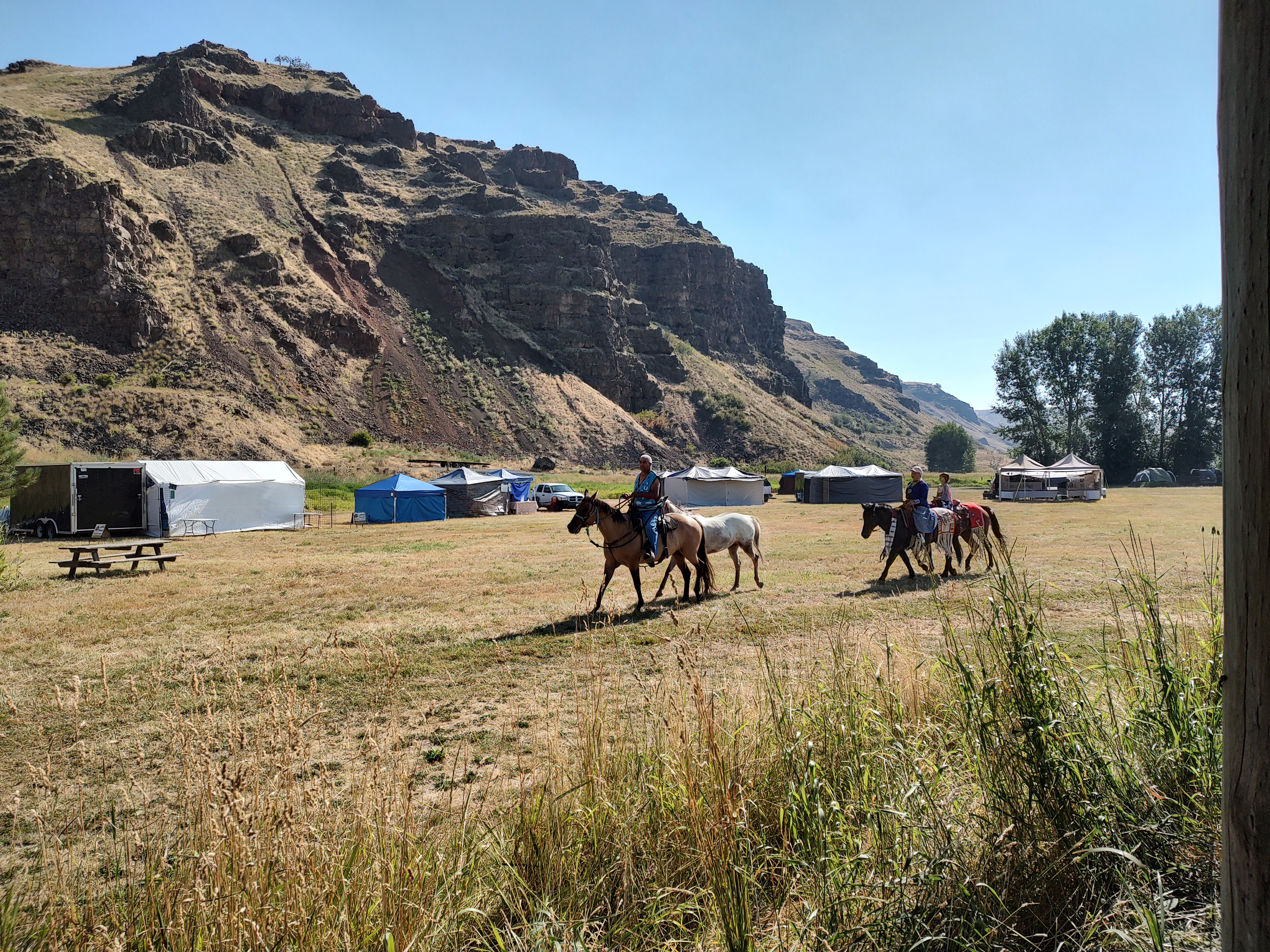
The Tamkaliks Celebration was as moving and colorful as I remembered. I’d attended this powwow a number of years ago, but after taking a class on writing Native American characters and the teacher suggested attending powwows and taking in the ceremonies and talking to people, I decided I needed to get to this one again. I also plan to have my characters attend the powwow in the next Hawke book. The songs, the welcome they give everyone, the friendship dance (we danced), and the reverence they pay to one another was so worthwhile.

Ceremony of the riderless horse. symbolizing the ancestors and those tribal members lost the past year.

The best part of the whole day was a woman that sat down in front of us. She openly explained what was happening to those around her and taught a young couple how to say her dog’s name which meant, Moose. This isn’t how you write the word, only how you say it, “Sauce Luck.” And she taught us how to say Good Morning. Again, not the way you write it but how you say it, which she explained. “Tots MayWe.” After watching her so enthusiastically sharing her culture, I sat down beside her and thanked her for explaining things and asked if she’d be interested in helping me bring more Nez Perce culture to my books. She was excited to help me! She told me about her education and her B.S. in American Indian Studies and Business and her new job that was basically teaching the Nez Perce culture to those who were interested. We exchanged names, emails, and phone numbers. I have sent her an email and she responded right away. I’m excited to have found another connection to help me make my books true to the Nez Perce culture.

And that, my friends, is why I am happy dancing!