Nova: A bright star….by Karen Shughart

I remember sitting on the wet tarmac in the parking lot of PetSmart. It was a cold, rainy day in April a year into the pandemic. Both my husband and I smiled when a man came walking over to us with a tiny Blue Tick beagle on a leash. I opened my arms and she walked into them, and from that moment it was true love.

We hadn’t wanted another dog, our dear Gretchen had gone over the Rainbow Bridge years before, but when we saw Nova on a no-kill shelter website where other friends had recently adopted dogs, we were smitten. The shelter staff was honest. Nova had been severely mistreated as a breeder at a puppy mill, and when she was of no more use to them, they threw her out. By the time the shelter found her, she had tick disease, ear and eye infections, had been shot multiple times with a BB gun (and had the pellets in her body to prove it) and had not been spayed. They didn’t know how long she’d live, given her health challenges. We decided that that we would love and cherish her for as long as we could.

From the beginning she must have sensed the strength of our love, and we provided her with the best medical care possible. After a few months she got a clean bill of health; her eyes sparkled and her coat was shiny . She loved her kibbles, green beans, and pumpkin, and each morning my husband shared a small piece of banana with her while he was eating his.
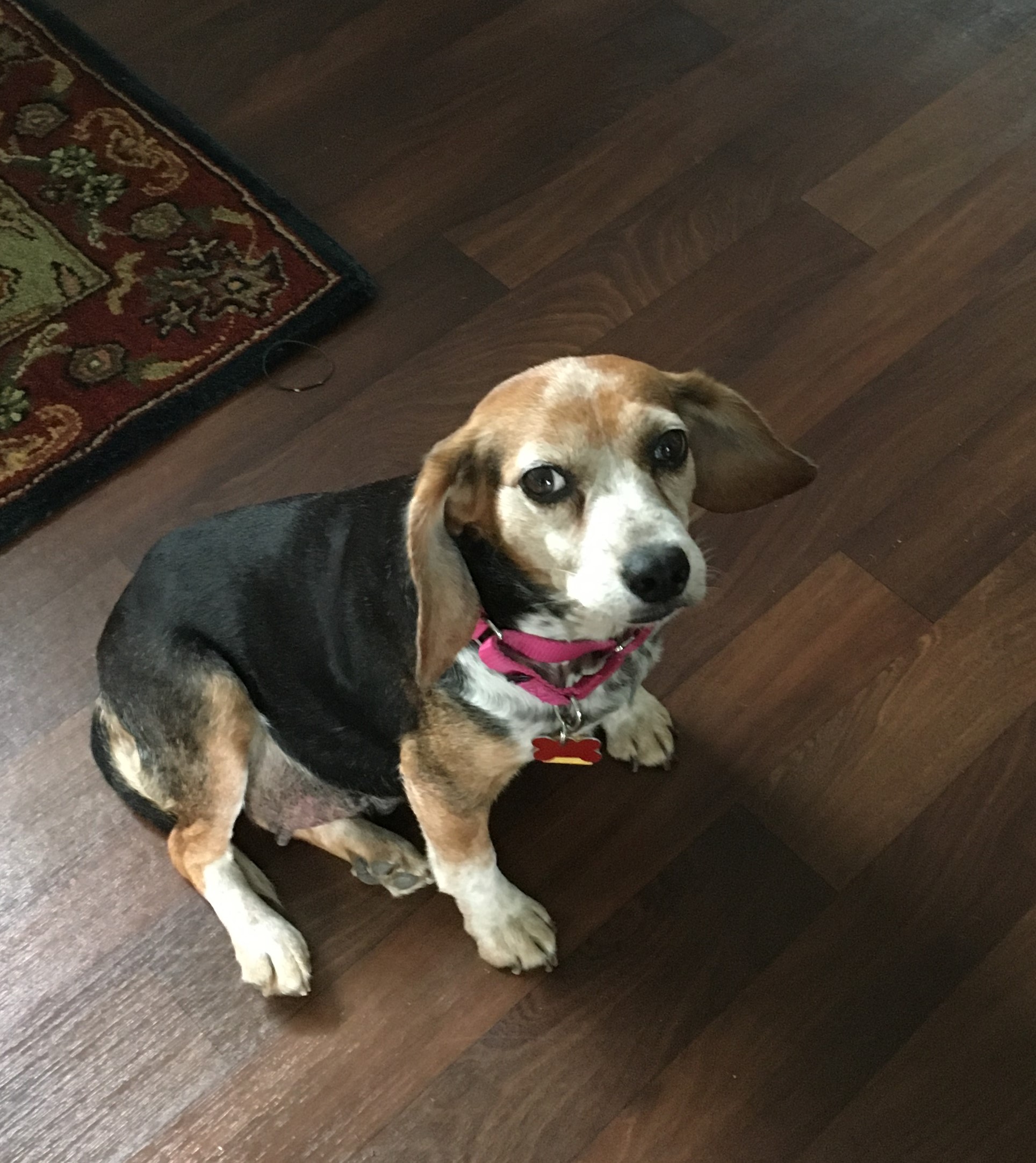
Nova

She learned to enjoy her daily leash walks and to not be afraid of grass, she’d never seen it before. Within weeks she was patrolling our yard in search of adventures, attempting to dig under our fence to see what was on the other side, and if truth be told, to find whatever goodies she could forage, she was a beagle after all. When we went out for an evening without her, she watched cartoons on TV and nibbled at a Kong filled with frozen green beans. She adored food puzzles and could solve them faster than we could say her name.

One of my favorite things was winter cuddling. On a cold, snowy day, we’d crawl onto the loveseat in our living room, fire blazing in the fireplace. I’d read with her head on my chest, both of us under a cozy throw; she’d fall asleep and snore softly, a paw on my shoulder. She loved being warm and when we tucked her in on a chilly night, I covered her with a soft blanket. She’d sigh and would lick my nose.

At first, we thought it was the heat, we’d had a warm summer, but this year in late August something changed.  She resisted her walks; when she went outside, she stayed on the deck instead of exploring the yard. Her high, squeaky, indignant howl(that had been suppressed by a bark collar at the puppy mill) to let us know she wanted to come back inside was replaced with her sitting in front of the door waiting patiently until we let her in. She started pacing at night, she couldn’t find a comfortable place to sleep, even with two of her beds in our room. Then we discovered several large nodules on her neck. We made an appointment with our vet, but before we could see her, Nova started having serious breathing issues.

That same night we drove to an emergency clinic, where a technician was waiting to admit her. It turns out she was riddled with cancer; the nodules were obstructing her breathing. Steroids to minimize the symptoms were one option; chemotherapy, too, but with either choice her life would be extended by only a few weeks or months.  We couldn’t bear to lose her, but neither could we bear for her to suffer. We made a choice.

At 2 a.m. that morning we gave her a snack of pureed chicken, talked and sang to her, petted and kissed her; with Lambchop, her favorite stuffed toy, and her “blankie” helping her on her journey to the Rainbow Bridge. Before she passed, she nuzzled us once more and gently fell asleep.
Guest Blogger ~ Lois Winston

Truth, Lies, and Fiction

My plots have always been influenced by real-life crimes and human-interest stories. However, with Guilty as Framed, my latest Anastasia Pollack Crafting Mystery, the story is more than influenced by an actual crime; it incorporates that crime, one that has fascinated me for decades, into the story. This, of course, posed various challenges, especially since it involved a cold case that was rife with lies, misdirection, and botched investigations.

The crime in question was the 1990 burglary of the Isabella Stewart Gardner Museum in Boston, considered the largest art heist in history. The theft consisted of priceless masterpieces by Rembrandt, Vermeer, Manet, Degas, and others. It involved such disparate characters as a pot-smoking security guard, the Irish mob, and even the Pope. It included the unsolved murders of some of the suspects and as the years passed, the deaths of most of the persons of interest.

There were sworn statements by mob relatives and associates claiming to have seen some of the missing paintings over the years, as well as speculation that the artworks are in Saudi Arabia. And in what must be one of the oddest law enforcement press conferences on record, thirteen years after the robbery, the head of the Boston FBI announced the crime had been solved, although he presented none of the missing artworks nor announced any arrests. He then ended with a plea to the public for help in solving the case.

True crime and cozy mystery are two distinct genres. One is fiction; the other is not. But in weaving a true crime into my fiction, I wanted to hone as closely as possible to the actual events of the case. To do so, I had to take some creative liberties. I decided to focus my story around one specific incident that involved a mob associate and his wife, weaving that aspect of the actual investigation into my plot.

Even though these people have since died, I changed their names and the names of other suspects and persons of interest who I incorporated into my story. (When dealing with members of organized crime, even ones long dead, it’s best to play it safe!) I also created additional characters, thus enabling me to weave a thirty-two-year-old Boston cold case into a series that takes place in present-day New Jersey.

Guilty as Framed is the eleventh book in my Anastasia Pollack Crafting Mystery Series. In each book I’ve challenged myself to create stories unlike my previous ones. No reader wants to read a book where only the names and places (and possibly the murder weapon) differ from other books in the series. This current book was my greatest creative leap to date. I’m hoping readers find the book as enjoyable to read as I did to write.

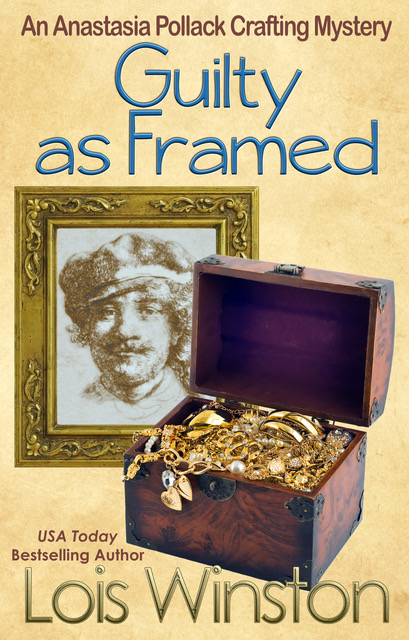
Guilty as Framed

An Anastasia Pollack Crafting Mystery, Book 11

When an elderly man shows up at the home of reluctant amateur sleuth Anastasia Pollack, she’s drawn into the unsolved mystery of the greatest art heist in history.

Boston mob boss Cormac Murphy has recently been released from prison. He doesn’t believe Anastasia’s assertion that the man he’s looking for doesn’t live at her address and attempts to muscle his way into her home. His efforts are thwarted by Anastasia’s fiancé Zack Barnes.

A week later, a stolen SUV containing a dead body appears in Anastasia’s driveway. Anastasia believes Murphy is sending her a message. It’s only the first in a series of alarming incidents, including a mugging, a break-in, another murder, and the discovery of a cache of jewelry and an etching from the largest museum burglary in history.

But will Anastasia solve the mystery behind these shocking events before she falls victim to a couple of desperate thugs who will stop at nothing to get what they want?

Buy Links

Paperback: https://amzn.to/3QLEYU5

Hardcover: https://amzn.to/3Ans5s6

Kindle: https://amzn.to/3tLnT3d

Kobo: https://www.kobo.com/us/en/ebook/guilty-as-framed

Apple Books: https://books.apple.com/us/book/guilty-as-framed/id6442846272

Nook: https://www.barnesandnoble.com/w/guilty-as-framed-lois-winston/1141500980?ean=2940185728703

USA Today and Amazon bestselling and award-winning author Lois Winston writes mystery, romance, romantic suspense, chick lit, women’s fiction, children’s chapter books, and nonfiction under her own name and her Emma Carlyle pen name. Kirkus Reviews dubbed her critically acclaimed Anastasia Pollack Crafting Mystery series, “North Jersey’s more mature answer to Stephanie Plum.” In addition, Lois is a former literary agent and an award-winning craft and needlework designer who often draws much of her source material for both her characters and plots from her experiences in the crafts industry. Learn more about Lois and her books at her website www.loiswinston.com where you can also sign up for her newsletter and follow her on various social media sites.

The Words No Writer Wants to Hear

Not for us. Good luck elsewhere.

Okay, that’s one we’ve all heard, or at least seen, in rejection slips. I no longer take this personally, because I understand that every publisher buys only a certain number of books per year; some slots are taken by their established authors; and my timing is off. (I recognize there’s also a slight possibility that they just don’t like my story or my style.) No problem, I’ll just publish it myself.

“I don’t really read.”

What? I’m never quite sure how to react to that statement. Does it mean that the person I’m talking to has no imagination, or that s/he is just so happy with the status quo of her/his own life that s/he needs nothing more? Sometimes I attempt to sleuth out whether that person at least adores movies so I can be assured that s/he does appreciate stories. But mostly, I just take my glass of wine over to talk to the next person who might know how to read. Personally, real life is just not enough for me.

“How much money do you make from your books?”

Really? Do I ask you how much money you make at your job? When this is followed by questions about lavish book tours or sumptuous dinners with my editor, I know this person has fallen for the movie stereotype of the bestselling-author. A very rare species indeed.

And then, in recent years, here’s one that I’ve heard too often, from the voracious readers that we might expect to be our best friends:

“I couldn’t put that book down! I read it in only two days, so I returned it and didn’t even have to pay for it!”

If you write fast-paced stories (like I always try to), you too may be aware that Amazon allows buyers to return ebooks within seven days of buying them. This is happening to me more and more, and has me wanting to belt out “R-E-S-P-E-C-T! You know what that means to me?” (Okay, I changed that line “just a little bit.”) I typically price my ebooks at $4.99, and these smart shoppers want to keep me from my massive $3.49 royalty? That hurts, readers! How am I supposed to pay my cat food bill? I’ve never even returned ebooks that I detested.

In general, Amazon has been nicer to me than my traditional publishers and certainly nicer than most bookstores, who think nothing of “returning” (or in reality, destroying) print books (that the publishers and authors have to pay for), but allowing returns on ebooks for seven days after purchase? That’s a punishment authors don’t deserve, Amazon. Show us a little R-E-S-P-E-C-T and shorten that up to 24 hours! (I realize anyone can make a mistake and purchase a book twice; God knows I’ve borrowed the same book more than once from my local library.)

Readers, if you really must plow through my ebooks and then return them to Amazon, at least do me the favor of writing me a nice review, okay?

Writers deserve R-E-S-P-E-C-T.

Words are Power by Paty Jager

When I looked up the word “limbo” to make sure I was using it correctly, I found more than one meaning! That is what I love about words and using them to make stories. If you use a word one way it means one thing and the same word can mean something else when used in a different sentence.

The mystery of words has always fascinated me. When my, by one year, older than me brother started reading, I peered over his shoulder, capturing the words and discovering the sounds letters made if they were placed with this letter or a different letter.

Who came up with that? I mean over the centuries the various cultures and people came up with their own set of marks that made sense to them. But how did they distinguish the sounds each mark or letter made? How did they decide which letters together made which sounds?

For my Spotted Pony Casino mystery books, I’ve been incorporating Umatilla language words into the story. It helps to show the culture and bring a little more Indigenous feel to my characters who are Umatilla. I’ve listened to Youtube videos where they speak the language. It sounds so different from the words that are spelled out with unique characters.

The Indigenous languages were spoken long before the Anglo people arrived with their alphabet. How did they, the Indigenous people decide which of the Anglo alphabet worked for their words? I’ll have to ask a Umatilla linguist I know and see if he can help me with this, one of many question that stir around in my head at 2 AM the nights my brain won’t shut down.

Words are so useful and yet can also destroy a relationship, a person, even a country. Knowing the right words to string together is powerful. Or it can be destructive. Words are power!

Book three in the Spotted Pony Casino mysteries will be released in ebook and the following week in print.

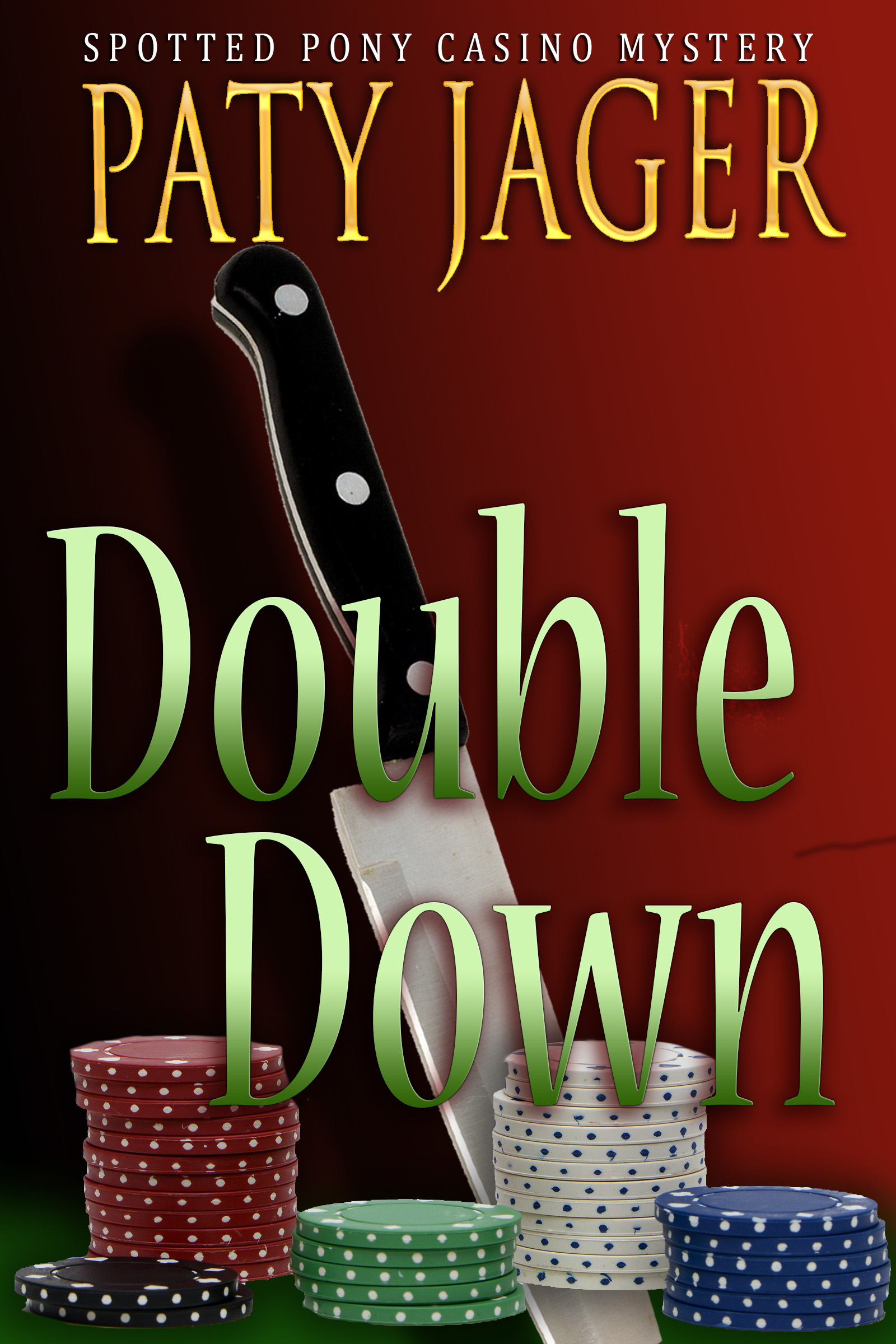
Double Down

A donkey, a three-legged dog, and a war-scarred veteran outwit the killer.

Dela Alvaro is the main suspect in the stabbing death of a man she stopped from beating his wife to death.  The detective she abhors is ready to toss her in jail and not look for any other suspects. When FBI Special Agent Quinn Pierce is called in and Tribal Officer Heath Seaver is forbidden to work the case, Dela decides to find the killer.

Was it the wife, the drug dealer, or the man wanting to take over the victim’s business? Dela and Heath ask questions and work to prove her innocence. If she is found guilty not only will she lose her life but she’ll never be able to solve the secret of her father.  

Universal Buy Link:

https://books2read.com/u/4D6Wa7

Fresh Eyes

I recently sent the manuscript of my latest Jeri Howard novel, The Things We Keep, to a writer friend. This is the third complete draft and it’s ready for a pair of fresh eyes.  At this point I’ve been working on the book for nearly two years, give or take a few hiccups in my life and adventures.

I know what I mean to say. And since this is the 14th book in the series, I am quite familiar with Jeri and her world. Plot, character, setting—I think all the parts fit.

But— Did I say it in a way that will engage readers and draw them into the book? Are there any plot holes lurking between points A and Z? Are the characters behaving the way I’d intended? Or are they escaping from their personas, wandering down byways I didn’t intend and bouncing off unexpected walls?

Will that other writer’s fresh eyes see what I see?

Well, I just got those comments, so I’ll find out.

Speaking of fresh eyes, yeah, I have a pair of actual fresh eyes. Well, fresher. I had cataract surgery in August. Double knee replacement last year, cataract surgery on both eyes this year.

I really hope I’m done with repairing and patching body parts, at least for the time being.

When traveling by air, I have to tell the TSA folks at the airport that I have bionic knees so they can send me through that booth where I have to raise my arms and get scanned. I learned that the hard way when I set off the alarms at Denver International Airport.

As for the eyes, the surgery is recent and I’m still doing the drill with eyedrops, being careful about bending and lifting. I’m told it can take four to six weeks to adjust. So far, so good.

My ophthalmologist tells me my vision is now 20/20 in both eyes. Considering that I’ve worn glasses since I was ten years old, and probably needed them before then, this is a big deal. I still wear glasses for reading and the computer, essential activities for a writer, of course. I can now drive without glasses perched on my nose. And things are really, really bright. Wearing sunglasses all the time when I go outside.

The onset of cataracts was gradual. Optometrists started mentioning it about 15 years ago, saying something like, “You’ve got the start of cataracts but it’s not too bad yet.”

Last year, I went to see the optometrist and told him my distance vision had “gone to hell,” as I put it. It was increasingly difficult to see street signs. Those cataracts that weren’t yet a problem? Now they were. Like having gray clouds in my field of vision. Now I don’t. Did I mention that things are really, really bright?

Fresh eyes. All the better to edit and revise The Things We Keep.