My Love Affair with Animals I Have Yet to See

One day when I was still employed at Microsoft, I was out walking the trails behind my campus, no doubt in an attempt to avoid committing homicide. (I was not cut out for a corporate career.)
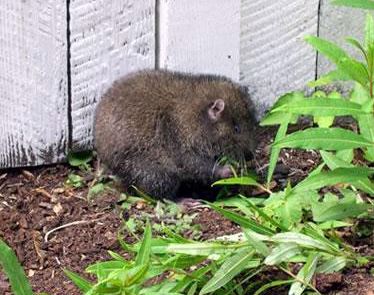
What the heck is this creature?

But homicide is not what this post is about. I was walking along the trails in a wooded area, inventing all sorts of creative murder scenarios in my head, when I almost tripped over a creature I didn’t recognize. It was about the size of an adult rabbit, with small ears and gray-brown fur and a short tail. I was, frankly, amazed. It was an animal that I, a lifelong nature lover, had never seen before! It ignored me as I watched it nibble the vegetation. I poked it with the tip of my shoe. It squeaked, but immediately went back to eating and ignoring me.

A jogger trotted by. I stopped her and asked, “Do you know what sort of animal this is?” She shrugged, replied, “Looks like a giant rat,” and jogged away.

What’s wrong with you?!” I wanted to yell. “How can you not be fascinated by an animal you’ve never seen? Do you spend your whole life on Amazon shopping for athletic shoes?”
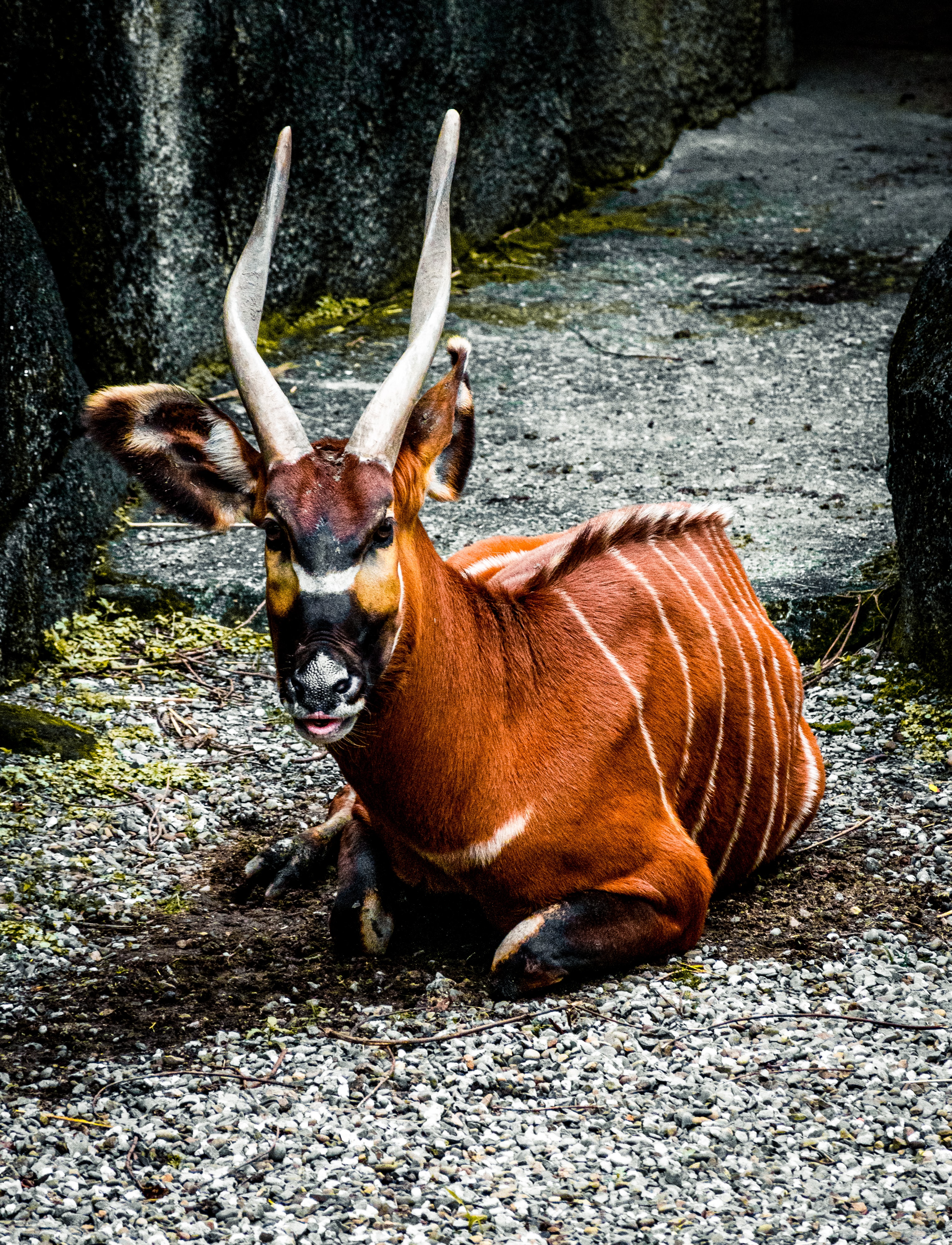
A male bongo

Okay, that’s probably not (completely) fair, and such rudeness only takes place in my imagination (most of the time). Personally, I just don’t understand how any person can walk past a tree completely filled with birds without even noticing, or how someone can not want to see a bongo in real life. (It’s a really cool striped African antelope, and no, I haven’t seen one yet.)

I went back to my office, now on a mission to identify the animal I’d seen. (Definitely a more rewarding activity than the spreadsheet I was supposed to work on.) My mystery creature was a so-called “mountain beaver” (Aplodontia rufa), which is actually not a beaver at all and doesn’t necessarily live in the mountains, which just goes to show you how common names can misdirect you. Aplodontia rufa is a “living fossil,” a very primitive mammal that’s been around for thousands of years.

I’ve since run into another mountain beaver one other time (again, not in the mountains). They really don’t register their surroundings much, but are totally focused on their food. I actually picked up the one I found in my yard and moved it away from the bush I wanted to preserve, but it merely squeaked and then went right back to the same place. I had to put these astounding creatures in a book, so I added one to a scene in my second Sam Westin mystery, Bear Bait.

All my books include at least one type of wildlife. As a hiker and scuba diver, I know some animals well: black bears, mountain goats, bobcats, way too many raccoons and coyotes, squid, octopus, morays, etc., etc. I’m always excited to see any kind of wildlife. (Rattlesnakes? Well, okay, not so much.)
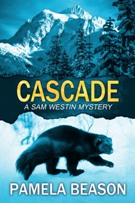
Cascade is finally published!

In my latest Sam Westin novel, Cascade (#6), I was determined to include a wolverine. I’ve never seen a wolverine, but I’m always looking for them in the North Cascades, or at least for signs of them. So is my protagonist, Summer “Sam” Westin. Of course, Cascade is a suspense novel, so I had to add a couple of avalanches, a collapsed ski lodge, and the mystery of why two teens wanted to trap a wolverine.

Maybe, one day, I’ll be lucky enough to spot a wolverine in the backcountry. And I hope I will find that bongo in Africa, too, someday soon. It’s important to me to see all these rare creatures before we humans drive them out of existence. I want to see vaquitas (tiny porpoises), pangolins (scaly anteaters), blue whales (the largest creature on earth), and oh, so many others I’m not even aware of yet.

I hope you don’t just jog by the Earth’s amazing wildlife, uninterested in any creature that is not a pet. People share this planet with so many other incredible beings! I hope you have at least one mind-blowing encounter with an awe-inspiring, non-human creature in your lifetime.
A Quiet Life by Karen Shughart

When my husband and I decided to move from Central Pennsylvania to a small village on the south shore of Lake Ontario it was because we agreed that in retirement, we wanted a quiet life. We knew it was a trade-off. In Pennsylvania we had easy access to cultural events and were within minutes to shopping and restaurants of every sort. But we also had to contend with gridlock traffic on the highways, light and noise pollution, a drive of between 15 and 40 minutes to visit with our friends and the hustle and bustle that goes with living near a state capital.

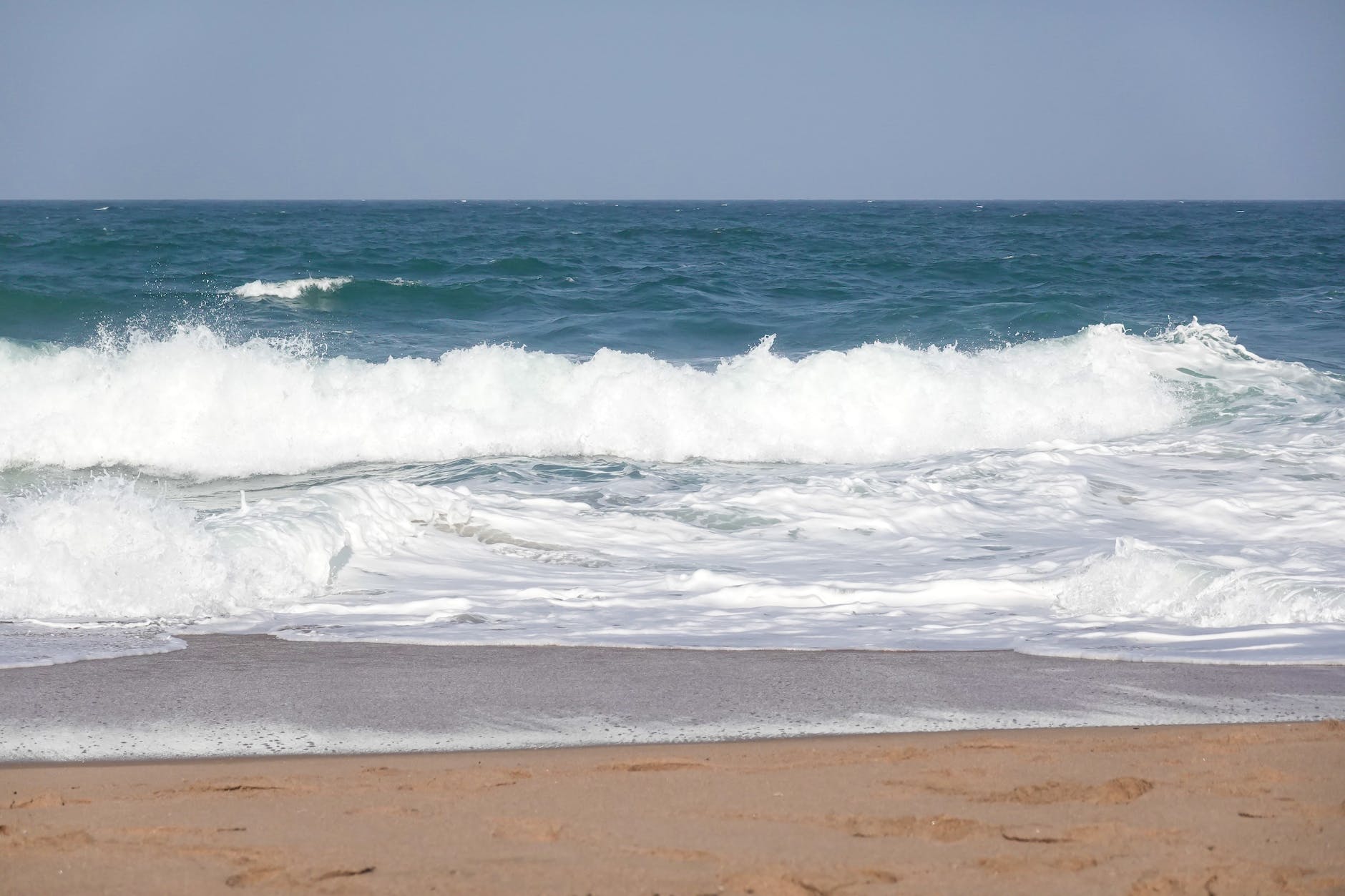
Photo by Magda Ehlers on Pexels.com

Up here, along the lake, we have a traffic jam when there’s a car at each stop sign at “four corners”, the four-way intersection as you enter our village. We travel a distance for symphony, ballet and opera performances, the nearest mall is a 45-minute drive, and supermarkets between 15 and 30 minutes from our home. But we have an abundance of restaurants, farm markets, small grocery and liquor stores, a post office and hairdresser, the beach and even a golf course within walking distance.

There’s music everywhere in the summer, concerts on a bluff overlooking the water, and groups performing at restaurants and parks. Friends live nearby, and the longest drive to visit them is at most five minutes. What some might call noise soothes my soul: waves pounding upon the shore, the morning cacophony of birdsong, the chittering of squirrels, the soft chirping of crickets on a late summer’s eve, and the mournful call of the loons.

The quiet here is also a balm for me as a writer. A short time ago I took part in a discussion with a Cozy writers’ Facebook group where the administrator asked how many of us write with music playing in the background. I discovered that I am in the minority, most of those who responded are stimulated and feel more creative with background music of every sort. Some were surprised when I said that I get distracted, it’s hard for me to concentrate when there’s too much “chatter”.

It was an interesting discussion, and as I thought more about it, I realized how creative juices are stirred in so many ways. Writing for me is meditative, I can write for hours without paying attention to the time, and sometimes without taking a break. My husband teases that he knows not to try and discuss anything important with me when I’m writing. If he tells me he’s leaving to play golf or run errands, I’ll nod and later not remember a word he’s said and wonder where he is.

As I thought more about it, I realized that as I’ve aged I choose not to multitask as much as I used to.  I can cook and listen to rock and roll, show tunes or jazz at the same time, and do word puzzles or Sudoku while watching TV, but for some reason, writing, reading, or listening to certain types of of music are activities I want to savor individually. There’s immense pleasure and something to be said about immersing oneself in quiet pursuits.

Guest Blogger ~ Joyce Woollcott

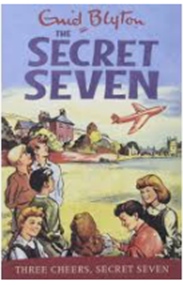
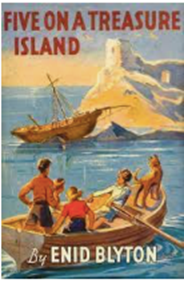
I’ve always been a reader, always. Even as a child when I look back, I remember particularly enjoying adventure and mystery. I grew up just outside Belfast and in those days, I couldn’t lose myself in social media so I lost myself in books. The Famous Five, The Secret Seven, anything I could get my hands on really. I think you can see the beginning of a trend.

I read the classics too of course, for school and pleasure, but I always enjoyed a good murder, just like my mum.

After graduating I came to Canada, got a job, married, raised a daughter and read. Michael Connelly, Lou Berney, Denise Mina, Ann Cleeves, P.D. James, and the like. I wrote while I still worked, as I suppose a lot of aspiring writers do, but only in a half-hearted way, feeling out of depth. When I took early retirement and could finally take the time, I enrolled in some night classes and learned how to format, what typeface and size to use. It was from those classes that I started to read my favourite books again and actually learn from them.

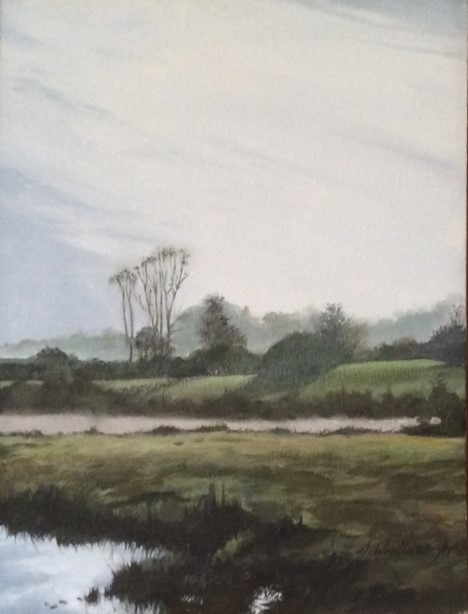
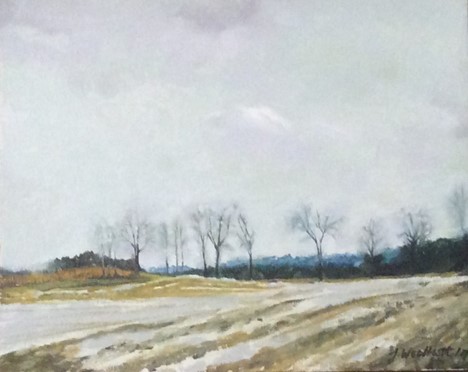
I started to paint too, somehow the idea of just writing seemed so foreign to me. Could a person write? I used to paint when I was younger and I thought I could fill my days doing both, and if the writing didn’t work out, well I could always fill my days painting …

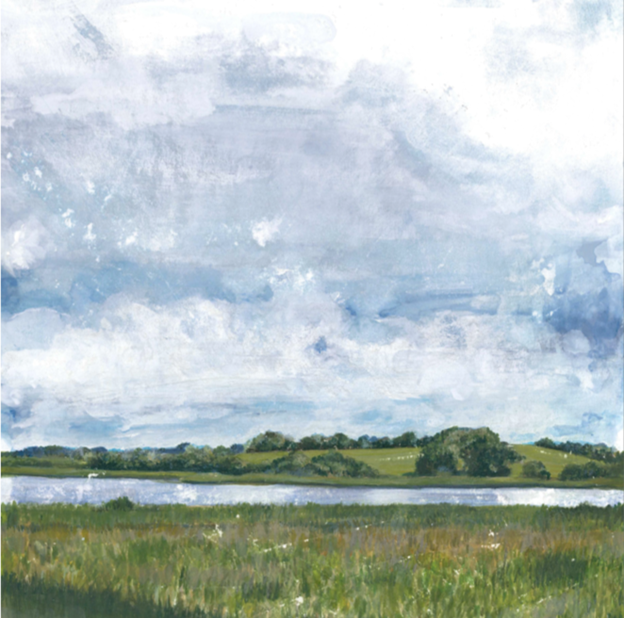
Mist on River.
Early Fall
Loch Erne, N. Ireland.

I signed on for a summer workshop at The Humber School for Writers in Toronto and the next year was accepted into a year-long, on-line, post-grad class there with Canadian novelist Robert Rotenburg. This was the beginning of a journey to complete my first ever manuscript. Abducted.

I passed the year with a Letter of Distinction. Encouraged, I entered Abducted in the Arthur Ellis Awards Unpublished contest. I was long-listed in December 2018.

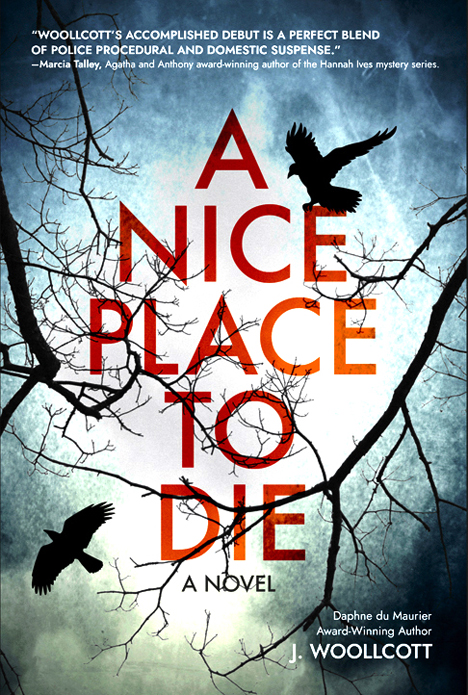
Spurred on by this, in February 2019 I entered the Daphne du Maurier Awards with my second novel, A Nice Place to Die. In May, 2019 I got a call from New York, telling me I was a finalist. On 24th July I watched the Awards via video link. I won the Daphne! This is for their largest group, Unpublished Mainstream Mystery/Suspense.

January 2020, I received notice that A Nice Place to Die made the long-list of the Arthur Ellis Awards, Unpublished, and finally in 2021, I made the short-list as a finalist in the Crime Writers of Canada Awards of Excellence.

As you can tell from this, my road to publication has been long. I was full of doubt and sought a backup plan, but in the end, writing took over and I was offered and signed off on a two-book contract in 2021. That contract is for A Nice Place to Die and the second book in the series Blood Relations. It’s been a lot of work but it’s been worth it and I do believe this is a process most writers have to go through. Yes of course there are debut novelists who hit the ground running, straight out of school or university or college, but I think this is the exception not the rule. We need to read, we need to write and we need to learn. This takes time and determination. Take courses, ask for help, seek out critique partners and readers. And listen to the criticism, because it will come. And when all that is done, submit your work. And good luck!

A Nice Place To Die

The body of a young woman is found by a river outside Belfast and Detective Sergeant Ryan McBride makes a heart-wrenching discovery at the scene, a discovery he chooses to hide even though it could cost him the investigation – and his career.

The victim was a loner but well-liked. Why would someone want to harm her? And is her murder connected to a rapist who’s stalking the local pubs? As Ryan untangles a web of deception and lies, his suspects die one by one, leading him to a dangerous family secret and a murderer who will stop at nothing to keep it.

And still he harbors his secret …

Buy Links:

US: https://amzn.to/3CGIzi0

Can: https://amzn.to/3TroD8K

UK: https://amzn.to/3CU4diN

B&N: https://www.barnesandnoble.com/w/a-nice-place-to-die-j-woollcott/1142154246?ean=9781685121662

J. Woollcott is a Canadian writer born in Northern Ireland. She is a graduate of the Humber School for Writers and BCAD, University of Ulster. Her first mystery, Abducted, was long-listed in the Canadian Arthur Ellis Awards in 2019. Her second book, A Nice Place to Die, won the RWA Unpublished Mystery/Suspense Daphne du Maurier Award in 2019 in New York. A Nice Place to Die was also long-listed in the Arthur Ellis Awards for 2020 and short-listed in the Crime Writers of Canada Awards of Excellence in 2021. She is working on part two of the Ryan McBride Belfast Murder Series, Blood Relations, due out in August 2023.

She is a member of Crime Writers of Canada, Sisters in Crime, International Thriller Writers,  and the Suncoast Writers Guild.

Website: https://www.jwoollcott.com

Twitter: @JoyceWoollcott

What To Write

While I always have a lot of ideas bouncing around in my head, when I finished the latest Spotted Pony Casino book, I wasn’t sure which idea I should write next.

Should I just pick one of the titles? I have a list of gambling terms that I use for the titles in the Spotted Pony Casino series. Or should I use one of my ideas and figure out which term/title would work for it? I pondered this as I began the next Hawke book. I like to be thinking about several books ahead while I write the current one. It’s how I can finish up one and dive right into the next one, because I’ve been thinking about it in the back of my mind.

I had a little help from my subconcious.

One night as I was taking a shower a scene popped into my head and I knew which idea I’d be using. I got out of the shower and wrote the scene down. Now that I know the direction the next story is heading, I can pick one of the ten titles I have to go with it, and I can begin plotting the suspects and motives.

When I finish writing the current Hawke book, Bear Stalker.

Because I write two series, hopping from one to the next I have also been wondering which of my Hawke ideas would be the next book. There are times I can have two to three books in a series lined out in my head and on paper, but I’m working on book 10 in the Gabriel Hawke series and while I have three more ideas written down, I wasn’t sure which direction I wanted to go.

The other night, just as I was about to drift off the opening scene for the next Hawke book trickled through my mind. I immediately grabbed the notebook by the bed, went into the bathroom and closed the door to not wake hubby and the puppy, and started writing it down.

As I wrote the opening scene, I realized the story would play out differently than I had originally planned for this scenario. I love when my brain figures out a better story line than what I’d first thought.

This new idea should make the readers who like when Hawke tracks in the mountains happy and will keep them wondering how many bodies Hawke will come across. 😉

When ideas come to me like this- out of the blue when I’m not trying to figure something out-I call them gifts. Because they are always better than what I had come up with while forcing myself to figure out a story line.

The mind is a wonderful thing. I hope we don’t lose our originality and creativity to machines.

Real Recipes from a Fictional PI by Heather Haven

When you treat your characters as living, breathing entities, things can happen. This includes those near and dear thinking you’re peculiar. For instance, when writing the third book of the Alvarez Family Murder Mysteries, Death Runs in the Family, the two cats from the series, Baba and Tugger, were catnapped and in the back of the villain’s station wagon speeding from Palo Alto to Las Vegas. For reasons I can’t remember, I had to stop writing the story at that point. For three whole days I was uncomfortable about it. I kept telling myself, it’s just a story, right? They’re not real cats trapped in carriers in the back of a station wagon without food or water for days on end, right? Wrong.

On the third night, even though I knew all the above intellectually, I woke up at two am and leapt out of bed, determined to write the fur balls into safety and a bowl of kibble. At nine am I staggered back to bed. But now I could sleep. The cats were fed, cuddled, and loved by Lee Alvarez, the protagonist of the series. On another note, even though my husband is not a writer, he knows me. That night he rolled over and went back to sleep, totally understanding my getting up and needing to save my fictional cats then and there. At least, that’s what he said. And still says. He shoulda been a diplomat.

Any writer will tell you giving fictional characters the same traits as living people is a good idea. Keeps things real, don-cha-know. But like anything else, it can depend on how far you go with it. I tread a fine line. Let’s get back to my protagonist, Lee Alvarez. I’m an eater. So she’s an eater. Of course, she’s a svelte size eight, because this is fiction. I’m a svelte Omar the Tentmaker. But I take great joy in her being a foodie. Which runs in the family. Her uncle, Tio, another character in the series, is a retired chef. His recipes just add to the fun. Sometimes I feel the need for Lee to share one of these recipes. Like now:

Lee here. Even though my idea of cooking dinner is to stop at the nearest deli for a roast beef sandwich, as the central character of the humorous Alvarez Family Murder Mystery Series, I do get to eat a lot of epicurean meals. That’s because my Tio was an executive chef at a well-known restaurant here in the Bay Area. During his career, his recipes were often written up in gourmet food magazines. They’d throw in a few pics of him, too, because Tio is one classy-looking guy. I have articles and pictures in a scrapbook I started in my early teens. That was before my PI days. I don’t have time to make scrapbooks anymore – I don’t have time to do squat anymore – except I do seem to find time to sit down at the dinner table and scarf down one of his culinary masterpieces!

Tío may be retired but his skills aren’t. He still likes to create great meals, but now just for family and friends. While doing so, he tends to make a dish again and again until it reaches his idea of perfection. Meanwhile, lucky me gets to gobble up every version, as he strives for the ultimate. When Tio was working on his Flan de Naranja, I gained six of the happiest pounds of my life. Fortunately, I spend a lot of time chasing bad guys over rooftops, so I can lose the weight as fast as I gain it.

No lie, his flan has gone down in song and legend. If I could sing, I’d demonstrate. Tio even picks the oranges himself right off our backyard tree. I thought it would be nice to share his recipe with you. If any of you make it, though, I sure hope you will invite me over for a helping. It’s a real winner!

Tio’s Flan de Naranja

Serves 4-6:

Preheat oven to 350 degrees F (175 degrees C).

Ingredients:

5 egg yolks

1 cup white sugar

3 cups heavy cream

1 cup half-and-half cream

1 vanilla bean, split and scraped

1 orange peel

1/2 fluid ounce orange liqueur

2 ounces candied orange peel, grated

Preparation:

In a medium bowl, beat egg yolks. Beat in sugar until smooth. Set aside.  In a large saucepan over medium heat, combine cream, half-and-half, the vanilla bean and its scrapings, and the peel of one orange. Heat until bubbles form at edges of liquid, reduce heat to low and simmer 15 minutes. Remove orange peel. Beat hot cream into egg mixture, a little at a time, until all is incorporated. Stir in orange liqueur. Pour into 4 to 6 individual custard cups.

Line a roasting pan with a damp kitchen towel. Place cups on towel, inside roasting pan, and place roasting pan on oven rack. Fill roasting pan with boiling water to reach halfway up the sides of the cups.

Bake in preheated oven 45 to 60 minutes, until set. Let cool completely.  Sprinkle candied orange peel on top of each cup before serving. Olé!