How to Survive Christmas

Some of us (actually, quite a few of us) detest the holidays. If you are single and childless, the constant commercial emphasis on family can make it seem like there’s a flashing neon LOSER sign pointing right at you, even if you cherish your purposely chosen independent existence. And if you’re not Christian, well, that’s another aspect of Christmas that you can’t appreciate. Throw in the sappy music that we’ve all heard thousands of times; it usually starts playing in stores just after Halloween. And then, there’s the ever-present reminder to buy, buy, buy; that also usually starts in stores around Halloween. All the stoppage of normal activities and the travel challenges due to the predictable bad weather add to the stress. What’s an intentionally single, childless, non-materialistic, non-religious person like me to do?

First of all, I go for a walk. There’s a foot of snow on the ground at my house right now, and it’s 13 degrees out, but I will nevertheless bundle up and go for a walk every day. Fortunately, I live close to miles of green belts and trails, and nature always soothes my jangled nerves and jumpy brain. The bare tree branches reveal bird and squirrel nests, and I like to watch the animals that are flitting about. Yesterday I saw a black squirrel leaping from one snowy tree to another. A flock of noisy varied thrushes was excitedly pecking away at apples still clinging to a tree; I’ve never witnessed that before.

Photo by James Wheeler on Pexels.com

I try to do things with friends. This doesn’t always work out so well, because a lot of them have families and are happily sucked into that holiday vortex and disappear for days, but there’s always someone who is eager to get out. I hope that families who get together actually do something other than giving gifts. I don’t remember a single Christmas from childhood for the gifts, but I do remember a few with special activities, like playing games or building snow people together.

I might give small gifts to children or the few people I know who actually need something, but I mostly resist the urge to buy more stuff that my relatives and friends don’t need. Instead, I give a nice card that includes a promise of time to help friends and family with something—an evening or day of childcare for a young couple, a miniature golf outing or beach day for kids, a helping hand with household chores or remodeling projects, a chauffeured ride for an elderly relative to visit a beloved friend in another town. Charities receive most of my year-end funds.

And I remind myself that this, too, will pass. After all, Christmas comes and goes every year. New Year’s is more my kind of holiday; a happy, hopeful start to the next year. Whatever you’re doing this holiday season, I hope you’re doing it with joy. Now, I’ve got to go out for a walk in the snow and enjoy the birds.
All in the lyrics

Christmas songs are blaring in the great room, and baby, it’s cold outside. Now and again, the lyrics to a song are so evocative they stop me in my tracks. Why? The precision, economy of words, and an image so clear that I would sell my right ear to create the same power in my writing.

Songwriters are lucky, they have a score and a singer to sell their lyrics. As writers, we have only our words, no chords, no major shifts, just the rattle of a turned page or a finger swipe. We rely on careful construction of characters, the description of a setting that is sufficient to create an image but not so detailed as to bore, and our ability to put it all together in a way that readers arrive where we want them to through the warp and weft of the narrative.

Lyrics are no different, they are images drawn so well and so clearly that they travel with us throughout our lives. Sometimes changing us, creating a longing to be or see or do. The lean, poetic cleanliness of a great lyric is something we might strive for daily.

To make my point, I picked stanzas from four songs. The first song was written long before I was a twinkle. But it is one I have known all my life and each time I hear it, I feel longing, hope, and loss. I dare you not to.

“I’ll find you in the morning sun, and when the night is new. I’ll be looking at the moon, but I’ll be seeing you.”

‘I’ll be Seeing You’ written in 1938 saw the country through WWII and onward, into infinity. NASA sent Billie Holiday‘s 1944 recording as its final transmission to the Opportunity rover when its mission ended on Mars in February 2019.  How fitting. Don’t you wish you packed a wallop like that with every line in a book?

The second song creates an indelible picture of freedom and the ties that bind us.

“Fly the ocean in a silver plane. See the jungle when it’s wet with rain. Just remember till you’re home again, you belong to me.”

Of course, it helps if Jo Stafford is singing it. If you’ve never heard her classic version of ‘You Belong to Me’ run to Pandora or U-Tube. But with or without Ms. Stafford, the imagery and emotion of the lyrics are undeniable.

Having grown up in Michigan with Motown 126 miles away, Smokey Robinson’s poetry fueled much of my music. The lyrics of my third selection never fail to get a grin and a singalong from me. Why?

“I’m stickin’ to my guy like a stamp to a letter, like the birds of a feather, we stick together. I’m telling you from the start, I can’t be torn apart from my guy.”

Because Mr. Robinson created a fulsome female protagonist with a clear agenda in only thirty-four words.

And number four brings us back to Christmas.

Christmas songs ring all the old familiar bells, a few lines, and you’re shivering in the back of your parent’s car, filled with excitement, knowing you’ll never sleep. Yet I admit that when it comes to indelible pictures, well – ‘Santa Baby.’

“Come and trim my Christmas tree with some decorations bought at Tiffany’s. I really do believe in you, let’s see if you believe in me.”

Well, do you? Money-grubbing little … gold digger.

I hope I’ve made my case that as writers with 70,000 words or more at our disposal, we might take a lesson from our favorite songs and etch rather than paint. You may disagree with the lyrics I picked, but really, how could you?

I’ll Be Seeing You by Sammy Fain / Irving Kahal

You Belong to Me by Chilton Price / Pee Wee King / Redd Stewart

My Guy by Ronald White / Smokey Robinson

Santa Baby by Philip Springer / Joan Javits / Anthony Fred Springer

Fiction or Fact: That Is the Question by Karen Shughart

If you’ve read any of the books in my Edmund DeCleryk Cozy mystery series, by now you will have noticed that with each murder there’s a historical back story that gives clues as to why the crime occurred.

When I conceived the series I decided to write about what I knew, which meant describing the beauty where we live up here on the southern shore of Lake Ontario: the beaches; fruit orchards; quaint homes and cottages, and the stunning weather that changes with each season. There’s also our close knit and friendly community and a rich tradition of history.

Across the lake lies Canada and in the middle of it, where the depths can reach 800 feet, shipwrecks occurred starting long before the Revolutionary War. The British invaded our village and burned most of it down during the War of 1812, and an active and committed abolitionist movement and the Underground Railroad helped to change the course of history. In the 1920s, rumrunners from Main Duck Island in Prince Edward, Ontario piloted across the lake to Chimney Bluffs-drumlins created by icebergs with a broad beach below-to supply the speakeasies here with booze. During World War II, several prisoner-of-war camps housed German soldiers, one of which has been converted to a state park near our home.

Photo by ArtHouse Studio on Pexels.com

I’ve been asked numerous times, at books talks and signings, about the inclusion of history into my books and the incidents are real. While the historical events are based on actual occurrences, I remind my readers that I write fiction, so history is merely a way to enhance the plot. Mostly, the characters are fictional and the details surrounding the events are figments of my imagination, although I do occasionally slip a real character into the mix.

In book one, King George, III had a minor role; in book two, I name-drop Morgan Lewis, the fourth governor of New York and quartermaster general during the War of 1812, whose father was a signer of the Declaration of Independence. In Murder at Freedom Hill, I mention Abe Lincoln  once or twice along with Frederick Douglass and Susan B. Anthony, but only to provide context to the back story.

I just started writing book four in the series, Murder at Chimney Bluffs. It’s early days, so at this point I have no idea who my historical celebrity will be, but whoever it is will have either supported Prohibition or opposed it, or be one of those mysterious crime bosses who organized the trips back and forth across the lake. I’ll figure it out as I move forward.

What I tell my readers is that what I love about writing fiction is that I can pretty much do anything I want with the plot, name dropping and historical events notwithstanding.  I wouldn’t have it any other way.

Gifts of the Season

“Christmas won’t be Christmas without any presents.” That’s what Jo March says in the opening paragraph of Louisa May Alcott’s Little Women.

Years ago, when we’d ask Dad what he wanted for Christmas, he’d always say, “A happy family.” It became the gentle, wry family joke. One year, while prowling around a secondhand bookstore, my brother found a book called The Happy Family. He bought it, wrapped it up and put it under the tree. Dad loved it. Now that Dad is gone, I’d give the world to hear him say it again. But I have the gift of that memory, and many others.

I start thinking about presents even before I do my after-Thanksgiving ritual of decorating my house and tree for Christmas. I am of an age where I don’t need more stuff. In fact, I’m really trying to get rid of stuff. So are most of the people on my list.

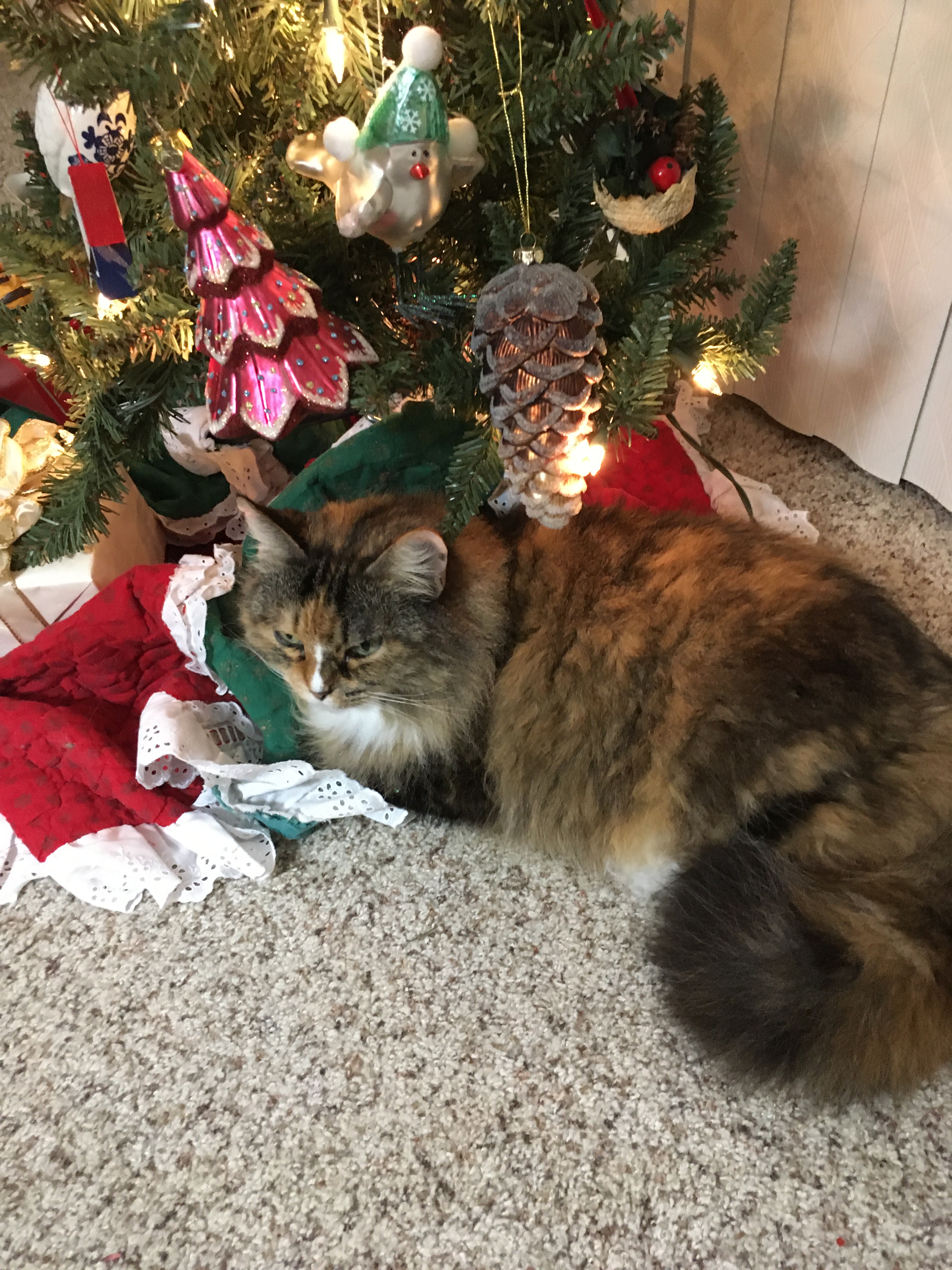
But still. It’s nice to have something under the tree (besides Lottie, AKA Mama Kitty). Chocolate, for example. Make mine dark.

If I’m really ambitious and I start early enough, I’ll sew. This is not one of those years.

When giving gifts, I’d like it to be something the recipient will use. Or eat. A pound of coffee. One doesn’t actually eat coffee, though I know java junkies who would happily chew the grounds to get a caffeine fix. That said, French roast is definitely a plus during the holidays.

Back to gifts that can be consumed. I have a terrific recipe for cranberry chutney, and I’ve been known to make lemon curd and apple butter. Baking is good. My holiday tradition is pumpkin bread, with fresh pumpkin puree made from my Halloween pumpkins. I’ve also been known to make biscotti, scones and big chewy ginger cookies. In fact, this year I have a special request for those cookies.

What about me, as the gift recipient? As noted above, I don’t need more stuff. I’m getting rid of stuff. But there are gifts I’m grateful for. A character in the movie Miracle on 34th Street calls them “those lovely intangibles,” and further says that they are the only things that matter.

Start with the gift of good health. That’s a big one. The past three years have been an obstacle course. Thank goodness for Covid vaccines and boosters. And flu shots. If you don’t think influenza is a big deal, I refer you to John Barry’s stunning and comprehensive look at the flu epidemic of 1918-1919. It’s called The Great Influenza: The Story of the Deadliest Plague in History. The book should be on everyone’s reading list.

I made it through 2020 wearing masks, limiting contact with people and sanitizing my hands like crazy. In 2021 had knee replacements. Both knees at once. That was an adventure. The medical adventure for 2022 was cataract surgery on both eyes. For 2023 and beyond, the best gift of all would be not to have any repair jobs on any more body parts. And it would be really great if we could finally get out of this Covid labyrinth.

And the gift of good health for other people. I have family and friends who were diagnosed with various types of cancer and/or had surgeries, who have spent the past year-plus dealing with the treatment of same and the aftermaths of that treatment. Then there’s my elderly mother, who had a long recovery from a fall.

The gift of warm and dry, with a roof over my head. As I write this in early December, it’s unseasonably cold for the San Francisco Bay Area. I’m back in my office running an electric space heater to keep warm. At least I am inside and comfortable, even if my fingers sometimes stiffen up.

And importantly, for a writer, I am grateful for the gift of time to write, time to go off into my own little fictional world and create plots, characters and settings. I spent so many years working at full-time jobs and shoehorning the writing into early mornings and weekends that it is a gift to be able to sit down at my computer and spend the whole day at my avocation.

And the time to enjoy the season, queuing up my Christmas movies and listening to my Christmas CDs.

How about you? What are the gifts of the season for you and yours?

The Art of the Literary Device by Heather Haven

Google states a “Literary Device is a writing technique that writers use to express ideas, convey meaning, and highlight important themes in a piece of text. A metaphor, for instance, is a famous example of a literary device. These devices serve a wide range of purposes in literature.”

And that’s probably as good of an explanation of a literary device as any other. It changes hues from one genre to another. Probably not that much, but enough to separate the people who know what they’re doing from the attempters. I was an attempter in the field of romance. Once. At about chapter 8, I was bored out of my mind. Where’d the dead body go, I asked? So, I added one. Instantly, there was a lot more zip to everything, including my step. But it was no longer a romance story. Let’s face it, if there’s no dead body in my novel, I’m not interested in writing it.

According to song and legend, Edgar Allen Poe was one of the first to qualify as a mystery writer. One of his short stories, “The Murders in the Rue Morgue” from 1841, paved the way for a lot of us. Arguably, there are 10 device steps that are needed in order to write a good mystery: a hook, atmosphere, a crime, a sleuth, a villain, narrative momentum, a trail of clues, foreshadowing, red herrings, and, of course, a satisfying ending. It sounds a lot easier to do than it is.

But other genres have latched on to their own devices. I don’t always know what they are or recognize them when they’re hurled out at me. But when I do catch on, I try to learn from them, even if they aren’t applicable to what I do.

Recently we went to see the national tour of Ain’t Too Proud the Life and Times of the Temptations, the Broadway musical. The musical is based on the book “Temptations” by the group’s founder, Otis Williams. For those of you arriving from another planet or born after the year 2010, they were the biggest singing group to come out of Motown, rivals to Diana Ross and the Supremes. And if you’re going to ask who Diana Ross and the Supremes are, please don’t do it in my presence. Or allow me to get a strong scotch first.

Ain’t Too Proud was one of the best productions of any show I’ve seen in a long, long time. Each performer was of star quality, from the leads to people playing multiple roles. The acting, singing, dancing, costumes, lighting, and sets went to a level of perfection seldom achieved in live theater. I have a background in theater and worked backstage on Broadway for 10 years, so naturally, I think I know what I’m talking about. It doesn’t mean I do, but try telling me that.

Anyway, the writer of the musical’s book, Dominique Morrisseau, is first-class. The storyline was clear, well-paced, entertaining, emotionally moving, and all the stuff a really fine book to a musical ought to be but seldom is. And the writer applied a device using verb tenses that astonished me. I will try to explain it. There would be a scene where one character would initially say they were going to do a specific thing. Then after a small amount of dialog, that same character would repeat the same line, but state they were doing that specific thing.  Further on in the scene, the same character would use the same sentence, but this time announcing the long-term result or outcome of what they’d done. So we would go future, present, past, in one fell swoop. Whether it was a few months or years, the plot advanced solely due to these tense changes. I did note that the same words had to be used each time in the sentence and said by the same character for clarity, but this device worked.

It would be great to know if any of you have either seen this device used before or have used it yourself. It was a first for me. And I loved learning about it! But whatever you do, try going to see Ain’t Too Proud. It will make you and your heart sing.