Guest Blogger ~ Lorie Lewis Ham

The Birth of My Main Character Roxi Carlucci

By Lorie Lewis Ham

The main character in my latest book, One of You, the second book in my Tower District Mystery series, had a bit of a journey before discovering where she belonged. Here is her story.

In the early 2000s, I wrote a mystery series that featured a gospel-singing amateur sleuth named Alexandra Walters. She lived in a fictional version of my hometown of Reedley called Donlyn. While writing the final book in the series, The Final Note, which came out in 2010, I started thinking about what I wanted to do next.

There is a character named Stephen Carlucci who has been with me from the very beginning. He has never had a series of his own, but he has been present in every book I’ve written. So when my last series ended I set him up to move on as well since Alex ended up with someone else and not him. The original plan was for him to move to the coast of California near Santa Cruz where his cousin Roxi Carlucci lived. First, though, I had to create Roxi.

I had decided to write a new series featuring Roxi set in a fictional town on the coast of California called Ayr. She ran a pocket pet animal rescue (hamsters, guinea pigs, pet rats) and wrote children’s books. When I first came up with this idea there weren’t any animal rescue cozies that I was aware of and it was a world I knew well having run an animal rescue for several years. It seemed like a perfect idea. I introduced Roxi in The Final Note, even including some chapters from her point of view. Done with the intention of immediately starting her series after that.

Alex had been too much like me, so I wanted Roxi to be different. I started by making her tall—I am not quite five feet. She is also braver than I am, and far more outspoken. By making her Stephen’s cousin, she automatically had a darker side as they come from a Mafia family, even though they both chose different paths. Roxi also knows how to use a sword—something I have since started learning myself.

When I finally tried to sit down and write the first book with Roxi, it just wasn’t working. I kept trying, but suddenly now the cozy mystery world was being flooded with animal rescue mysteries so it also no longer felt unique. Perhaps I wasn’t able to write it because it just wasn’t the right series for Roxi. The world I created for her just didn’t work. But since I’d already created Roxi, I didn’t want to let her go. So what was I to do with her?

While I was pondering that question, I was also creating my online magazine called Kings River Life (KRL), and that began taking up a lot of my time. But it also ended up leading to the answer to my dilemma with Roxi. While half of KRL covers mystery, the other half is all local (I live in the San Joaquin Valley of California near Fresno). We cover local arts and entertainment, food, and animal rescue, among other things. One day while in Fresno’s arts and entertainment district to review a play it dawned on me that this area would make a great setting for a mystery series! This district is called The Tower District! Hence the Tower District Mysteries came to be.

Roxi however, lived on the coast of California so I had to figure out how to get her to the Tower District. I decided that I would have her lose her book contract, and have her roommate get married and move out, leaving Roxi without a way to pay her mortgage. Mean I know, but sometimes it just has to be done.

I also decided that after being dumped by Alex, her cousin Stephen moved to the Tower District and he just “happened” to have a spare room that Roxi could stay in while figuring out the rest of her life. So Roxi closed her rescue, packed up her life, and moved to the Tower District. She may not have been thrilled at first about leaving behind a lovely coastal town for the summer heat of Fresno, but by book 2, One of You, she is settling in nicely and discovering that living in the Tower District isn’t so bad. She’s made friends, started an entertainment podcast, and she is even helping to put on a big mystery event called Mysteryfest during Halloween at the local bookstore.

As to the rest of how she came to be, well oddly enough Roxi shares a lot of my interests, even if she isn’t as much like me as Alex was. Just a different assortment of them than Alex did—with a few exceptions like Frank Sinatra—come on she’s Italian!

I hope you will want to get to know Roxi in the first two books in this series, One of Us and One or You, and that you will come to like her as much as I do.

Lorie has a Giveaway of an ebook copy of One of You or One of Us winner’s choice. Just leave a comment and she’ll pick a winner
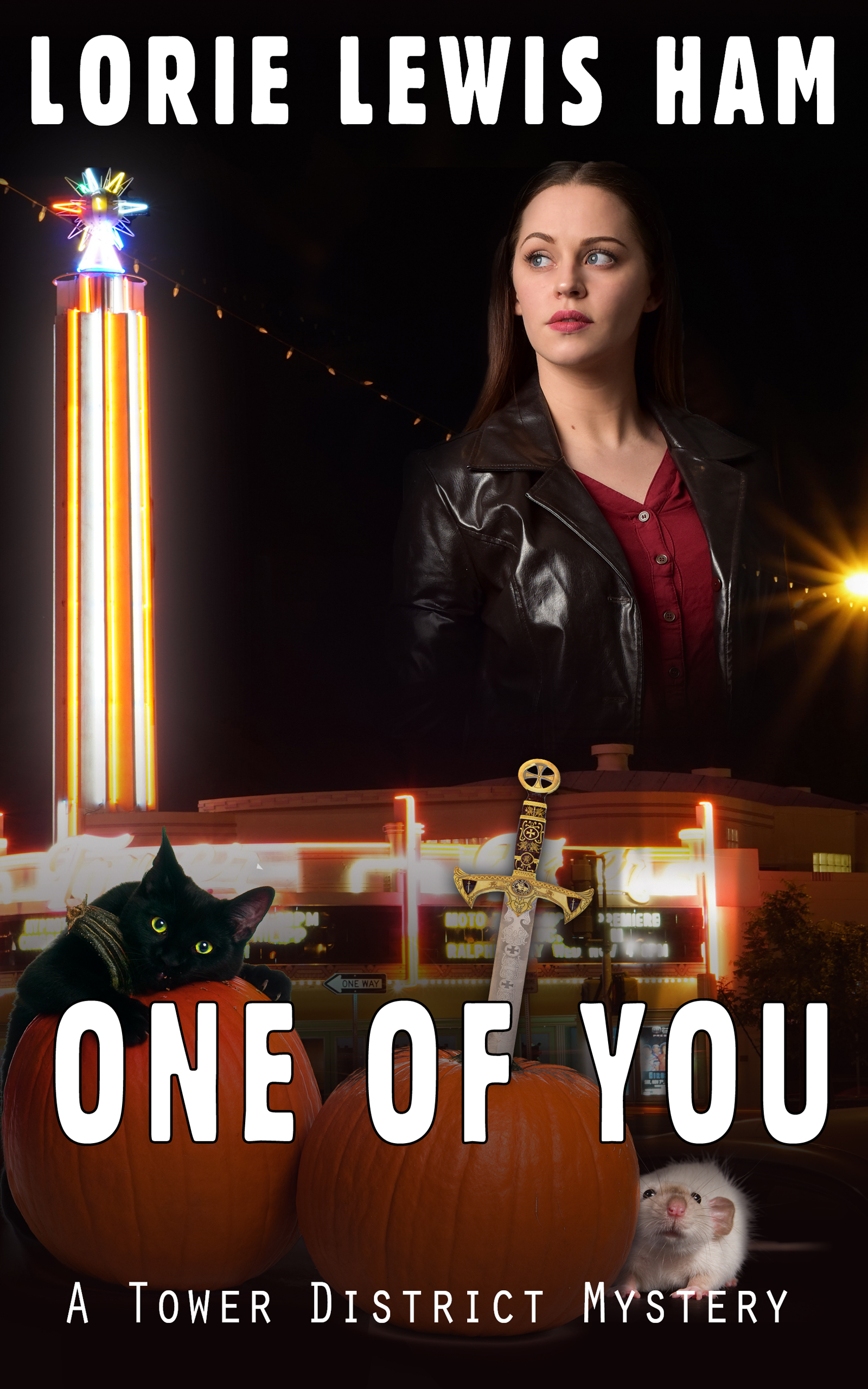
With her life on the California Coast behind her, Roxi Carlucci is beginning to feel at home in the Tower District—the cultural oasis of Fresno, CA—where she now lives with her cousin P.I. Stephen Carlucci, her pet rat Merlin, a Pit Bull named Watson, and a black cat named Dan. She has a new entertainment podcast, works as a part-time P.I., and is helping local bookstore owner Clark Halliwell put on the first-ever Tower Halloween Mysteryfest! The brutal summer heat is gone and has been replaced by the dense tule fog—perfect for Halloween!

She just wishes everyone would stop calling her the “Jessica Fletcher” of the Tower District simply because she found a dead body when she first arrived. But when one of the Mysteryfest authors is found dead, she fears she jinxed herself! The Carlucci’s are hired to find the killer before they strike again. Will Mysteryfest turn into a murder fest? How is the local gossip website back, and what does it know about the death of Roxi’s parents?

Buy links-

Ebook amazon https://tinyurl.com/83befuae

Amazon print https://tinyurl.com/tb79uukj

Barnes and Noble.com ebook https://tinyurl.com/4trwukbb

Barnes and Noble.com print https://tinyurl.com/yf3kyhxj

Kobo https://www.kobo.com/us/en/ebook/one-of-you-3

Universal Buy Link https://books2read.com/u/m0eWAy
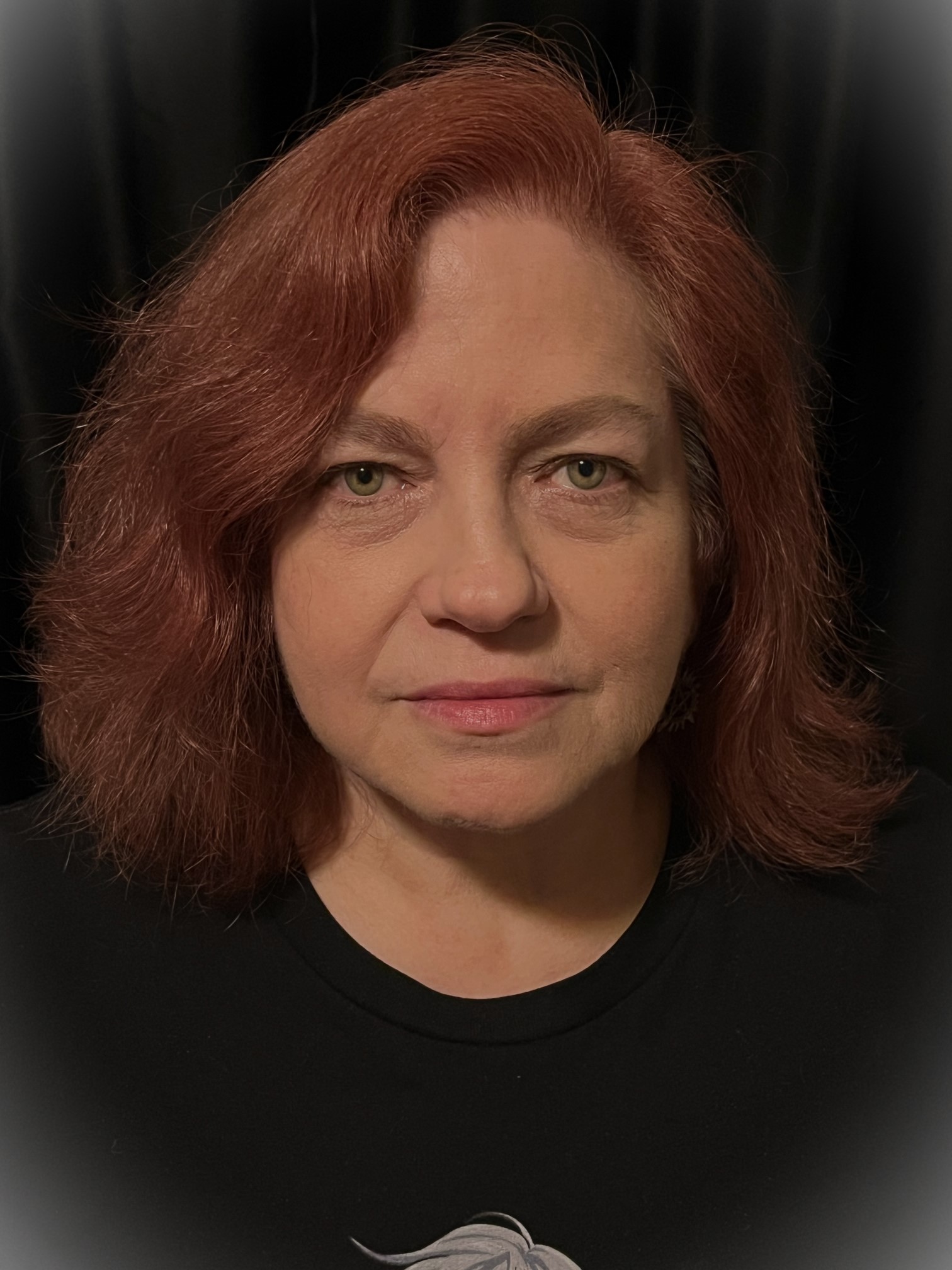
Lorie Lewis Ham lives in Reedley, California and has been writing ever since she was a child. Her first song and poem were published when she was 13, and she has gone on to publish many articles, short stories, and poems throughout the years, as well as write for a local newspaper, and publish 7 mystery novels. For the past 14 years, Lorie has been the editor-in-chief and publisher of Kings River Life Magazine, and she produces Mysteryrat’s Maze Podcast, where you can hear an excerpt of her book One of Us, the first in a new series called The Tower District Mysteries. Book 2, One of You, was released in June of 2024. You can learn more about Lorie and her writing on her website mysteryrat.com and find her on Facebook, BookBub, Goodreads, and Instagram @krlmagazine & @lorielewishamauthor.
LEFT-HANDED, RIGHT-BRAINED

Over the years, I’ve taken a couple of nasty spills and hurt both of my hands. Of the two falls, my left hand experienced the worst injuries. So, imagine my frustration when I started having trouble with my right hand. By the way, I am not left-handed, but I am very left-brained.

My issues started when I tackled yard work this spring. I love working in the yard, removing winter debris and pesky weed upstarts that threaten to take over my flower bed. We live in a rural area, and our house sits on the edge of a farmer’s field. I’ve found weeds in my yard that I can’t identify. It’s like the well-known weeds invited the otherworldly weeds to come and join the fun.

Armed with my garden wagon, various tools, and new gloves, I set out on a lovely spring day to eliminate all unwanted plants. Within two days, I’d cleared the flower bed and began covering the ground with a weed barrier to prevent uninvited vegetation from putting down roots.

After a few days of gardening, both of my hands began to ache. But since I was close to finishing the barrier so I could spread river rock in the flower bed, I ignored the pain and pushed forward. And then it happened …

As I pounded a yard staple into the fabric and underlying dirt, my right hand cramped, and my ring finger slammed into my palm. I noted some pain, but what surprised me was that I couldn’t lift my ring finger. It was as if my brain couldn’t connect with my hand.

Now sidelined with a painful and swollen right hand, I abandoned my yard work. Thinking if I let my hand rest, it would be fine in a couple of days; I attempted to do tasks with my left hand. Everything took longer, and I felt extremely clumsy.

Thankfully, I schedule time to write every day and found my right hand managed to move across my laptop keys, albeit slowly. My current WIP, “Chaos in Cabo,” is moving slowly, too, and I started to think about the plot line and characters. Maybe I should shift my creative process to the right side of my brain as I’d done when switching to my left hand.

I have always been a linear thinker. I’m analytical when approaching my day job. Methodical in planning and organizing my calendar. I like order and logic. One of the compliments I receive regularly in reviews is: Kimila is a master plotter! The kudos belong to my left-sided brain.

My plot in “Chaos in Cabo” seems solid. Now, forty chapters in, I feel the beginning of the book has my characters headed down the right story threads. Sometimes, okay, maybe all the time, I struggle with the middle of my story, letting uninvited insecurities plant seeds of self-doubt in my head.

I decided it might be time to embrace non-linear thinking and let my imagination conjure up some implausible situations for my characters. Oh, what fun!

I’ve spent the last few weeks writing different scenarios for my characters than what I’d initially plotted. Maybe my hero can’t forget or forgive the past. If that’s the case, he might have to let the love of his life walk away and into the arms of another man. What if my heroine starts questioning who she’s really in love with, which could cause her to lose everything? Is my villain a good person whose moral compass was skewed after suffering abuse at the hands of a sadistic rapist? Or will she justify killing someone she perceives to be her rival?

Not only did I discover new things about the three main characters, but I also came up with the plot line for my next México Mayhem book, “Lost in Loreto.”

I decided on this blog topic those first few days of struggling to use my left hand. But it didn’t occur to me to Google (my favorite research tool) Left Brain/Right Brain until I began writing the piece last week. Since you’re all writers, I’m sure you already know this, but writers use both sides of their brain equally.

My right hand is still giving me trouble, and the preliminary diagnosis is osteoarthritis. Old age is definitely not for the weak of heart. But every time I have to switch to my left hand to complete a task, I smile and tell myself eventually, my hands will become equals like my very well-rounded brain!

Happy writing, Ladies ~

Punctuation

I’m a fan of punctuation. It’s not something I thought much about in my earlier years, except when a teacher told me I was using commas incorrectly. For my next paper I made sure to use commas as correctly as I could manage. Her response was, “It looks like you sprinkled them like salt.” This did not mar my love of all those black marks on the page also known as letters and punctuation marks, but I did grow skeptical of her instructional skills. 
 
When I arrived in graduate school and stared down at a passage composed in Sanskrit and printed in Devanagari (the script usually associated with that language) at the end of the first semester, I came to appreciate those little marks even more. Not all languages use them, and not even Western languages used them until the medieval period. Until then most paragraphs looked like this.
 
Wordswerewrittenallbunchedtogetherwithnoindicationofwheretoputastoporcommaorquestionmarkthatwouldmakesenseifweallreadwordsthesamewayitwouldntmatterwhatwasmissingbecausetherewouldbenodisagreementwheresomethingendsorbeginswouldbedeterminedtobethesamebyallreadersbutwouldthatbethecaseiftherewerenomarkertoshowwouldweknowhowotherreaderswereinterpretingaparticularpassagecouldbereadinanynumberofways
 
Now consider reading passages like this in a foreign language and a different script. Why am I thinking about all of this?
 
My partners and I have just finished editing and setting the new anthology from Crime Spell Books this year titled Devil’s Snare. One of them remarked that there were a lot of dashes and ellipses in this year’s crop of stories. We agreed that was so. But why?
 
In general most writers understand the correct use of the comma, colon, semicolon, period, quotation marks, question mark, and exclamation point. We know the basic purpose of the dash and the ellipses. I for one blame Emily Dickinson for the overuse of the dash. If she hadn’t been such an inspired poet, that particular mark might have faded into disuse. As it is, it’s at least as popular as the ellipsis. Why do I care?
 
I’m not sure that I do care about these marks. I use them but not nearly as often as many other writers I read. What I do care about is the reading experience. These two marks are so ubiquitous that I finally had to wonder why, and I think I have an answer. 
 
When I read I form a picture of the characters going about their actions in the setting given. I hear them speaking, usually in a manner that conforms to my image of them. If the writer is a good one, my imagination is stimulated and those characters are robust, filling my head. I hear the intonation that tells me Stella is annoyed, hinted by the way the author has described her posture and glance. When the little boy is frightened by the store owner on his first attempt at shoplifting, showing off to his friends, I can hear him stutter, pause, unsure whether he should go on or go quiet or get out as fast as he can. But sometimes my imaginings of the characters’ doings are interrupted by the text. The author wants me to hear an interruption, and ends a sentence with a dash, just so I’ll be sure to notice that the character is interrupted. And if the character should pause to reflect, the author uses an ellipsis to make sure I know the character is pausing, unsure what to say next. But why do this? Doesn’t the writer trust the reader’s imagination?
 
At this point I don’t think the writer is thinking about the reader. I think he or she is thinking about how this scene looks on a stage, in front of a camera. I think he or she has slipped into writing stage directions in the prose text for the actors. The writer is telling the actors how to interpret the scene, and the reader who has imagined something that seems rich and satisfying comes to a series of these doctored lines and the imagination is blunted. It comes to a halt. Clunk.
 
There is a valid use for both marks, but I see it less and less often. When I’m tempted to use one or the other, I take that as a hint from the writing unconscious that I may be getting lazy and it’s time to rework the sentence or the scene. I don’t want to do anything to hinder a reader’s imagination.
 
Perhaps I’m being irked by overuse, so in the interests of fairness I pulled out a copy of The Maltese Falcon by Dashiell Hammett. The Great Man uses dashes and ellipses, not with abandon, but with care and precision. Hammett was too good a writer to get lazy in the middle of a scene; he could rely on his characters getting across how they felt, what they were doing, and why. I doubt he was thinking about his books being turned into movies, or how a particular actor would interpret a particular scene. (Yes, I know, I could be wrong.)
 
I have finally reached the point where I want to eliminate every ellipsis I encounter, and slip back into my own imagining of the story and its characters. And this may well become my policy as an editor.

The QWERTY of It All

From the Milton-Howard collection.

The QWERTY keyboard? Who in the right mind would organize letters that way? And yet, we all use it. Our fingers know exactly where to find the letters. Well, mostly. If you’re like me and your right index finger occasionally misses the tiny dimple on the j, a trip to Bletchley Hall may be required to decode your deathless prose. So, who put the A there and the M where it is?

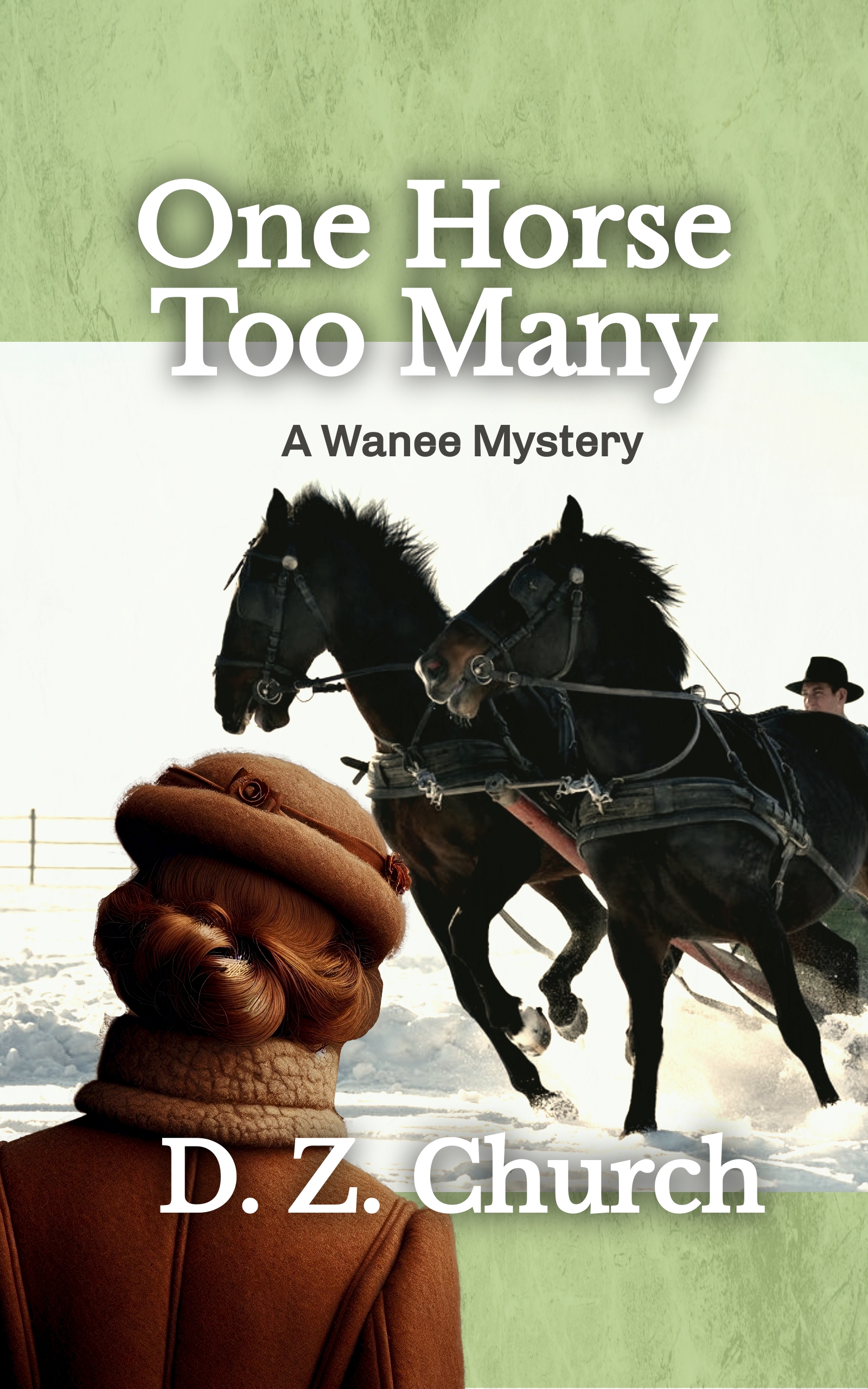
In my newest book, One Horse Too Many, Cora’s boarders are gathered for dinner in Countryman House’s dining room where Dr. Shaw speaks of the Centennial Exposition of 1876, where the QWERTY type-writer, the Bell telephone, and giant boilers able to heat whole buildings were introduced. Yet, while people traveled to Philadelphia to see the wonders, General Custer fatefully met the Sioux in Montana, and the James-Dalton Gang robbed the Northfield Minnesota bank. The years 1876-77 were like that, colored by the past and roaring toward the future.

Telegraph operators tapped out the news of the massacre and the robbery on QWERTY keyboards. So, how did the board’s odd array of letters come to be? In October 1867, Christopher Latham Sholes, a newspaper editor and printer who lived in KenoshaWisconsin, filed a patent application for an early writing machine developed with the assistance of two friends (Glidden and Soulé). 

Sholes worked five more years to perfect his invention, rearranging the alphabetical keys, until 1873, when the QWERTY keyboard came to be. If you spend some time with your keyboard, you will notice that the letters are arranged in diagonally slanting columns. This was done purportedly to accommodate the mechanical linkages, as slanted columns prevented the levers from tangling. Yes, you pushed on a key, and a lever slammed the letter onto a ribbon of ink, leaving an imprint on your actual paper.

Now, researchers into the evolution of the keyboard conclude that the typewriter’s mechanics did not influence keyboard design. Instead, QWERTY resulted from how and by whom typewriters were first used – namely, telegraph operators, whose need to quickly transcribe messages informed the letter arrangement. Also, some cite educator Amos Densmore’s study of bigram (letter-pair) frequency as influential in the design.

In 1873, Sholes & Glidden sold the manufacturing rights to their Type-Writer to E. Remington and Sons. Remington made several adjustments after purchase that resulted in the modern QWERTY layout. These adjustments included moving the R key to the place previously allotted to the period key. With the new arrangement, the last vestiges of the actual alphabet appeared only in the home row sequence DFGHJKL. It makes you want to kiss them, doesn’t it?

And how about this nugget? The QWERTY arrangement allows thousands of English words to be spelled with only the left hand but only a couple hundred with the right hand, even though using alternating hands with the first hand striking as the second readies aids speed and accuracy. Does that make any sense?

Well, this makes sense – business sense. In addition to typewriters, Remington offered training courses (for a small fee), ensuring typists learned on their proprietary system. This forced companies that hired trained typists to buy Remington typewriters. By 1890, more than 100,000 QWERTY-based Remington typewriters were in use nationwide.

When the five largest typewriter manufacturers merged in 1893 to form the Union Typewriter Company, they agreed to adopt QWERTY as the de facto standard, and it still is. Though there have been attempts to make an easier to use keyboard, the QWERTY board is so prevalent that the cost to make a worldwide change is prohibitive.

And really, why change something that has produced so many enjoyable books, like One Horse Too Many, available September 15 (pre-order starting September 1)? Here’s a teaser: Sales are up at Cora’s dress shop, and she is making headway on her debt. Her new cook scares everyone and her domestic is a mess. Things have just settled when much-needed drugs are stolen from the hospital, and the newspaper office is tossed. If you like a rip-snorting yarn and appealing, strong-willed characters, you’ll get a kick out of this old-fashioned mystery.

Check out my books at https://dzchurch.com.

Dreams do come true: I am officially a Lady of Mystery!

Can you tell us about your journey into writing and journalism, and what inspired you to pursue this career path?
The one constant in my life has been writing – poetry, short stories, essays, articles, books. As I was poised to begin a PhD in sociology, I decided to explore job options that would let me do more writing and less research. That led me into public relations and eventually to start my own company, Quantum Communications. In university I wrote regularly for the school paper. That led me to freelancing. I discovered you could be paid for writing – one of my personal top-five favorite discoveries – and I have freelanced ever since. My background in communications, journalism, editing, and related endeavors led to requests for me to teach. I accepted those requests and discovered that I thoroughly enjoyed engaging with people to explore ideas and theories while building skills. I did not enjoy grading.

Your portfolio includes a diverse range of publications, from The National Post to Chatelaine. How do you adapt your writing style to suit different audiences and platforms?
As a journalist (and a communications professional), you quickly learn that you are writing for the reader, and readers change from one type of publication to another. Adapting your style to meet their needs, and the requirements of the publication, is essential. That said, there are writing foundations that remain constant: conciseness, flow, readability.

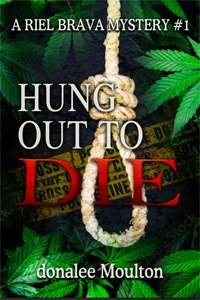
“Hung Out To Die” introduces us to Riel Brava, a unique protagonist. What inspired the creation of this character, and what do you hope readers take away from the story?
A bath inspired this story. I’m a big believer in bubbles, candles, scrubs, essential oils, and music with birds chirping in the background. Friends call this bathroom time my shrine. One night immersed in a lavender cloud I realized it was time to begin writing my mystery. Get off the pot kind of thing. That led me to a litany of possible characters and crimes. Through the mist Riel emerged. Not fully formed but outlined enough that I wrote down my ideas before I even moisturized.

Like 4-12% of all CEOs, Riel is a psychopath. Not the Dexter-Hannibal Lecter-Norman Bates kind of psychopath. The kind who live and work among us, mostly unnoticed, often successful, always on full alert their differences will be uncovered. Riel is personable, even charming. He’s keen to understand how the human mind works, so he’ll blend in.

It is my hope that people will close the last page on Hung Out to Die with a smile, maybe a tear, and a little bit more acceptance of all those around us.

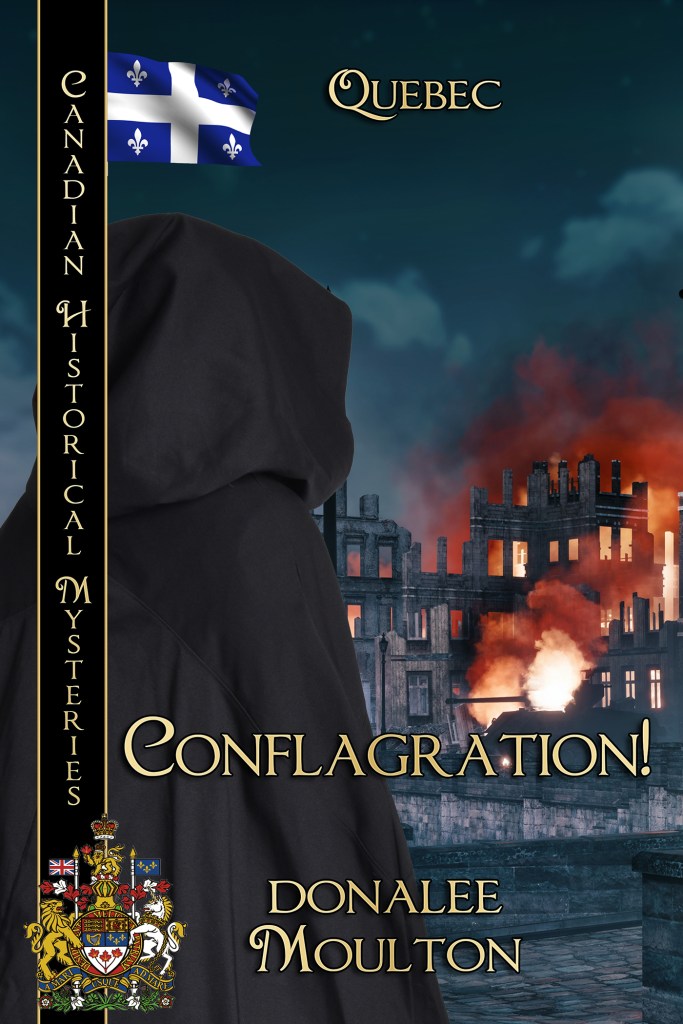
“Conflagration” delves into Canadian historical events, particularly focusing on the story of an enslaved Black woman. What drew you to this story, and what challenges did you face in bringing historical events to life in a fictional setting?
This book was a gift from my publisher, BWL Publishing, which has a series of historical mysteries set in each province and territory in Canada. My publisher unexpectedly lost her Quebec writer and asked if I could step in. I couldn’t wait.

Conflagration!, a historical mystery that follows the trial of an enslaved Black women accused of arson in Montreal in 1734, is founded in real-life events but wrapped in a mystery of my own making. The level of detail in court transcripts and the timelines set by the trial process meant I had a detailed blueprint for the book before I even began.

Your non-fiction book, “The Thong Principle: Saying What You Mean and Meaning What You Say,” explores effective communication. How do you apply the principles outlined in this book to your own writing process?
The Thong Principle is a way of communicating and a way of thinking. It’s about, as the subtitle indicates, a way to communicate that works on all levels. A way of communicating that works for the person sending the message and the person or people receiving the message. For writers and for readers.

As participants who’ve taken my courses know, I’ve been talking about the thong principle for decades. It’s a way to remember what matters most when we’re trying to convey a message or tell a story.  It’s a reminder that how we convey a message is as important as what we have to say.

I’ve taken that to heart.