
I sat across from Michael Connelly’s agent and wondered how I ended up there. To say that Connelly was an influence in my pursuit to be a storyteller would be an understatement. Along with Grisham and Patterson, he is in the top three of my favorite authors. Connelly’s agent had read my first novel, The Disillusioned, or at least enough of it to request a meeting. I listened as he shared how they had built Connelly’s career culminating with finalizing the Amazon deal for Bosch. I shared with him a story idea that had been resonating for a few years and knew from his response that I had something unique.
When I left his office I knew that The Disillusioned was only the first novel in the Guardian series. But what was next? As I thought about my story idea and my conversation with Connelly’s agent, I had a moment of inspiration. To move the series ahead, a story from the 1920’s would become an underlying mystery revealed throughout the series. It wasn’t enough on it’s own. The challenge was to bridge the gap between these two eras. Eight months later I had a first draft of Waking Lazarus, an epic global adventure filled with riveting characters and page turning twists and turns. While I had written a first draft of Waking Lazarus in less than a year, it took months of rewriting and editing to cross the finish line.
I write in this genre because I love mysteries filled with suspense. I love the rush of diving into a scene and seeing what happens next. And I love writing stories that go beyond entertainment. As you’ll find in the first two novels of the Guardian series there are key themes of light versus darkness, religion versus faith, and power versus innocence that drives the characters forward. You’ll also find that there are strong female characters and colorful settings throughout to keep readers on edge.
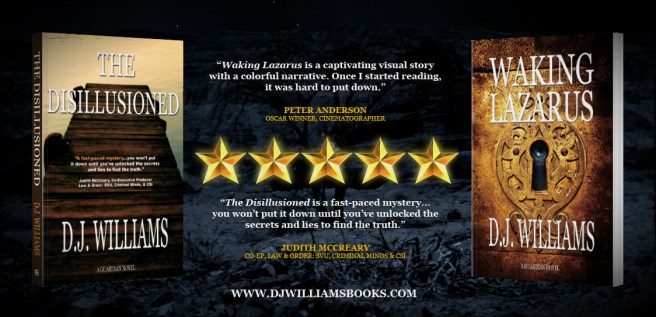
One month ago, Waking Lazarus was released worldwide. Once again I’ve been humbled to capture the attention of industry veterans including Peter Anderson, Oscar Winner/Cinematographer, who has endorsed this latest adventure, “Waking Lazarus is a captivating visual story with a colorful narrative. Once I started reading, it was hard to put down.”
I will always remember those few hours being taught a master class in how to build a series that could potentially go the distance. Thank you Michael Connelly’s agent for imparting your words of wisdom!
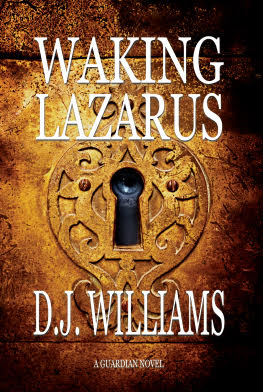
Waking Lazarus
by D.J. Williams
Jake Harris’ life hasn’t turned out the way he planned. Battling his addictions, and the shattered pieces of his family, he is hired to ghostwrite a memoir. From the 1920’s story of a controversial evangelist, to the present day mystery of a former District Attorney, everything changes when his search for the truth leads to an atrocity hidden from history. With a past he can’t remember, he begins to discover that he is not the person he believed himself to be. Rather, he is a threat to a secret society that has remained in the shadows for nearly a century. Jake is drawn deep inside a world he never knew existed that brings him closer to his own extraordinary destiny.
Facebook – https://www.facebook.com/djwilliamsbooks
Twitter – https://twitter.com/djwilliams316
Instagram – https://www.instagram.com/djwilliamsbooks/
 Oops! A day late and a dollar short! That’s me! I’m late with my posting. I was so busy packing up my kitchen in preparation for renovation–new floor, new lights, new paint, new stove–that I totally forgot to post yesterday when I was scheduled. So, I hope you don’t mind that I’m popping in a day late.


 I grew up in Philadelphia. The Port Richmond neighborhood, d’you know it? It’s not bad. We were happy. Well, I was happy. Dad worked hard. A lot. Mom, too. Dad’s first generation American. His dad came from Poland with his father — my great grandfather — during the war. Lots of stories there, I’m still looking into that.



You must be logged in to post a comment.