Music to my ears

­By Sally Carpenter

I got the idea of using chapter headers in my books from Steve Hockensmith. His “Holmes on the Range” books have cute headers that hint at the chapter content. I use headers in my books so I can keep track of the action in each chapter. Just using chapter numbers doesn’t jog my memory. And it’s fun looking for titles to match the story.

I began using chapter headers with my Sandy Fairfax Teen Idols series. Since Sandy was a musician, it made sense to use song titles for the heds. “The Baffled Beatlemaniac Caper,” of course, used only Beatles songs (group and solo) for the headers. “The Cunning Cruise Ship Caper” had all Elvis songs for no particular reason. The other two books used a mix of artists and decades.

 My new series, The Psychedelic Spy Mysteries, is set in 1967, so all of the songs are from the 1960s. One title, “Searchin’,” was released by The Coasters in 1957, but a soon-to-be very famous group re-recorded it for its audition tape for Decca Records in 1962, so it worked.

Nearly all of these songs are in my personal record/CD/tape collection, which gives you a hint as to my personal tastes. The recording of “Runaway” that I have is from a Micky Dolenz live concert CD. His sister Coco sings the song (she has a great voice too).

See if you can match the original artists with the songs! Hint: some musicians are used more than once. And how many of these songs do you still remember?

Chapter 1: Baby the Rain Must Fall

2: This Boy

3: What Goes On

4: Dr. Robert

5: Your Mother Should Know

6: Little Children

7: Secret Agent Man

8: Pictures of Matchstick Men

9: Strawberry Girl

10: Incense and Peppermints

11: Ask Me Why

12: Magical Mystery Tour

13: Everybody’s Talkin’

14: What’s New, Pussycat

15: Runaway

16: Surprise, Surprise

17: Writer in the Sun

18: Tell Me That Isn’t True

19: Tombstone Blues

20: I’ve Gotta Get a Message to You

21: On a Carousel

22: You Know My Name (Look Up The Number)

23: It’s a Gas

24: Fun, Fun, Fun

25: Where Were You When I Needed You

26: Searchin’

27: All Together Now

28: Black Magic Woman

29: Trip, Stumble and Fall

Answers:

Chapter 1: Glenn Yarbrough

2: The Beatles

3: Beatles again

4: Fab Four

5: That group from Liverpool

6: Billy J. Kramer

7: Johnny Rivers

8: Status Quo

9: Tommy Boyce and Bobby Hart

10: Strawberry Alarm Clock

11: John, Paul, George and Ringo

12: Ditto

13: Harry Nilsson

14: Tom Jones

15: Del Shannon

16: Rolling Stones

17: Donovan

18: Bob Dylan

19: Bob Dylan

20: The Bee Gees

21: Moody Blues

22: The Beatles (a rarity not found on the “official” albums)

23: Alfred E. Newman (released onto the world by Mad Magazine)

24: Beach Boys

25: Grass Roots

26: You can hear this one on the first Beatles “Anthology” album

27: One last time for the Fabs

28: Fleetwood Mac

29: The Mamas and The Papas
 

Haunted Timer Tales

Hey yo. What’s up?

So, this month I’d planned to talk about summer, writing outside and why it’s awesome BUT, instead, we need talk about something spooky that happened.

I don’t know if you remember from my last post, but I was talking about how I’d just started writing full-time and how I was having difficulty managing my time and settling into a routine. (And pomados! Let’s not forget the pomados!)

Anyway, I modified the whole pomado technique (because I just love being able to say to people, “I can’t right now, I have to pomado”—not that I’ve had the chance to say it to anyone, but I practice saying it in my head all the time). Yes, so, now my version of pomadoing means I estimate how long I think it will take me to accomplish something, halve that amount of time and set a timer. Why do I halve it? Well, I used to have a boss that would set unrealistic time goals on tasks:

Her: We got a hundred boxes of stock in delivery. You have until lunchtime to get all stripped, hung and tagged. (“stripped” just means taking the plastic off—in case you were wondering.)

Me: Lunchtime when? Lunchtime next Thursday? Cool, I can do that. (I’ve always had a poor work attitude!)

Her: Lunchtime today.

Me: *checks watch* That’s three hours. There’s no way we can do that.

Her: Well, you have no choice because that’s when I need it done. *walks away*

Me: *flips her off behind her back* (see above comment about poor work attitude)

Her: I can see you in the mirror.

Me: I was stretching my fingers. Didn’t want to pull a muscle and not get this done by lunchtime … *slinks off to the stock room*

Now, every time I think of estimating how long it will take me to do something I always think back to that and her unrealistic goals. Because of that, I got into the habit of setting deadlines much further away than I really needed. There’s nothing more demotivating than setting a deadline that is going to be impossible to hit. Or one that’s going to be so tight, you get stressy over it. Life’s too short.

So I got into the habit of overestimating … and then I found this nugget of time management wisdom: “However long you set for a task, that’s how long it will take. If you set a week—it’ll take a week. If you set a month—it’ll take a month.”

Which is true (for me, at least). Even with this last book. I set the goal to have it ready to send to my editor a week earlier than the deadline. But that didn’t happen. I got it finished the day before I needed to send it off because that was (technically) how long I actually had to get it finished.

Anyway, so I halve my time estimate and set the timer. And there’s something about seeing a timer count down and thinking “Maybe I can get it done much faster than I thought”.

But, time management aside, the thing I wanted to tell you was that I have a battery operated timer (remember this—it’s important). Just a regular kitchen timer. I’ve used it for nearly two months now. It counts down (timer setting) and it counts up (stopwatch setting). I wanted to use it to count up so I could time something—I forget what now. Naturally, I pressed the “mode” button thinking that it would switch it from “timer” to “stopwatch”, but I found another setting called “clock” … and it tells the time.

I can hear you’re, like, “So? What’s the big deal?”. Well, the “big deal” is that it’s a battery operated timer! It has no way to know the time. It’s not wifi connected. I frequently take the batteries out so they don’t run down. There is no way for it to connect to the internet or anything to sync with to get the time. But it knows the time! How does it know the time!!? And, it is always nine minutes fast. Crazy.

I suppose it could be counting up from whenever I put the batteries in but that seems like a huge coincidence …

Worlds Collide - FINAL COVER

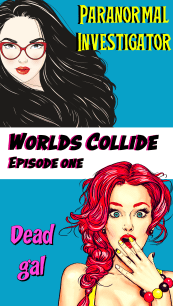
So, obviously, I channelled that experience into a story. It features two of my main characters and it’s free … but you have to sign up for my newsletter to get it (sorry!), but you can always unsubscribe straight away. Why can’t I give you a link where you don’t have to sign up? I promised my newsletter peeps the only way you could get it was by being a newsletter peeps—gotta be a woman of my word, yo.


Here’s the link: https://dl.bookfunnel.com/qujqdjo00l

Yeah, so that’s my haunted timer tale. Have you had anything like that? Let me know in the comments.

Until next time,

Jordaina 🙂


So How Did I Write That Novel? by Karen Shughart


Shughart,Karen-0016_ADJ_5x7 (1)

My first novel, Murder in the Museum, was recently published by Cozy Cat Press, and I must admit it was a real labor of love. It’s the first (at least I hope it is!) in a series of Edmund DeCleryk Mysteries that takes place in Lighthouse Cove, NY, a fictional village located on the southern shores of Lake Ontario. If you know anything about the seasons in the Great Lakes, you’ll understand why I chose late fall and winter for my series’ debut. Brrrr! Lots of dark and blizzardy nights with lots of howling wind, along with stunningly gorgeous seasonal vistas.

I’ve been published before, non-fiction, and have worked as a journalist and newspaper columnist, but this was my first venture as a fiction writer. So how did I do it?

The idea:  For whatever reason, I envisioned my sleuth as a retired police chief who lives with his wife, Annie, the head of the historical society, in a small lakeside community. Ed, also a retired Navy SEAL, is hired to investigate murders when there’s an oversized work load for the village police.

The structure: Like many novelists, I began with a plot outline, list of characters, and lots of hand-scribbled notes. But I’m not good with much structure and probably wouldn’t have followed a strict outline anyway, so I let the plot meander in whatever direction made sense.  I like puzzles, and this was like solving one.

The drafts:  After completing my first draft, and several others, I realized I wasn’t even close to being finished. The book needed lots of work. I was writing like a journalist, using as few words as possible to make a point. Not a good way to go with a novel.

The rewrites: I rewrote the prologue so that it would capture readers’ attention from the get-go, expanded character development, enhanced description and created bridge narratives to link one part of the story to another. I added some twists and turns to keep readers a touch off balance, and to keep them guessing about “whodunit”.  My book grew from 30,000 to 66,000 words; at last, a novel!

The critics:  When I was minimally satisfied with my creation, I invited three close friends to serve as my readers (my patient husband had already read it multiple times). I knew they would be brutally honest about what they liked and disliked. Their excellent feedback and suggestions made the book much better.

The publisher: Finally, I researched publishers and came up with a list of those I hoped would be interested in Murder in the Museum. Cozy Cat Press has been a good fit.

The moral: Writing a novel isn’t easy, the process can take time, and it’s smart to have others read and critique your book before submitting it to a publisher. Was it worth it? You bet!

Committed to a Character

A fellow writer in an online discussion group asked how other authors feel about their main characters. Why do we stick with them and want to write about them?

When I started writing my series, I needed a lead character who could solve the type of mysteries I wanted to write. The “villains” aren’t killers. Some commit other types of crimes such as theft or stalking; some are fraudulent shamans or healers; some are corrupt or dangerous in a personal and spiritual way without breaking the law. My protagonist, Mae Martin, is psychic, though that’s not the only skill she brings to solving mysteries. Like any amateur sleuth, she’s observant, analytical, persistent, curious, and she’s the kind of person people turn to for help.

Except for being psychic, Mae is based on a good friend (the friend knows I did this). If I feel I’m losing touch with her, I just have to ask myself what my friend would do or say. She’s generous and nurturing, but she’ll only put up with so much, and when she speaks her mind, she can be a handful. Her willingness to help others is both her greatest strength and her greatest weakness, because she can go overboard. Mae sometimes catches herself in the act of getting too wrapped up another person’s troubles, but she ends up doing it anyway.

My friend, who is a good bit younger than me, is on her third marriage. So far, Mae is dodging number three, but she has what she calls a “man habit,” and hasn’t managed to go as long without a relationship as she meant to at the end of marriage number two. One of the things I enjoy about her is that she was raised to be a nice Southern lady, but she’s feisty and she likes to win. When she seems too good, I remember her competitive streak, and her bad choices as well as her good ones. I like her for her faults as much as for her strengths.

I once read a blog post in which an author said to give your characters just three traits—don’t make them more complex or contradictory. Interesting idea, and it may work for certain subgenres of mystery, but it’s not my approach to building characters. Though I don’t have to reveal and explain every aspect of their psyches, complex people feel more real to me, and they apparently seem real to my readers.

Some readers are deeply attached to Mae’s boyfriend, and they tend to take his side when the couple has fights; others take her side. I was strangely flattered when a friend asked me to create a character based on her so she and Mae could go through a conflict and work out some problems. This friend feels that she and Mae don’t get along as well as they did in the first few books. “I want to start out as her nemesis and become her friend,” she said. I’m inclined to do it. There’s already a character in one of the two books in progress who resembles this woman in age, appearance, and occupation. She and the real person who inspired Mae strike me as incompatible, though they’re two of my closest friends. They live in different states and have never met, but I’ll have fun throwing them together in fiction and seeing how they both grow and change through the encounter.

On Ramona DeFelice Long’s blog, she once suggested a character “I’m not” exercise: having the character list their perceptions of what they are not, and then checking to see if these things helped or hindered the character, and if these perceptions were static or changing. I found it helpful to look at how Mae sees herself, not just how I see her. After all, we can have inaccurate perceptions of ourselves. She doesn’t necessarily know herself as well as  she could, and that’s where the potential for growth comes in—the shortcomings that get her into trouble and challenge her to learn.

What keeps you committed to your series protagonist?


It’s a Small World/Nothing to do with Disneyland


Visalia Book Fair 5

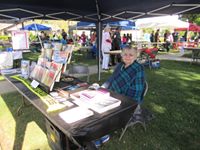
Recently I participated in a large outdoor book festival put on by the Visalia Library with lots of help from Leadership Visalia. It was their first annual and one of the best organized of these events I’ve attended. Besides many authors and other vendors, lots and lots of people came and it’s one of these people I want to talk about.

Near the end of the event, a young man came up to my table and looked over my books. “I see you write a lot about law enforcement.”

I launched into my usual spiel about my son-in-law being a police officer who came to our house after his shift to tell me about his adventures. I added that he took me on a ride-along, and when I moved to Springville, I also went on a ride-along with a female officer in the town of Porterville.

He asked, “Do you remember the name of the officer?”

I didn’t and he told me the name of his aunt who had been the first female office in Porterville. And it was the lady cop I did the ride-along with! I told him how great she was, she let me follow her around on every call she made, including all the bar checks. The only time she told me to stay in the car was for a domestic dispute. Her sergeant came to check on her and only listened at the door of the house.

He came back and told me that she was the best at calming volatile situations—which she did this time too.

The young man was pleased to hear all this about his aunt.

I also told him that from 3 a.m until 6, she didn’t get any other calls and as we patrolled the streets of the city, she told me all about being a single mom and the only female in the department. Through the years I’ve used so much of what she said in both my Deputy Tempe Crabtree series and my Rocky Bluff P.D. series. He promised to let her know how valuable her information had been to me.

I did sell a lot of books at the festival, but this was definitely the highlight of the day.

Marilyn Meredith