
Why I Write Mysteries by Saralyn Richard

Guest blogger banner

I love reading and writing in all genres. I’ve taught creative writing to high schoolers and adults, and I’ve rarely met a story or a writer that I didn’t enjoy getting to know, but when it comes to writing novels of my own, I choose to write mysteries. I could tell you the reasons have to do with suspense and tension, tight plots, clues, character motivations, themes of good vs. evil, or other such elements, but the truth is simpler.

I love mysteries, because in no other genre is the connection between reader and writer so vivid. When an author lays out a mystery, she is ever-mindful of the reader. She unfolds the crime and investigation clue by clue, scene by scene, in a sometimes tortuous path toward solution. She hopes that the reader is traveling along the path, enjoying the adventure every step of the way. If she plants a clue in one chapter, will the thoughtful reader recall it in a subsequent chapter? Will the red herrings be identified as such? The author hopes to strike the perfect balance between foreshadowing and surprise, so the reader is captivated and delighted.

Every single time a reader responds to one of my books, I feel a new thrill, as if seeing the story through new eyes creates a wholly new perspective, one that I may never have considered before. A mystery is an invitation to the reader to come along with the detective, to match wits with the criminal, to bring his own clever ideas to bear upon solving the puzzle. The synergy created by the author-reader partnership is intellectually and emotionally stimulating and rewarding.

In MURDER IN THE ONE PERCENT, a group of the country’s wealthiest and most powerful elite gather for a birthday party in the lush, peaceful Brandywine Valley of Pennsylvania. When one of them is killed, and almost everyone has a motive, young Detective Oliver Parrott realizes this will be the case to challenge his intellect and to test his moral compass. Figuring out who comes to the party with murder in his heart and poison in his pocket becomes an active mental exercise for the reader. As the author, I am literally one step ahead of the reader, leading him by the hand, with an enigmatic smile on my face.

Book Blurb:

Final cover w quoteSomeone comes to the party with murder in their heart and poison in their pocket…

A powerful and rich playboy, a rare but naturally occurring poison, a newly divorced woman with an axe to grind, and pressure from the former President of the US—these are just a few of the challenges that African-American Detective Oliver Parrott faces when he answers a routine call for back-up and discovers someone died at a country estate the morning after an elaborate birthday party. When Parrott learns the deceased is the wealthy former US Secretary of the Treasury and just about everyone at the party had a motive to kill him, he realizes this will be the investigation to make—or break—his career.

Buy Links:

https://www.amazon.com/Murder-One-Percent-Saralyn-Richard/dp/1626947716/ref=sr_1_2?ie=UTF8&qid=1517072668&sr=8-2&keywords=murder+in+the+one+percent

https://www.barnesandnoble.com/w/murder-in-the-one-percent-saralyn-richard/1127890200?ean=9781626947719

https://black-opal-books.myshopify.com/products/murder-in-the-one-percent

http://www.saralynrichard.com/bookstore/ 

Author Bio:
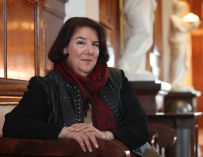
Galveston Author Saralyn RichardAward-winning mystery and children’s book author, Saralyn Richard, is a writer who teaches on the side. Her children’s picture book, Naughty Nana, has reached thousands of children worldwide.

Murder in the One Percent, ©2018 Black Opal Books, pulls back the curtain on the privileged and powerful rich. Set on a gentleman’s farm in Pennsylvania and in the tony areas of New York, the book introduces Detective Oliver Parrott, who matches wits with the country’s elite.

A member of International Thriller Writers and Mystery Writers of America, Saralyn has  completed the sequel to Murder in the One Percent, entitled A Palette for Murder. Her standalone mystery, A Murder of Principal, will be released soon. Her website is www.saralynrichard.com. 

Social Media Links:

My author’s website is http://www.saralynrichard.com. https://www.facebook.com/saralyn.richard,

https://www.twitter.com/SaralynRichard,

https://www.linkedin.com/in/saralyn-richard-b06b6355/,

https://www.pinterest.com/saralynrichard/,

https://www.instagram.com/naughty_nana_sheepdog/ and https://www.goodreads.com/author/show/7338961.Saralyn_Richard.

I am available to meet with book clubs and organization members. Contact me at saralyn@saralynrichard.com.


Not Your Usual Suspect by Paty Jager

gabriel hawke logoThe way my mind, and I would expect most writer’s minds work, if I see a person with something interesting about them, chances are they are going to end up in one of my books.
I like to make my main and secondary characters stand out. Whether it’s their background, their mannerisms, or just the way they look. Study the people around you. No one is exactly like another. Yes, they may have the same color of hair or wear glasses. But if you look close, one may have designer glasses while another has the cheapest brand. And one may have smooth, shiny hair while another has hair that could use some conditioner or even be washed.  Both the glasses and the hair tell you a lot about that character without me saying too much.

That is what I like to do when writing. Give the readers just enough information about a character to then let their imaginations fill in the blanks.

I think if you over describe a character, you are not allowing the reader to fully use their imaginations in “seeing” your story.

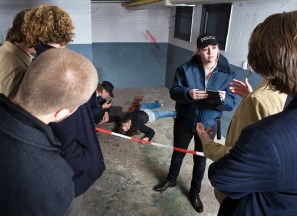
Crime SceneIt’s like the scene were six people witness a crime and each one sees something different. I think all readers are the same way. Even if I did give them an exact description of a character, they would still “see” the character in their own way in their mind.
And I like to flip things around. If I see a well-dressed man with a bald head and carrying a brief case that’s normal. But I see he is wearing sneakers- that’s different. I figure out why he is wearing sneakers in my mind, then in my story, it’s a woman in her sixties, in a jacket and skirt, with sneakers and gray hair. She is wearing sneakers because she is finished with her appointments for the day and she is getting ready to walk home.  Maybe…

Now the man may just wear sneakers all the time because he is a CEO of a sporting goods firm, but I gave the spin on the woman and why she is wearing shoes to show some insight into her. She is a person concerned for her health, so she walks. And is wise enough to bring sneakers and confident in herself to be able to wear sneakers with business clothing.

Or- is she grudgingly walking because of her health. Perhaps her doctor told her she had to get more exercise and rather than “waste” time, she found she could walk to and from work faster than driving and that way, she gets her exercise and a few more minutes of work time?  There are so many ways to spin one character and so many ways to falsely show they may be the killer.

I would have to say my favorite part of writing murder mystery books is finding ways to throw the reader off and point a finger or evidence toward an innocent person. Does that make me cruel? Perhaps! But it is what makes writing and reading mystery books so much fun!

Go ahead, pick out a person and study them. How can you use something about them to create a character?

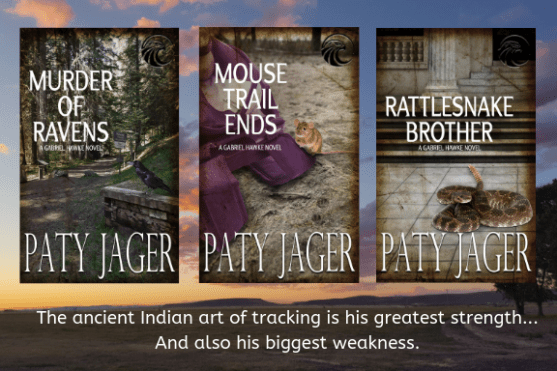
The ancient Indian art of tracking is his greatest strength... And also his biggest weakness.

MURDER OF RAVENS

Arresting his brother-in-law ended his marriage, could solving this murder ruin a friendship? https://www.books2read.com/u/bxZwMP

MOUSE TRAIL ENDS

Dead bodies in the wilderness. A child is missing. Hawke is an expert tracker, but he isn’t the only one looking for the child. https://books2read.com/u/mlYaWB

RATTLESNAKE BROTHER

Corrupt officials. Death to those who dare complain.  (Releasing March 20th)


Poise Versus Panic By Patricia Smith Wood

imageSince I’m a Gemini, I have many “twin” features. Sometimes I’m one side, sometimes I’m the other.

I’ll give you an example. I can often take two different sides of an argument. Not as much as I once could (I think I’m getting set in my ways), but when called upon, I can. That means I can sometimes talk myself “down off the ceiling” when I get upset about something, or am too invested in one outcome over another.

I think most of us would prefer to respond to problems with poise, as opposed to panic, but sometimes, we just don’t pull it off. I’m going to tell you about two women who did.

I belong to the Croak & Dagger New Mexico Chapter of Sisters in Crime. As most chapters do, we have an interesting speaker (or two) at each of our meetings. For our February meeting, our program chair had secured two very interesting women who just happened to also be members of our chapter. One was a medical doctor with lots of emergency room experience, and the other was a Ph.D. in biology who had been a dean at the University of Wisconsin. They would talk to us about poisons—a subject they were both well versed in. They had given the same talk to a large group of writers at a conference in Las Vegas last summer, and they graciously agreed to provide it for us.

Well, naturally, mystery writers are interested in ways to kill people, so we were looking forward to the presentation. The two experts were going to give us a slide show to impart their information. Our intrepid program chair had contacted the officials at our meeting place (a community center) and requested a slide projector and a laptop for the night of the meeting. This was not an unusual request, and we had often asked for and received equipment such as this for a program. Everything was on track.

Until it wasn’t. Our program chair showed up early at the community center and found only a projector set up in the room—not the needed laptop. She immediately contacted the front desk and inquired. She explained she had been promised the equipment would be there, ready for the presentation no later than 6:30. The two young women (volunteers) shrugged. They knew nothing. It wasn’t their job.

I arrived within seconds of these revelations. I’m the membership chair (and immediate past president) of the group. I hadn’t known there would be slide presentation so was surprised at the problem. I called my husband and asked him to bring a laptop to me which we had used a number of times for slide shows. He did. I tried to set it up, there was a problem. Nobody there knew how to fix it, including me.

If you were a presenter, how would you feel right about now? What would you do? Say you’ll do it another time? Throw up your hands and pout? That’s NOT what our two ladies did.

They used their notes (and the laptop screen) to go through their presentation verbally. They took turns, went through the list of most potent poisons and where they come from. They explained the ways in which someone might be introduced to each poison. They answered questions and thoroughly captured their audience. It was a wonderful presentation.

No, we, the audience, did not get to see the slides. I’m sure that would have been wonderful. But that isn’t the point. Some people (and maybe even me) might have lost their cool, thrown a tantrum because the equipment they needed wasn’t available, or walked out and left us without a program. Not these ladies.

They didn’t pout—they were (and are) poised. They behaved like the professionals they are. They showed us all how to react to a minor disaster.

Which is, as it turns out, to do whatever you can to fix it, but if you can’t, do the best you can under the circumstances. I must admit I was inspired as much by the way they handled the situation as I was with the actual presentation. It’s a lesson I hope I don’t soon forget.

When I grow up, I want to be just like those two ladies.

It Couldn’t Happen Here

By Sally Carpenter

For this post I’m going to forgo fiction for true crime.

Every week, it seems, another city is ravaged by a mass shooting. It’s easy from the security of ones own home to say, “How tragic, but it could never happen here.”

Until it does.

Thousand Oaks, Calif., is a large city about 10 or so miles south of where I live. It’s considered one of the safety cities of its size in the U.S. But on the night of Nov. 7, 2018, T.O. became another sad statistic.

An armed ex-Marine walked into the Borderline Bar and Grill during the monthly College Night when many young adults were relaxing and dancing to live country music. Within minutes, 12 people were shot dead—including a police office who lived in my town—and others wounded. The killer then turned his gun on himself and committed suicide.

Three months later, I’m still trying to wrap my head around it. I don’t know any of the people present at the bar that night and I wasn’t there, so I can only image the terror as the survivors fled for their lives or helped others to safety. The survivors will no doubt be dealing with raw emotions for the rest of their lives. And the grief of the victims’ families seem unthinkable.

The police have determined no motive for the slaying. A few theories have been suggested, including PTSD, but questions remain: Of all the bars in T.O. that night, why that one? Why that night? What triggered the act? What did the madman hope to accomplish through killing strangers?

The bar remains closed out of respect for the victims, but another local music venue has stepped in to host a weekly Borderline Country Music Night, so the former house bands can continue to perform and the Borderline regulars can still gather in solidarity.

The rest of the community has shown amazing support. A foundation set up a special fund with the monies going directly to the victims’ families. Many groups and individuals have held fundraisers. A jeweler created unique necklaces with the profits going to the special fund. A printer created “T.O. Strong” T-shirts and has been working nonstop for weeks to fulfill orders.

REO Speedwagon was already scheduled for a local January concert, so the band (several of the musicians live in the area) decided to donate the ticket sales to the special fund. Due to audience demand, a second concert was added.

Another benefit concert was held in the large Civic Arts Plaza with a slew of well-known country singers along with Arnold Schwarzenegger as the emcee.

A small church of about 35 members held a special collection for the special fund that resulted in its largest Sunday offering to date. The local megachurch, Calvary Community, opened its doors to host several funerals for the victims, even those who were not church members.

An artist drew pencil sketches of the victims and donated the portraits to the families.  Another artist created a large wall banner with life-size color drawings of the fallen.

I work at a community newspaper, and besides carrying the news coverage, the paper is also running profiles of each victim. The reporter said the families have been happy to talk about their loved one and share their memories with the world.

I don’t have a neat way to wrap up this post, as real life is often messy and many crimes are never solved or resolved, as the pain lingers on long after the police report is filed.

Perhaps that is why we write mysteries. As authors, we have control over good and evil. Writers can punish the wicked and bring them to the justice that often seems lacking in reality. Authors can delve into minds and find the motive. Writers can tie up loose ends and leave readers with the satisfaction that, at least in our story, all will turn out right for the good guys.

Note: in your comments, please do not discuss gun control, mental illness, politics, police efforts or similar subjects. This post is not the place to debate such topics.


Getting the Details Right

GETTING THE DETAILS RIGHT

Recently I was asked to be a speaker at a writers’ conference—the topic being character and setting description. The chairperson titled it “Getting the Details Right.” Because I have messed up on the details in a few of my books, this is the perfect topic for me.

First off, two of the biggest mistakes I’ve made:

  1. Changing the type of car someone drives. In my first Deputy Tempe Crabtree mystery, the car changed from a Blazer to a Bronco several times.
  2. Names of people—giving new characters in a story more than one name.
  3. Leaving out an important day of the week in a book that moved day to day through the week. (I fixed that before it got published.)

What I’ve seen in other people’s books:

  1. Giving a Japanese character a Chinese last name.
  2. Putting in details about a real city that are totally wrong. (And this is why I created my own cities even though they have a resemblance to a real place.)
  3. Setting a story in a fictional mid-west town with the wrong kind of geography and kinds of trees.
  4. Having too much happen in a much too small amount of time.
  5. Changing an important piece of description of a main character such as eye color

Let’s start with setting. I love books that clearly describe the places where the action takes place inside and out and also includes the weather (because this can be an important part of the plot), and different smells (which also can be an important part of the plot, or merely a means to evoke another sense of what the setting is like).

With characters we don’t need to know every detail of a person’s look, but enough to create a picture of the person in the reader’s mind. Along with the outward appearance, the personality is even more important. What in the person’s background would make someone do certain actions? Think about triggers to behaviors and motivations.

All of this is important, but to make sure not to get things wrong as I and many other authors have done, some means of keeping track of all these details needs to be used. Authors do this in many different ways from simply keeping written notes or an elaborate computer system. This is even more important for those of us who write series.

Anyone want to share how they keep track of the details? Or a mistake you’ve found in a book you’ve read

Marilyn

P.S. Though it’s been fixed now, I mixed up some character’s names in my last Rocky Bluff P.D. mystery. No one noticed ahead of time–my critique group, the editor I sent it too first, or the publisher who thought it was my best book in the series.

tangledwebs

Yep, this is the one.