Guest Blogger – Jeannette de Beauvoir

Diamonds Are a Girl’s Best Friend
We’re all attracted to things that sparkle. From the moment we’re born, our eyes follow shiny objects. And because everyone likes them, precious stones and gems have acquired a substantial monetary value.

And therein, naturally, lies crime.

In the nursery rhyme, the “little star” twinkles “like a diamond in the sky,” but diamonds are no little stars: they’re big and bright and can be very, very dangerous. Blood diamonds cost countless people their lives and limbs. Diamonds are stolen and imitated, fought over and killed for, and still every February we buy them, give them, and receive them as delicate, beautiful expressions of love.

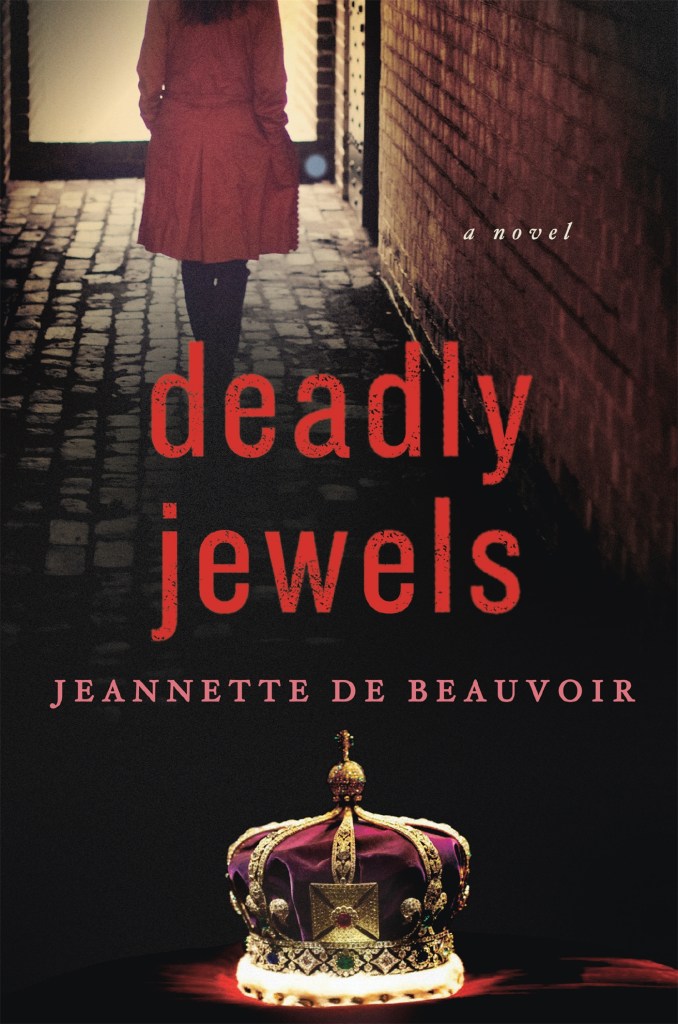
One of my novels, Deadly Jewels, deals with a diamond theft during World War II that has repercussions in the present day, its unfinished business echoing up through the years. And you might think that it was easier to steal diamonds back then, but you’d be wrong: unlike other crimes, which seem to be more and more blocked by technological advances in loss prevention and law enforcement, it seems that jewel thieves are alive and well and very much at it.

One of the things that we say about murder is that we only know about the failures—a successful murderer being, of course, one who is never caught because murder is never suspected. The same cannot be said for heists: we know only too well when and where they occur, and sometimes even by whom.

And I have to say that the history of heists isn’t without some humor.

Take the so-called Pink Panther gang, some very serious thieves from Eastern Europe who earned their nickname following the theft of a £500,000 diamond in central London—they hid the stone in a jar of face cream, a move learned from watching The Return of the Pink Panther. That’s right: Inspector Clouseau taught them. They’ve been enormously successful and are responsible for what are considered some of the most glamorous heists ever.

A science museum isn’t the first place you’d think of as a backdrop to a diamond heist, but that happened in the Netherlands during an exhibition called The Diamond: From Rough Stone to Gem. Thieves got away with $12 million in diamonds and jewelry after smashing a window to get in (they weren’t picked up on video and none of the guards saw or heard anything) and accessing six of 28 alarmed cabinets in the main jewelry room before escaping. That one still has a lot of people scratching their heads.

In 2013, thieves netted $136 million in diamonds belonging to an Israeli guest at the Carlton Intercontinental Hotel in Cannes—the same hotel that was the setting for Alfred Hitchcock’s 1955 jewelry heist film To Catch a Thief.

I could go on and on—really, I could—but you get the point. There’s something about diamonds that brings out the James Bond or Marilyn Monroe in all of us. And the mystery not only of their attraction but of the lengths to which people will go to steal them is one of endless fascination—for this mystery writer, anyway!

DEADLY JEWELS

When Martine LeDuc, publicity director for the city of Montréal, is summoned into the mayor’s office, she’s pleasantly surprised to find the city is due for a PR coup: a doctoral researcher at McGill University claims to have found proof that the British crown jewels were stored in Montréal during WWII.

Martine is thrilled to be part of the excavation project, until it turns out that the dig’s discoveries include the skeleton of a man with diamonds in his ribcage and a hole in his skull. Is this decades-old murder leading her too far into the dangerous world of Canada’s neo-Nazi networks, or is there something going on that makes the jewels themselves deadly? Is history ever really completely buried?

With pressing personal issues crowding into her professional life, Martine needs to solve not only the puzzle of the jewels, but some more recent crimes—including another murder, a kidnapping, and the operation of an ancient cult in Montréal—and do it before the past reaches out to silence her for good.

https://www.amazon.com/Deadly-Jewels-Novel-Jeannette-Beauvoir-ebook/dp/B0140MQVX8

Jeannette de Beauvoir is the author, most recently, of The Matinée Murders. A member of the Mystery Writers of America, Sisters in Crime, the Author’s Guild, and the National Writers Union, you can find out more (and read her blog or sign up for her newsletter) at her website. You can also find her on Amazon, Facebook, Instagram, Patreon, and Goodreads.

She doesn’t own any diamonds.
Writing A Cozy Is Not As Warm And Fuzzy As It Sounds by Heather Haven

Several nights ago I finished Casting Call for a Corpse, Book 7 of the Alvarez Family Heather cartoon-smallest copyMurder Mysteries, labeled a fun detective cozy. Fun or not, I actually didn’t finish it. My little pea-brain just likes to think I did.  What really is finished is the initial creative stage. I immediately emailed this ha-ha magnificent work of literature off to the content editor. She will return it several weeks from now noting a bazillion errors, mistakes, misquotes, and/or things that made no sense or didn’t work for her. I will sob for a while, and then will make the corrections or clarifications. I will then send it off to the line editor, who will also find a bazillion things wrong, such as grammar, language, syntax, names, dates, you know, that sort of stuff.  Sobbing, I will do the corrections and pretend that I knew ‘whom’ went there instead of ‘who’ but I was so busy being creative, doncha know, it got by me. And Paris? So in France. Did I write Spain? Whoops. After that, the manuscript will go to the Beta readers. Repeat any and all of the above.
Meanwhile,  I will need to come up with an elevator pitch condensing an 86 thousand-word story into under 25 words. Then I will write several back cover blurbs in varying lengths. But whether the blub is 2 sentences, 2 paragraphs, or 10, it has to be so exciting and pithy, it just makes anyone who picks up that book want to buy it. What is saving my sanity is I no longer have to do the publicity for this little gem. I am paying someone else to do that. Which is good. Because I will be too busy sobbing and being fed up. I will have had it with the stupid story, the stupid book, the stupid series, not to mention the stupid writing process. But soon, as follows the night the day, it will be up and running. And so will I.

I will be running on to my next novel, Spring Thaw, Book 2 of the Snow Lake Romantic Suspense Novels. And I can’t wait to get started!


Where Do Your Characters Come From?

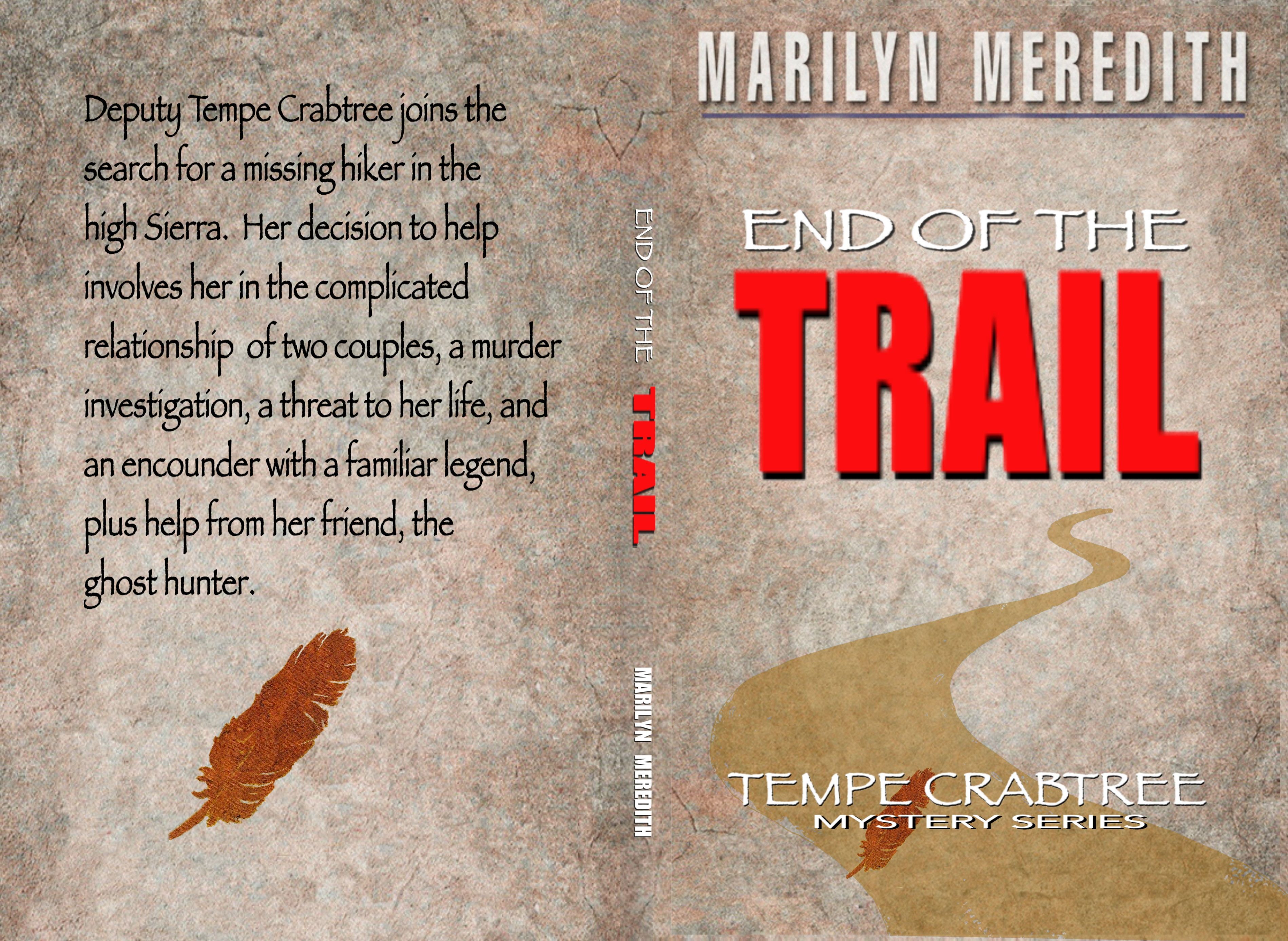
End of Trail full cover

This question is frequently asked of authors. My answer is “They come from many places.”

My heroine in the Deputy Tempe Crabtree series was inspired by three women: A female resident deputy I interviewed for a newspaper article, a female police officer and single mom who took me on a ride-along and shared a lot about her life, and a native Yokut who grew up on the reservation.

Tempe’s husband is a composite of the many pastors in my life—some are relatives.

Nick Two John’s appearance came another native Yokut. (He read Deadly Omen and called to tell me I got the Pow Wow right but didn’t mention recognizing himself.)

Over the years, I’ve held contests for people to have a character named after themselves. When I do this, the character in the book is always much different than the real person. My friends and now editor, Lorna Collins, won one of the contests, and her namesake has now appeared in three Deputy Crabtree mysteries as a ghost hunter.

Another friend and fan of the series pleaded with me to put her in a book I did, in Raging Water. Because the character has my friend’s looks and personality (as she wanted), I changed her name to Miqui Sherwood. When her friends read the book, they said I described her perfectly. She has since appeared in two more books, including the latest, End of the Trail.

https://www.amazon.com/dp/B087SFTC6K/ref=tmm_pap_swatch_0?_encoding=UTF8&qid=1588514254&sr=1-1

Over the years I’ve met many interesting people, sometimes I borrow their personality traits to create a character or unusual appearance or way of dressing.

And often the character appears out of my imagination, especially the villains and the victims—though bits and pieces of real people might make up a part of one.

Over the years, I’ve heard of many ways that authors have created their characters, if you are an author, where do your characters come from?

Marilyn


The Question of the Victim

One of the first ideas that come to me when I begin a novel or short story is the identity of the villain. As soon as the basic scene takes shape, the victim is the first of the characters to gain a sharp outline in my imagination. The villain, among several possibilities, is the last to be identified.

The selection of both victim and villain allow me to explore various questions, but in the beginning I was mostly interested in mastering the form and telling a particular kind of story.

image

In the cozy mystery, the victim tends to be “the person we love to hate,” the obnoxious neighbor or underhanded business partner, especially the philandering husband or the domineering departmental supervisor. No one misses them, or is sad to see them go. In my first mystery, Murder in Mellingham, Beth O’Donnell made everyone cringe with her sarcastic and cutting remarks, a bully though diminutive in every other way. With the victim neatly dispatched emotionally for the audience, the reader concentrates on those around her. But as the series progressed I wanted the victim to play a more complicated role.

Kali_Front

Setting a murder mystery in an exotic location (to us, the outsiders) offers new possibilities, and I took the opportunity to present a victim who was admired and mourned. Jean is an American nurse traveling through India on her way to Burma, or Myanmar, with a plan to be smuggled in to work in a clandestine clinic in the jungle. This will be her second trip, and she has come prepared with medicine and equipment. Who would want to kill her and thwart her humanitarian work? In Under the Eye of Kali, Jean disappears and is later found dead. Her openness about her plans seems to suggest smugglers or ordinary thieves could be the culprits. We care more about who the villain is because we care more about Jean.

Below the Tree Line

In the first Pioneer Valley entry, Below the Tree Line, Felicity O’Brien finds a young woman she’s only met once dead in her woods. This is the first of two deaths, neither of which fall into the category of expected victims. The reader has no reason to hate either woman, and the convenient category of the cozy victim has no role here. There can be no ambiguity about the death of either woman, and thus no pleasure in the reader at the elimination of an odious character.

The choice of victim tells the reader several things, but mostly what our own values are as we come to know the character and gradually discern the shape of his or her life. We conveniently agree that the obnoxious victim in the cozy got what he or she deserved; we admire the sleuth who tracks down the killer of a virtuous person risking her life for others; and we agree there can be no justification for killing an innocent person.

Crime fiction or mystery fiction opens for discussion and exploration our basic principles and beliefs. In Modus Operandi, Robin Winks, the late reviewer of and writer about this genre, was eloquent on this point. “Ultimately one reads detective fiction because it involves judgments—judgments made, passed upon, tested. In raising questions about purpose, it raises questions about cause and effect. In the end, like history, such fiction appears to, and occasionally does, decode the environment; appears to and occasionally does tell one what to do; appears to and occasionally does set the record straight. Setting the record straight ought to matter.”

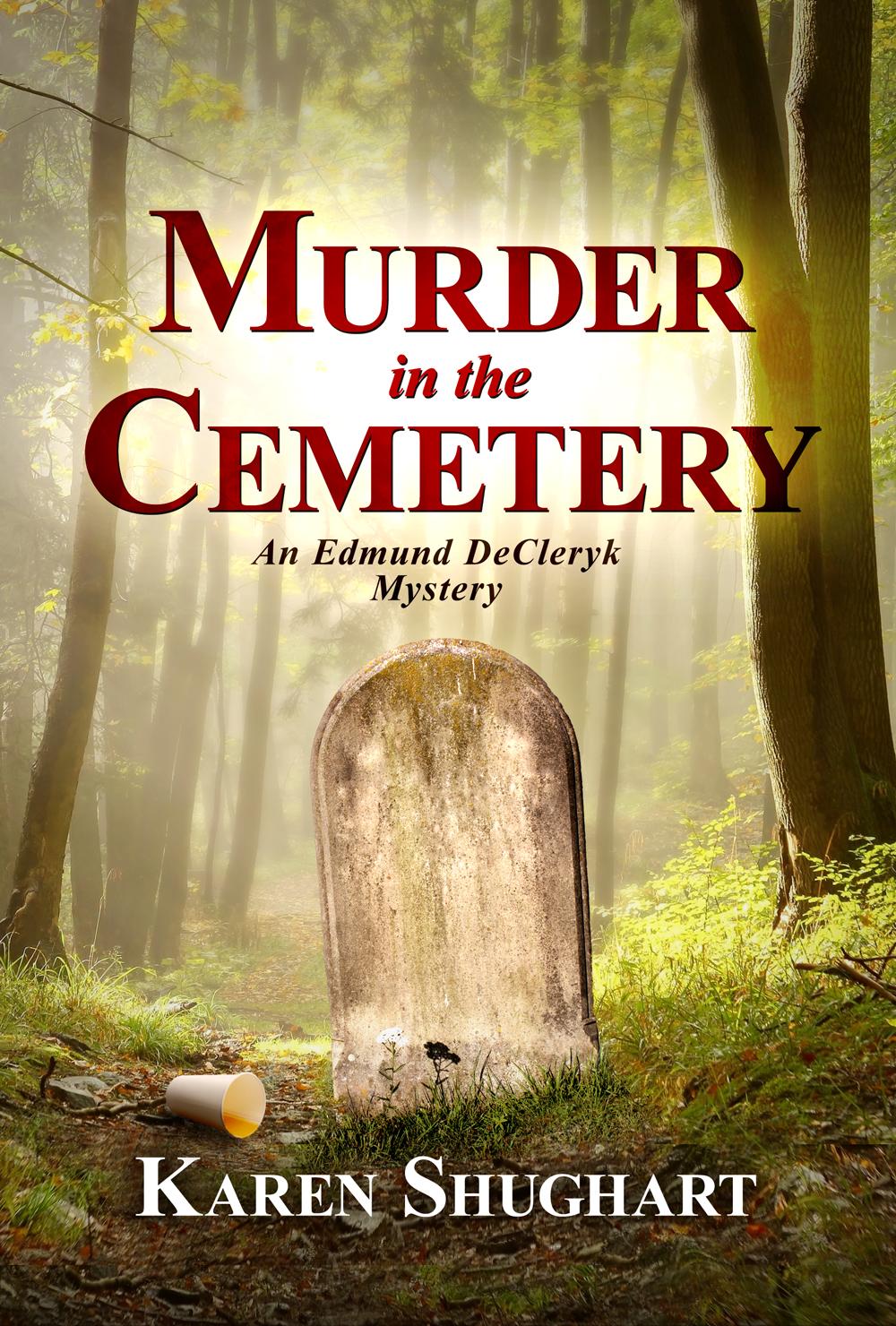
Why Cozies by Karen Shughart


Shughart,Karen-0016_ADJ_5x7 (1)Whew! Haven’t these past several months been surreal? Did you ever think a year ago that your life would change in ways that you probably never could have imagined? Before COVID-19, we expected that there would be ups and downs, but in most cases our daily routines were pretty much the same. And then BOOM! In a period of weeks, we’re wearing masks and gloves, ordering online more frequently, having our groceries delivered or picking them up curbside and enjoying happy hours with our friends, neighbors and family members on Zoom or by standing across the street from each other for a shout-out while we walk our dogs. That is, for those of us who have stayed healthy.

So, what does this have to do with the title of this blog? Plenty. I did a search on Google to see if I could find the definition of a Cozy mystery and this is what I found:

“(A) Cozy mystery is the gentlest subset of the broad genre of crime writing. As its name suggests, it’s a comfort read that leaves you satisfied and at one with the world, rather than scared to sleep alone with the lights out.” Source: Debbie Young, Cozy author and blogger http://www.authordebbieyoung.com/

“Cozies are a subgenre of crime ficiton in which sex and violence are downplayed or treated humorously, and the crime and detection take place in a small, socially intimate community.” Source: Wikipedia

“The small size of the setting makes it believable that all suspects know each other. The sleuth is usually a very likeable person who encourage(s) community members to talk freely about each other. There is usually at least one knowledgeable, nosy (and of course, … reliable!) character in the book who is able to fill in all the blanks, thus enabling the sleuth to solve the case.” Source:  Cozy Mystery List.

I’m not sure about you, but for me the global pandemic and its consequences have been a bit unnerving, to say the least. Don’t get me wrong, I count my blessings and have a lot to be thankful for. But could any of us have imagined that when we turned on the TV, the news would almost completely be about a virus that was infecting and killing masses of people? That schools, non-essential businesses, cultural and sports venues would be closed? The world changed in an instant and we had to adapt to it without any time to prepare.MurderintheCemeteryfrontlarge - Copy

So, getting back to the title of the blog: Why Cozies? While this hiatus may have encouraged some of  us to take an online class or catch up on the classics, stimulating non-fiction or that documentary we’ve always planned to watch; truth be told, many of us want to be transported to a time, place and setting where we can escape for a while and read a great story with lots of twists, turns and sometimes surprise endings. In short, something fun. Cozy mysteries can provide just that. And what’s wrong with sitting by the fire or on your front porch, cup of tea in hand, whiling away the hours being transported to a place where you know the horrors of our world won’t encroach?