Writing as Discovery

by Janis Patterson

Want to start a lively ‘discussion’ among writers? All you have to do is say something about how ‘plotting’ or ‘pantsing’ is superior. It doesn’t make any difference which; both have their outspoken and extremely vocal adherents. Just make sure you can hold your ground or you have a direct path to an exit. Both sides have passionate adherents.

For those who aren’t familiar with the terms (if there are any of you left out there!) ‘plotting’ is basically an outline, yes, like you used to make in elementary school, but adapted toward a book. Whether it’s the old Roman numeral/Arabic numeral/alphanumeric letter – i.e., bullet point type of outline – or a paragraph style, the outline is a detailed road map of every twist and turn in your story. ‘Pantsing’ is taken from the old phrase ‘seat of your pants,’ meaning you just write and see what happens.

In general, pantsers tend to do more re-writing than plotters, but plotters spend more time on pre-writing work.

I am an avowed pantser. Sort of. My personal system is sort of like a suspension bridge. I know where the story begins. I know where the story will pretty much end – but that has been known to change. I know a couple of plot points in between, though they can be shifted a bit during writing. Then all that’s left is to spin the webwork of the story between them. Does my story change while I’m writing? Yes, it can and has, and I think that’s a good thing, because that means the story is growing organically and being true to itself and – more importantly – to its characters.

Plotters vary from those who put down only a few plot points and notes to those who put in every raise of the hero’s eyebrow and every shrug of the heroine’s shoulders. They also do lots of pre-plotting work, making character sheets, location maps and doing interviews with their characters. I once saw a character worksheet that was at least 5 pages long and included such things as the character’s favorite flavor of JellO and their maternal grandmother’s maiden name. Personally, I’ve had close friends for decades and I don’t know that much about them!

Always willing to improve my craft, I once took a much touted ten-box plotting course that was supposed to be almost magical in creating a book’s structure. A stubborn person, I finished it even though I knew from the second or third lesson that it wasn’t for me. After all, I had paid for it and believe in getting my money’s worth.

Basically you put every turning point and every reaction into one of the ten boxes. An outline, just minus the Roman and Arabic numerals. Using this system I plotted a pretty good romantic suspense novel about Egypt, antiquities smuggling, trust issues, terrorism and a dirty bomb thrown in for good measure.

It will never be written, at least not by me. By the time the last box was filled in I was so bored with the whole idea I never wanted to see it again. Believe me, it shows in the final product when the writer is bored with the project. No matter how good the writer is, the book is lifeless and mechanical.

Don’t think this is a vote either for or against plotting or pantsing. It’s one of those things to which there is no one ‘right’ answer for everyone. The writer has to decide for himself what works for him. And perhaps it is the reader who is the ultimate judge, though most don’t have the slightest idea of the writer’s process. They just know if they like the book or not.

So what do I do? I get an idea for an opening situation, I sit down and I start to write. If the idea is sound, if the story is a good one, the characters just take over and I become more scribe than writer. Do I have to go back and do some re-writing when the plot changes direction? Occasionally, but it only makes the story stronger. Sometimes it surprises me what comes up on the screen as I write, and to my mind that is a good thing. Remember, someone – I don’t remember who – said, “No surprise for the writer, no surprise for the reader.”

Wishing everyone a Merry Christmas, and a wonderful holiday season!

There’s A Cat in the Christmas Tree!

There are two cats in the Christmas tree photo above.

One is easy to spot. You’ll have to look for the other one. But he’s there.

I love my holiday rituals. That includes decorating my home and putting up a Christmas tree, usually the day after Thanksgiving.

Of course, when one has cats, and I do— Well, if you have cats, you know what I mean. If you don’t, I’ll tell you.

Bodie, an adventurous kitten.

Some cats don’t pay any attention to the Christmas tree. That has never been the case at my house. As soon as I start decorating, my feline companions gather, eagerly twitching their whiskers, as they happily contemplate that big cat toy that appears once a year.

Pearl, who went to the Rainbow Bridge decades ago, would carefully remove the shiny tinsel balls and bat them around the living room. She rarely broke one, unless she batted it into a chair leg.

Then there was Gus, also long departed, but still remembered fondly, especially for this story. One morning as I was getting ready for work, Gus was under the Christmas tree, checking out the presents and making the ornaments jingle and jangle. In a loud voice, I told him to get away from the tree.

To be fair, he did. But he was tangled in a string of lights, so he took the tree with him. He dragged it several feet across the living room, accompanied by the tinkle of broken ornaments.

The following year, I tied the tree to a sturdy piece of furniture.

I love the smell of a real pine Christmas tree. But disposing of the dried-out corpse at the end of the holiday season gives me the blues. The remedy for that was to go with an artificial tree. I bought a seven-footer at a local store’s after-Christmas sale. When I got it home, I put it up, just to see how it looked.

That’s when I discovered it would hold a full-grown cat. The cat in question, Dexter, was midway up the tree, resting comfortably on a branch.

Clio the kitten, perched midway up the tree.

The climbing-the-Christmas-tree baton was passed to Bodie and Clio, brother and sister, who appeared on my patio ten years ago with their mother, Lottie. That year as I put up the tree, the kittens enthusiastically climbed it.

The following year, I set up the tree and was getting ornaments out of the box when I glanced up and saw Clio precariously balancing at the very top. She stayed up there long enough for me to snap a photo.

Yes, that really is Clio at the top of the tree!

She doesn’t do that any more. The tree is smaller and she’s much fatter.

These days the Christmas tree tradition is mostly playing with the ornaments on the bottom and sleeping under the tree. Lottie likes to make a nest out of the Christmas tree skirt and snooze underneath. So do Bodie and Clio, both too big to climb the tree now. At least I hope so!

Bodie sits under the tree.

Happy holidays!

If you put up a Christmas tree, I hope it stays upright.

The Man Who Waits by Heather Haven

Other than changing my social doings, Covid19 has done little harm to my professional or artistic life. I’m still writing, when I’m not fretting over who’s going to be the next president of the United States. My books are still selling. Instead of sitting in Bay Area traffic trying to get from point A to point B, I now Zoom from my office with my writing pals and organizations. The gas gauge of my car is grateful and so is my back.

This is not true for hubby. He is an entertainer, a singer, and musician. He needs an audience, as does every other performer out there. Working steadily since his teens, he’d been singing with the same rock and roll band nights and weekends for nearly 17 years. He’d built up a thriving business during the day entertaining the inhabitants of assisted living homes throughout the Bay Area. What was a career for him, money coming in, a purpose for getting up in the morning, crashed and burned early last March.

But you can’t keep a good man down. And tough times like these, more often than not, show the true mettle of a person. Instead of sulking and feeling sorry for himself — which would have been my route — he is perfecting his piano playing by taking lessons on the internet. He’s learning lyrics to new songs. When he can, he performs with other artists via Zoom. But those are rare days. What he does daily is practice to become an even better musician. And he was pretty danged good in the first place.

Eventually, the vaccine will be available to one and all. Eventually, opera houses and theaters will resume. We will start going back to nightclubs and other venues. Maybe even take a cruise again. But this November and December, we will celebrate the holidays by ourselves. We will be grateful. Not for what we don’t have but for what we do have. That would be our health, our home, each other, and enough money to squeak by on. These are things many others do not have.

But it is what it is. And meanwhile, he waits.

Happy holidays to you and yours. And remember, the heart cannot be separated from those we love. So Zoom your love this holiday season and stay safe. There is a future before us.

The Natural World in Crime Fiction

Many of the books I enjoy include some aspect of the natural world. An obvious recent example is The Witch Elm by Tana French, which revolves around an old tree in a yard where the main characters played as children and one returns as an adult to recover from an assault. Then there’s my own Below the Tree Line, which is set on a farm in rural Central Massachusetts. Now that I’m writing about a suburban setting, I’m taking a look at my neighborhood for scenes or aspects of nature to include in a traditional mystery. It’s not going as expected.

My first choice was to talk about apple trees, since we have one. However, it hasn’t produced a real crop in a few years, and right now looks like it’s dying. It might work if the book were entitled “Death of an Apple Orchard,” since the tree looks more like a sculpture than something that might have ever produced fruit. Scratch that idea.

The ornamental trees in this area seem to have developed a disease that kills off their leaves, so for the last two years they have looked like they too are dying. No one seems concerned enough to take them down, so we’ll have to wait and see what the future holds.

To this I can add all the invasive species that have killed off our native species, thereby depriving other plants, birds, and animals of expected sustenance. Our own backyard is being overtaken by bittersweet, bamboo, rose of Sharon, and lots more. I’m not sure it’s even possible to get rid of the invasives now. It may be too late. Nature as evil invader. Not my idea of the setting for a cozy.

The other obvious choice for drawing nature into a tale is birds. I love birds, love watching them flit among the shrubs picking up a meal—bugs or seeds—and jabbering at each other. Cardinals are of course always welcomed, along with goldfinches, northern flickers, and egrets, even crows. But the winged creatures I most often see are not nearly as attractive, or as much of a pleasure to watch. Turkeys.

Turkeys are everywhere now.

Last year a flock made its way slowly down our street, passing from yard to yard in search of edibles. When they encountered a fence they headed out to the street. A driver trying to park made the mistake of honking at one of them. This is received as a direct insult, and the turkeys responded accordingly. Two of them attacked the car, pecking and jabbering at it. Not satisfied with this display of temper, they headed out into the street, bringing two lanes of traffic to a halt. This was so disruptive that a neighbor entered the fray shooing away the turkeys to the other side of the road, allowing traffic to flow again. But the turkeys weren’t done yet. They reentered traffic, once again tying it up, until bored, they wandered away, down the center of the road.

Once when a turkey was behaving appropriately, I snapped a pic of it. The click of my iPhone startled the bird and he looked up, scanning the area for whatever creature had threatened him. I moved on.

These feather characters won’t work as background detail for a story, though they might serve as a motive for murder.

Notice I began looking for an apple tree but mine was not attractive, and then moved on to other aspects of nature that were less than serene or beautiful. The cozy mystery needs the apple tree in blossom, but a thriller or suspense story needs the scaly fruit tree. Nature offers us both (and a lot in between) and as writers we choose aspects of the natural world to signal theme, tone, mood. I plan to get those diseased decorative trees into a story very soon. The turkeys are more likely to find their way into a humorous story, perhaps fleeing a homeowner determined to get rid of them. I’ll enjoy writing that one. And then I’ll talk about the rabbits that are now everywhere.

Thanks Giving

D. Z. Church

How lucky am I to have my blog appear on Thanksgiving Day! This year. In the middle of a pandemic. When no one can travel or sit at a table with all those they love. Okay, it’s been on my mind.

A lot.

Thanksgiving has always been my holiday. Back in the days when we had nuclear families, as in grandparents living with us or nearby, aunts and uncles and cousins just up the road, Thanksgiving was it! Just a great big, whack-a-doodle party from beginning to end. Especially since as kids our entire responsibility was to stay out of the way while the feast was prepared. My older sister and I and an aunt and uncle our ages made Christmas chains out of all the left-over aluminum foil at a big old card table in the front parlor. If we were really good, we got to pour water into the water glasses and set up the kids’ tables. Remember those?

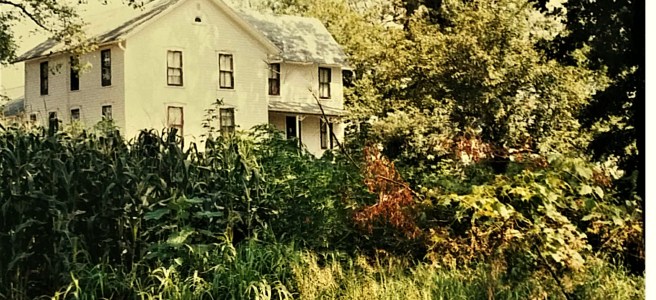
The outbuildings at the farm, the house was to the left of the tall trees.

The entire family, including great aunts and uncles from Chicago, all converged on the family farm, a Century farm in northwestern Illinois with a big old Victorian farmhouse. The local aunts, uncles, and cousins arrived by late morning. But, since we lived only twenty minutes away, we strolled in for breakfast, which always included Grandma Mid’s thumbprint cakes. These things were to die for, and you might actually die from them. They involved large dollops of heavy cream hand-churned from milk from our cows by a second cousin a few miles away. OMG!

Cooking for the big day, started the previous weekend with pies. Grandma Mid and her daughters were glorious pie makers. The inscription on one aunt’s tombstone ends with: And the best damn pie maker. No kidding. For reference, imagine one of those ads you used to see with a huge family around an enormous table covered in food and double it. It was like a Norman Rockwell painting gone wild.

As soon as we were released from our eating obligations, we kids would roar out into the farmyard or across the lane to the timber and romp and stomp. Back then, there were only six grandkids and our youngest aunt and uncle, but the eight of us could make a world out of the woodland, the ditch, and the farmyard. Sooner or later, a ball game would erupt on the front lawn with the walnut trees standing in for bases. When darkness descended, the Hearts game started. My uncles played hardcore unforgiving Hearts with raised voices, accusations of cheating, and peals of laughter.

I once drew a picture for my second grade class of Thanksgiving at our farm. I was meticulous about it, putting every single one of the thirty-one participants in the picture. The assignment had been to draw a true picture of the holiday, suspicious my teacher questioned my accuracy. She even showed it to my mother, who forever gained my adoration by systematically naming all thirty-one persons in the picture. Though I think she fudged on more than a few.

Is it any wonder that this farmhouse stood in for the one in my Cooper Vietnam Era Quartet? Becoming a character in the newest and third book, Pay Back.

The farmhouse

Redolent with years of yeasty bread and the gossip of farm families, the farmhouse kitchen took up a full quarter of the ground floor and was the aorta of the home. Everything and everyone flowed through it whether to climb the stairs, enter the front parlors, or go to the bathroom. An oak table, ten feet long without leaves, surrounded by ladder-backed oak chairs with a captain’s chair at each end, took a full third of the room. A built-in corner hutch gleamed with a new multi-paned glass door.

Ash planking adorned the restored floor. The cabinets were white, the countertop butcher block, and the appliances stainless steel and time-tested. Rag rugs made by the Plainwell Woman’s Club from strips of used clothing were sprinkled around the room, one in front of the six-burner gas stove, one in front of the sink, and one under the oak table.

That kitchen stove had a bun warmer to one side. Every now and then, I would have the joy of tumbling downstairs for breakfast to tiny cheeps emanating from behind the warmer door. I remember Grandmother frying eggs at the stove, then casually leaning over to open the bun warmer as the cheeps crescendoed. Tiny little yellow chicks bobbled out on to the floor, trying their untried wings, and wobbling along. Grandma’s calico cat, the only working cat allowed in the kitchen, rested her paws on the edge of her water dish. She watched them take their first drink, her little cat lips pursed.

Sigh.

We may not have this Thanksgiving with family, but we have all that came before and all those to come. So, get out the albums, cook up your turkey, and snuggle in front of a fire (be it on Netflix, electric, gas, or wood), and spend time with your family on Zoom, Hangouts, or a video conference of choice. And enjoy!

Three books of the Cooper Era Vietnam Quartet: Dead Legend, Head First, and Pay Back are available on Amazon in paperback and ebook. Pay Back at https://www.amazon.com/Pay-Back-Cooper-Vietnam-Quartet-ebook/dp/B08CJDHP92