While I enjoy writing my books more than promoting or marketing, I do enjoy coming up with items to give away as swag. S.W.AG.= Something We All Got. I had to look that up! LOL I didn’t realize it actually meant something.
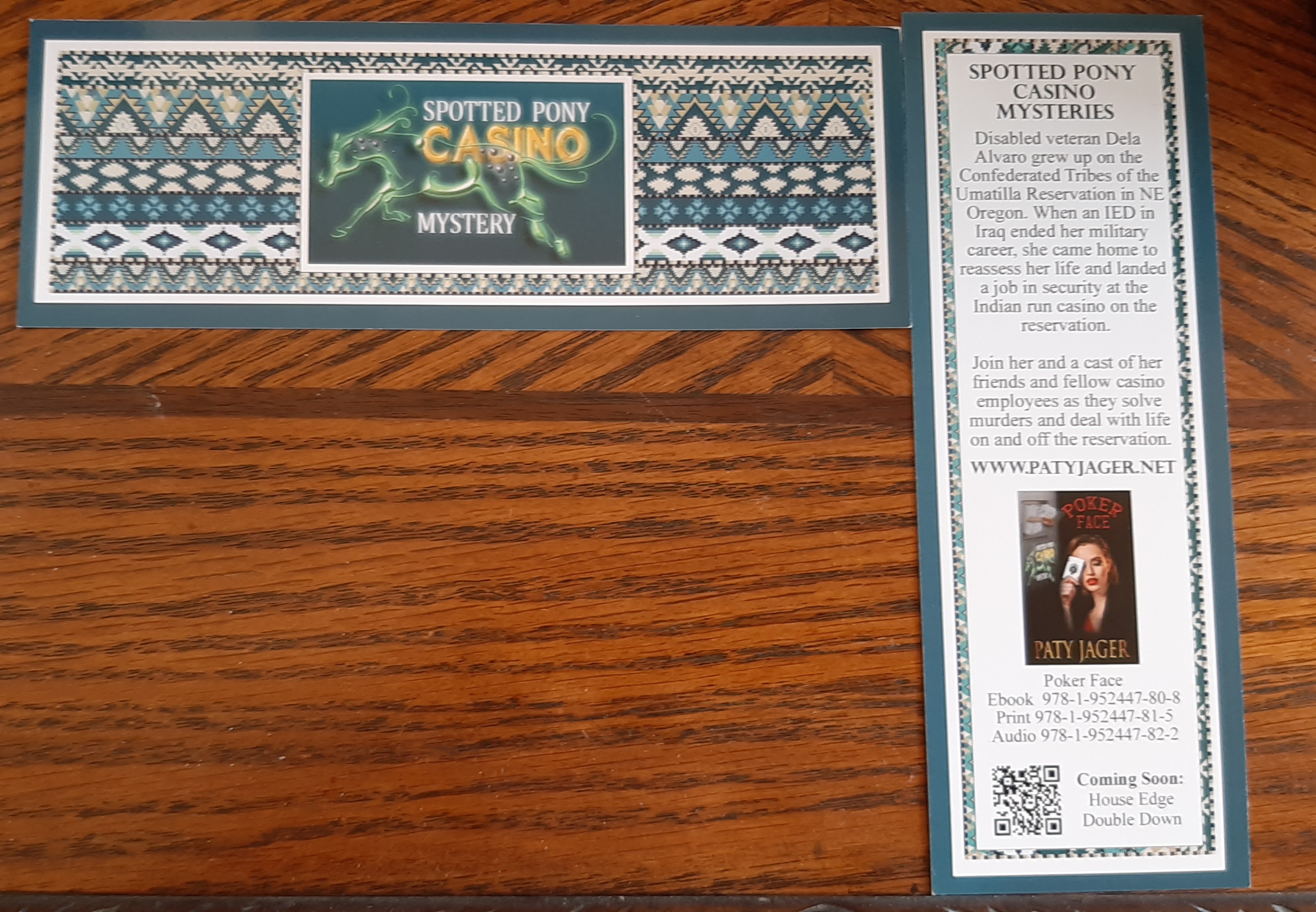
Anyway, as I chortle over the definition… With the new series I needed bookmarks. My awesome daughter to has designed most of my covers and all of my bookmarks and swag, came up with this design for my Spotted Pony Casino Mystery bookmark.
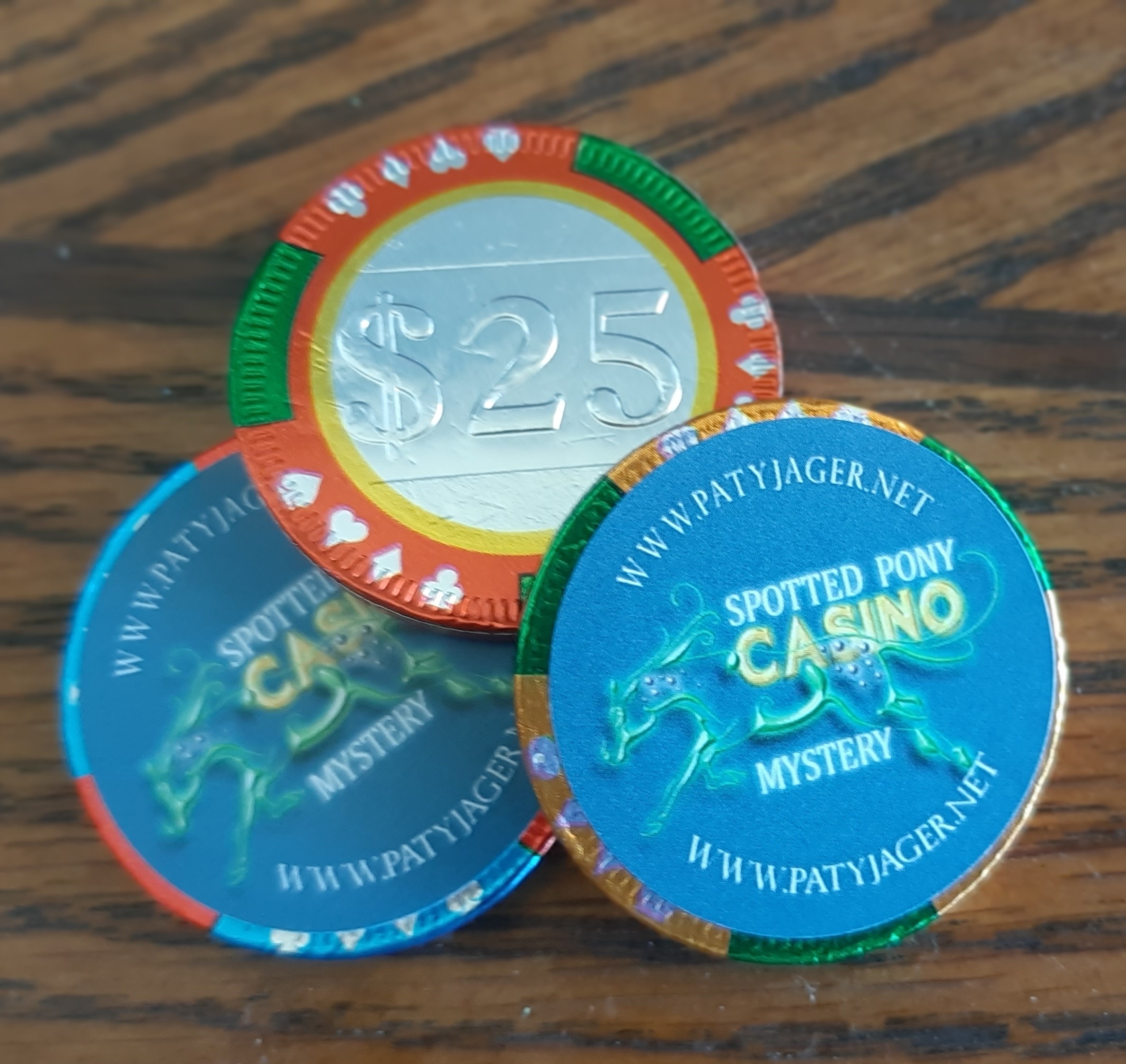
And because I’m headed to Bouchercon this month and wanted items to give away during the event, she also designed these chocolate poker chips I’ll be handing out. I wanted something that said “Casino Mystery” and was lucky enough to find a promotion site that made custom chocolate poker chips.
The one on the left is fuzzy due to the setting on my camera.
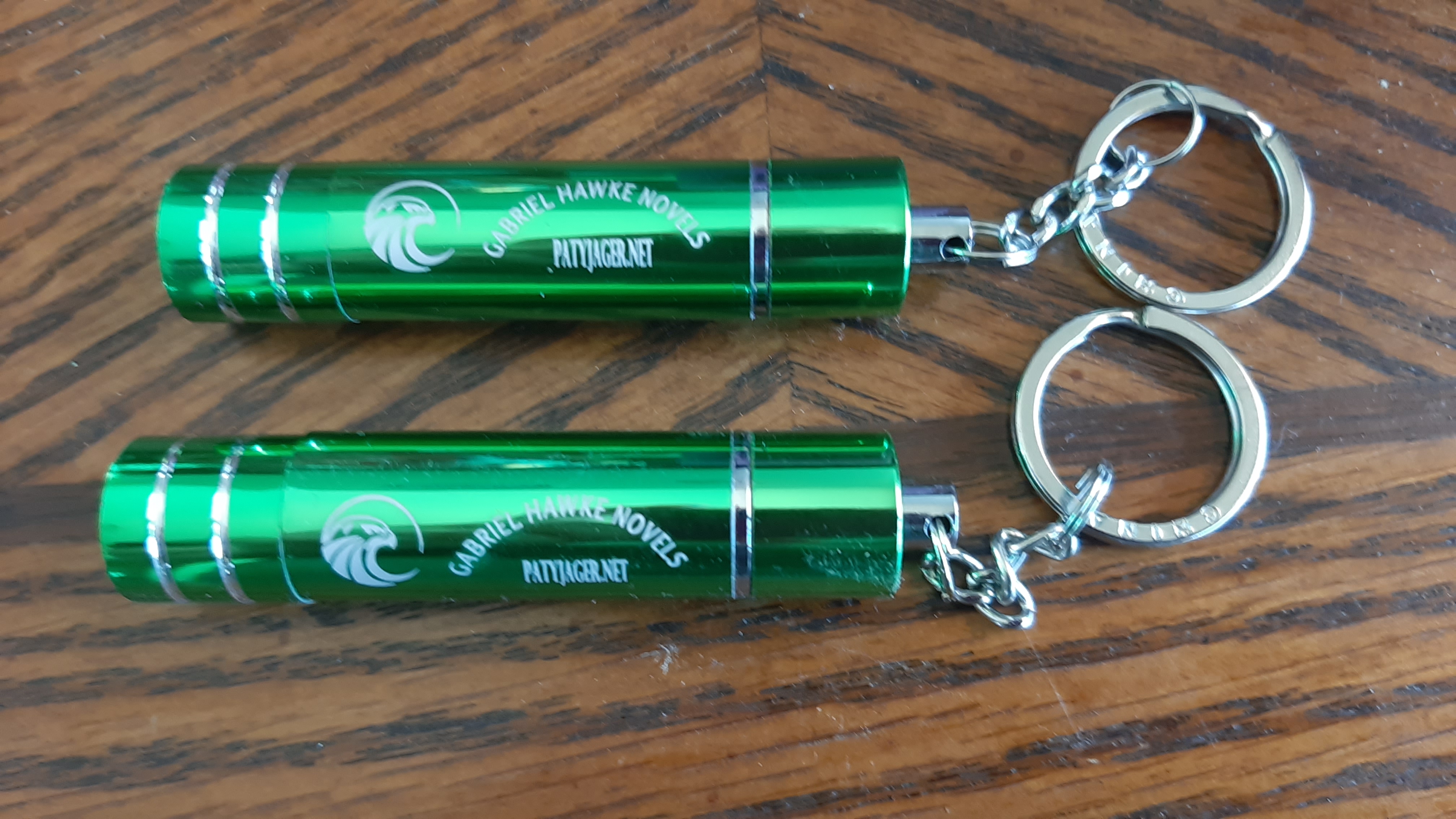
For my Gabriel Hawke fans, I ordered these fun flashlights for Bouchercon last year. A conference that never happened. Good thing flashlights hold over well. 😉 Worried about transporting this on the plane, I asked a security person when we took our grandson to the airport if they would be allowed and he said, “yes.”
Over the years I’ve given away ereader covers I made, Dream catchers I’ve made, and I hand out small tote bags with purchase at the Sumpter Flea Market twice a year. The bags do help. I had one woman tell me that seeing someone carrying one of my bags reminded her she needed more of my books. I am finding out that while I’ve picked up swag over the years that didn’t move me to purchase a book, it does seem that a bit of the freebies handed out do help to sell the next book by an author.
For Bouchercon, I also made a 4″ x 6″ chap book with the first chapter from each of the first books in my mystery series and my Romantic Suspense trilogy. I’ll be handing those out during my “Speed Dating” event. I’ve made several of these over the years that I hand out at conferences. I have one that is the first book of my historical western romance series. One that is the first chapter of the first book of my trilogies or series with Native American elements. And one with the first chapters of my mystery books, like this one, only minus the new mystery series.
As an author what are some of the things you’ve given away over the years? As a reader what are some of the items you’ve received that you kept? Did that every remind you to look for a book by that author?
SINCE WRITING THIS POST BOUCHERCON HAS BEEN CANCELED. So the swag will have to wait for another conference.
“An accomplished work of haunting mystery fiction fans of the genre won’t want to miss.”—ReadersFavorite.com
A mystery is a mystery is a mystery—not.
Readers who enjoy solving a whodunnit with their fiction can chose a cozy, a hard-boiled detective mystery, a police procedural, a noir mystery or even a historical mystery.
They each have their own conventions, required elements and fans. But they all have in common one thing …a body, often on the first page, almost always within the first chapter. Readers of these sub-genres will usually meet the victim—sometimes a nice, unwitting fellow, sometimes a despicable character even a mother couldn’t love—within the first few pages and learn about them, often with a nice dash of back story thrown in. Just before the victim, well, becomes the victim.
Then the reader spends the remainder of the novel trying to unravel the puzzle as they encounter character after character, searching each for motive, means and opportunity, dodging red herrings to try to arrive at the culprit, hopefully right before the great reveal by the author.
It’s how it’s done, it’s expected. For all the types of mystery—except mine.
Like the other types, my Haunted Shores Mysteries are classic whodunits, with the parade of possible bad guys (and girls), turns down wrong alleys, and a meticulous shifting through clues—though all these are harder to navigate because each is a cold case murder, the deed occurring years earlier.
But the aspect that sets my narratives apart from these other mysteries is the victim. Oh, Darrell—and the reader—encounters the victim in the first few pages, but he has no idea who the victim is. And it’s not a simple case of mistaken identity. You see, when Darrell first stumbles onto the victim—or more likely he/she runs into him—he/she is a ghost.
And his or her death has been covered up so as to not look like murder. The challenge for Darrell—and the reader, I hope—is to sift through clues together to first learn who the victim really was, then determine how he/she died, then try to unravel the clues that lead to the murderer. It’s a complicated process fraught with peril.
In CRIMSON AT CAPE MAY, the newest novel in the series, a tall, injured female chases Darrell down the street of Cape May—all in the first few pages. He has no idea who she is, why she is following him or that she is a victim. Until she reveals she is a ghost and pleads for his help. Even when he finally decides to help this poor woman find justice, he has no idea who she is, how she really died, much less who could be possible suspects for the murder. A tall mountain to climb.
If you’re a mystery lover who enjoys solving a complicated puzzle, check out CRIMSON AT CAPE MAY (or the other #1 best selling entry in the series, BLOOD ON THE CHESAPEAKE). See if you can get to the top of the proverbial mountain before Darrell. I’ll guarantee it will be fun trying.
No matter how far you run, you can never really escape a haunted past.
Darrell Henshaw—teacher, coach, and paranormal sensitive—learned this lesson the hard way. With his job gone and few options, he heads for Cape May to coach a summer football camp. The resort town, with gorgeous beaches, rich history and famous Victorian mansions, might just be the getaway he needs. Only, no one told him Cape May is the most haunted seaport on the East Coast. One resident ghost, the Haunted Bride, stalks Darrell, begging for his help.
He can’t refuse.
Joining forces with Cassie, a street-wise teen and another sensitive, he investigates the bride’s death and discovers her murder is connected to a far greater horror. But can Darrell and Cassie expose those behind the crimes before they end up being the killer’s next victims?
Incredible sale on the entire Haunted Shores Mysteries series!
BLOOD ON THE CHESAPEAKE-$.99, CRIMSON AT CAPE MAY–$1.99, SCARLET AT CRYSTAL RIVER (pre-publication price)—$2.99.
Dr. Randy Overbeck is an award-winning educator, author and speaker. As an educator, he served children for more than three decades in a range of roles captured in his novels, from teacher and coach to principal and superintendent. His thriller, Leave No Child Behind (2012) and his recent mysteries, the Amazon and B & N No. 1 Best Seller, Blood on the Chesapeake and Crimson at Cape May have earned five star reviews and garnered national awards including “Thriller of the Year–ReadersFavorite.com, “Gold Award”—Literary Titan, “Mystery of the Year”—ReadersView.com and “Crowned Heart of Excellence”—InD’Tale Magazine. As a member of the Mystery Writers of America, Dr. Overbeck is an active member of the literary community, contributing to a writers’ critique group, serving as a mentor to emerging writers and participating in writing conferences such as Sleuthfest, Killer Nashville and the Midwest Writers Workshop. When he’s not writing or researching his next exciting novel or sharing his presentation “Things Still Go Bump in the Night,” he’s spending time with his incredible family of wife, three children (and their spouses) and seven wonderful grandchildren.
Back in 2007, I had been challenged by other writers to create a protagonist who wasn’t Barbie doll perfect. So I came up with The Persephone Cole Vintage Mystery Series. It takes place in 1942 Manhattan during the beginning of the country’s entrance into WWII. The stories revolve around one of the country’s first female detectives, a full-figured gal named Persephone (Percy) Cole. She is 5’11”, strong, able, and very secure living in a man’s world. At 35 years old, which was considered middle-aged for the times, she has a mouth on her, wears Marlene Dietrich pants suits, altered for her size, and her father’s fedora hat. She is also a single mother who moves back into her parents 4th floor walk-up on the lower east side, as much for her 8-year old son’s sake as that of her parents.
From the git-go I loved Percy. I had accidentally created my ideal protagonist, a woman who could go anywhere a man could go, do anything a man could do, and was smarter and sassier about it. I was surprised when the books didn’t leap off the shelves after publication. Or at least climb off. I thought for sure women would love to read about a woman who found her place in the sun, even with everything stacked against her, and did it with humor and guile. Didn’t happen. Meanwhile, the Alvarez Family Murder Mysteries continued in their popularity, this sparkly, contemporary series about a Silicon Valley detective agency led by protagonist Lee Alvarez, who is, frankly gorgeous on every level. Make no mistake, I am forever grateful for that. But still.
I had a pang in my heart for my beloved Percy, her son, Oliver, Mother, Pop, and their 1940’s world. However, after the 3rd book of the series didn’t sell any more copies than the first two, I decided to stop writing them and move on. But still the pang lingered. The Alvarez Family grew in popularity, Percy Cole continued to languish.
But I see the world has changed. And a woman’s place in it. Women like being physically strong now. They like knowing they can defend themselves and not depend on a big strong man to do it for them. They appreciate – we appreciate – self-sufficiency. So I have decided to pull Percy out, dust her off, and see if this pistachio nut eating heroine will go. I am currently writing the 4th book of the series.
“Put another nickel in, in the nickelodeon, all I want is having you, and music, music, music.”
If you are of a certain age, like me, you’ve heard that song. You might even know what a nickelodeon is.
The song is called “Music, Music, Music.” It was recorded in 1950 by Teresa Brewer and the Dixieland All Stars. It was the B side of the recording. But the bouncy, effervescent tune, with 1950s written all over it, became a major hit.
What has this got to do with writing mysteries? Well, if you’re writing a historical novel, or even a contemporary one, music is a great way to define time period and setting. The Jill McLeod novels take place in the early Fifties, 1952 and 1953. One method of giving the readers the flavor of the times is to mention what music Jill and her friends and family are listening to.
In The Ghost in Roomette Four, Jill is having a conversation with her younger brother Drew. He’s a guitarist in a blues band and has an upcoming gig at a club in West Oakland. He disparages a popular song of the time, “How Much is that Doggie in the Window.” If there was ever a song that says early 1950s, it’s Patti Page singing about that dog.
And nothing says Bakersfield like country music. In Witness to Evil, my private eye Jeri Howard is heading south down the valley, listening to Patsy Cline. When she goes to New Orleans in The Devil Close Behind, well, New Orleans! In the first chapter, Jeri goes to Preservation Hall with her father. Hey, second-line parades and musicians on the corner, playing traditional jazz, with Jeri dancing on the sidewalk.
I’m writing another Jeri Howard case, this one called The Things We Keep. I keep running into the Sixties, with plot, characters, and setting. One character, Gloria, lived in San Francisco’s Haight district during the 1960s. She was the lead singer for her boyfriend’s band and proudly claims she knew Janis Joplin. And by the way, she was at the Monterey Pop Festival in 1967. Talk about the flavor of the times. Picture Janis on some stage in the Haight, singing “Piece of My Heart.” Or Jefferson Airplane, with Grace Slick vocalizing “White Rabbit.”
Bring on the bell bottoms.
Yes, music is an effective, even essential addition to the writer’s toolbox.
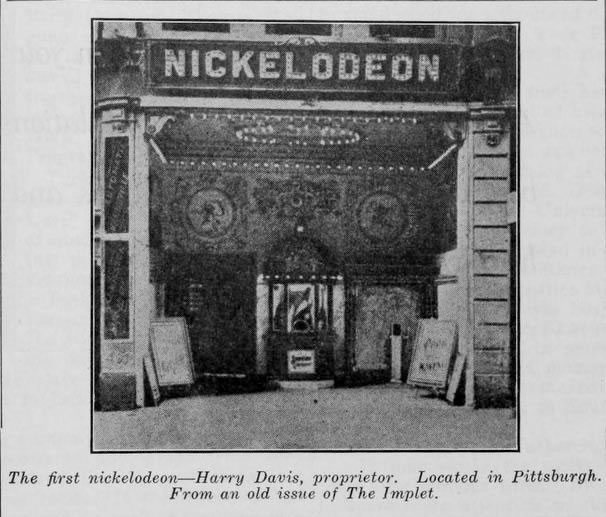
And just what is a nickelodeon?
It’s a coin-operated machine that plays music. Could be a jukebox or a player piano. The original meaning, however, was a movie theater or cinema that cost five cents.
In every creative writing class the instructor is sure to note at some point the importance of the first line. These few words should grab the reader, and lead her into the rest of the story. We all know the classic first lines by Tolstoy and Chekhov and Chandler and Christie, but those don’t really help us with writing our own. I didn’t always recognize the brilliance of some first lines, which made coming up with my own even harder.
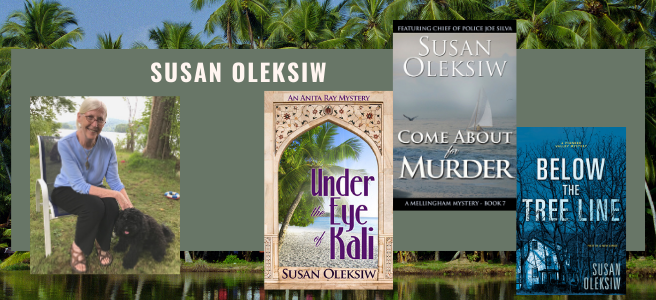
At first the issue seemed to be to write something intriguing. For the first book in the Mellingham series, I wrote and rewrote the first line along with the first chapter, writing, in the end, three first chapters and stacking them one in front of the other. In the end I was persuaded to cut most of them, and I ended up with what I thought was a pretty good first line for Murder in Mellingham. “It had been some time since Lee Handel had ventured out willingly on a social occasion, but his wife, Hannah, had reassured him that this party would be safe.” This line sets the stage for the evening to come but not much else. That line introduced the first of seven titles in the Mellingham series.
The first line of Under the Eye of Kali, the first in the Anita Ray series, was even less connected with the story to follow, but it set the scene nicely. “Guests from various foreign countries began filling up the Hotel Delite dining room, taking every seat at the main table—this was a small hotel, only eight rooms, with the owner’s, Meena Nayar’s, suite on the top floor, and that of her niece, Anita Ray, above a separate garage.” This was the first of four books, with a fifth one waiting on my desk.
You would think by the time I came to write my thirteenth book that I would have mastered the art of the first line, but you’d be wrong. Below the Tree Line opens with what I regard as a terrific line, but it isn’t necessarily the best first line for a mystery novel. But I didn’t come to this conclusion until recently. Below the Tree Line opens with this: “On the third night Felicity lifted the shotgun from its place in the cabinet, and this time she loaded it.” There isn’t much wrong with this line as it stands, but it doesn’t tell you as much as you might think about what’s coming next.
After publishing dozens of shorts stories and thirteen novels, I tried a new approach in creating the perfect first line. I don’t know if the result is perfect, but I established a definition of that first sentence that works for me. I now consider the first line as the apex of a pyramid, and the story is within that pyramid. Whatever happens must be traceable back directly to the first line. This by itself means extraneous scenes, extra characters, digressions into backstory, or a humorous or romantic subplot that is more filler than mystery, are all to be excluded.
In my current novel, now with my agent, I rewrote and reworked the first line more than a dozen times until I had something that, like a math or drawing compass whose points never deviate as they draw the circle, could embrace the entire story, holding each part in tight, streamlining and smoothing the narrative. This, then, is the first line of So Comes the Reckoning: “The first time Renee watched a man die, she was eleven years old, kneeling beside him as he lay on the ground.”
As I wrote the 82,000 word story I kept that first line in front of me and asked myself repeatedly, Is what I’m writing now linked to that statement? If not, why not? It was hard to find myself jettisoning entire chapters because I seemed to think they were needed but could find no connection to the first line and its implications. Why was she there? Why was this a first time? Why did she not, as an eleven-year-old child, run away or at least stand apart? The implications of those words kept me on track.
Since then I have come to appreciate the difference between a good snappy sentence and a good first line to a particular novel. They are not necessarily the same. The challenge is to combine them in such a way that the story unfolds from those opening words. It’s an ongoing challenge.









You must be logged in to post a comment.