A Regional Anthology Continues

Last year, in 2020, Level Best Books announced that it would no longer publish its annual anthology of stories about New England, and would instead focus on its mystery novel line. Everyone who had ever been involved with the anthology was disappointed. The annual Best New England Crime Stories anthology was a much-loved collection, but it had changed over the years. One aspect that remained constant, however, was publication of the winner of the Al Blanchard Award.

The crime fiction world offers lots of anthologies for readers, so the end of one was sad, but the loss of the publication of the Al Award winner seemed a huge loss. Leslie Wheeler, who has been chairing the award committee for years, was especially concerned, and trying to figure out what to do about that drove early discussions among several of us until all of a sudden three of us had signed on to continue the anthology—Ang Pompano, Leslie Wheeler, and myself.

Best New England Crime Stories will be published by our new press, Crime Spell Books, and will include only short fiction by New England authors. 

A little history is in order here. In 1993 Kate Flora, Skye Alexander, and I founded Level Best Books to publish an anthology of crime fiction by New England authors. When Skye moved to Texas, Ruth McCarty took her place. Eventually we passed the LBB on to another group, Mark Ammons, Kat Fast, Barbara Ross, and Leslie Wheeler. After several years they passed LBB on to a group around DC, associated with Malice Domestic. They changed the requirements to stories set in New England by writers living anywhere, not only in the six New England states. 

Crime Spell Books intends to return to the original parameters—stories by writers living primarily in New England (we admit that some of our favorite writers escape New England winters by moving south; we’re jealous but forgive them the error of their ways). Regional anthologies occupy an important place in the world of fiction—opening up one region to readers in another. A good anthology presents a sufficiently varied group of stories to take the reader deep into the territory but also an assemblage of characters closely related enough to give the reader the feel of a novel, an immersion in a way of thinking and living.

We know that many writers who appeared in earlier volumes will be disappointed—unless, of course, they move here. But we are excited to focus on New England authors. Over the years LBB published many first stories by writers now well established and well known. We want to continue that tradition of giving new writers a strong start while also supporting other writers well known and not so well known. Look for our first anthology, Bloodroot, coming in November 2021.

Will We Ever Evolve?

All fiction writers would like our novels to be considered timeless, so when we incorporate historical events or trends into our stories, we often fret that although that makes a story seem more currently relevant, our books could be considered “dated” as the years pass.

However, with my Sam Westin mysteries, I have found that hasn’t been a problem. And that is, frankly, disturbing. My first book, Endangered, was published a decade ago. Its theme of the media and the public inflaming each other to the detriment of truth is still all too relevant, as we have all watched Twitter and Facebook and even television channels spread misinformation to capture the headlines and the public’s attention on a daily basis.

The second book, Bear Bait, originally published in 2012, features armed, racist, anti-government movements intent on perpetrating violent acts against government employees across the nation. Hmmm. Have we seen anything like that lately?

The third book, Undercurrents, includes two parallel stories, one in the Galapagos Islands and the other in Arizona, both with villains fueled by malice toward foreigners coming into their countries. That anti-foreigner attitude clearly hasn’t changed, as our recent leadership seemed hell bent on building a wall on our southern border and tried to prevent travelers from Muslim countries from entering the U.S.

I did manage to more or less escape the political arena for the fourth book, Backcountry, which deals with the effects of the murders of two women hikers. I say “more or less” because the story does include a lot of issues with guns in the wilderness. Sadly, murder is a recurring theme throughout human history.

Then, after a trip to the aforementioned wall along the U.S./Mexico border, I just had to write about the crimes, the environmental destruction, and the ruin of so many lives and livelihoods in that area in Borderland. And all those issues will no doubt affect Americans for decades to come.

I’ve also written the Run for Your Life trilogy (Race with Danger, Race to Truth, Race for Justice), about a champion teenage endurance racer who is living under an assumed identity because of the unsolved murders of her parents, who worked for a pharmaceutical company that supplies vaccines for a continuously evolving virus. Yeesh. I wrote those books between 2015 and 2018.

What does it all mean? That Americans, or maybe even humans, are incapable of evolving? Are we stuck in some sort of endless loop, doomed to forever repeat the cycles of hate and violence? Whether we’re discussing sports or religion or politics or wearing masks in a pandemic, we can’t seem to get beyond some sort of “us against them” attitude. It’s all a bit depressing. But it’s also good fodder for fiction.

And then, just yesterday, I watched a woman become vice president for the first time 100 years after women won the vote in this country. That milestone has been slow in coming, but it offers a spark of hope for the future. Which is also good fodder for fiction.

Promoting Covid-Way by Karen Shughart

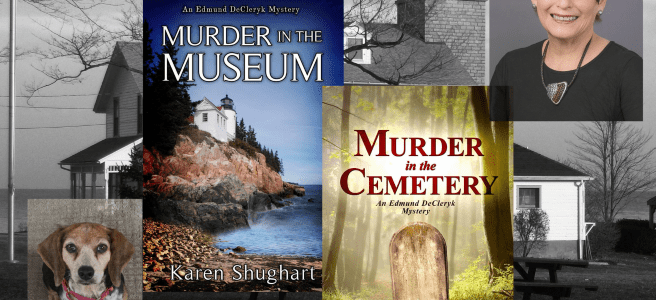
I had planned to write this month about traditional ways of promoting books. My second mystery, Murder in the Cemetery, was released last February by Cozy Cat Press, and I had already lined up book signings, talks, appearances at mystery writers’ events, a book-launch party, and an appearance as a panelist at a mystery readers’ conference. But then Covid 19 hit, and one-by-one everything was cancelled. It’s a difficult time for book sales when the normal avenues of promotion are no longer available.

My publisher, Patricia Rockwell, aware of the challenges facing authors during the pandemic, produced a YouTube video, shot by my friend Tom Lightfoot, where I prepare one of the recipes from my first book, Murder in the Museum. It’s been well-received. I also hired a publicist to promote my books on social media, recognizing how important it is and how inexperienced I am.

A free-lance writer, Laurel Wemett, has been an amazing supporter, announcing the publication of book two in last summer’s edition of the lovely regional magazine, Life in the Finger Lakes; then reviewing it for the 2020 November/December issue. Later she wrote a blurb for the e-version of the magazine on how the cover of book one placed #13 out of a field of 360 in a monthly cover contest sponsored by AllAuthor. She also sent the cooking video to Mike Murphy who interviewed me in his weekly column, “Eat, Drink and Be Murphy”, about the marrying of my books with cooking for the Daily Messenger and Wayne Post print and online newspapers.

I learned about AllAuthor from Patricia, who has been instrumental in encouraging all of us authors affiliated with Cozy Cat to promote in non-traditional ways. With her encouragement, I applied and was accepted as a member of the Crime Writers Association of the UK, a lofty organization with a presence in the US.

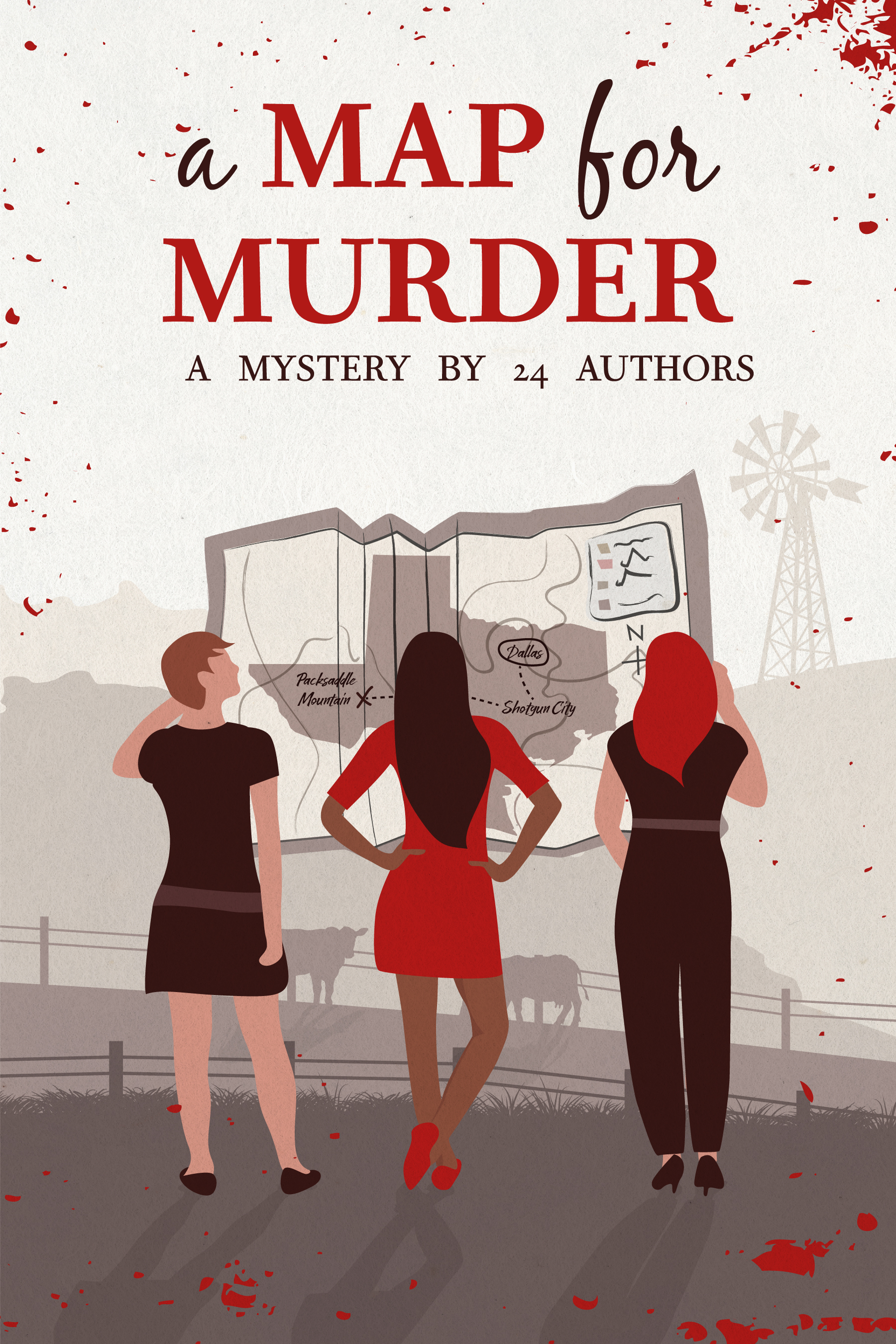
Finally, I participated in writing one of 24 chapters for the newly released book, A Map for Murder. It was lots of fun, and I think readers will enjoy the zany, fun-filled adventure three young women have in solving the murder. We authors recently were filmed talking about the book that you can view on YouTube.

All of the above has helped call attention to and generate very respectable sales for my books, and I’m grateful for the help and encouragement I’ve received. To those of you who read my monthly blog and have sent messages of support, I thank you.

So yes, 2020 turned out to be different than I thought it would, but in times of Covid and new book releases, it turned out much better than I ever expected. Hopefully this year will be less surreal, and we’ll be able to resume a semblance of normalcy in our lives.

Starting Afresh, With Hope

by Janis Patterson

Happy New Year! Hopefully 2021 is going to be a better year than 2020. It would have to work very hard to be worse!

I’ll admit I was off my game during 2020, and I’m not sure why. My life did not change that much during the lockdowns. My normal day (if writers do indeed have anything that could be regarded as a ‘normal’ day) consists of spending most of the day sitting in the den in front of my computer all alone with my invisible friends. During the lockdown I spent most of the day in the den in front of my computer all alone with my invisible friends. The only change was that The Husband was here for about two months before he had to go back to work. Then I sat alone in the guest room/my office all alone with my invisible friends. I did miss the lunches with my real living friends, but we talked on the phone and made do with that. I also missed – and still do – our various clubs’ meetings and fear greatly that some of them will not come back after this plague is over.

Now the big change in our lives is The Husband is officially retired as of January 8 and that is a big adjustment for us both. I have pretty much moved my work into my office, leaving the den and the television – and our spoilt and yappy intrusive little dog – to him during the day. The only chore left – and it’s a big one – is to train him that when I am in my office with the door closed I am working. I’m not retired like he is – and has to learn he shouldn’t disturb me unless there is death, flames or blood. I honestly don’t know how that will go; a former Navy captain, he is not used to taking orders.

So – assuming that I am able to work at least semi-uninterrupted in my office – what will I be doing? As I said, I did a lot of goofing off this year, letting my writing and publishing slide, a distressing situation which I must endeavor to correct. I must quit taking an afternoon break bingewatching Netflix and chatting for hours on the phone. I must set up a writing schedule for the year, as I have done for many years before the disaster of 2020, and more importantly stick to it. I must set a daily routine, just as if I had an office job, because we all know writing is not only a real job, it is a strict taskmaster. Dilettantes don’t last long.

Can I do all that and become the hard-working, dedicated professional novelist I used to be? I honestly don’t know. Two years ago after a long recovery following my very first surgery ever I claimed the sloth as my spirit animal, and he is a stern taskmaster. Maybe that’s ‘anti-taskmaster.’ I can find all kinds of real and logical reasons why I shouldn’t get up and accomplish something, and let’s be honest, the madness of 2020 most definitely did not help. Sometimes it takes hours to force myself off the couch and back to the computer. Bad sloth, teaching me such self-destructive but pleasurable habits! Bad me, for giving in to them!

And, to prove I’m really working on it, tomorrow I’m releasing not one, but two brand new books. ROMANCE AT SPANISH ROCK, written under my romance name of Janis Susan May wherein an LA photographer inherits a ranch in Texas’ Palo Duro Canyon, and A WELL-MANNERED MURDER, a murder mystery written under my crime name of Janis Patterson wherein a middle-aged woman trying to survive a divorce is researching a long closed charm school and gets involved with the Kennedy assassination. Both are available as ebooks only (at the moment) on Amazon and Kindle Unlimited. You see, I am trying!

2021 will be better. I will see to it. I promise.

Just Like In The Movies

Books have been adapted into movies since Hollywood became the glittering city, drawing hopefuls on stardom promises since the early 20th century. I could look up which movie was the first to adapt its storyline from a novel, but I don’t want to, and that’s not this month’s thesis. But, as the cinematic empire evolved, I found myself thinking about books, and how this medium needs writers to captivate minds enough to open their wallets.

But before books came to be thanks to Johann Gutenberg’s printing press in 1555, what did people do for information and education, to spark dreams and ideas? They told stories. Before then, the poor couldn’t afford books, copying reads to parchment by candlelight was painstaking tedium and boring (could you imagine starting over if you left out a word or wrote one wrong? Yikes!), so oral retellings committed to memory was the only way to share. Not like they had TMZ, Hearst, or podcasts to rely on for such things.

Some stories are lost to time by extinction and elemental damage, unfortunately. But oral traditions in many, many other stories survived the tellings and retellings to captivate the listener in imagination, in laughter or sorrow, or a strong lesson learned. Reading is no different. Again, many thank-yous to our innovator Johann G.
undefined,
Terry Brooks, author of the Shannara series and The Magic Kingdom stories, put it best (paraphrasing mine) of this medium: “Reading is the least expensive form of entertainment, but has the most lasting impact. It forces the brain to slow down and process this information, leaving an imprint unforgettable for some time.” And the late, great Paul Harvey once said in his broadcast of a Harry Potter film adaptation release: “Directors of movies think they have the author’s story vision for a blockbuster film, but it’s readers who hold more power. That story in your hands, Reader, is your script. You, Reader, are the true director in which the words feed your imaginations’ worlds (paraphrasing also mine).”

Okay, damn! But he and Paul Harvey weren’t wrong. The books are almost always better, and I speak from experience.

At the time of the 1982 release, I was excited as hell for the adaptation of The Outsiders. You know that story, right? No? Here’s the gist without giving away the story much: a ragtag bunch of guys eventually confronts their more privileged rivals after one kills another in self-defense. There’s more themes in this story than this post permits time for, but while the book brilliantly drew out uncomfortable truths of classism and how some are more equals than others if you have enough money to get you there, the film itself didn’t capture this in the least. Seeing the move on first-night release as an eager 17-year-old, I left disappointed and pissed. Thinking it was just me and expecting the movie to live up to my exprectations, I went again the following night.

Nope–was right the first time, and spot on since seeing this film thereafter: The movie version sucks at worst and passable at best. But hey, the guys playing Two-Bit Matthews (Emilio Estevez), Johnny Cade (Ralph Macchio), Sodapop (Rob Lowe), Darry (Patrick Swayze), and Ponyboy (C. Thomas Howell) Curtis were/are super-easy on the eyes. I even thought Diane Ladd (Sherry “Cherry” Valance) was sexy as shit then and still so today. Still didn’t take from the fact Coppola could’ve taken the time to capture on film what Hinton did for me in her story pages–which validated Harvey’s point of the reader’s imagination being the best movie experience far better than any director can do, if he’s doing his job right as the author sure has to do. It’s also reported Roald Dahl–Charlie and the Great Glass Elevator and James and the Giant Peach author–thought the 1971 Willy Wonka and the Chocolate Factory movie was atrocious, and loudly voiced his objections (it’d been reported a third into the film, he walked out). I have wondered, though, what his thoughts might’ve been on Tim Burton’s take on the same story, but at least Burton had the stinking decency to stay true to the book! We’ll never know, sadly; Dahl died in 1975.

While watching TCM with my husband Pete one Sunday morning–Noir Alley wirh Eddie Muller, to be precise—we got to talking. The films often don’t do the books justice, but authors have to give more than enough visual guides to feed a reader’s asleep-dreams as directors do for the adaptations, Coppola and Mel Stewart notwithstanding. We authors dream about our scenes, settings, titles, characters’ wardrobe; what they look like, smell like, act like, talk like, are like. But if I’ve done my storytelling job well, what my TOMM cast looks like doesn’t just matter to me, it matters to the one reading me. Say a homeschooled teenager’s reading FROST BITE on the low (his parents are super strict on his book content, and I didn’t exactly craft a work Victorian-era prudent **smirk**). Let’s also say this kid’s bisexual on the rogue. What if he’s wildly in love with my FROST BITE narrator–hey, you’ve crushed on your past book characters, don’t judge! :)–and in this kid’s dreams, my narrator’s good with this, even though he’s told me he’s sunbeam straight? Honestly, there’s nothing either of us can do about that aspect, because I’m not in that kid’s mind as Logan, my MC, is. In other words, it could be Logan’s doppelgänger belonging to this kid who’s enjoying a Luther Vandross and scented candles romp, but the author’s fictional McGuinness isn’t. Or, as the Harry Potter director cast a young unknown at the time named Daniel Radcliffe for the part, the readers and audiences may’ve had a completely different look in mind on a more personal level–their imagination Harry is green-eyed to Daniel’s blue, or their imagination Harry was a taller eleven-year-old than the one for Sorcerer’s Stone (and while on the topic, they couldn’t’ve fitted Daniel with non-Rx green-irised contacts? The movie is pretend, after all! But it’s done, and I digress.).

And then there’s our story of lore in who had to be casted as Margaret Mitchell’s Rhett Butler for the iconic film–no question Clark Gable was the only one to fit that bill (To be fair and in her defense, though I don’t claim to know if Mitchell’d had him in mind while writing GWTW, her knowing the cast so well automatically connected the actor with the character in the readers’ minds before the film came to be–much like we prefer young Elvis over old, or the late Sean Connery as the 007 James Bond.). Does this make sense?

I read a lot as a child, even more when I moved to, and lived in, 6,000-strong Page, AZ in 1980 (pop. today: 73,442, based on most recent U.S. Census compilations). I didn’t make many friends, I was quite ostracized for being different–ho-ho, much like today after shedding three writing orgs, right, #RioLinda? :). Lacking means to get around other than walking, I needed an escape from my family and nothing-to-do-in-Podunk-AZ surroundings. Books were that, like movies and drawing horses were for The Outsiders‘ narrator Ponyboy Curtis. I wore that book out reading it so much, I could near quote whole chapters from memory, which was why the film still disappoints today. Though impressive, it didn’t win me many friends or influence people, writing did. It became another escape, like some watch old movies, or play aquash, or take long distance runs for the same thing. Just like those movies, imaginations are stirred enough to find a fedora to wear like James Coburn or James Stewart did in their films. And on occasion, because of this sparking my imagination, I don’t mind rabbits, love the name Harvey, and look fierce in a fedora.

Books are the readers’ personal movie scripts they get to direct. Some readers may become writers and authors themselves as result. Some stay readers and want more scripts. We spin yarns for your imaginations. And always for ours, too. That’s doing-it-for-Johnny, “Outsider” enough for me.