In the Air, Like Pollen

It’s the question we writers often get at events: “Where do you get your ideas?”

My standard answer: They’re in the air, like pollen. Ideas for crime novels come at us from all sides. When it happens, it’s great.

A few weeks ago, I got an idea. I didn’t know whether it was a short story or whether it would grow to be a novel. The characters: a man and a woman. They are both living like recluses, away from society by choice. They are thrown together by circumstance.

Then the woman goes missing.

I started making notes and next thing I knew I had more than a dozen pages, exploring just who these two people are and what’s happening in their lives. They both have pasts that are leading them to the present. What happens in the future? Well, I haven’t yet figured that out, or how I’m going to get there. But I do have a setting now. And names for those two people. It’s been exciting to see the plot take shape in the short time these two characters made themselves known.

And apple trees are involved. Go figure.

Then there’s my novella, But Not Forgotten. Several years ago, I attended my 50th high school reunion. Yes, I’m that old. There was a big poster at the first evening’s event, listing all our classmates who had died, including the year of their deaths and the causes. I looked at the poster and said, what if? What if there was a question mark next to one of those names? What if a classmate disappeared on graduation night and was never seen again? What if another classmate was determined to find out what happened?

I thought about this as I drove my rental car to the airport. Inside the terminal, waiting to board, I took out a notebook and scribbled furiously. By the time I got home, I had my plot and characters and I’d solved the fictional mystery.

Right now I’m working on The Things We Keep, Jeri Howard’s 14th case. How did this one start? Well, it was the setting. I go to the local farmers’ market on Saturday mornings and sometimes I park in the vicinity of an old Queen Anne Victorian. Someone is living there, but the house is quite rundown. It looks haunted, as a matter of fact.

What if?

The idea pollen started flying. What if Jeri Howard finds a trunk full of bones in the attic? Two skeletons, even. Jeri has to figure out whose bones are in the trunk, how they got there, and who is responsible. Things are getting convoluted and I have a lot of plot to untangle, not to mention characters who are coming to vivid life.

Believe me, I’m having fun with this one, thanks to all that idea pollen in the air.

Living the Fiction by Heather Haven

Being involved in what you write is one of the keys to being a good writer. But it can get out of hand. When I started the first book of the Alvarez Family Murder Mysteries, Murder is a Family Business, the story included finding a kitten. I discovered I couldn’t write those scenes without becoming a little misty-eyed. I think a lot of that was due to the fact the feline in the story was based on my cat, Tugger, whom I loved and adored. He’s been gone to that great catnip haven in the sky for over eleven years, and I still love and adore him.

Wait. Misty-eyed.

The scene where Tugger was found by our protagonist in an abandoned phone booth in the rain, a frightened, drenched kitty, could never be written with completely dry eyes. This stayed with me no matter how many rewrites. I didn’t think much of it at the time, but hoped it was an indication that I was a true writer rather than needing therapy. And I’m sticking to that.

Fast forward. As I was writing the 3rd book of the series, Death Runs in the Family, both Tugger and another cat, Baba, are catnapped. In the story, they’re put into their carriers, placed into the back of a station wagon, and are being driven to Las Vegas. As I write cozies, they would, of course, be rescued. That was the plan. However, before I could write the rescue scenes, something happened in real life that took me away from the computer. For three long days! I was good the first two. I would tell myself, this is just a story. But no matter how often I repeated the phrase, each time there was this little ping that would strike at my heart.

In the middle of the third night, I sat bolt upright in bed. It was three am. I had done nothing but toss and turn. I had to face it. I wasn’t going to get any sleep until I did something about the cats. My jerky movements and noisy sighing woke my husband up who wanted to know what was wrong. I said, “I have got to get those cats out of the back of the station wagon. They haven’t had any food or water for three days!” “Whatever you say, honey.” Then he rolled over and went back to sleep. You can’t be married to a writer for long without learning their ways. So I got up, went to the computer, and wrote the chapters where not only are the cats rescued, but they get salmon, water, and lots of cuddling. Within the storyline it had been probably six to eight hours. But in my heart it had been three long days. I went back to bed at seven am wondering how Eric Knight wrote the story Lassie, Come Home and managed to get some sleep.

I thought (hoped) this affliction only surfaced when there were animals in my stories. Unfortunately, not so. The 4th book, DEAD…If Only, has several chapters taking place on a thirty-foot cabin cruiser in the Gulf of Mexico during a hurricane. Many’s the night I would wake up seasick from the ten- and twenty-foot fictional waves pounding the boat. The 5th book, The CEO Came DOA, revolves around a Columbian drug called Devil’s Breath, a drug which reportedly takes a victim’s will power away and even kills in strong enough doses. You can succumb to this drug through swallowing, inhalation, or skin absorption. In short, pretty versatile, pretty lethal. Naturally, as I was writing this book we went on a Caribbean cruise that docked in Columbia for a day. I was a nervous wreck. I almost didn’t get off the ship. After hubby finally talked me into going ashore, I clung to him like a three year-old child to a teddy bear. This was a little difficult when one of us had to go to the baño or bathroom. I’m not sure what I did to international relations, but we took solace in the fact I was only there for one day.

I am currently writing the 8th book of the series, The Drop Dead Temple of Doom, set in the Guatemalan jungle. Woven into the story is the Yellow Dart Frog, one of the most poisonous amphibians in the world, and the Fer de Lance viper, one of the most poisonous snakes in the world. I threw in some pumas and jaguars just to round things out. Lately, I have been quite careful when I step outside my front door. You never know what’s going to pounce.

The Readers’ Responsibility – Valid Reviews

As readers, I would like to suggest that we have a responsibility to leave reviews, especially if we love the book. Reviews help other readers discover new authors, ones not touted by major publishers but by independent publishers and self-publishers. Getting a good book noticed as an independent (whether publisher or self-publisher) rests almost entirely on the reader’s shoulders. It isn’t hard to leave a review. In fact, most e-books end with the option. And as reviewers, we don’t have to write a treatise explaining what we liked or didn’t like; just assign a star from 1-5 on most sites.

Besides helping the book get noticed and sell, reviews help authors in three ways; 1) eat, 2) improve so that your next reading experience is better, and 3) keep a publisher publishing an author you like.

Unless a book has ten reviews on Amazon, it is at a disadvantage. So, for authors, ten reviews is a decent but frustrating goal. As a publisher and author, I ask that you take the time to give any Bodie Blue Books book a star rating, if not an actual review.

A Common Scale

The biggest challenge to comparing reviews across books is that there is no consistent, holistic scale used across readers. Simply put, each five-star review is given on a personal scale that may not be consistent book to book, much less across genres. For instance, a five-star book may be one you were driven to finish that delivered a rip-snorting solution to the mystery. Others may consider it a three because something was missing for them, even though they finished it in one reading.  

Momentary rant: Nothing is more frustrating for the author than to get a great review and a three-star score when the same review written by another reader would result in five stars. Worse, some readers seem to believe that they have the sensibilities of a New York Times book critic. Here is a hint: most don’t. What we do have is an absolute sense of what we enjoy as readers and what annoys us.

Back on topic: I spent a good deal of my business career teaching people how to evaluate student creative writing on a holistic scale. Reviewers were trained to apply a set scale consistently to rank students writing. A simple holistic score is easy to use. Further, it assesses the overall book not that one annoying swear word or mistake in the setting or time, but your overall reading experience. Below are a couple of example scales.

Example 1

5 Enjoyed it a lot, could be convinced to love it, a lively entry into the genre.
4  Enjoyed it, had elements that I loved, a solid entry in the genre.
3 Ahhh, liked it but average for the genre.
2  Expected more, below average for the genre 
1 Argh, got lost in a black hole

Examples 2 and 3

5 Loved it.I can’t wait for the next book from this author
4  Enjoyed it.I look forward to reading this author again
3 OkayI would consider reading this author again
2  Readable but . . . I would have to be convinced to read another book by this author 
1 Where is my red pencil?I have banished this author from my brain

The Point

A single holistic scale applied across online book sites would provide buyers a consistent, realistic method to compare books. Not having such a scale supports the dominance of mega-authors with big advertising budgets and faithful fans, not because the books are better, but out of habit and accessibility. This leaves writers who write as good as or better books in the weeds. Because sites, such as Amazon, rely almost entirely on reviews to determine who gets the best placement for advertisements, which books are featured, and which books pop during a genre search.

So, I beg you, when you finish reading a book, leave a review. Until we have a common scale, use your best judgment but be consistent in applying it. And remember, every review you leave helps an author EAT.

So where do I get my ideas?

One of the questions I have come to almost dread is the standard one about where I get my ideas for a story or a novel. The question is frustrating because no one really knows where an idea of any sort comes from. These things pop into our heads and we either play with them or toss them. But this morning I was trying to recall a thought about a particular memory that had been nagging at me. And that got me thinking about story ideas.

Some of my story ideas are not story ideas at all but arrive first as an experience I’ve heard about or undergone and can’t quite shake. One day, while still employed in social services, I was working quietly in my office when a conversation beyond my door caught my attention. A woman waiting to see her social worker had gotten into a conversation with the volunteer on the desk, and they were exchanging information on what happens after you’ve been convicted, served time, and are released. The man explained that the County House of Correction bus took you back to where you were originally picked up, usually right outside the courthouse. As he pointed out, you were wearing the clothes you had on when you were picked up. In his case, he was wearing shorts and was sentenced to six months. He was released when it was January and snowing. The woman said the situation was different for women. No one provided transportation for women. She got a voucher for a bus or train ticket and had to walk to the station. Two stories grew out of this overheard conversation.

I had seen the navy blue bus before, along with the man checking off names, and never really thought about it. Now I did. In “Kenny Orslow Shows Up on Time” (Mystery Weekly February 2020), a young man is convicted of buying drugs and shows up at the bus stop at the appointed time, but he’s not on the list and the officer won’t let him on. Kenny is now homeless and stranded—and desperate. I had a lot of fun with this story.

The second story grew out of the differences between how the men and women were treated. In “Francetta Repays Her Debt to Society” (AHMM October 2014) a young woman is released from prison but no one is there to meet her. While away, her boyfriend died and she has nowhere to go. She makes her way back to her hometown and arrives at her cousin’s apartment. The cousin is cool and then surprisingly friendly.

The overheard conversation took place in the early 2000s, but it stuck in my imagination for years until I figured out what to do with it. Another odd bit of information came to me more than thirty years ago. A college student drowned in a snow-covered reservoir. The chief of police attributed the accidental death to the student being from the Midwest and not recognizing that the flat expanse was not a field or pasture but a body of water. That comment stuck in my head for years until it emerged in “The Pledge” (AHMM July/August 2020).

Years and years ago I came across a poster of cartoon faces (like the smiley face) showing a range of emotions, with titles underneath—rows of little round faces each with a different expression. This had been developed as an aid for autistic children learning coping skills. This made me wonder how a person otherwise capable could manage in a world where human interaction seemed so opaque. That question lingered in the back of my mind for years (probably decades) until I finally got an idea, which appeared in “Picture This” (Saturday Evening Post, online edition Friday, April 30, 2021).

When one of these factoids, or odd bits of information, comes to me, I don’t think, Oh, there’s a story here. I just remember it because it seems so peculiar, so different from my regular life. Most of my short stories and novels grow out of this kind of tidbit. Right now I have a few of these rattling around in my brain and I’m not sure what to do with them. One involves a man probably in his sixties. He parked his pickup out front of my house and knocked on the door. He wanted to know if I would trade some of the apples in my tree for a bucket of his—he had several buckets in his truck. I agreed because, why not? While he harvested what he wanted (“Please, take more. I can’t use them all.”) he told me about all the fruit trees in Salem that were on public land and therefore whatever they produced was free for the taking. He’d been harvesting, hence the filled buckets in his pickup. I know he’ll end up in a story but I can’t say when.

Meanwhile I’ve been working on a story about an inept hustler who learns damaging information about a friend and tries to use it as leverage with a drug dealer. The idea came from an interview with one of the guards at the Stewart Gardner Museum. A reporter tracked him down in a shabby apartment in a small town and told him some people thought he was in on the robbery. His comeback? “Would I be living here if I had been?” We’ll see where that one goes.

So when someone asks me where my ideas come from, the answer is, Well, it’s complicated. Mostly from life.

Using Weather in Writing

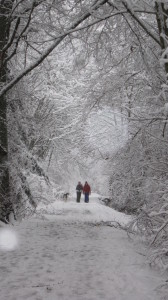
A few years ago, after a surprisingly heavy snowfall (for my coastal area), I decided to pull on my hiking boots and stroll the 1.5 miles to my favorite park while the scenery was coated in white.

The trail was only a bit slippery and the frosting of snow made thick woods and waterfalls completely enchanting. The winds were calm, and the temperature hovered around the freezing point, hardly life-threatening. I was deep into my beloved woods when I noticed that other aspects of my walk might be more than a little hazardous.

BellinghamSnow2014 022

Branches overhead were so burdened with wet snow that every few minutes I heard a loud CRACK! Then a branch would crash to the ground, sometimes from as high as fifty feet in the air. I spent a fair amount of time hugging big trees as I waited for plummeting snow and debris to settle around me. The situation added an unexpected element of suspense to my outing. As in: I could die here today! At least one person dies every year in my state from falling limbs.

This was a good reminder of how much weather conditions can add to any story and help set the mood. I decided that the falling tree limbs would make a great addition to one of my next novels; now I’ve got to find an appropriate place to put that scene.

Weather can set the mood and intensify the feelings an author wants to provoke in readers. Although it might be a bit cliché to set your big suspense scene during a thunderstorm, flashes of lightning and claps of thunder can add a lot of tension. Delve into your memory and sort through all the weather situations you’ve experienced in your lifetime, and you’ll think of interesting weather elements to add to scenes. Because I’m a hiker, kayaker, snowshoer, and scuba diver, I’ve had a lot of run-ins with dramatic weather over the years.

Gathering storm clouds

I included a thunderstorm in my novel Endangered, but the main threat in that Utah setting is peripheral to the storm: when it’s raining on the high plateau, a flash flood could soon be roaring through the slot canyons. An earthquake opens my romantic suspense Shaken, and my heroine Elisa is pinned to the ground by a falling tree. But again, the earthquake isn’t the real threat; it’s the cool damp weather, and because she is trapped, she soon has to battle hypothermia as well as a broken leg.

Pouring rain and driving snow lessen visibility and can add suspense when a character needs to be on the move outside, or if that character is on guard against a threat coming from outdoors. If your characters are indoors, bad weather outside can make a scene feel more “cozy” and romantic.

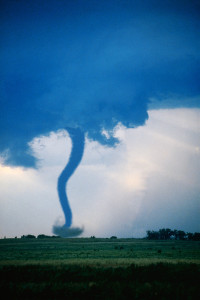
Tornado

Tornado conditions are always anxiety-provoking: I grew up in Kansas and Oklahoma and once had the occasion to watch as the change in air pressure caused the giant plate glass panels at the front of a store to bow inward. (Fortunately some doors flew open and equalized the pressure before the windows shattered, otherwise I might not be here to write this.)

Sunshine and gentle breezes can add to a pleasant scene. Relentless baking sun and drying winds are a different story.

You see what I mean. The snow is all gone from my neighborhood now, but I want to add those cracking limbs to a future book. And maybe I’ll find a place for those dramatic bowed windows, too, although I no longer live in tornado country. There have been a lot of avalanches in the west this year, so of course my next novel features one.

woman celebrating the sun

In real life, we all deal with the weather every day. And you don’t have to be out camping in the wilderness to deal with weather-related disasters. I often think about all the people trapped in 2012 in high-rise buildings in NYC during a blackout caused by the flood after a hurricane–remember that? Personally, I can’t think of anything worse.

So when I feel the story I’m writing is lacking in some respect, I try to think about how I could use the weather to add drama.