The Importance of Setting by Karen Shughart

aerial view, architecture, autumn

As I write this, it’s raining. Heavily and steadily. And there’s a bit of a chill in the air. After all, it’s fall, a transition month of warm days, cool nights, brilliant sunshine and cloudless skies; apples, pumpkins, red orange, rust and yellow leaves and a profusion of brightly colored mums. And, of course, there’s also the rain, wind and a sea so noisy we can hear it with our windows closed. I’ve worked all morning on Murder in the Cemetery, the second book in the Edmund DeCleryk series, which is set in the fictional village of Lighthouse Cove, NY. I imagine Ed, and his wife, Annie, sitting in front of a roaring fire at the end of the day, drinking red wine and discussing the case.

Yesterday was different. It was one of those days when you just want to be outside enjoying the crisp fall air and the smell of the decaying leaves. I imagine a reflective Ed, walking on a deserted beach, waves lapping onto shore, cup of steaming coffee in hand.

In the winter my characters take long walks in the snow and meet friends at cozy pubs with wood-beamed ceilings that have parking lots filled with snowmobiles.  They eat hearty food and settle in with a good book in front of the fire.

In the spring the roads they drive on meander through acres of fruit trees covered with fragrant, fuzzy pink and white blossoms, and in summer, you might see them sailing on the teal blue waters of Lake Ontario or watching a splendid fireworks’ display from their decks.

Each season of the year has its own beauty and inspires me to interject that beauty into the plot of the Cozy mysteries I write. I have an affinity to Cozies because of their charm, but also because the reader gets to know not only the cast of characters but also the towns and villages where they live.

Think about Louise Penny’s Three Pines series- would it be as engaging if it weren’t set in a small, quaint Canadian village? And what about the works of Martha Grimes, whose character, Richard Jury, gets help solving cases from friends living in the quirky village of Long Piddleton.  If you’ve ever watched Midsomer Murders (one of my favorite “cozy” TV series), you’ll remember the festivals, concerts and fairs as well as the enticing Midsomer County woods, fields and streams that help set the scene for those murders.

The setting of a book is crucial to drawing the reader into the plot. “It was a dark and stormy night, ….” although comically trite, really does warn the reader that something ominous is about to occur. But then there’s also an intriguing juxtaposition between a day when the birds are singing, the sunrise glorious and all’s right with the world, and a horrific murder that occurs that same morning in dark and swampy woods.

Introducing my Next Deputy Tempe Crabtree Mystery

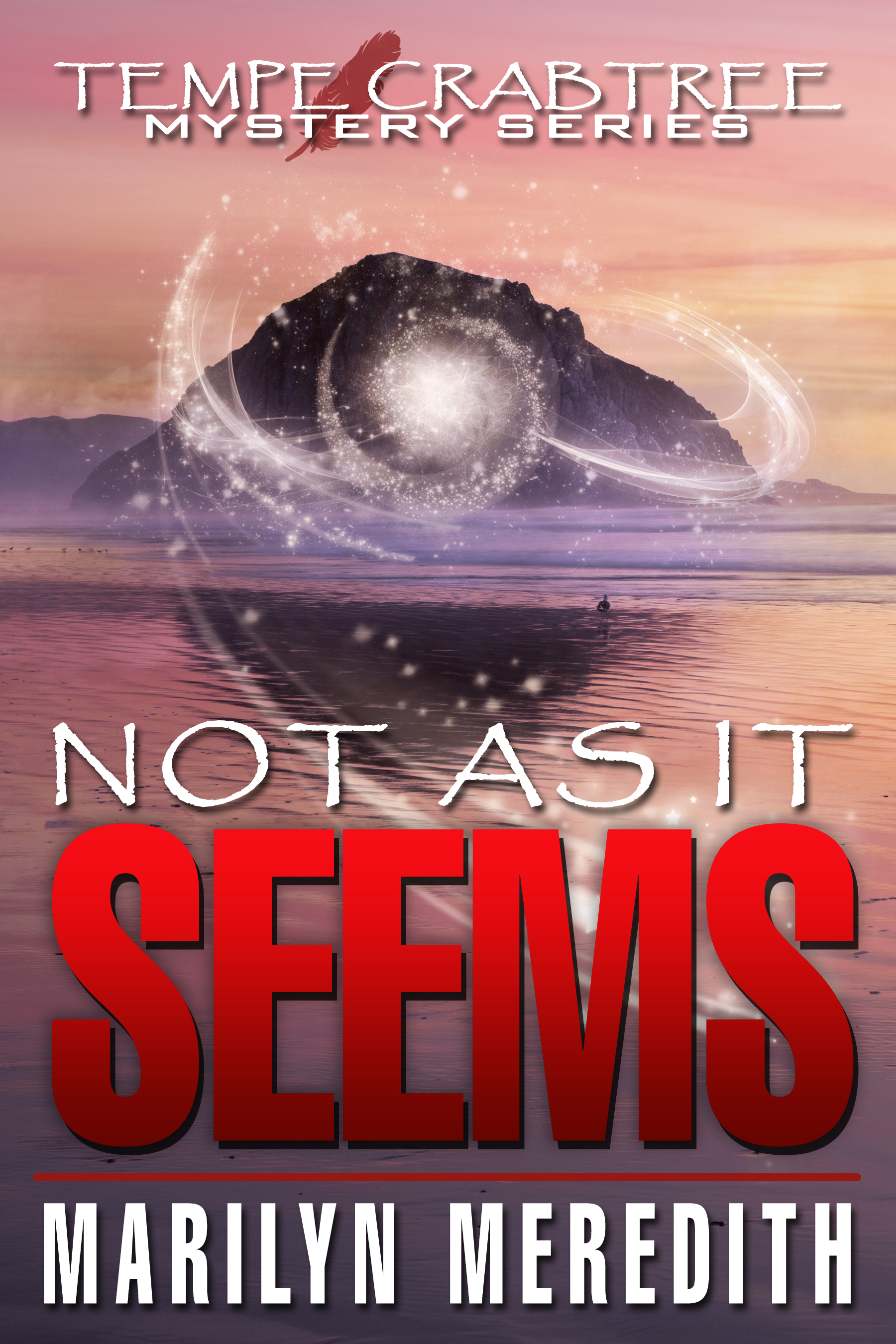
Since this is also my wedding anniversary, it’s a good time to announce that I have a new Deputy Tempe Crabtree mystery–Not as it Seems.

NotAsItSeems-lg

Tempe and her husband, Hutch, travel to Morro Bay to attend their son’s wedding. This is also the first time they’ve been able to meet Blair’s fiancee, Amaresh.

I did some new things in this mystery. Usually, the setting in my Tempe mysteries are fictional though based on real places. This time I used one of my favoirte places on the California’s Central Coast. Doing so, my fictional characters also visited some great and very real restaurants as well as other attractions including the San Luis Obispo Mission, Montana de Oro, and Pismo Beach.

What isn’t new is Tempe is thrust into the supernatural world of the local Indians, in this case, the Chumash and Salinans.

My husband I have visited all these places many times and it seemed natural to have Tempe and her husband visit them too. Friends who live in the area I’ve written about helped me too.

The main plot of the story is centered around the missing maid of honor.

Like with most of my mysteries, some of the ideas came from my experiences, others came from new things I’ve learned. Being an author is so much fun. Memories from the past pop up and give me ideas for plot twists. Sometimes I read something that immediately says, “Use me!”

I hope that others will chime in and tell where some of their ideas for their mysteries come from.

Marilyn Meredith

Creating more ‘dramatic’ characters

Carpenter photo_WEB gifBy Sally Carpenter

When I began writing in earnest, I was more interested in playwrighting than penning novels. As a kid, I checked out plays from the local library to read instead of novels. Plays read fast (knock one off in an hour!), had lot of white space on the page, and got to the action immediately. Books had hundreds of pages of close-set type, long passages of boring description and slow moving plots.

Now that I’m entrenched in writing cozies, the skills I learned as a playwright are still serving me well. One of the primary tools for character development that I picked up from acting class is major meanings. The following is an over-simplification of the process.

Every person has major meanings in her life. These are the two to three things the person needs to have a fulfilling life. Major meanings are tangible items, not abstract ideas like joy, peace, security and safety (although the major meanings might provide such things.)

The major meanings create tension among each other. When one major meaning is realized, another meaning may be neglected.

An example: a middle age female executive has the major meanings of career advancement, family and sobriety. However, climbing the corporate ladder leaves little time to spend with family. Business lunches and networking parties with an abundance of booze flowing might tempt her sobriety. She may forgo a job promotion so she can care for an aging parent.

Watch the sparks fly when two characters have different major meaning. The wife values peace and quiet but hubby, who loves auto racing, wants his buddies over to watch the Indy 500 on the big screen TV. Resolving the conflict to everyone’s satisfaction (or not—that’s when the murder occurs) is the stuff of good storytelling.

For the writer, major meanings are often not planned in advance and may pop up as the manuscript progresses. The author should never state major meanings outright but let the reader discover them.

When an actor approaches a play, she reads the script until she finds her character’s major meanings and then she internalizes them. She imagines herself as the character living out her major meanings and life history. When the meanings are ingrained, the actress goes on stage and, as she says a line or listens to the other characters, the right feeling and reaction will occur because the major meanings will spring to the surface naturally and in the moment. This provides a more natural performance than for the actor to plan to advance how she will say or react to a line.

 In my writing I often imagine myself in the character’s place or “see” the character acting out the scene in my mind. If I’m stuck for what the character will do or say next, I let the major meanings simmer and the character will do the right thing. (Writing is harder work than acting. An actor only had to build one character whereas the author has to do the work for several!)

To put this idea into practice, take a favorite novel, play or movie and find the protagonist’s major meanings. How do these meanings cause the character to make the choices she does? How do the major meanings of the other characters, cause conflict for the heroine?


Location, Location, Location by Carole Sojka

Readers often ask me if I’ve ever lived in Florida, and when I say I haven’t, they ask, copylogically, I suppose, “Then why are your mysteries set there?” But I’m afraid I don’t really know the answer. Because I’m a seat-of-the-pants writer who doesn’t outline and who lets the characters dictate the course of the story, Florida as a setting just kind of happened.

My friend of longest duration−−we met as babies−−lives in the area where A REASON TO KILL is set, and I’ve visited her often over the years. On my trips we went to the usual tourist sites, and I found attractions that found their way into my imagination and then into my books.

My original idea for the story centered around the houses of refuge built by the U.S. government in the late nineteenth century.  The barrier islands along the Florida coast were the scene of many shipwrecks from the years when the Spaniards sailed ships back to Europe loaded with treasure until today. These islands had no fresh water, no food, no inhabitants, and until recently, no means of communication with the outside world. Surviving a shipwreck didn’t mean the sailors would live. Stranded, they died of thirst and starvation before they could be rescued.

Starting in 1876, the U.S. government built ten houses of refuge along the barrier islands to provide shelter, food and water to men shipwrecked and stranded on these islands until they could be rescued. The Gilbert’s Bar House of Refuge is the last remaining one, and my first idea for a novel was centered on the wife of a keeper of the house, a lonely woman isolated with her husband, who falls in love with a shipwrecked sailor.

That idea didn’t make it past a few draft chapters, but still I liked the house of refuge setting. Mara, my alcoholic character and the one suspected of murder in A REASON TO KILL, was my original protagonist, and she was closely tied to the Gilbert’s Bar House of Refuge. But I felt more comfortable with a police detective who had the authority to ask questions and demand answers rather than an amateur sleuth, so I created Andi Battaglia, the detective in the Burgess Beach Police Department. I kept Mara and her problem with alcohol in the story, but she became a more minor character. Thus are settings and stories born.

Besides the houses of refuge, I also was interested in the groups who observed and protected the endangered loggerhead turtles as they came ashore along the coast to lay their eggs. This became the setting for the poisoning of Max Denman in A REASON TO KILL.

Once I set the first book in Burgess Beach, my pseudonym for the real town of Jensen Beach, when I wrote  the second book, SO MANY REASONS TO DIE, of course it was also set in Florida. This time my range expanded south to Miami and South Beach and north to Fort Pierce. The area, by the way, was christened the Treasure Coast because of the 1961 discovery of treasure from, among other shipwrecks, the 1715 Spanish Treasure Fleet, lost in a hurricane near the Sebastian Inlet.

Perhaps Andi and Greg will leave Burgess Beach in the third book—now in progress—but I can’t tell you that yet because I’m only the writer. It’s up to the characters to decide.

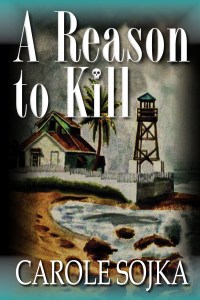
A REASON TO KICover__8x5LL is the first in the series. When nine strangers convene on a Florida beach to observe and protect the endangered loggerhead turtles nesting there, one dies of poison and another turns up dead soon after.  It’s up to Andi Battaglia, a rookie detective in the Burgess Beach Police Department, to find out who among the remaining wildlife supporters has a reason to kill.

When in SO MANY REASONS TO DIE, Andi’s police partner, Greg Lamont, walks onto the murder scene of his ex-lover, he and Andi find themselves tangling with dangerous drug dealers amid the sizzling nightclubs of Miami’s South Beach.

See you all next month.