
Why Do We Write?

by Janis Patterson

It’s just about the greatest mystery of all – why do we write? Oh, let’s be honest – we all have great dreams of becoming rich and famous, hitting every list made, having screaming fans lined up around the block just to buy a book with our autograph in it… all lovely dreams, but I think that most of us are savvy enough to realize that such things happen to only a very few. (I mean, it could be me, but most likely not…)

These days the vast majority of professional writers are not getting rich. Some make a decent living, some make money on the hobby level. Only a few are truly prospering. Almost all – save for the fortunate few – could make much more money in some other field of endeavor. A great number do have to work at another job to survive.

Of course, there is the indefinable cachet of being ‘an author,’ of having written a book.

Perhaps that accounts for some of the people writing today. They aren’t that interested in writing a book, but they positively salivate at the thought of being known as having written one.

And therein lies one of the main problems of self-publishing. Don’t get me wrong – self-publishing is one of the greatest things to happen to both readers and writers. It expands the market, gives power (and money!) to the authors and gives the readers a much wider choice of reading materials. On the downside, it also allows people who should never be allowed near a word processor to publish a ‘book’ and become a ‘published author.’

Stringing a requisite number of words together does make a book – sort of – just not necessarily a good one. There is no magic pill to turn an idea into a good book. Writing a good book is not easy, but just about anyone can do it, if they put enough work into it. Talent can make it easier, but mainly it’s learning what makes a good book and how to create one… and I repeat, that is a lot of work.

Usually the ‘I am now a published writer’ crowd stops with one or two books. Even good writers sometimes stop with one or two books after they learn how much work it takes to get their ideas decently on to paper – or how little remuneration most of them can expect. If the writer is holding out for traditional publishing, the wait can go on for years before the bland negativity of a rejection letter appears. Even if one is lucky enough to be picked up by a trad house, the money usually isn’t all that good and there’s even more waiting until release.

So why do we write? It’s pleasant to create a world and a population out of nothing but imagination and caffeine (and on occasion chocolate). It’s pleasant to talk about ‘my publisher’ and ‘my new release.’ It’s pleasant to see one’s name on a book, and – should you have a book signing – enjoyable to talk to people who like to read and then to write your name into the copy of your book they just bought. And to receive the checks, however small, is nice too.

Still such minor triumphs can’t justify why people continue to write and submit and self-publish for years with minimal returns. It is made even harder when their books are of decent to very good quality – but the lightning of good luck strikes a badly written story, dousing its author with fame and fortune.

So why do we do it? The answer is simple. There’s no choice to it. Anyone can write, given enough time and study and dedication. Writers cannot help but write.
 

Clue, Clue, Who’s Got the Clue, or How to Sneak Your Way to a Good Mystery

by Janis Patterson

Writing a mystery means walking a very fine line.

You want to play fair with the reader and give him the chance to solve the mystery. Sort of.

Readers love to play along and see if they can match/beat your sleuth to the correct solution. In almost every case (so said because there is an exception to everything) nothing makes readers angrier than the solution just coming out of the blue with nothing leading up to it. Worse than that, it’s lazy writing.

So how do you do play fair and still mystify the reader?

Be sneaky.

Put your clues out there, but make them appear to be inconsequential, throw-away things that have no relation to the case. Also put out fake clues leading to a different conclusion (some call them red herrings, but I don’t like fish), but put them out in two ways – some as inconsequentials and some as great big whacking things that might as well have CLUE in blinking neon above them.

No one said you had to play completely fair, did they?

There’s also a traditional ploy called a MacGuffin. Sounds sort of like it should be some kind of fast food, but it’s real – trust me. The MacGuffin is a lovely tool of misdirection. That’s the word I’ve been looking for – misdirection! Just like a magician, you direct the reader’s attention in one direction with one hand while the other hand – in semi-plain view – is actually doing the trick, but no one is really looking at it.

Anyway, the MacGuffin is what everyone in the book seems to want – such as everyone believes the vicar was murdered in a foiled robbery attempt to steal an ancient chalice. All the characters go rushing around trying to figure out who wanted to steal the chalice and why, while the vicar was really murdered because his tulips were certain to win the annual flower show away from the Grande Dame of the village who dislikes losing. The chalice is only a MacGuffin. Now that’s an extremely simplistic example, but in reality the MacGuffin is one of the best tools in the mystery writer’s arsenal.

MacGuffins and misdirection – use them well, and you will keep your reader happily amused and hopefully confused. Or is it the other way around?

(For those with very good memories, you know I wrote this blog several years ago. I am reposting it now because (1) it is still true and relevant and (2) for several days before this appears and for several days after I am up to my earlobes in a very intense professional conference. It seemed better to share a ‘golden oldie’ than to just cobble together something or skip posting entirely. Hope you understand. Also, because I will not have my computer available, please forgive if I am not able to okay comments until this madness is over. I promise I will then!)

What a Difference a Year Makes

by Janis Patterson

Ta-da! It’s really real! Finally!

As you probably know, one year ago (almost to this exact day!) The Husband and I went to Egypt to research a novel. My dear friend Dr. Dirk Huyge had invited us to come spend a few days at the El Kab dig house, which is formally known as Bayt Clarke. The house, built in 1906 by an English Egyptologist named Somers Clarke, is reputed to be haunted by his ghost. Unfortunately, Mr. Clarke did not make an appearance – though it wouldn’t have been difficult for him, as his grave is in the courtyard – but the rest of the trip was magical, from our time at the dig house to the flat we rented on the West Bank in Luxor that overlooked the Gurneh hills.

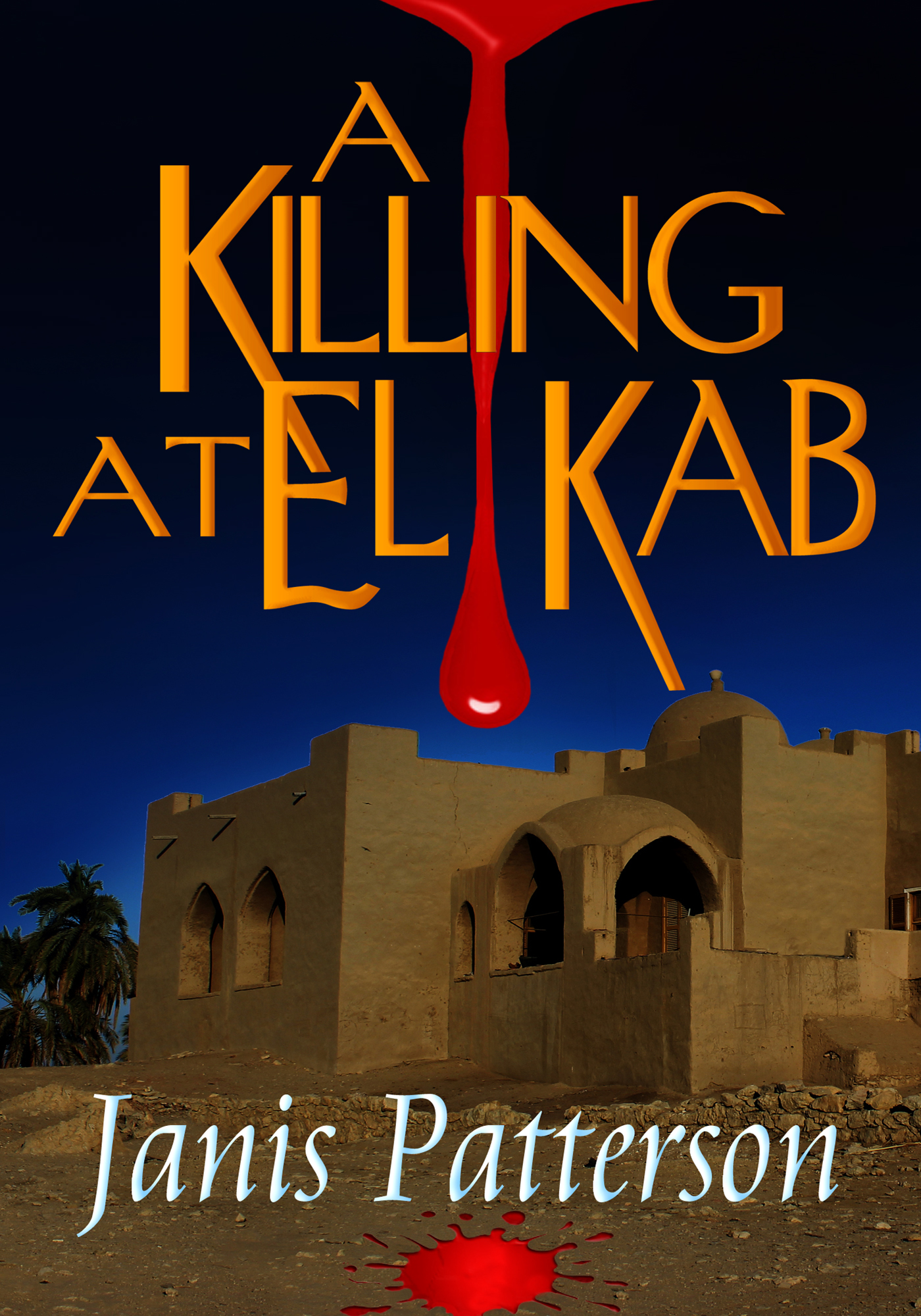
The result is my new book A KILLING AT EL KAB. It’s a straight murder mystery, but with the extra benefit of the reader being able to see an archaeological dig from the inside. Dirk was kind enough to be my advisor, reading the book in chunks as I wrote it so to be sure that it was as accurate as possible.

El Kab eBOOK COVER

I started the book while we were still at the dig house. I remember sitting very early one morning pretty much in the dark (pre-dawn) at the eating table on a most uncomfortable chair with a huge French door overlooking the Nile in front of me. I was typing furiously as the story danced through my brain faster than my fingers could move. One of my best memories of that trip is one afternoon (when the entire crew worked indoors after a long morning out at the excavation) I was sitting typing and could hear two of the crew members walking very slowly behind me. In tones of awe and wonder one whispered to the other, “She’s writing a novel while we watch!”

The official release date for A KILLING AT EL KAB is the 20th of March, chosen months ago because we were at the dig house on that date. I had hoped to have everything ready to release by then. Isn’t it true that when you really care about something everything that can will go wrong? Oh, the electronic versions of the book are great – the print version is apparently cursed.

So I made an executive decision. I took the electronic version and put it up as a pre-order on Amazon while I am wrestling with the malign cybergremlins who are playing with the paperback. This is a new thing for me – I’ve never done a pre-order before. After hearing some tales from other writers about the intricacy of putting up a book on pre-order, all I can say either I am an astounding genius (not!) or Amazon has made the pre-order process very easy (more likely). Anyway, it is available.

I made another executive decision – during the pre-order period the price is only $2.99 – it will go up to the regular price of $4.99 on the official release day.

The Husband laughs at my ‘executive decisions’ as I am terrible at making decisions – seeing me trying to choose from a menu is painful, as are my deliberations on what to wear to almost any function.

Some things just are ‘right,’ though, and A KILLING AT EL KAB is one of them. I am a very proud book mommy!

The Mystery of Romance – or is it the Romance of Mystery?

by Janis Patterson

Last weekend I was fortunate enough to be included on the panel at the public library sponsored Romance in Bonham, a nice county seat town a little over an hour away. The ladies of the library hold this event every other February, and it’s great fun. After the panel discussion and the book signing and everything is all over they provide the panelists and the family members they bring along a down-home potluck lunch. Always some of the best ‘lady food’ I’ve ever had! (Wish they’d do a cookbook…)

Although this is a romance-centric event, I brought several of my mysteries and was slightly astonished at the interest they generated. Apparently there is a growing interest for more mystery in romances – or more romance in mysteries. Both of which, I think, are a very good thing. For far too long readers and writers both have been pigeonholed into fairly rigid and unforgiving categories. Mystery was mystery. Romance was romance. Romantic suspense was a step in the right direction, but unfortunately it was soon codified into so much a percentage romance, so much a percentage mystery/adventure by most traditional publishers.

Now, almost in the manner of a superhero, self-publishing has started to break down the artificial barriers between genres, allowing them to become just stories with all kinds of elements. Want a mystery with lots of blood and danger and nary a kiss between characters? It’s out there. Want an exciting mystery where a couple falls in love while evading the bad guys/saving the world/whatever? It’s out there. Want a tender romance where a couple falls in love happily ever after while solving a usually gentle mystery? It’s out there. Want any combination of the above? Or just about anything else, including vampires, shapeshifters talking cats or kung-fu knitters? Even all at once? It’s out there.

I don’t know if the traditional publishers – the kind one finds on the shelves of your local bookstore, if there are many of those left – have twigged to how complete this revolution of thought is, but the virtual aisles of electronic/print on demand publishing are full of proof. You can find almost any permutation of any storyline now. Self and small publishing have opened up the world of stories, and readers/writers are no longer bound to restrict their desires to the small and rigid genres the trad publishers have decreed will make them the most money. True, in the days when traditional publishing reigned supreme and controlled not only content but distribution, print runs were enormous and had to be done ahead of release, then stored in gigantic warehouses. The publishers had to look to what would give the best return on their not-inconsiderable investment. Now, though, in the burgeoning world of electronic and print on demand self-publishing, such considerations are no longer the end-all and be-all of what’s available. Niche markets that were too small to interest the trad publishers are now flourishing and expanding.

And that’s all to the good. Choice is a good thing, and genre-blending is a good way to expand reader interest. If there is a downside, it’s that the freedom of self-publishing has opened the floodgates to an unbelievable amount of pure dreck. There are people who believe that not only putting down X number of words is writing a book, but that doing so will guarantee them fame and fortune. We can only hope that their number dies off quickly, because this wave of badly written, badly conceived and badly formatted messes is reflecting badly on self-published books as a whole. There are self-pubbed books (usually written by veterans – or perhaps we should say survivors – of the trad publishing industry) whose quality is unquestionably equal to or better than anything from the Big 5, but they are shadowed with the prevailing belief that all self-published books are rubbish. That’s a misconception that only time and persistence can alter. But it will, it surely will, and writers and readers the world over will benefit from it.


Dumb or Dumber

by Janis Patterson

I know when we write our villains we want them to be smart – smart enough, at least, to make our sleuth have to work to catch them, and look good when they do. If the villain isn’t a worthy opponent to our sleuth, the story is boring and not worthy of a book.

But is it like that in real life? Mostly, no. There are villains who lay complex plots with lots of red herrings and blind alleys or who skillfully cover their tracks, but they are – thankfully – rare. Let’s face it – most criminals are stupid, or they wouldn’t be criminals. There are even TV shows about how stupid some criminals are. Who hasn’t seen a film coverage of some burglar getting trapped in a chimney or a doggy door, or committing equal stupidities and having to be rescued by police?

Moving it up a level, murder/attempted murder/aggravated assault is a little different. Most burglars/thieves have to do some kind of pre-planning, however little and inadequate. Murder and its attendant variants can happen in the blink of an eye or be planned for a long time. The spur-of-the-moment murder is usually the easiest one to solve and in general is unworthy of our sleuths. If two guys are drinking and fighting and one of them ends up dead while the other is found still holding the gun… no book-worthy story there. On the other hand, the victim dead but seemingly asleep in a locked room… is it murder or is it natural death? If it’s murder, who among the victim’s many enemies did it? And how? That is a problem worthy of our sleuth!

So how do we do this in our writing? How do we make our villains into real people with hopes and dreams and desires? Remember everyone including villains is the hero of their own story – i.e., in their own mind. They have to have a reason for doing it, and never forget that whatever that reason is, it has to make sense to them. While killing someone because they wore purple on a Thursday seems absolutely mad to us, it must mean not only something but something very important to our villain. Remember those old super-hero cartoons of the 70s where the villain screams that he serves evil and does everything he does because it is evil? Doesn’t make much sense outside of a cartoon, unless the villain is a certified mental case, and I’m not sure even then the story is worthy of a book. Even the mad must have their logic, even if they are the only ones who can understand it.

Frankly I’m very glad that most criminals are stupid and therefore caught – in real life. In fiction, however, I love the crafty villain and the intrepid sleuth to be equally matched… at least, almost equally matched. I also like the sleuth and therefore justice to prevail. That makes a story worth reading.